Takatoriyama Castle (Nogata City, Fukuoka Prefecture) Complete Guide: History, Remains, and Access Information
Takatoriyama Castle, built on Mount Takatori in Nogata City, Fukuoka Prefecture, played an important role in Chikuzen Province during the Sengoku period. This article thoroughly explains the charm of this mountain castle, from its history and lords to the features of its remains and how to access it.
Overview of Takatoriyama Castle
Takatoriyama Castle is a medieval mountain castle built near the summit of Mount Takatori (approximately 320 meters above sea level) in Nogata City, Fukuoka Prefecture. Located at a strategic point overlooking the Chikuhō region, it functioned as the residence of the Asō clan during the Sengoku period.
Basic Information
- Location: Nagamitsuji, Nogata City, Fukuoka Prefecture
- Alternate Names: Takatori Castle, Takatoriyama Castle
- Castle Structure: Mountain Castle
- Construction Period: Estimated to be from the Nanboku-cho period to the early Muromachi period
- Main Lord: Aso clan
- Year of Abandonment: Tensho era (1573-1592)
- Remains: Enclosures, moats, earthworks, vertical moats
- Designated Cultural Property: Nogata City Designated Historic Site
History of Takatoriyama Castle
Construction and the Aso Clan’s Rule
While there are no clear records regarding the construction period of Takatoriyama Castle, it is believed to have been built sometime between the Nanboku-cho period and the early Muromachi period. The castle was ruled by the Aso clan, a powerful local lord of Chikuzen Province.
The Aso clan was originally based in Aso, Buzen Province (near present-day Iizuka City, Fukuoka Prefecture), and expanded its influence into the Chikuhō region during the Muromachi period. Takatoriyama Castle served as an important base for the Aso clan’s control of northern Chikuhō.
Conflicts during the Sengoku Period
During the Sengoku period, Takatoriyama Castle became a battleground for conflicts with surrounding forces. Of particular note is its relationship with the Akizuki clan.
In the mid-16th century, the Ōtomo clan’s influence in Chikuzen Province was growing stronger. The Aso clan was initially subordinate to the Ōtomo clan, but their relationship with surrounding forces such as the Akizuki clan was complex.
During the Tenshō era (1573-1592), Toyotomi Hideyoshi’s conquest of Kyushu progressed. The Kyushu campaign of 1587 drastically changed the situation in Chikuzen Province. The Aso clan’s territory was secured under the Toyotomi regime, but due to subsequent changes in their domain, Takatoriyama Castle lost its strategic importance and is believed to have been abandoned.
After the Edo Period
In the Edo period, Chikuzen Province came under the control of the Kuroda clan, and Takatoriyama Castle was completely abandoned. Since then, the castle site has become a forest, and remains so to this day.
Layout and Remains of Takatoriyama Castle
Characteristics of the Layout
Takatoriyama Castle is a typical mountain castle built on the ridge from the summit of Mount Takatori, which is approximately 320 meters above sea level. Multiple baileys are arranged around the main enclosure, and defenses are strengthened by moats and vertical trenches.
It is a medium-sized mountain castle, and practical defensive facilities can be seen throughout. The layout, which skillfully utilizes the terrain, retains many characteristics of medieval mountain castles.
Main Enclosure (Honmaru)
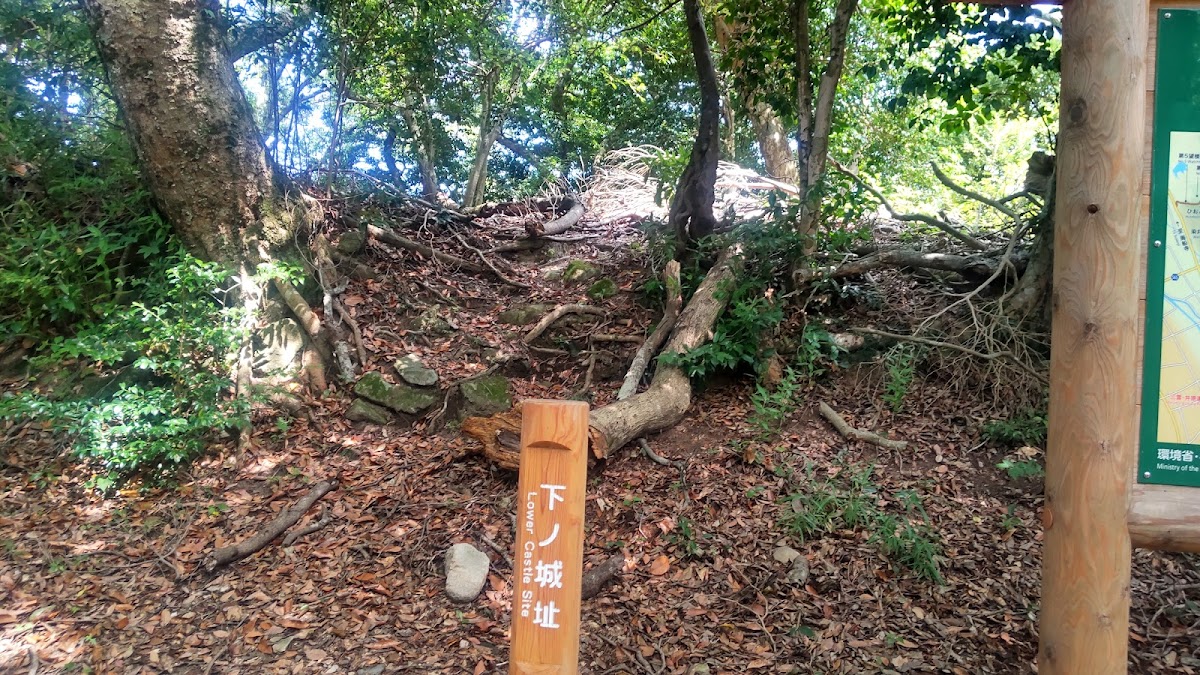
The main enclosure, located near the summit, is the central part of the castle. The castle grounds have a relatively large, flat area, suggesting the presence of the lord’s residence and other important facilities. Traces of earthworks surround the main enclosure, indicating its defensive function.
From the main enclosure, one can enjoy a panoramic view of the Chikuhō Plain, suggesting it also served as a military observation post. On clear days, one can see the Ongagawa River basin and the Nogata Plain.
Enclosures
Several enclosures are arranged in a stepped pattern around the main enclosure. These enclosures are thought to have been used as garrisons for soldiers and storage areas for supplies.
Each enclosure is relatively small, but efficiently positioned to suit the terrain, demonstrating ingenuity in maximizing the limited space.
Moats
Multiple moats blocking the ridgeline can be identified. Moats are important defensive structures to prevent enemy intrusion, and at Takatoriyama Castle, their placement is particularly designed to anticipate attacks along the ridgeline.
The moats vary in size, but all remain clearly visible as part of the topography, making them valuable remains for studying the defensive techniques of medieval mountain castles.
Vertical Moats
Several vertical moats dug along the slopes have also been identified. These moats served to prevent enemy incursions from the slopes and also clearly demarcated the areas between enclosures.
Some of the vertical moats at Takatoriyama Castle utilize the natural valley terrain, demonstrating the skillful castle-building techniques.
Earthworks
Traces of earthworks remain around the main enclosure and major baileys. These earthworks functioned as defensive walls, protecting against enemy arrows and stones.
While some parts are now obscured by weathering and vegetation, careful observation allows you to trace the lines of the earthworks.
Highlights of Takatoriyama Castle
Views
One of the greatest attractions of Takatoriyama Castle is its views. From the main enclosure, a 360-degree panoramic view unfolds, offering a sweeping vista of the Chikuhō Plain, the Ongagawa River, and the city of Nogata. On clear days, it’s even possible to see as far as Fukuoka City and the Genkai Sea.
This view is the very same perspective from which the castle lords once surveyed their territory and monitored enemy movements. It’s a valuable place to relive the tension of the Sengoku period.
Well-Preserved Remains
Takatoriyama Castle, having remained largely untouched by development, boasts relatively well-preserved remains of a medieval mountain castle. The moats, trenches, and layout of the baileys are clearly visible, making it a fascinating historical site for castle enthusiasts.
In particular, the depth of the moats and the length of the trenches allow you to truly appreciate the castle’s defensive capabilities by seeing them in person.
Natural Environment
Takatoriyama is blessed with abundant nature, offering beautiful scenery throughout the seasons. The fresh greenery in spring and the vibrant autumn foliage make it a popular hiking destination.
One of the charms of Takatoriyama Castle is that you can enjoy both exploring the castle ruins and observing nature at the same time.
Access to Takatoriyama Castle
By Public Transportation
By JR
- Get off at JR Chikuhō Main Line “Nogata Station”
- Approximately 40 minutes on foot from the station to the trailhead, or approximately 10 minutes by taxi
- Approximately 30-40 minutes on foot from the trailhead to the summit
By Bus
- Nishitetsu buses are also available from Nogata Station, but the number of buses is limited, so advance confirmation is necessary.
By Car
From Fukuoka City
- Approximately 20 minutes from Kyushu Expressway “Yahata IC” via National Route 200
- Or via Fukuoka Urban Expressway/Kitakyushu Urban Expressway to Nogata City
From Kitakyushu City
- Approximately 30 minutes south on National Route 200, via Nogata city center to the trailhead
Parking
- Several parking spaces are available near the trailhead (free)
- However, caution is required when driving due to the narrow roads.
Ascent Routes
There are mainly two routes to Takatoriyama Castle.
Eimanji Route (Main Route)
- A route starting from the Eimanji settlement
- Relatively well-maintained and easy for beginners
- Estimated time: Approximately 30-40 minutes from the trailhead to the summit
North Route
- Somewhat steep and more suitable for advanced climbers
- Allows for a more detailed observation of the ruins
- Estimated time: Approximately 40-50 minutes from the trailhead to the summit
For both routes, appropriate hiking attire and shoes are necessary.
Precautions When Visiting the Castle
Clothing and Equipment
- Shoes: Hiking boots or trekking shoes recommended (sneakers are acceptable, but there are slippery areas)
- Clothing: Long-sleeved shirt and long pants recommended (for protection against plants and insects)
- Items to Bring: Drinking water, towel, insect repellent (summer), rain gear
- Winter: Warm clothing (the mountaintop can be windy)
Safety Precautions
- Avoid visiting the castle alone; visit with others if possible.
- Be careful as the ground can be slippery during and after rain.
- Check cell phone signal strength in advance.
- Inform family or friends of your destination before visiting the castle.
- Allow ample time to descend before sunset.
Manners
- Do not damage or dig up the ruins.
- Always take your trash with you.
- No open fires.
- Do not trespass on private property.
- Do not collect plants or animals.
Nearby Tourist Attractions
Nogata City Coal Museum
This facility allows you to learn about the history of Nogata City’s coal industry. The Chikuhō region was a coal mining area that supported Japan’s modernization, and understanding its history deepens your understanding of the region.
- Location: 692-4 Nogata, Nogata City, Fukuoka Prefecture
- Opening Hours: 9:00-17:00
- Closed: Mondays (or the following day if Monday is a public holiday)
- Admission Fee: 100 yen for adults
Nogata City Central Community Center Local History Museum
This museum displays materials related to the history and culture of Nogata City. Some materials related to Takatoriyama Castle are also sometimes on display.
Mt. Fukuchi
One of Fukuoka Prefecture’s famous mountains, with an elevation of 901 meters. Recommended for those who want to enjoy serious mountain climbing. Many mountain climbing enthusiasts visit it in conjunction with Takatoriyama Castle.
Ongagawa Riverbed
The riverbed of the Ongagawa River, which flows through the Chikuhō Plain, is ideal for strolling and cycling. In spring, the cherry blossoms are beautiful, making it a popular spot for local relaxation.
Historical Significance of Takatoriyama Castle
Position in the History of the Chikuhō Region
Takatoriyama Castle is an important historical site for understanding the medieval history of the Chikuhō region. As the base of the Asō clan, a powerful local lord, it was deeply involved in the political and military situation of northern Chikuzen Province.
The Chikuhō region has been a crucial transportation hub since ancient times, and in the medieval period, many local lords vied for power. Takatoriyama Castle, as a symbol of one such regional power, serves as a valuable clue in the study of regional history.
Value in Mountain Castle Research
Takatoriyama Castle possesses the typical characteristics of a medieval mountain castle and is valuable in the study of castle architecture. Practical defensive facilities such as moats, vertical trenches, and the arrangement of baileys remain well-preserved, making it important material for understanding the castle construction techniques of the time.
In particular, the layout, which skillfully utilizes the terrain, demonstrates the wisdom of medieval samurai who sought to achieve maximum defensive effectiveness with limited resources.
Regional Identity
For the citizens of Nogata, Takatoriyama Castle is one of the region’s historical symbols. It is featured in the city’s history education and used as teaching material to foster local pride.
Preserving regional historical heritage and passing it on to future generations plays a crucial role in shaping regional identity.
Preservation and Utilization of Takatoriyama Castle
Current Situation and Challenges
Takatoriyama Castle is protected as a Nogata City designated historical site, but due to its nature as a mountain castle, maintenance and management present challenges. Overgrown vegetation obscures some of the remains, requiring regular maintenance.
Further improvements are needed to promote its utilization as a historical site, including ensuring visitor safety and installing information boards.
Preservation Activities
Preservation activities are being carried out by local history enthusiasts and citizen groups. Maintenance of hiking trails, cleaning of remains, and guided tours are conducted on a volunteer basis.
These grassroots activities form the foundation for protecting this valuable historical heritage and passing it on to future generations.
Future Potential Uses
Takatoriyama Castle has potential not only as a site for historical learning but also as a tourist resource.
- Historical Tours: Guided historical walking tours
- Educational Programs: Historical learning in collaboration with school education
- Health Promotion: Use as a mountain climbing/hiking course
- Event Hosting: Holding historical lectures and mountain castle summits
These initiatives have the potential to contribute to regional revitalization.
Things to Know Before Visiting Takatoriyama Castle
Best Time to Visit
Spring (March-May)
- Beautiful fresh greenery and mild weather
- Pollen allergy sufferers should take precautions
Summer (June-August)
- Dense greenery and many insects
- Heatstroke prevention and insect repellent are essential
- Early morning visits are recommended
Autumn (September-November)
- Beautiful autumn foliage and pleasant weather
- The most suitable season for visiting
- Excellent views
Winter (December-February)
- Clear air and great views
- Cold weather precautions are necessary
- Climbing the castle is difficult during snowfall
Estimated Time Required
- From trailhead to summit: 30-40 minutes
- Sightseeing and rest at the summit: 30-60 minutes
- Descent: 25-35 minutes
- Total: Approximately 2-3 hours
Plan your trip with plenty of time to spare. ### Reference Materials and Contact Information
Nogata City Board of Education, Culture and Sports Promotion Division
- Address: 7-1 Tonomachi, Nogata City, Fukuoka Prefecture
- Phone: 0949-25-2241
- Provision of materials and information regarding Takatoriyama Castle
Nogata City Tourism Association
- General tourism information for Nogata City
- Availability of brochures, etc.
Summary
Takatoriyama Castle is a valuable medieval mountain castle site remaining in Nogata City, Fukuoka Prefecture. As the residence of the Aso clan, it is an important historical site that tells the history of the Chikuhō region during the Sengoku period, and the remains such as moats and vertical trenches are well preserved.
The view from the mountaintop, approximately 320 meters above sea level, is magnificent, offering a panoramic view of the Chikuhō Plain. It is a recommended spot not only for history buffs but also for hiking enthusiasts.
When visiting, please prepare appropriate clothing and equipment, and enjoy exploring the mountain castle and feeling the spirit of the Sengoku period while taking safety precautions. Takatoriyama Castle, where you can learn about local history and enjoy nature, is a hidden gem that you should definitely visit when you come to Nogata City.
It is our responsibility to pass on this valuable historical heritage to future generations while striking a balance between preservation and utilization.