.png)
Buzen Matsuyama Castle (Fukuoka Prefecture) Complete Guide: History and Highlights of a First-Class Fortress in Buzen Province, Dating Back to the Nara Period
What is Buzen Matsuyama Castle?
Buzen Matsuyama Castle is a mountain castle built on the summit of Mount Matsuyama, 128 meters above sea level, located in Kanda-cho, Miyako-gun, Fukuoka Prefecture. Currently, the small hill visible directly ahead when crossing the connecting bridge to Kitakyushu Airport is the site of Matsuyama Castle. It was a strategically important location facing the Suo Sea and was known as “Buzen Province’s First-Class Fortified Mountain Castle.”
It is said to be the oldest mountain castle in Buzen, built in 740 AD by Fujiwara no Hirotsugu, and watched over the history of the Buzen region for approximately 900 years, from the Nara period to the early Edo period. Currently, it is preserved as a designated historical site of Kanda-cho, and the remains of the main enclosure, second enclosure, and third enclosure remain near the summit.
History of Buzen Matsuyama Castle
Nara Period: Fujiwara Hirotsugu’s Rebellion and Castle Construction
The history of Matsuyama Castle dates back to the Fujiwara Hirotsugu Rebellion in 740 AD (Tenpyo 12). According to the ancient record “Buzen Kojōki” (Record of Ancient Castles of Buzen), Fujiwara Hirotsugu, who was a Shōni (Junior Governor) of Dazaifu, built a castle on this site when he rebelled against the imperial court. Hirotsugu opposed the policies of the Tachibana no Moroe administration and raised an army demanding the removal of the monk Genbō and Kibi no Makibi, but was suppressed by the imperial army.
Matsuyama Castle, built during this period, is the oldest mountain castle in the Buzen region and laid the foundation for the subsequent development of castles. Despite being a relatively low mountain at an altitude of 128 meters, its location overlooking the Suō Sea indicates its importance as a monitoring base for maritime traffic since ancient times.
Sengoku Period: The Struggle for Control Between the Ouchi, Otomo, and Mori Clans
During the Sengoku period (Warring States period), Matsuyama Castle became a crucial strategic base in northern Kyushu, the stage for fierce battles between various daimyo (feudal lords). During the Koji and Eiroku periods (1555-1570), the Mori clan, the dominant power in the Chugoku region, and the Otomo clan, the powerful force of Kyushu, waged a brutal battle over this castle.
Initially, Matsuyama Castle was under the control of the Ouchi clan, but after their downfall, ownership shifted between the Mori and Otomo clans. Along with Moji Castle, it functioned as a key defensive point in the northern part of Buzen Province, and was an important strategic location controlling the Suo Sea, a vital point for maritime traffic. It is believed that during this period, the castle’s defensive capabilities were significantly strengthened, and remnants such as stone walls, earthworks, and moats were constructed.
Toyotomi Hideyoshi’s Kyushu Campaign and the Era of Kuroda Kanbei
In 1587, Toyotomi Hideyoshi’s Kyushu campaign significantly altered the power dynamics in the Buzen region, including Matsuyama Castle. After conquering Kyushu, Hideyoshi granted Kuroda Yoshitaka (Kanbei) five of the eight districts of Buzen Province—Kyoto, Nakatsu, Chikujo, Kamimo, and Shimomo—and a portion of Usa District, totaling approximately 120,000 koku.
For Kuroda Kanbei, Matsuyama Castle became a crucial branch castle located at the northernmost tip of the Kuroda territory. It is believed that the castle underwent renovations as a strategic point to protect the domain’s borders. Indeed, roof tiles bearing the paulownia crest have been unearthed from the castle ruins, providing valuable evidence of renovations under the Toyotomi regime. While the Kuroda clan’s main base was Nakatsu Castle, Matsuyama Castle continued to function as a northern defensive stronghold.
The Hosokawa Clan Era and the Castle’s Abandonment
After the Battle of Sekigahara, in 1600 (Keicho 5), when the Kuroda clan was transferred to Fukuoka in Chikuzen Province, Hosokawa Tadaoki took over Buzen Province. The Hosokawa clan established their base at Kokura Castle, and Matsuyama Castle continued to function as a branch castle of the Hosokawa clan. However, due to the Edo Shogunate’s “One Castle Per Province” decree, it was abandoned around 1606 (Keicho 11).
After its abandonment, Matsuyama Castle withdrew from the stage of history, but its remains were preserved in good condition and remain to this day as a valuable historical site that conveys the history of the Buzen region.
Castle Structure and Layout
Main Enclosure (Honmaru)
The main enclosure of Matsuyama Castle is located near the summit of a mountain 128 meters above sea level and is a bailey measuring approximately 40 meters east-west and 30 meters north-south. Clear earthworks remain today, and traces of the surrounding defensive structures can be seen. From the main enclosure, one can enjoy a panoramic view of the Suo Sea, making it clear that this was an ideal location for monitoring maritime traffic.
The interior of the main enclosure is relatively flat and leveled, suggesting that the lord’s residence and other important facilities once stood here. Parts of the stone walls remain, showing traces of renovations from the Sengoku period to the early Edo period.
Second and Third Enclosures
The second and third enclosures are arranged in succession around the main enclosure, forming a stepped layout. These enclosures functioned as a defensive line protecting the main enclosure, designed to prevent enemy incursions in stages.
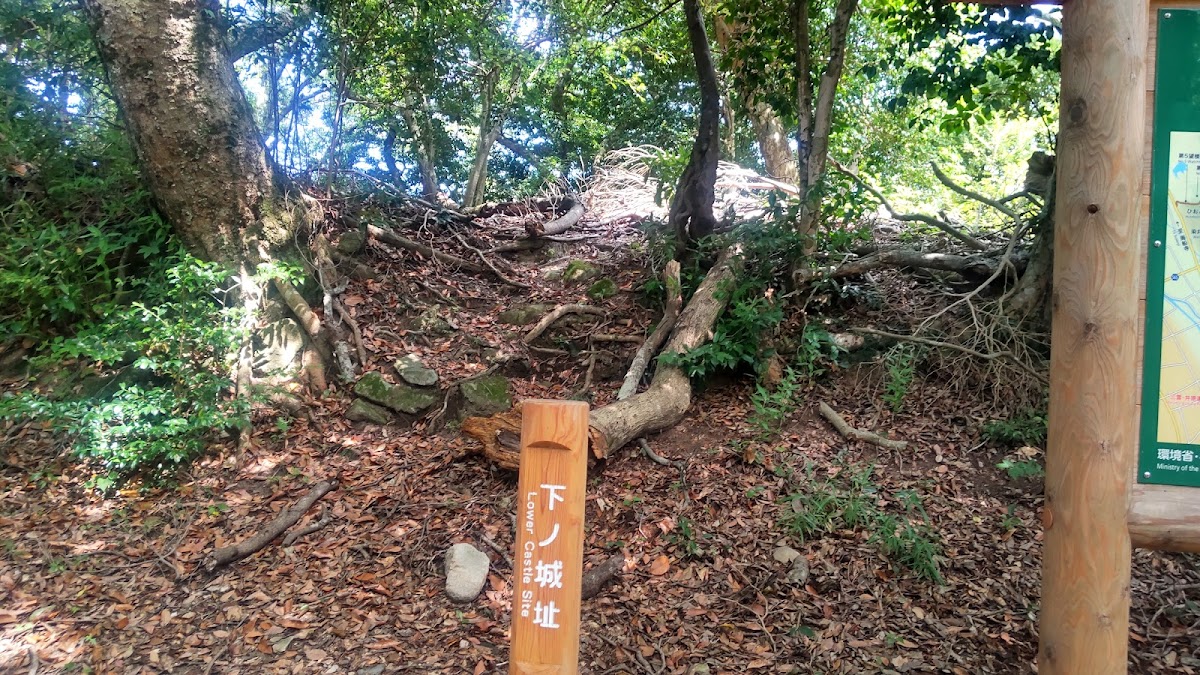
Stone steps were built between each enclosure, serving as pathways within the castle. These stone steps, still maintained as a path to the castle today, are valuable remnants that preserve the atmosphere of the time. Earthen ramparts and moats are positioned between the second and third enclosures, demonstrating a sophisticated multi-layered defensive system.
Stone Walls and Earthworks
A notable feature of Matsuyama Castle’s remains are the stone walls and earthworks found throughout the site. The stone walls utilize the nozurazumi technique, a method of stacking natural stones, demonstrating castle construction techniques from the Sengoku period to the early Edo period. The stone walls around the main enclosure are particularly well-preserved, providing valuable historical evidence of the stonework techniques of the time.
The earthworks surround the enclosures, with some remaining structures approximately 2-3 meters high. It is believed that fences or walls were built on top of these earthworks, enhancing their defensive capabilities.
Moats and Ridge-Shaped Vertical Moats
Moats and ridge-shaped vertical moats are characteristic defensive features of mountain castles. Moats are dry moats dug to cut across ridges, serving as an important defensive line to prevent enemy intrusion. Matsuyama Castle employed multiple moats, achieving a multi-layered defense.
The ridged vertical moats were defensive structures dug in parallel on a slope, effectively making flanking attacks difficult. These remains provide important evidence of the development of mountain castle defensive techniques.
Horizontal Moats
Horizontal moats surrounded the baileys, preventing enemy approaches and clearly defining the castle’s boundaries. The moats were dug along contour lines, demonstrating ingenious use of the terrain.
Highlights of Buzen Matsuyama Castle
View from the Main Bailey
The greatest highlight of Matsuyama Castle is the spectacular view of the Suo Sea from the main bailey. Although it’s a relatively low mountain at 128 meters above sea level, the unobstructed surroundings allow for a 360-degree panoramic view. The view overlooking Kitakyushu Airport and the Suo Sea is particularly breathtaking; it’s likely that the castle’s former lords monitored maritime traffic while gazing at this view.
On a clear day, you can see all the way to Yamaguchi Prefecture on the opposite shore, truly appreciating the strategic importance of Matsuyama Castle, located on the border between Buzen and Suo Provinces. Below, the town of Kanda and Kitakyushu Airport spread out, highlighting its continuous role as a transportation hub from ancient times to the present day.
Well-Preserved Stone Wall Remains
The stone walls of Matsuyama Castle are valuable relics showcasing castle construction techniques from the Sengoku period to the early Edo period. The stone walls around the main enclosure, in particular, are remarkably well-preserved, allowing observation of the skillful use of natural stones in the nozurazumi (rough-stone masonry) technique. The construction methods and stone selection reflect the advanced skills and knowledge of the stonemasons of the time, making them important historical materials for studying the development of castle architecture.
Some sections of the stone walls show traces of renovations during the Kuroda and Hosokawa periods, allowing us to trace the changes in castle construction techniques over time. Tiles bearing the paulownia crest, unearthed from gaps in the stone walls, are attracting attention as evidence of renovations under the Toyotomi regime.
Arrangement of Enclosures and Earthworks
Matsuyama Castle’s layout is typical of a mountain castle, with the main enclosure at its center and the second and third enclosures arranged in a stepped pattern. The earthworks separating each enclosure remain clearly visible today, providing important clues to understanding the defensive system of the time.
By observing the height and arrangement of the earthworks, we can discern the castle’s defensive philosophy and the intentions of its builders. The earthworks surrounding the main enclosure, in particular, are well-preserved and serve as valuable resources for castle research.
Moats and Vertical Ditches
Notable defensive features of Matsuyama Castle include the multiple moats and ridged vertical ditches. These are defensive techniques unique to mountain castles and possess a distinctive structure not found in castles on flat land. The moats are dug deeply, cutting across the ridges, and their scale reveals the advanced civil engineering technology of the time.
The ridged vertical ditches are multiple vertical ditches dug parallel to the slope, effectively making flanking attacks difficult for the enemy. By actually walking through and observing these remains, you can experience the ingenuity of the mountain castle’s defensive system.
Ascent Route and Stone Steps
The current ascent route utilizes the former castle’s internal movement paths, and some of the original stone steps remain. Climbing these steps and exploring the castle allows you to imagine the daily lives and wartime movements of the castle’s soldiers.
The stone steps are constructed using natural stones, and it’s amazing that this technology from over 400 years ago is still functional today. Information boards are also installed along the ascent route, allowing you to enjoy your walk while learning about the castle’s history and structure.
Access and Visiting Information
Location
Matsuyama, Kanda-machi, Miyako-gun, Fukuoka Prefecture
Access Methods
Access by Car
- Approximately 5 minutes from the Higashi-Kyushu Expressway “Kanda Kitakyushu Airport IC”
- Located before the Kitakyushu Airport connecting bridge; directional signs are installed.
- Parking: Free parking available (a few spaces at the foot of the mountain)
Access by Public Transportation
- Approximately 10 minutes by taxi from JR Nippo Main Line “Kanda Station”
- Approximately 40 minutes on foot from Kanda Station
- Approximately 5 minutes by taxi from Kitakyushu Airport
Castle Visiting Hours and Precautions
- Castle Visiting Hours: From sunrise to sunset (open 24 hours)
- Time Required: Approximately 20-30 minutes on foot from the foot of the mountain to the main enclosure
- Admission Fee: Free
- Parking: Free (however, limited number of spaces)
Precautions
- As it is a mountain castle, comfortable shoes and clothing are recommended for visitors.
- In summer, insect repellent is necessary; in winter, warm clothing is required.
- Be careful as the ground can be slippery during and after rain.
- There are toilets near the base of the mountain, but none at the summit, so it is recommended to use the facilities beforehand.
- Please take all your trash with you.
- The use of fire is prohibited.
Best Season for Visiting
Matsuyama Castle can be visited throughout the year, but spring (late March to May) and autumn (October to November) are particularly suitable for visits. The weather is mild during these times, making the climb to the castle comfortable. You can enjoy historical walks while admiring the fresh greenery in spring and the autumn foliage in fall.
In summer (June to September), it is hot and there are many insects, so early morning visits are recommended. Winter (December to February) offers clear air and particularly beautiful views from the main enclosure, but warm clothing is essential.
Nearby Tourist Attractions
Kitakyushu Airport
Located very close to Matsuyama Castle, Kitakyushu Airport opened in 2006 as a maritime airport. From the airport’s observation deck, you can enjoy views of Matsuyama Castle and appreciate the fascinating landscape where history and modern transportation hubs coexist.
Kanda Castle Ruins
In addition to Matsuyama Castle, Kanda Castle Ruins are also located within Kanda Town. Visiting both will provide a deeper understanding of the castle history of the Buzen region. Kanda Castle is thought to have played a supporting role to Matsuyama Castle.
Kanda Town Historical Museum
For those who want to learn more about the history of Matsuyama Castle and its excavated artifacts, a visit to the Kanda Town Historical Museum is recommended. You can see roof tiles bearing the paulownia crest excavated from the castle ruins, as well as exhibits on the history of the Buzen region.
Suo-nada Coast
Just a few minutes’ drive from Matsuyama Castle lies the Suo-nada coast, where you can enjoy restaurants serving seafood and strolls along the shore. Enjoying seafood after a castle siege is one of the pleasures of visiting the Buzen region.
Historical Value of Buzen Matsuyama Castle
Buzen Matsuyama Castle is a valuable historical site with a long history spanning approximately 900 years, from the Nara period to the early Edo period. It has consistently been involved in important turning points in Japanese history, from the Fujiwara Hirotsugu Rebellion, a significant event in ancient history, to the conflicts between the Ouchi, Otomo, and Mori clans during the Sengoku period, Toyotomi Hideyoshi’s Kyushu campaign, and Kuroda Kanbei’s rule of Buzen.
In particular, its robust defensive system, hailed as “the first-class fortified mountain castle of Buzen Province,” represents the pinnacle of castle construction technology at the time and occupies an important position in the study of mountain castles. Various defensive structures, such as stone walls, earthworks, moats, and ridged vertical trenches, remain in good condition, allowing visitors to experience the castle defense philosophy of the Sengoku period firsthand.
Furthermore, its location facing the Suo Sea indicates its function as a monitoring base for maritime traffic, illustrating that this region was a crucial hub for land and sea transportation from ancient times to the early modern period. The recent construction of Kitakyushu Airport nearby symbolizes this continuity as a transportation hub across different eras.
Summary
Buzen Matsuyama Castle is a mountain castle located in Kanda Town, Fukuoka Prefecture, at an altitude of 128 meters. It is the oldest castle in Buzen Province, originating from the Fujiwara Hirotsugu Rebellion of 740 AD. During the Sengoku period, the Ouchi, Otomo, and Mori clans fought fierce battles for control of the castle, and after Toyotomi Hideyoshi’s Kyushu campaign, it functioned as an important branch castle of Kuroda Kanbei.
Its robust defensive system, described as “the first-class fortified mountain castle of Buzen Province,” remains well-preserved today as diverse structures such as stone walls, earthworks, moats, and ridged vertical trenches, making it a valuable historical site for learning about mountain castle defensive techniques. From the main enclosure, you can enjoy a panoramic view of the Suo Sea, the same scenery that the castle’s lords once gazed upon.
Despite its convenient location just a 5-minute drive from Kitakyushu Airport, it’s a hidden gem of a castle, relatively uncrowded, allowing visitors to quietly enjoy a historical stroll. Admission is free, and parking is available, making it a must-visit historical site for anyone exploring castles in Kyushu or the history of Fukuoka Prefecture.
Buzen Matsuyama Castle, with its history spanning approximately 900 years from the Nara period to the early Edo period, offers a unique experience. Standing on the mountaintop overlooking the Suo Sea, listening to the stories told by its stone walls and earthworks, you will become a witness to the history of Buzen Province.