Complete Guide to Yamanaka Castle: A Sengoku Period Mountain Castle with Beautiful Shoji-style Moats and the History of Fierce Battles with Toyotomi Hideyoshi’s Army
What is Yamanaka Castle?: A Strategic Hakone Fortress Built by the Later Hojo Clan
Yamanaka Castle is a mountain castle from the late Sengoku period located in Yamanaka Shinden, Mishima City, Shizuoka Prefecture. It was one of the ten Hakone castles built by the Later Hojo clan (Odawara Hojo clan) as a western defensive base for Odawara Castle, and was a strategically important fortress that incorporated the Tokaido road into its territory.
Built on the western ridge of the Hakone outer rim at an altitude of approximately 580 meters, the castle grounds extend approximately 500 meters east-west and 1,000 meters north-south. Its layout is characterized by its maximum utilization of the natural fortifications, surrounded by steep slopes between the headwaters of the Yamada River and Raiko River.
Designated a national historic site in 1934, it is now open to the public as Yamanaka Castle Ruins Park. Selected as the 40th of Japan’s Top 100 Castles, Yamanaka Castle is highly regarded as a valuable cultural asset with well-preserved remains of a medieval mountain castle.
History of Yamanaka Castle: From Construction to Fall
Construction during the Eiroku Era and the Strategy of the Later Hojo Clan
Yamanaka Castle is believed to have been built by the Later Hojo clan during the Eiroku era (around 1558-1570). While some suggest it may date back to the Tenbun era (1530s), the Eiroku era is considered the most likely based on reliable records.
The Later Hojo clan was a powerful daimyo family that expanded its influence throughout the Kanto region from its base in Odawara. They established several branch castles in the Hakone mountain range to prepare for threats from the west. Yamanaka Castle, in particular, was positioned as a crucial base for monitoring and blocking the Tokaido, a major highway, and was operated as a guard castle (a castle without a lord).
The Expansion in 1589 and Hojo Ujimasa’s Decision
In 1589, when relations between Toyotomi Hideyoshi and the Later Hojo clan deteriorated, Hojo Ujimasa, the head of the clan, began a large-scale expansion of Yamanaka Castle in preparation for the siege of Odawara the following year. During this period, new enclosures such as the Daisaki Outpost and the construction of moats were rapidly advanced.
However, the construction was not completely finished, and parts of the castle remained unfinished when the Toyotomi army attacked. It is believed that these unfinished sections became a fatal weakness in later battles.
The Siege of Odawara and the Battle of Yamanaka Castle in 1590
On March 29, 1590, Toyotomi Hideyoshi’s siege of Odawara began. A large army of approximately 70,000 men led by Toyotomi Hidetsugu attacked Yamanaka Castle, and it is recorded that the castle fell in just half a day.
The Hojo army’s defenders numbered approximately 4,000, and were commanded by castle lords such as Matsuda Yasunaga and Mamiya Yasutoshi. However, their resistance was futile against the overwhelming numerical superiority and fierce attack of the Toyotomi army, and the castle fell. It is estimated that between 700 and 1,000 Hojo soldiers were killed in this battle, and many Toyotomi generals, including Ichiyanagi Naosue, were also killed in this fierce fighting.
The fall of Yamanaka Castle was the prelude to the Siege of Odawara, which led to the downfall of the Later Hojo clan, and is etched in history as one of the battles symbolizing the end of the Sengoku period.
Structure and Layout Characteristics of Yamanaka Castle
Unique Castle Construction Techniques of the Later Hojo Clan
Yamanaka Castle is a fortress that embodies the advanced castle construction techniques of the Later Hojo clan. While maintaining the typical form of a medieval mountain castle, consisting only of earthworks and dry moats without the use of stone walls, it exhibits many original and ingenious features.
The castle is centered around the main keep (Honmaru) and consists of major enclosures such as the West Bailey, North Bailey, Second Bailey, and Third Bailey, each protected by a complex arrangement of moats and earthworks. The Tokaido road passed through the center of the castle, and it also served as a checkpoint for monitoring and controlling the highway.
Shoji-bori and Une-bori: The Greatest Highlights of Yamanaka Castle
The most distinctive features of Yamanaka Castle are the shoji-bori (paper screen moats) and une-bori (paper screen moats). These are unique dry moat styles developed by the Later Hojo clan, and they are particularly beautifully preserved at Yamanaka Castle.
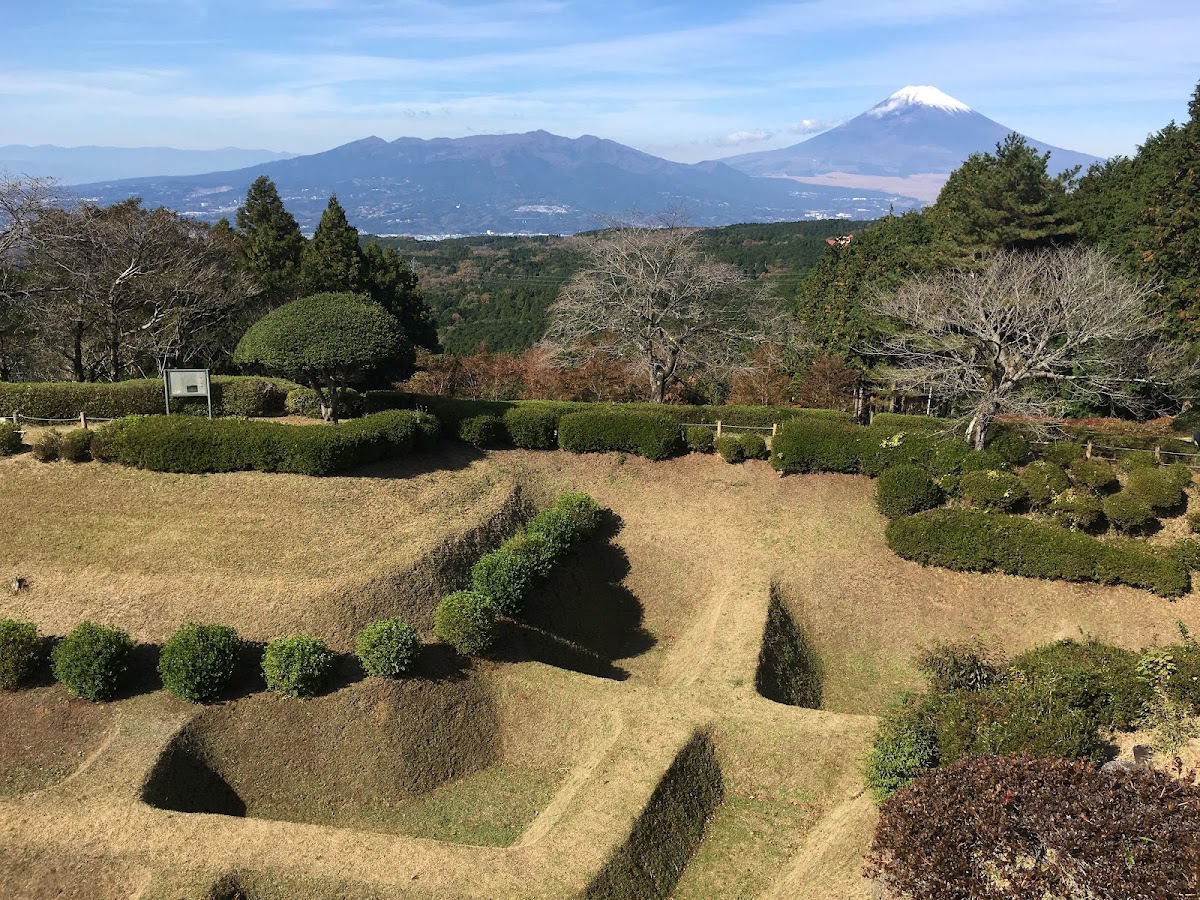
The shoji-bori is a structure with a grid-like division at the bottom of the moat, so named because it resembles the latticework of a shoji screen. It effectively prevented enemy soldiers from moving freely even if they descended into the moat, and also made group movement within the moat difficult. Particularly well-preserved remains are found around the West Bailey, and their geometric beauty captivates many visitors.
Unebori is a structure in which a series of ridge-shaped earthen ramparts are built at the bottom of the moat. It is particularly noticeable around Kitanomaru and, like Shojibori, was constructed to hinder enemy mobility. These unique dry moats represent the pinnacle of the Later Hojo clan’s castle-building techniques.
Main Enclosures and Defensive Facilities
Honmaru is located in the center of the castle, at the highest point. From here, Mount Fuji and Suruga Bay can be seen in their entirety, and the excellent views are one of Yamanaka Castle’s attractions.
Nishi-nomaru is located to the west of Honmaru and is surrounded by a magnificent Shojibori moat. This area has undergone the most extensive archaeological excavation and restoration, making it a valuable historical site that conveys the appearance of a Sengoku period mountain castle to the present day.
Daizaki Demaru is an enclosure newly constructed during the 17th year of Tensho (1589) expansion, and is positioned as a projection on the southwestern side of the castle. This area is also heavily fortified with shoji-bori and une-bori moats, but it is believed that parts of it were attacked by the Toyotomi army while still unfinished.
Kita-no-maru is an important enclosure protecting the north side of the castle, surrounded by une-bori moats. This is considered one of the sites of fierce battles with the Toyotomi army, and it is said that many Hojo soldiers were killed here.
History of Excavation and Development of Yamanaka Castle Ruins
Designation as a National Historic Site and Commencement of Investigations in the Showa Era
Yamanaka Castle was designated a national historic site in 1934 (Showa 9). However, at that time, many of the remains were covered with thickets and bamboo grass, and the full extent of the castle was unclear.
Mishima City began full-scale excavation in 1973 (Showa 48), starting the work of revealing the appearance of the mountain castle that had been buried for approximately 400 years. This investigation continued over a long period, and unique remains such as shoji-bori and une-bori moats were discovered one after another.
Heisei Era Development Project and Park Establishment
Based on the results of archaeological excavations, Mishima City proceeded with a project to develop the Yamanaka Castle ruins into a historical park. Careful removal of undergrowth was carried out to avoid damaging the remains, and grass was planted to visually represent the shapes of the moats and earthworks.
This development has made the beautiful grid-like form of the shoji moat clearly visible, making it a valuable place where visitors can observe the remains of a medieval mountain castle, a rare sight nationwide, up close. Information boards and explanatory signs have been installed throughout the site, creating an environment where visitors can understand the historical background and structure while viewing the site.
Reiwa Era Construction Completion and Current Status
In April 2026 (Reiwa 8), construction within the park was completed, creating a more comfortable viewing environment. Facilities such as parking lots and restrooms have also been established, making it a popular tourist spot visited by many castle enthusiasts and history lovers throughout the year.
Highlights and Sightseeing Points of Yamanaka Castle
Seasonal Natural Beauty and Views of Mt. Fuji
Yamanaka Castle Ruins Park captivates visitors not only with its historical value but also with its natural beauty. Cherry blossoms bloom in spring, and azaleas and hydrangeas add vibrant colors in early summer. Water lilies float on Tajiri Pond, and spider lilies bloom profusely in autumn, offering a delightful array of seasonal flowers.
Above all, the most impressive sight is the majestic view of Mt. Fuji from various points within the castle grounds. The view of Mt. Fuji across the Shoji-bori moat is truly breathtaking, making it a popular photography spot for many photography enthusiasts. On clear days, Suruga Bay can also be seen in the distance, allowing visitors to relive the scenery that warlords of the Sengoku period must have seen.
Stone Pavement of the Old Hakone Highway
Adjacent to the Yamanaka Castle Ruins, a 350-meter stretch of the stone pavement of the old Hakone Highway has been recreated. This cobblestone path, which preserves the appearance of the Tokaido road during the Edo period, allows for a deeper understanding of the relationship between the road and the castle when viewed in conjunction with Yamanaka Castle.
Walking along the cobblestone path, you can experience the feeling of being an Edo-period traveler and appreciate the crucial position Yamanaka Castle held at a vital transportation hub.
Japan’s Top 100 Castles Stamp and Souvenirs
Yamanaka Castle is the 40th castle in Japan’s Top 100 Castles list, making it a must-visit for castle enthusiasts collecting the stamps. The stamp is located at the Yamanaka Castle Ruins souvenir shop (open 10:00 AM to 4:00 PM, closed during the New Year holidays).
The shop also sells books, pamphlets, and souvenirs related to Yamanaka Castle, which can be purchased as mementos of your visit. The Mishima City Tourism Association also provides information about Yamanaka Castle.
Access and Visiting Information
Access by Public Transportation
By Train and Bus:
- Take the Tokai Bus bound for “Motohakone Port” from JR Mishima Station or Izuhakone Railway Mishima-Tamachi Station.
- Get off at the “Yamanaka Castle Ruins” bus stop (approximately 30 minutes).
- Buses run only a few times a day, so it is necessary to check the timetable in advance.
Discount Tickets:
Using the Tokai Bus Free Pass “Mishima 1-Day Pass Mishimaru Ticket” allows unlimited rides on Mishima city bus routes for one day, including round trips to Yamanaka Castle Ruins, making it a cost-effective option.
Access by Car
By Tomei Expressway:
- Approximately 20 minutes from Numazu IC via National Route 1.
- Approximately 30 minutes from Gotemba IC via National Route 138 and National Route 1.
Parking:
Free parking is available, with space for approximately 50 regular cars. During peak tourist seasons and weekends, it can get crowded, so early arrival is recommended.
Visiting Hours and Facility Information
Opening Hours:
Yamanaka Castle Ruins Park is open 24 hours a day. However, there is no lighting at night, so daytime visits are recommended.
Admission Fee:
Free
Estimated Visiting Time:
Approximately 1-2 hours is a good estimate for viewing the main remains. If you want to thoroughly explore all the baileys, allow 2-3 hours.
Facilities:
- Gift shop (Opening hours: 10:00 AM – 4:00 PM, closed during New Year holidays)
- Restrooms
- Free parking
- Information boards/explanatory signs
Notes:
- The castle ruins are uneven; comfortable walking shoes are recommended.
- Caution is advised during rainy weather as the ground can become slippery.
- Please refrain from entering areas outside the fence to prevent falls into the moat.
Tourist Attractions Around Yamanaka Castle
Tourist Attractions in Mishima City
You can enjoy sightseeing in Mishima City in conjunction with your visit to Yamanaka Castle. Mishima Taisha Shrine is an ancient shrine known as the Ichinomiya (first-ranked shrine) of Izu Province and is popular with history buffs as a shrine associated with Minamoto no Yoritomo. Also, in the city center of Mishima, there is “Rakujuen,” where groundwater from Mt. Fuji springs forth, allowing visitors to enjoy a beautiful Japanese garden and spring-fed pond.
Mishima Skywalk is Japan’s longest pedestrian suspension bridge and a popular spot for enjoying spectacular views of Mt. Fuji. It is also relatively close to Yamanaka Castle.
Tours around Hakone
Yamanaka Castle is located at the entrance to the Hakone area, making it a great place to combine with Hakone sightseeing. It offers excellent access to major Hakone attractions such as the Hakone Checkpoint, Hakone Shrine, and Lake Ashi.
Odawara Castle, as the base of the Later Hojo clan, has deep historical ties to Yamanaka Castle. Visiting both castles will provide a deeper understanding of the Later Hojo clan’s castle system.
Resources and Information for Deeper Understanding of Yamanaka Castle
Books and Research Materials
Detailed information about Yamanaka Castle can be found in excavation reports published by the Mishima City Board of Education and materials from the Japan Castle Association. Specialized books on Sengoku period castle architecture and the history of the Later Hojo clan also provide detailed explanations of Yamanaka Castle.
Guided Tours and Volunteer Commentary
The Mishima City Hometown Guide Association offers guided tours of the Yamanaka Castle ruins (advance reservations required). With explanations from expert guides, you can gain a deeper understanding of how to view the ruins and their historical background. If you wish to use this service, please contact the Mishima City Tourism Association.
Digital Resources and Online Information
The Mishima City official website publishes the latest information on Yamanaka Castle ruins and the results of archaeological excavations. Detailed information and photographs can also be viewed on the official website of Japan’s Top 100 Castles and the websites of castle research organizations.
Summary: Historical Value and Modern Significance of Yamanaka Castle
Yamanaka Castle is a tragic castle that disappeared from the stage of history after a battle lasting only half a day at the end of the Sengoku period. However, its remains, after more than 400 years, have been revived as a valuable cultural asset that conveys the advanced castle-building techniques of the Later Hojo clan and the appearance of a Sengoku period mountain castle to the present day.
In particular, the beauty of the shoji-bori and une-bori moats is unique and not seen in other castles, and it occupies an important position in the study of medieval castles. Furthermore, the breathtaking views of Mount Fuji and the beauty of nature throughout the seasons enhance its appeal as a tourist destination, in addition to its historical value.
Through continuous archaeological excavations and restoration work from the Showa to the Reiwa eras, Yamanaka Castle Ruins Park has been developed into one of the nation’s leading historical parks. Free to visit and relatively easy to access, this castle site is recommended not only for history buffs but also for families and hiking enthusiasts.
Walking along the beautifully maintained moats and earthworks, imagining the Sengoku period, and gazing at the view of Mount Fuji as seen by the samurai warriors—Yamanaka Castle is a special place where you can spend such a luxurious time. When you visit Mishima City, be sure to visit this treasure trove of history.