Goryu Castle (Hiroshima Prefecture) Complete Guide: The History of the Shishido Clan’s Fortress and the Conflicts with the Mori Clan
Goryu Castle, located in Kamikotachi, Koda-cho, Aki-Takata City, Hiroshima Prefecture, is a mountain castle that played an important role in Aki Province during the Sengoku period. Despite being only about 4-8 km from Yoshida-Koriyama Castle, the base of Mori Motonari, it was a strong fortress that served as the base of the Shishido clan for approximately 250 years.
This article comprehensively explains the history, layout, highlights, and current state of the remains of Goryu Castle—information that Japanese mountain castle fans and history enthusiasts would want to know.
Location and Geographical Characteristics of Goryu Castle
Goryu Castle is a mountain castle built on the tip of a hill approximately 310m above sea level, located at the southwestern edge of the Kotachi Basin. The elevation difference is approximately 130 meters, and the terrain cleverly utilizes the peninsula-like topography that juts out at the confluence of the Enokawa River and the Honmura River (also known as the Japanese River).
Topography as a Natural Fortress
The castle’s location is strategically excellent, possessing the following characteristics:
- Topography surrounded by rivers on three sides: The Kawai River and Honmura River act as natural moats, making enemy intrusion difficult.
- Steep cliffs: The sides of the hill are steep cliffs, creating a natural defensive wall that is difficult to climb.
- Observation post for the Kōtachi Basin: Located in a position overlooking the entire basin, it allows for early detection of enemy movements.
- Distance from the Mōri clan’s Kōriyama Castle: The distance of approximately 4-8 km was an exquisite position that allowed for mutual support if allies were in a relationship, and maintained a constant state of tension if enemies were in a relationship.
History of Goryu Castle: From the Nanboku-chō period to the Sengoku period
The Shishido clan’s entry into Aki Province and the construction of the castle
There are various theories regarding the construction period of Goryu Castle, but the most likely theory is that it was built by Shishido Tomoie during the Nanboku-chō period. The Shishido clan was a prestigious family descended from Hatta Tomoie, who served Minamoto no Yoritomo, and originally held the position of governor of Hitachi Province (present-day Ibaraki Prefecture).
Traditional tradition held that Shishido Tomoie was appointed governor of Aki Province in 1334 and moved to Kōtachi. Initially, he built Yanagi Castle at the foot of Kikuyama Mountain, and later moved the castle to Motokiyama Mountain on the opposite bank, marking the beginning of Goryu Castle.
However, recent historical research has confirmed records indicating that in 1498, the Mimura clan of Bicchu Province, allied with the Hosokawa clan, attacked and captured Goryu Castle, which belonged to the Shishido clan, who were allied with the Ōuchi clan. This confirms that Goryu Castle existed at least during this period and functioned as an important military base.
Conflict and Peace with the Mōri Clan
During the Sengoku period (Warring States period), Goryu Castle became one of the central stages of the political situation in Aki Province. As Mori Motonari expanded his power from his base at Yoshida-Koriyama Castle, his relationship with the Shishido clan became increasingly complex.
Early Conflict
Due to their geographical proximity—only 4-8 km from the Mori clan’s Koriyama Castle—the two clans constantly clashed over territory and influence. It is believed that tensions with the Mori clan persisted during the time of Shishido Motogen.
Formation of an Alliance Through Marriage
The turning point came with Mori Motonari’s skillful diplomatic strategy. As a peace measure, Motonari arranged a political marriage: his eldest daughter (Goryu-no-Tsubone) was married to Shishido Takaie, the grandson of Shishido Motogen.
Through this marriage, the Shishido clan was incorporated into the Mori family, and Goryu Castle came to serve as an important “domain wall” (defensive stronghold) protecting the Mori clan’s eastern territory. Shishido Takaie served as a senior retainer of the Mori clan and made a significant contribution to the Mori clan’s unification of the Chugoku region.
The Mori Clan’s Relocation to Suo and Nagato Provinces and the End of Goryu Castle
After the Battle of Sekigahara, when the Mori clan’s territory was reduced to the two provinces of Suo and Nagato (Bōchō), Goryu Castle was abandoned. Goryu Castle, which had functioned as the Shishido clan’s base for approximately 250 years, from the Nanboku-chō period to the end of the Sengoku period, thus withdrew from the stage of history.
The Layout and Structure of Goryu Castle
Goryu Castle has a typical concentric mountain castle layout. Many remains are still preserved, which are very useful for understanding the basic structure of mountain castles.
Basic Layout Structure
The castle has a structure in which multiple baileys are arranged in a series on a ridge, each separated by a moat. This interconnected layout created a multi-layered defensive system, allowing for the construction of successive defensive lines even if the enemy captured one enclosure.
Major Remains
- Honmaru (Main Enclosure): The most important enclosure at the center of the castle, believed to have housed the lord’s residence and command post.
- Ninokuruwa (Second and Third Enclosures): Secondary defensive strongholds protecting the Honmaru.
- Horikiri (Moat): A defensive structure created by deeply digging into the ridge to hinder enemy advances. Goryu Castle retains several moats, and their large scale suggests a strong defensive awareness.
- Earthworks: Defensive walls made of piled-up earth around the enclosures.
- Stone Walls: Traces of stone walls have been confirmed in some areas, indicating that it was not merely an earthen castle, but that stone was also used for defensive reinforcement.
- Well Remains: Traces of securing a water source in preparation for a siege remain.
Defensive Techniques as a Mountain Castle
The layout of Goryu Castle exhibits defensive techniques unique to mountain castles of the Sengoku period:
- Cut Slopes: The area around the enclosures is cut down at a near-vertical angle to make climbing difficult.
- Vertical Moats: Moats dug vertically along the slope to prevent lateral movement of the enemy.
- Horizontal Moats: Moats dug along contour lines to limit the enemy’s advance routes.
- Koguchi (Tiger’s Mouth Entrance): A structure designed to heavily fortify the entrance to the bailey.
These techniques allowed Goryu Castle to function as a “strong fortress,” effectively defending even with a small force.
Highlights and Current State of Goryu Castle
Goryu Castle ruins are designated as a Hiroshima Prefecture Designated Historic Site, and many remains are still well-preserved.
Main Highlights During Your Visit
1. Clearly Remaining Moats
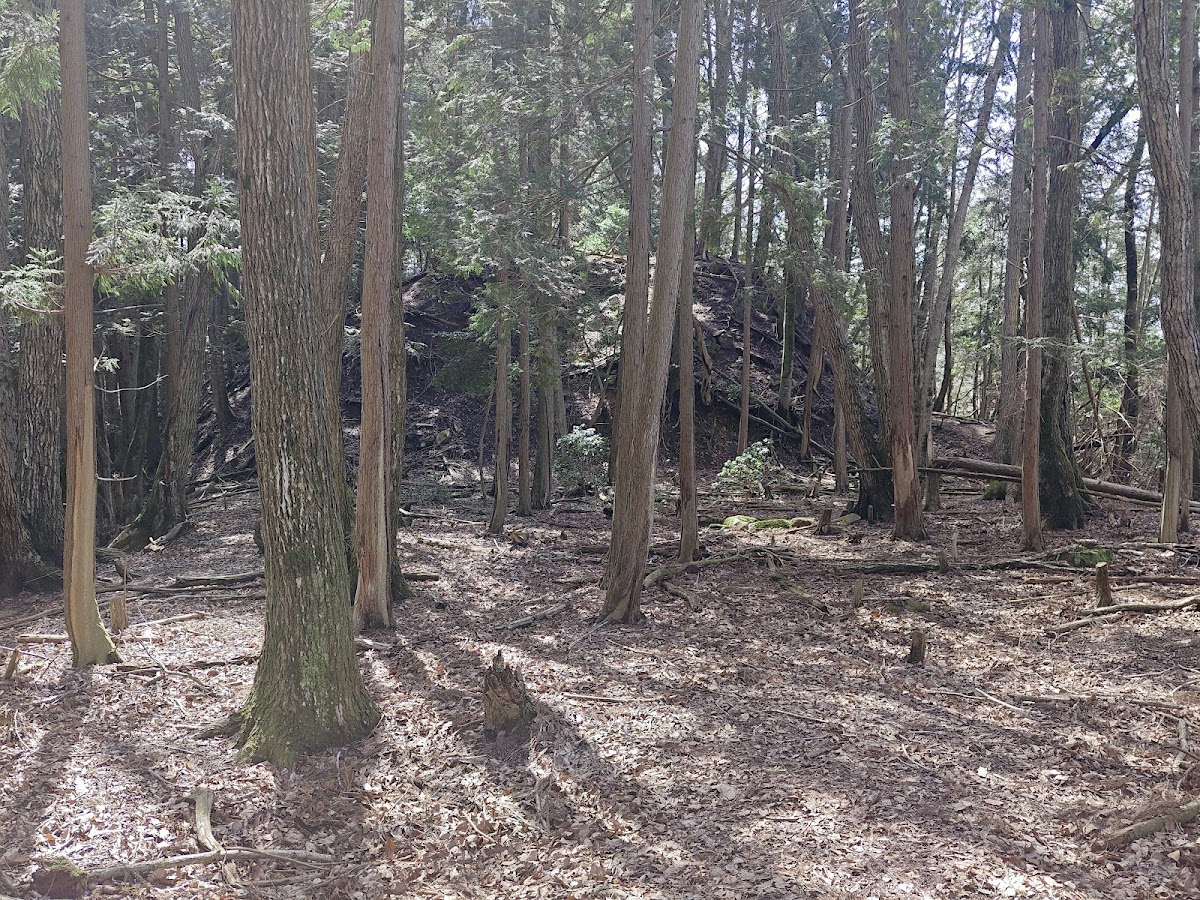
The greatest highlight of Goryu Castle is the large moats separating multiple baileys. These moats, several meters deep, demonstrate the advanced castle-building techniques of the time. The moats around the main bailey are particularly well-preserved, allowing visitors to experience the defensive system of the Sengoku period.
2. Consecutive Baileys
The consecutive baileys arranged along the ridge are a valuable example of a typical multi-bailey mountain castle. The scale and arrangement of each bailey reveal the castle’s functional divisions and defensive plans.
3. Traces of Stone Walls
The remaining stone walls show the transitional period from earthen castles to stone castles, making them important remains for understanding the development of castle architecture.
4. View
From the castle ruins, you can enjoy a panoramic view of the Kōtachi Basin, and even see the direction of Kōriyama Castle of the Mōri clan in the distance. This view allows you to appreciate the strategic importance of Goryu Castle.
Preservation Status of the Remains
Because Goryu Castle is located in a forest, it has not been affected by development, and the remains are preserved in relatively good condition. However, as it is a natural mountain castle, the following preparations are necessary for a visit:
- Appropriate clothing and shoes for hiking
- Insect repellent (especially in summer)
- Drinking water and snacks
- Map or GPS app (some sections of the trail are unclear)
Access and Visiting Information for Goryu Castle
Location
Kamikodachi, Koda-cho, Aki-Takata City, Hiroshima Prefecture
Access Methods
Access by Car
- Approximately 15 minutes from the Takada IC on the Chugoku Expressway
- Parking space is limited, so please be careful not to park on the road.
Public Transportation
Access by public transportation is difficult. Since it is a distance from the nearest bus stop, we recommend visiting by car.
Ascent Route
It takes approximately 20-30 minutes on foot from the entrance to the main keep. Since it is a mountain trail, those who are not confident in their physical fitness should not push themselves and should limit their visit to what is comfortable.
Precautions for Visitors
- Please observe proper etiquette when visiting, as you may need to pass through private property.
- As it is a mountain castle, please avoid visiting in bad weather.
- Visiting in groups is safer than visiting alone.
- Please take all your trash with you.
- Damaging or removing any remains is strictly prohibited.
Goryu Castle and Surrounding Castles
When visiting Goryu Castle, visiting the surrounding castles will give you a deeper understanding of the Sengoku period history of Aki Province.
Yoshida-Koriyama Castle
This was the base of Mori Motonari and is located approximately 4-8 km from Goryu Castle. It is one of Japan’s 100 Famous Castles and retains the remains of a large mountain castle. Visiting it together with Goryu Castle will give you a better understanding of the relationship between the Mori and Shishido clans.
Yanagi-ga-jo Castle
This castle is believed to have been the base of the Shishido clan before Goryu Castle. It is an important historical site for understanding its relationship with Goryu Castle.
The Story of Aki Province in the Sengoku Period as Told by Goryu Castle
The history of Goryu Castle symbolizes the complex political situation in Aki Province during the Sengoku period.
Survival Strategies of Regional Lords
The Shishido clan maintained their independent power despite being adjacent to the powerful Mori clan. Ultimately, they achieved the survival and development of their family by becoming part of the Mori clan through marriage. This is a typical example of a survival strategy adopted by regional lords during the Sengoku period.
Mori Motonari’s Diplomatic Skills
Mori Motonari is known as a Sengoku daimyo who expanded his power not only through military force but also through diplomacy. His acquisition of the Shishido clan, based at Goryu Castle, through the marriage of his daughter, is a prime example of Motonari’s skillful diplomacy.
Military Technology of the Sengoku Period as Seen from Mountain Castles
The layout of Goryu Castle is a valuable resource that shows the developmental stages of mountain castle construction technology during the Sengoku period. From the remains such as moats, earthworks, and stone walls, we can glean insights into the military technology and tactical thinking of the time.
Current Status and Future Challenges of Goryu Castle Research
While investigations into Goryu Castle have been conducted by the Hiroshima Prefectural Board of Education and others, many aspects remain unclear.
Future Research Topics
- Determining the Construction Date: There are theories placing it during the Nanboku-cho period and the Muromachi period, but no definitive evidence has been found.
- The Castle’s Transformation Process: Detailed investigations are needed to understand how the castle’s structure changed over time.
- Identifying the Site of the Shishido Clan’s Residence: The location of the lord’s residence remains unclear.
- Structure of the Castle Town: Archaeological investigations are needed to determine what kind of castle town settlement was formed at the foot of Goryu Castle.
Efforts for Preservation and Utilization
The local Aki-Takata City is working on the preservation and utilization of castle ruins within the city, including the Goryu Castle site. Efforts are underway to create a safe environment for visitors, including the installation of information boards and the maintenance of the approaching paths.
Summary: The Historical Value of Goryu Castle
Goryu Castle is a mountain castle of high historical value in the following respects:
- Importance in the History of Aki Province during the Sengoku Period: An important historical site that tells the story of the relationship between the Mori and Shishido clans.
- An Excellent Example of Mountain Castle Construction Techniques: As a typical example of a multi-bailey mountain castle, it conveys the military technology of the Sengoku period.
- Excellent Preservation of Remains: Moats, baileys, and stone walls remain clearly visible.
- Material for Regional History Research: Clues to the activities of local lords from the Nanboku-cho period to the Sengoku period.
For history buffs and mountain castle enthusiasts visiting Hiroshima Prefecture, Goryu Castle is a must-see spot. Visiting it together with Mori Motonari’s Yoshida-Koriyama Castle will allow for a deeper understanding of Aki Province during the Sengoku period.
The Goryu Castle ruins are a valuable legacy of the Sengoku period that remains to this day. It is our responsibility to properly preserve these things and pass them on to future generations.