Iwao Castle (Kamimashiki District, Kumamoto Prefecture) Complete Guide: A Thorough Explanation of History, Remains, and Access
Iwao Castle is a medieval mountain castle located in Yamato-cho (formerly Yabe-cho), Kamimashiki-gun, Kumamoto Prefecture. Known as the residence of the Yabe clan, a branch of the Aso clan, it played a significant role in the medieval history of Kumamoto Prefecture. This article provides a detailed explanation of Iwao Castle, from its history to its current remains and access methods.
Basic Information on Iwao Castle
Iwao Castle is a mountain castle built in Yamato-cho (formerly Yabe-cho), Kamimashiki-gun, Kumamoto Prefecture, located on a mountaintop approximately 600 meters above sea level. This castle functioned as the base of the Yabe clan, a branch of the Aso clan, and was an important strategic point in southern Higo Province from the medieval period to the Sengoku period.
Location and Geographical Characteristics
- Location: Yamato-machi, Kamimashiki-gun, Kumamoto Prefecture (formerly Yabe-machi)
- Elevation: Approximately 600 meters
- Topography: Mountain castle utilizing the mountaintop
- Geographical Importance: Located at a strategic point connecting the Aso region and the Yatsushiro area
Iwao Castle is situated in a corner of the Kyushu Mountains and is a highly defensible castle that skillfully utilizes the natural terrain. The surrounding area is surrounded by steep mountains, making it extremely difficult for attackers to conquer.
History of Iwao Castle
Construction and the Yabe Clan
There are various theories regarding the construction period of Iwao Castle, but it is generally believed to have been built by the Yabe clan, a branch of the Aso clan, during the Kamakura to Nanboku-cho periods. The Yabe clan, as a branch of the Aso clan, was entrusted with governing this region.
The Yabe clan, as an important branch of the Aso Grand Priest family, was responsible for the defense and governance of southern Higo Province. Iwao Castle became a military and political center, serving as its base of operations.
The Turmoil of the Nanboku-cho Period
During the Nanboku-cho period, Iwao Castle was also caught up in the turmoil of the era. In Higo Province, the forces of the Southern and Northern Courts fiercely clashed, and the Aso clan sometimes shifted their allegiance. Iwao Castle is believed to have functioned as one of the important strongholds of the Southern Court.
During this period, the castle was the site of several battles, and it is thought that its defensive structures were strengthened. Many of the remaining structures are presumed to have been developed from this period through the Sengoku period.
Iwao Castle in the Sengoku Period
With the arrival of the Sengoku period, Higo Province became a battleground for major Kyushu powers such as the Shimazu, Otomo, and Ryuzoji clans. The Yabe clan and Iwao Castle also fought for survival within this complex power structure.
Particularly in the latter half of the 16th century, with the northward advance of the Shimazu clan, southern Higo Province was subjected to fierce warfare. It is believed that Iwao Castle was attacked several times during this period, but records show that it withstood the attacks due to its strong defenses.
Toyotomi Hideyoshi’s Conquest of Kyushu and the Abandonment of the Castle
In 1587 (Tensho 15), Toyotomi Hideyoshi’s conquest of Kyushu drastically altered the balance of power in Higo Province. Hideyoshi granted Higo Province to Sasa Narimasa, but a local uprising occurred, and subsequently, Kato Kiyomasa came to rule northern Higo, and Konishi Yukinaga to rule southern Higo.
During this process, many of the local lords who had ruled since the Middle Ages fell into decline, and it is believed that Iwao Castle was also abandoned. During the Edo period, the castle completely lost its function, and only its remains were left.
Layout and Remains of Iwao Castle
Main Enclosure (Honmaru)
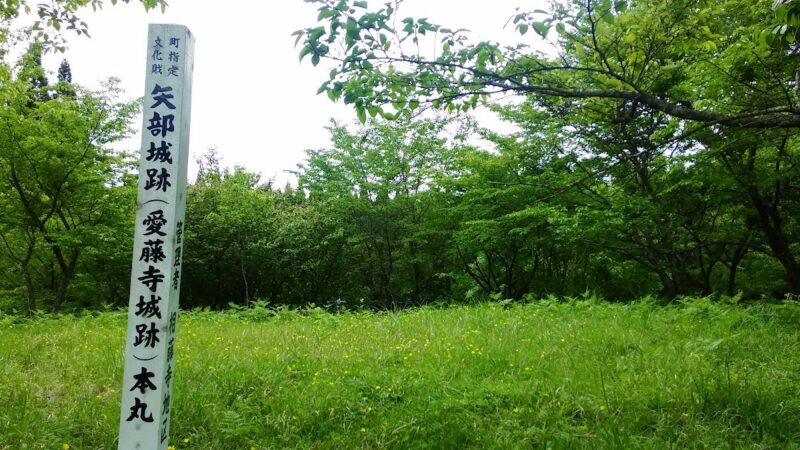
The main enclosure of Iwao Castle is located on the mountaintop, and the remains of a flat enclosure can still be seen today. The main enclosure measures approximately 30 meters east-west and 40 meters north-south, a standard size for a medieval mountain castle.
Traces of earthworks remain around the main enclosure, suggesting that fences or walls once stood there. Furthermore, the arrangement of foundation stones, believed to be the remains of a building, has been confirmed in one corner of the main enclosure.
Enclosures
Several enclosures are arranged in a stepped pattern around the main enclosure. These enclosures are thought to have served not only as defensive spaces but also as residences for retainers and garrisons for soldiers.
The main enclosures are as follows:
- Second Enclosure: Located east of the main enclosure, it is the second largest enclosure after the main enclosure.
- Third Enclosure: Located below the second enclosure.
- West Enclosure: A defensive position located west of the main enclosure.
- Lower Enclosure: A group of small enclosures surrounding the main enclosure.
Moats and Vertical Moats
The moats and vertical moats are particularly noteworthy defensive features of Iwao Castle. The moats are dry moats dug to divide the ridge, serving as an important defensive line to prevent enemy intrusion.
Clear moats remain on the north and south sides of the main enclosure, approximately 3-5 meters deep and 5-8 meters wide. These moats can still be clearly seen in the forest today.
In addition, several vertical moats descending the slopes have been identified; these served to hinder enemy lateral movement and limit attack routes.
Entrance (Koguchi)
The entrance to a castle, the koguchi, is the most crucial point for defense. At Iwao Castle, the koguchi to the main enclosure was located on the east side, and it is presumed to have had a staggered structure.
This structure prevented the enemy from directly charging into the main enclosure, allowing for a more advantageous battle for the defenders.
Well Remains
Securing a water source is a matter of life and death for mountain castles. At Iwao Castle, a depression believed to be the remains of a well has been confirmed near the main enclosure. However, since securing water at the mountaintop was difficult, it is possible that during sieges, they relied on rainwater storage or water transport from the foot of the mountain.
Highlights of Iwao Castle
Well-Preserved Remains
The greatest appeal of Iwao Castle is that, untouched by development, the appearance of a medieval mountain castle is relatively well-preserved. Basic structures such as the main enclosure, baileys, and moats remain clearly visible, allowing visitors to experience the original layout.
The moats, in particular, remain deep and clearly defined, making them valuable historical remains for studying the defensive techniques of medieval mountain castles.
Views
The views from the mountaintop are one of the attractions of Iwao Castle. On a clear day, you can see the Aso Mountains and the peaks of the Kyushu Mountains, giving you a real sense of why this area was a strategically important location.
From the castle, you can overlook the Yabe Valley and the surrounding roads, clearly illustrating its role as a military surveillance base.
Harmony with Nature
The Iwao Castle ruins are currently surrounded by abundant nature. The fresh greenery in spring and the autumn foliage are beautiful, allowing you to enjoy nature along with exploring the castle ruins. However, as it is a mountain castle, appropriate equipment and preparation are necessary.
Access to Iwao Castle
Access by Car
The most convenient way to access Iwao Castle is by car.
From Kumamoto City:
- Approximately 40 minutes from the Mifune IC on the Kyushu Expressway via National Route 445
- Head towards Yamato Town via National Route 218
From Aso:
- Approximately 50 minutes via National Route 325 and National Route 218
Parking:
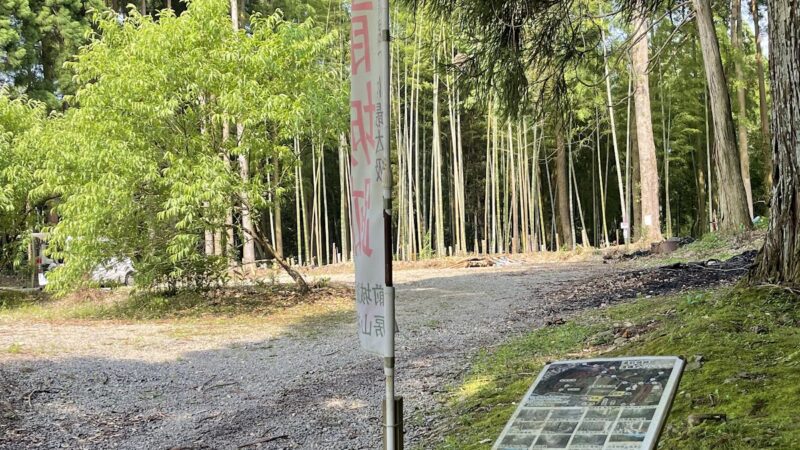
There is no designated parking lot near the castle ruins, but there is space for a few cars near the trailhead. However, consideration should be given to avoid inconveniencing local residents.
Access by Public Transportation
Access by public transportation is limited.
- Take the Sanko Bus from Kumamoto City towards Yamato Town (formerly Yabe Town)
- A short walk from the nearest bus stop is required (approximately 2-3 km).
If using public transportation, it is recommended to check the timetable in advance and allow sufficient time.
Ascent Route
The ascent route to the castle ruins is a mountain trail. The climb from the trailhead to the main enclosure takes approximately 30-40 minutes. Important Notes:
- Wear appropriate footwear such as hiking boots.
- Insect repellent is necessary during summer.
- Avoid climbing alone; visiting in groups is recommended.
- Be careful as the ground can be slippery during and after rain.
- Note that there are areas where cell phone signals do not reach.
Points to Note When Visiting Iwao Castle
Safety Measures
Iwao Castle is not a well-maintained tourist site, but the remains of a mountain castle. Please pay attention to the following points when visiting.
- Appropriate Equipment: Wear hiking boots, long-sleeved shirt and long pants, a hat, gloves, etc.
- Hydration: Bring plenty of drinking water.
- Weather Check: Check the weather forecast in advance and avoid visiting in bad weather.
- Time Management: Allow ample time to descend before sunset.
- Emergency Contact: Carry a cell phone and inform family members of your destination.
Manners and Preservation
Iwao Castle ruins are a valuable cultural asset. Please observe the following manners when visiting.
- Do not damage the historical remains.
- Always take your trash with you.
- Do not collect plants.
- Do not use open flames.
- Obtain permission from the landowner if visiting private land.
Best Time to Visit
The best time to visit Iwao Castle is as follows:
- Spring (April-May): Beautiful fresh greenery and mild weather.
- Autumn (October-November): Beautiful autumn foliage and suitable temperatures for hiking.
- Times to Avoid: Mid-summer (hot and many insects), rainy season (slippery), winter (possibility of snow).
Nearby Attractions
Historical Spots in Yamato Town
When visiting Iwao Castle, we recommend also visiting the nearby historical spots.
Tsūjun Bridge:
A stone arch bridge built during the Edo period, designated as a National Important Cultural Property. Located about 20 minutes by car from Iwao Castle, it is a representative tourist attraction of Yamato Town.
Hamamachi Townscape: Hamamachi, which flourished as the center of Yabe, retains its old townscape, allowing visitors to enjoy historical walks.
Natural Spots
Soyokyo Gorge: A magnificent gorge known as the “Grand Canyon of Kyushu,” located about 30 minutes by car from Iwao Castle.
Gorogataki Waterfall: A waterfall with a drop of approximately 50 meters, where you can refresh yourself while breathing in negative ions.
History of Iwao Castle and the Aso Clan
About the Aso Clan
The Aso clan was a family that served as the chief priest of Aso Shrine and was also a powerful local lord that controlled the northeastern part of Higo Province during the Middle Ages. As a unique group possessing both Shinto priesthood and samurai characteristics, they had a significant influence on the history of Higo Province.
Relationship between the Yabe and Aso Clan
The Yabe clan, as a branch of the Aso clan, functioned as the Aso clan’s military and political representative in the south. Iwao Castle was an important base protecting the southern edge of the Aso clan’s sphere of influence, and the Yabe clan played a crucial role in stabilizing the region.
The main branch of the Aso clan and the Yabe clan were related by blood and cooperated in critical situations. Records show that the Aso and Yabe clans worked together to defend against invasions from external enemies.
Research and Investigation of Iwao Castle
Academic Value
Iwao Castle is an important historical site for studying the history of castles in medieval Higo Province. It provides valuable information for understanding the Aso clan’s sphere of influence and the structure of medieval mountain castles.
In recent years, local historians and castle researchers have conducted investigations, creating layout maps and detailed records of the remains. These studies are making the historical value of Iwao Castle clearer.
Future Preservation and Utilization
Discussions regarding the preservation and utilization of the Iwao Castle ruins continue among local governments and history enthusiasts. To preserve this valuable cultural asset for future generations, a balance between proper preservation and management, and creating a safe environment for visitors, is crucial.
In the future, if explanatory signs are installed and the access routes to the castle are improved, more people will be able to experience the history of Iwao Castle.
Summary
Iwao Castle is a medieval mountain castle located in Yamato-cho, Kamimashiki-gun, Kumamoto Prefecture. It played an important role as the residence of the Yabe clan, a branch of the Aso clan. Even today, the remains of the main enclosure, baileys, and moats are well-preserved, making it a valuable historical site for learning about the structure of medieval mountain castles.
While preparation for hiking is necessary for a visit, the experience of walking through nature while feeling the romance of history is very appealing to castle enthusiasts. By visiting in conjunction with other nearby tourist spots, you can fully enjoy the history and nature of Yamato-cho.
Iwao Castle is not a famous tourist destination, but that is precisely why it is a place where you can quietly reflect on history. We highly recommend a visit to anyone interested in medieval mountain castles, those who want to learn about the history of the Aso clan, or those who want to visit hidden historical sites in Kumamoto.
Please enjoy the history and nature of Iwao Castle while taking sufficient safety precautions.