Kajiki Castle (Kagoshima Prefecture) Complete Guide: History, Highlights, and Access Explained in Detail
Kajiki Castle, located in Hando, Kajiki-cho, Aira City, Kagoshima Prefecture, is a mountain castle and a historical heritage site that played an important role in the history of Japanese castles. Built on a hill approximately 100 meters above sea level and 60 meters above ground level, the castle functioned as a political and military stronghold in southern Kyushu from the Heian period to the early Edo period. It is particularly known as the site of the “Battle of Kajiki Castle,” where firearms are believed to have been used in combat for the first time in Japan, and as the place where the famous Sengoku period general Shimazu Yoshihiro spent his later years.
This article thoroughly explains the charm of Kajiki Castle, from its detailed history from construction to its abandonment, to the turbulent events of the Sengoku period, the highlights of the remaining ruins, and how to access it.
Table of Contents
- Overview and Location of Kajiki Castle
- Construction and the Rise of the Kajiki Clan
- Expulsion of the Kajiki Clan and the Rule of the Kimotsuki Clan
- The Turmoil of the Sengoku Period and the Shimazu’s Attack on Kajiki Castle
- The Site of Japan’s First Actual Use of Firearms in Combat
- Shimazu Yoshihiro and Kajiki Manor
- The Establishment of the Kajiki Shimazu Family
- The Castle’s Abandonment and Current Status
- Castle Structure and Highlights of the Remains
- Access and Visiting Information
- Nearby Tourist Spots
Overview and Location of Kajiki Castle
Kajiki Castle is located in Hando, Kajiki-cho, Aira City, Kagoshima Prefecture, built on a hill overlooking the inner part of Kinko Bay (Kagoshima Bay). At an altitude of approximately 100 meters, with a relative height of about 60 meters from the base, it is a medium-sized mountain castle, but its location was strategically extremely important.
The castle was located approximately 20 kilometers northeast of downtown Kagoshima, along the route leading to the current Kagoshima Airport. It was built at a strategic transportation hub facing Kinko Bay, allowing for the monitoring and control of both maritime and land traffic. From the castle ruins, one can see not only Kinko Bay but also Sakurajima and the Kirishima mountain range, a view that speaks to its high military surveillance capabilities.
In the medieval period, Kajiki was a manor of the Shōhachiman Shrine (present-day Kagoshima Jingu Shrine), but with the rise of samurai power, Kajiki Castle gained increasing importance as the residence of the local powerful clan.
Construction of the Castle and the Rise of the Kajiki Clan
Construction by the Ōkura Clan
There are various theories regarding the construction period of Kajiki Castle, but it is believed to have been built by the Ōkura clan in the late Heian period. The Ōkura clan was originally descended from naturalized immigrants who had moved from the central government, and was a powerful clan that expanded its influence in southern Kyushu. The Okura clan was initially dispersed throughout Satsuma and Osumi provinces, but the branch that established its base in Kajiki leveraged the geographical advantages of the area to build its power. While historical records are scarce and details of the early Kajiki Castle are unclear, it is presumed to have followed the typical form of mountain castles of the time, with the main enclosure at the summit and multiple enclosures arranged along the ridge.
Change of Surname to Kajiki
The Okura clan strengthened its ties with the central aristocracy by marrying a son of Fujiwara no Yoritada, the regent, and eventually changed its surname to “Kajiki,” taking the place name. This change of surname was not merely a name change, but a significant event indicating that they had taken root in this area and established their own sphere of influence.
From the Kamakura period to the Muromachi period, the Kajiki clan controlled the surrounding area from Kajiki Castle and grew into a powerful local lord in northern Osumi Province. During this period, Kajiki Castle was frequently renovated and expanded, likely strengthening its defensive capabilities.
Expulsion of the Kajiki Clan and Rule of the Kimotsuki Clan
Conflict with the Shimazu Clan
In the late Muromachi period, the Shimazu clan, the shugo daimyo of Satsuma Province, expanded their power and strengthened their influence over Osumi Province. Initially, the Kajiki clan was subordinate to the Shimazu clan, but from the late 15th to the early 16th century, they became embroiled in internal power struggles within the Shimazu clan.
In particular, as the struggle for the headship of the Shimazu clan intensified, Ijichi Shigesada, the lord of Kajiki Castle, took a stance against the Shimazu clan. This was an attempt to maintain independence by exploiting the internal conflicts within the Shimazu clan, but it ultimately drastically altered the fate of the Kajiki clan.
Subjugation by Shimazu Tadayoshi
In the 1530s, Shimazu Tadayoshi (Nisshinsai), who was gaining real power within the Shimazu clan, decided to defeat Ijichi Shigesada of Kajiki Castle, who was resisting him. Shimazu Tadayoshi was a renowned general later known as the “restorer of the Shimazu clan,” and his military talent and political acumen had led to the unification of the Shimazu clan.
Shimazu Tadayoshi’s attack resulted in the death of Ijichi Shigesada, bringing an end to the Kajiki clan’s rule. This incident marked a crucial step in the Shimazu clan’s unification of Osumi Province and a major turning point in the history of Kajiki Castle.
Transfer to the Kimotsuki Clan
After destroying the Kajiki clan, Shimazu Katsuhisa (Tadayoshi’s lord) granted Kajiki Castle and its surrounding territories to Kimotsuki Kanenori. The Kimotsuki clan was a powerful local family in Osumi Province, based at Takayama Castle (present-day Kimotsuki Town). By acquiring Kajiki Castle, they expanded their influence into northern Osumi Province.
During this period, the Kimotsuki clan was allied with the Shimazu clan, but their relationship was not always stable and would eventually escalate into conflict.
The Turmoil of the Sengoku Period and the Shimazu’s Attack on Kajiki Castle
Intensification of the Conflict Between the Shimazu and Kimotsuki Clans
By the mid-16th century, relations between the Shimazu and Kimotsuki clans rapidly deteriorated. While Shimazu Takahisa (son of Tadayoshi) advanced the unification of Satsuma and Osumi, the Kimotsuki clan resisted, attempting to maintain their own sphere of influence. Kajiki Castle became one of the Kimotsuki clan’s important strongholds in this conflict.
The Kimotsuki clan strengthened Kajiki Castle in preparation for Shimazu attacks. The castle’s defensive facilities were reinforced, and provisions and weapons were stockpiled. At this time, Kajiki Castle was not merely a local mountain castle, but a battleground on the front lines of the struggle for supremacy in southern Kyushu.
The Battle of Kajiki Castle in 1539
In 1539 (Tenbun 8), the Shimazu clan launched a full-scale attack on Kajiki Castle. Ijuin Tadaaki, a senior retainer of Shimazu Takahisa, led the attacking force and besieged Kajiki Castle. This battle contains events of note in the history of Japanese castles.
The First Use of Firearms in Combat in Japan
The Introduction of Firearms and the Battle of Kajiki Castle
The Battle of Kajiki Castle is known as the first battle in Japan where firearms were used in combat (although there are various theories). The prevailing theory is that firearms were introduced to Tanegashima in 1543, but some researchers point to the possibility that firearms were brought to Japan earlier, and the Battle of Kajiki Castle is considered one piece of evidence for this.
This battle, in which Ijuin Tadaaki’s forces are said to have used firearms, was a revolutionary event in the history of Japanese military tactics. The roar and destructive power of firearms had the potential to completely change the fighting style that had previously centered on bows, arrows, and spears.
Surrender of the Kimotsuki Clan
In this battle, the Kimotsuki clan could not withstand the Shimazu clan’s attack and ultimately surrendered. While it is not clear from historical records whether the power of firearms was decisive, the Shimazu clan’s military superiority was evident. With this surrender, Kajiki Castle once again came under the control of the Shimazu clan.
The Kimotsuki clan continued to maintain power, centered around Takayama Castle, but their influence in northern Osumi Province declined significantly. The loss of Kajiki Castle was a major strategic blow to the Kimotsuki clan.
Shimazu Yoshihiro and Kajiki Castle
Shimazu Yoshihiro’s Entry into the Castle
In 1607 (Keicho 12), Shimazu Yoshihiro, known as a famous general of the Sengoku period, moved to Kajiki. Shimazu Yoshihiro was a samurai who made a name for himself in the Korean campaigns and the Battle of Sekigahara. His “Shimazu retreat” at Sekigahara, in particular, is recounted as one of the most courageous battles in Japanese military history.
The reason Yoshihiro moved to Kajiki was due to political considerations within the Shimazu family. Having sided with the Western Army at the Battle of Sekigahara, the Shimazu clan struggled to maintain relations with the Tokugawa shogunate. Yoshihiro handed over the family headship to his nephew, Shimazu Iehisa (later Tadatsune), and retired to Kajiki.
Construction of Kajiki Manor
Shimazu Yoshihiro constructed a new manor, “Kajiki Manor,” at the foot of Kajiki Castle and made it his residence. Kajiki Manor was designed as a residence for peacetime and had more of the characteristics of a samurai residence than a castle. Yoshihiro spent his later years here, living out his life in Kajiki until his death at the age of 85 in 1619 (Genna 5).
Kajiki Castle as a Reserve Castle
After the construction of Kajiki Manor, Kajiki Castle was positioned as a “reserve castle.” A reserve castle is a fortified castle not used in peacetime, but intended as a place to take refuge in times of emergency. During the peaceful Edo period, mountain castles were inconvenient for daily use and were maintained as the last line of defense.
During this period, the facilities of Kajiki Castle were kept to a minimum, and the actual political and administrative center shifted to Kajiki Manor at the foot of the mountain. However, its function as a castle was not completely lost, and it continued to exist as part of the defense system against the shogunate.
Establishment of the Kajiki Shimazu Family
A Branch Family of the Shimazu Clan
After the death of Shimazu Yoshihiro, his descendants were granted Kajiki as their territory, and the Kajiki Shimazu family became one of the branch families of the main Shimazu clan. As a powerful branch family of the Shimazu clan, the Kajiki Shimazu family played an important role in the politics and military affairs of the Satsuma Domain.
The heads of the Kajiki Shimazu family ruled Kajiki for generations, possessing a territory of approximately 10,000 koku. Throughout the Edo period, the Kajiki Shimazu family continued to exist as an important family supporting the main Shimazu family, and played a central role in the Satsuma Domain even during the turbulent period at the end of the Edo period.
Kajiki in the Edo Period
During the Edo period, Kajiki developed as a castle town. Samurai residences lined the streets around the Kajiki Manor, and commerce flourished. Furthermore, Kajiki functioned as a post town on the Satsuma Highway (corresponding to the current National Route 10), experiencing a bustling flow of people and goods.
Kajiki also valued education, implementing a unique youth education system of the Satsuma Domain called “Gochu Education.” This system produced many talented individuals who played active roles during the late Edo and Meiji periods.
Castle Abandonment and Current Status
Castle Abandonment After the Meiji Restoration
With the abolition of the feudal domains and establishment of prefectures in 1871 (Meiji 4), the rule of the Kajiki Shimazu family came to an end. Although Kajiki Castle had already ceased practical use since the Edo period, it was officially abandoned by the Meiji government’s castle abolition decree.
After its abandonment, the castle buildings were demolished, and some of the stone walls were also destroyed. The castle site land was sold off to private individuals, and some parts are now used for farmland and residential development.
Current Remains
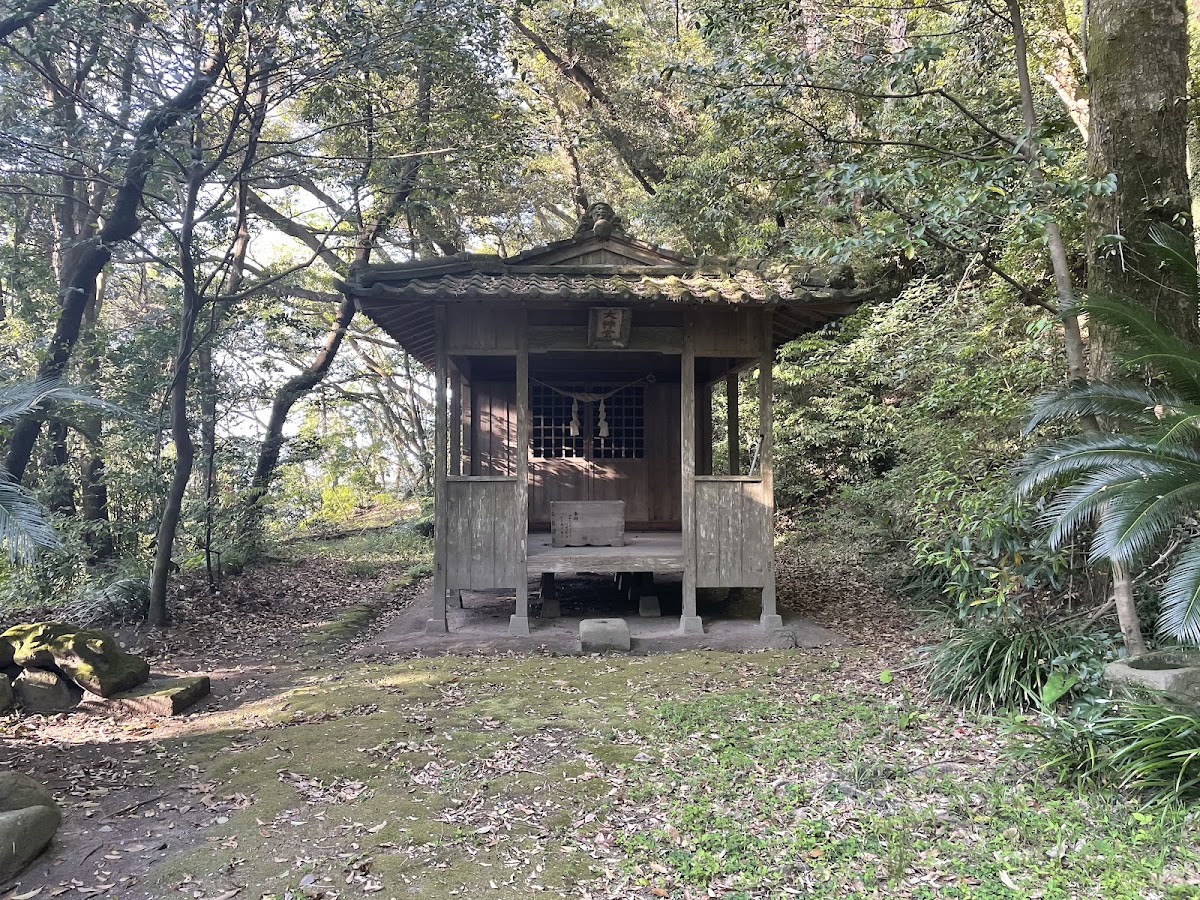
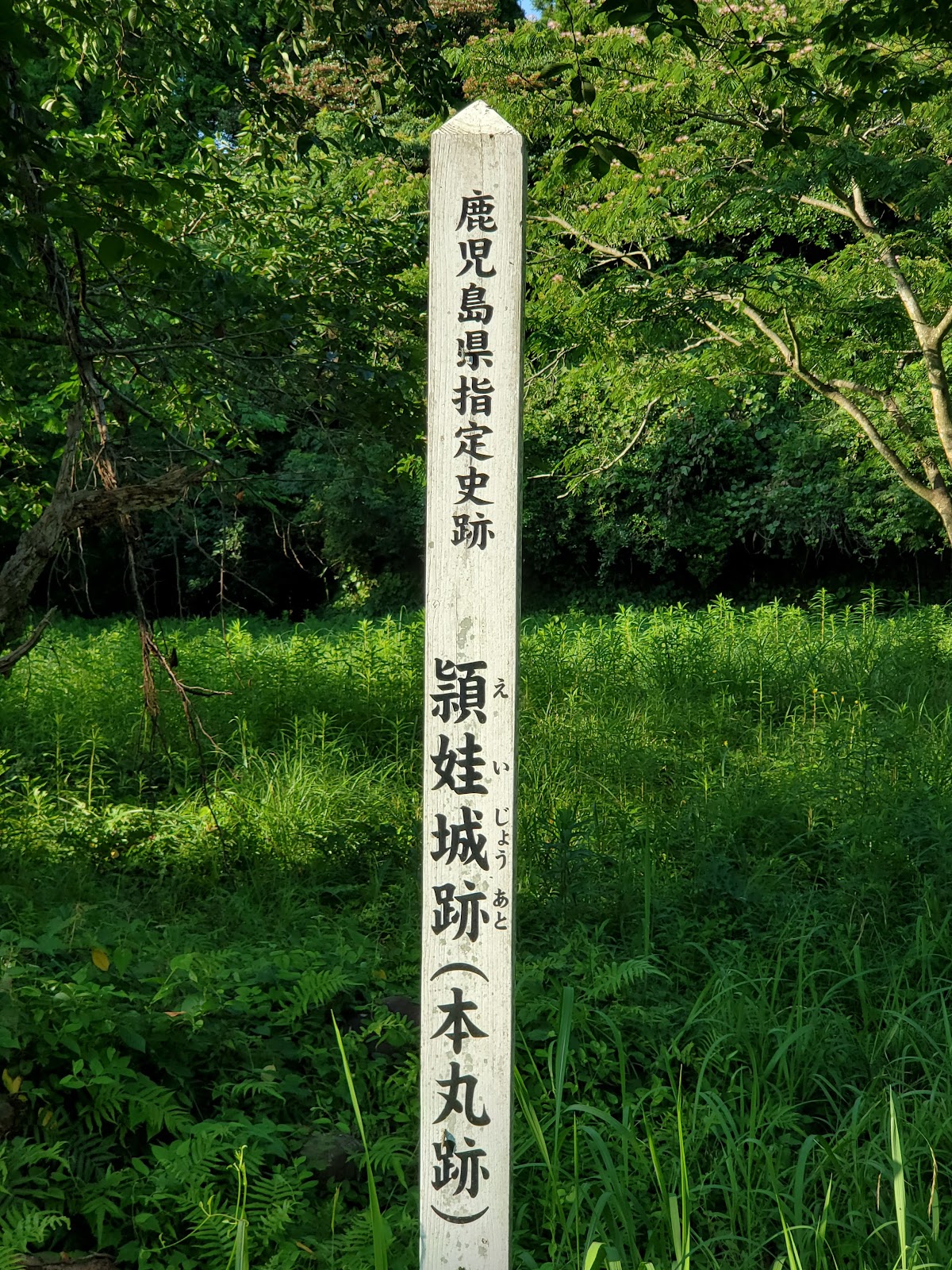
Currently, no original structures remain at the Kajiki Castle site, but the basic layout and topography of the castle are relatively well preserved. You can see the remains of the main enclosure at the mountaintop, traces of several baileys, and remnants of earthworks and moats.
Regarding the stone walls, while some parts have been altered in later periods, some stonework believed to date from the Sengoku period to the early Edo period remains. However, many castles of the Shimazu clan, including Kagoshima Castle (Tsurumaru Castle), are characterized by having “no stone walls” or “very few stone walls,” and Kajiki Castle was not a castle with large-scale stone walls.
Access to the castle site is well-maintained, with a signpost at the entrance to the road leading from Prefectural Road 55 to the mountaintop settlement. There is an information board halfway up the mountain, and parking space is available nearby.
Highlights of the Castle Structure and Remains
Layout and Structure
Kajiki Castle has the structure of a typical medieval mountain castle. This castle features a main enclosure at the mountaintop, with multiple enclosures arranged in a stepped pattern along the ridge, creating a linear layout. The main enclosure is an oval shape, approximately 40 meters east-west and 30 meters north-south, and is believed to have housed the lord’s residence and important facilities.
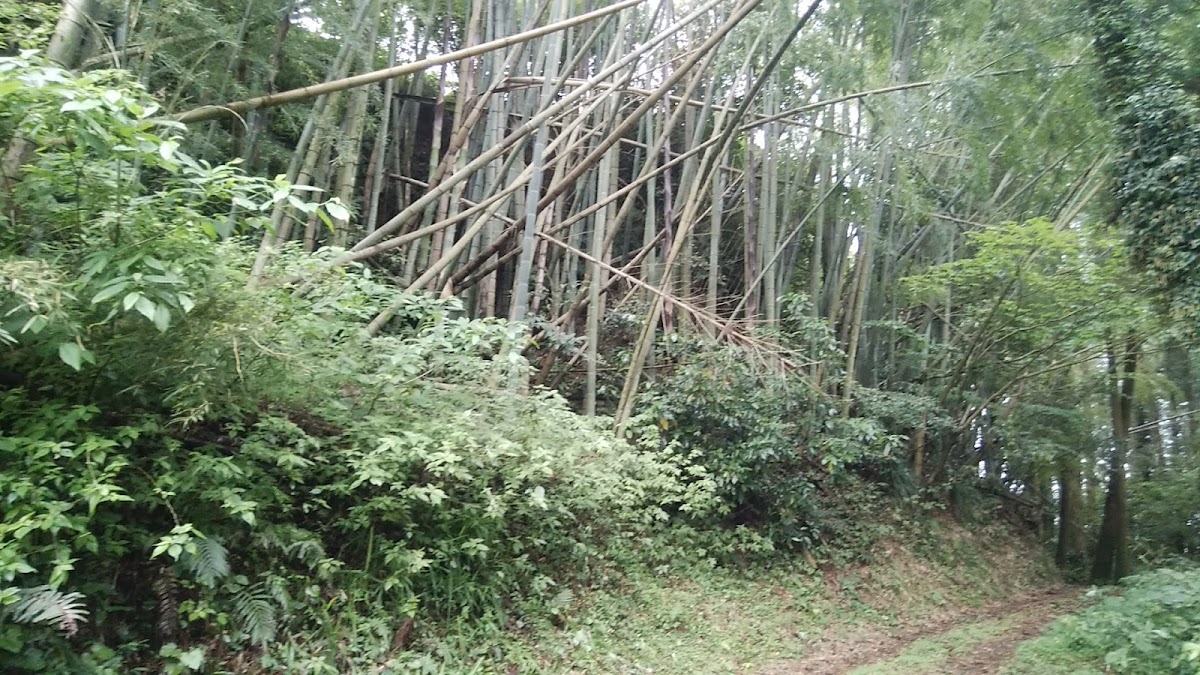
A belt-shaped enclosure surrounds the main enclosure, with the second and third enclosures located on lower levels. Each enclosure is separated by earthen ramparts, enhancing its defensive capabilities. Furthermore, trenches were strategically placed at key points along the ridge to deter enemy intrusion.
Main Remains
Main Enclosure Site: Located at the mountaintop, it is now a flat area. It is elevated above the surrounding area, indicating it was the core of the castle.
Earthen Ramp: Traces of earthen ramparts remain around the main enclosure and each enclosure. They are approximately 1-2 meters high and functioned as defensive structures.
Trees: Several trenches cutting across the ridge can be identified. The depth was approximately 2-3 meters, and it served to hinder enemy advances.
Enclosures: The remains of enclosures arranged in a stepped pattern can be seen descending from the main enclosure. These are thought to have been used as troop encampments and storage areas for supplies.
Gateways (Entrances): The remains of gateways, which were entrances to the castle, can also be seen in some areas. While not as complex as a masugata gate, the layout is clearly designed with defense in mind.
Views
The views from Kajiki Castle ruins are magnificent, offering panoramic views of the beautiful coastline of Kinko Bay, the majestic Sakurajima volcano, and the Kirishima mountain range. This view demonstrates the castle’s high level of military surveillance and remains a major attraction for modern visitors.
Especially on clear days, you can see as far as Mount Kaimon and the entire Satsuma Peninsula. This geographical location is one of the reasons why Kajiki Castle has been considered important for so many years.
Access and Visiting Information
Access by Public Transportation
By JR: The nearest station is JR Nippo Main Line “Kajiki Station”. It takes approximately 25 minutes by rapid train and approximately 35 minutes by local train from Kagoshima-Chuo Station to Kajiki Station. From the station to the castle ruins is approximately 30-40 minutes on foot or approximately 10 minutes by taxi.
By Bus: From Kagoshima city, take a Nankoku Kotsu bus towards Kajiki. After getting off at the “Kajiki” bus stop, it’s approximately a 25-minute walk.
Access by Car
Kyushu Expressway: Approximately 5 minutes from “Kajiki IC”. From Kagoshima city, head north on National Route 10; it takes approximately 30 minutes.
Parking: There is a parking space (for several cars) along the road leading from Prefectural Road 55 to the mountain village, with a signpost. It’s about a 10-15 minute walk from here to the castle ruins.
Notes for Visitors
- As it’s a mountain castle, comfortable shoes and clothing are necessary.
- In the summer, insect repellent and bringing drinking water are recommended.
- While there are information boards, the explanations of the remains are limited, so learning about the history beforehand will enhance your experience.
- Part of the castle ruins is private property, so please be careful not to enter restricted areas.
Estimated Visiting Time
Approximately 1-1.5 hours is a guideline for visiting the castle ruins from the parking lot to returning. If you want to carefully observe the remains and enjoy taking photographs, allow about 2 hours.
Nearby Tourist Attractions
Historical Sites of the Kajiki Shimazu Family
Historical sites related to the Kajiki Shimazu family, such as the Kajiki Manor ruins and the tomb of Shimazu Yoshihiro, are scattered throughout the town. Visiting these sites will allow you to experience the deep connection between Shimazu Yoshihiro and Kajiki.
Ryumon Falls
Located about 15 minutes by car from Kajiki, Ryumon Falls is a magnificent waterfall selected as one of Japan’s Top 100 Waterfalls. The waterfall, 43 meters wide and 46 meters high, is breathtaking and well worth visiting in conjunction with a tour of Kajiki Castle.
Gamou’s Great Camphor Tree
The Great Camphor Tree at Gamou Hachiman Shrine in Gamou-cho, Aira City, is designated as a National Special Natural Monument. With an age of over 1500 years and a trunk circumference of over 24 meters, it is one of the largest camphor trees in Japan, located about 20 minutes by car from Kajiki.
Kagoshima Shrine
Kagoshima Shrine, located in Hayato-cho, Kirishima City, is the original Hachiman Shrine that ruled Kajiki as a manor during the medieval period. It is an important shrine for understanding Kajiki’s history, and is located about 15 minutes by car from Kajiki.
Kirishima Onsenkyo
Located about 40 minutes by car from Kajiki, Kirishima Onsenkyo is a popular hot spring resort known for its diverse range of spring waters. Relaxing in the hot springs after exploring the castle ruins is highly recommended.
Summary
Kajiki Castle is an important castle ruin with a history spanning approximately 600 years, from its construction in the Heian period to its abandonment in the Edo period. As rulers changed from the Okura clan to the Kajiki clan, then to the Kimotsuki clan, and finally to the Shimazu clan, this castle became the stage for political and military affairs in southern Kyushu.
In particular, the Battle of Kajiki Castle, considered the site of Japan’s first use of firearms in combat, and the fact that it was the site where the famous Sengoku period general Shimazu Yoshihiro spent his later years, enhance the historical significance of this castle. Although no buildings remain today, the well-preserved layout and topography, along with the magnificent views, allow visitors to imagine its former glory.
When you visit Kagoshima Prefecture, be sure to stop by Kajiki Castle Ruins and experience the historical romance of southern Kyushu. The view from the castle ruins overlooking Kinko Bay and Sakurajima will surely be an unforgettable memory.