Kasugayama Castle, Niigata | A Thorough Explanation of Uesugi Kenshin’s Fortress, an Impregnable Mountain Castle
Located in Joetsu City, Niigata Prefecture, Kasugayama Castle is a mountain castle nationally known as the residence of Uesugi Kenshin, a famous general of the Sengoku period. The magnificent castle ruins, built on the entire Kasugayama mountain (approximately 180 meters above sea level), are designated a national historic site and selected as one of Japan’s 100 Famous Castles. As a renowned castle that skillfully utilized the complex terrain to create an impregnable fortress, it remains a representative tourist spot in Niigata Prefecture, attracting many history enthusiasts and tourists.
History of Kasugayama Castle and Uesugi Kenshin
Construction and Development of Kasugayama Castle
There are various theories regarding the construction period of Kasugayama Castle, but it is generally believed to have been built in the mid-14th century during the Nanboku-cho period by Nagao Takakage, the deputy governor of Echigo Province. Initially a small mountain castle, it underwent large-scale expansion during the Sengoku period, under Nagao Tamekage and his son, Uesugi Kenshin (Nagao Kagetora). Kenshin became the lord of Kasugayama Castle in 1548 and ruled Echigo Province from this castle for approximately 30 years. To enhance the castle’s defenses, Kenshin made maximum use of the complex natural terrain, transforming the entire mountain into a massive fortress. As a result, Kasugayama Castle became one of the largest mountain castles in Japan, spanning approximately two square kilometers.
Uesugi Kenshin and Kasugayama Castle
Uesugi Kenshin is one of the most representative warlords of the Sengoku period, known as the “Dragon of Echigo” and the “God of War.” His fierce battle against Takeda Shingen at the Battle of Kawanakajima is particularly famous, and it is said that Kenshin participated in over 70 battles in his lifetime.
Kenshin deeply revered Bishamonten, and a Bishamondo (hall dedicated to Bishamonten) was built within Kasugayama Castle. It is said that Kenshin himself displayed a banner bearing the character “毘” (Bi), and considered himself an incarnation of Bishamonten. This deep faith and military talent are believed to be reflected in the design philosophy behind the construction of the impregnable Kasugayama Castle.
Kasugayama Castle After Kenshin’s Death
When Uesugi Kenshin died suddenly in 1578, a succession dispute (the Otate Rebellion) erupted between his adopted sons, Uesugi Kagekatsu and Uesugi Kagetora. Kagekatsu won this dispute and inherited Kasugayama Castle, but in 1598, he was transferred to Aizu by order of Toyotomi Hideyoshi.
Later, Hori Hideharu took up residence in Kasugayama Castle, but in 1607, he moved his residence to Fukushima Castle (present-day Joetsu City), and Kasugayama Castle was abandoned. Although it was a short period of only about 60 years, Kasugayama Castle left its mark on history as the residence of Uesugi Kenshin.
Structure and Features of Kasugayama Castle
Clever Layout as a Mountain Castle
The most distinctive feature of Kasugayama Castle lies in its layout, which skillfully utilizes the complex terrain. The main keep was located at the summit of Mount Kasugayama, approximately 180 meters above sea level, surrounded by the second and third baileys, and even extending down to the foot of the mountain, creating a comprehensive defensive structure.
The entire castle area spanned approximately 900 meters east-west and 1,700 meters north-south, with the entire mountain functioning as one massive fortress. Within this vast castle grounds, the remains of residences of important retainers and religious facilities such as the Naoe Residence, Kakizaki Residence, Goma-do Hall, and Bishamondo Hall are scattered, conveying the appearance of the castle town at the time.
Ingenious Defensive Features
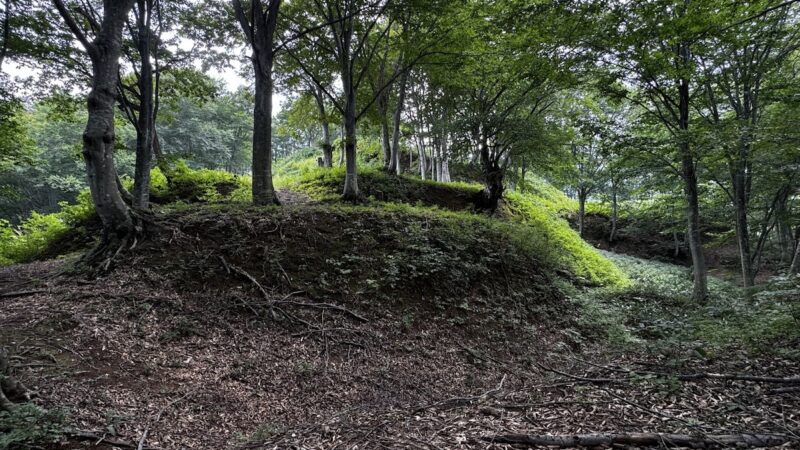
The reason Kasugayama Castle was called “impregnable” lies in its clever defensive features. Numerous dry moats and earthen ramparts were constructed within the castle grounds, with mechanisms designed to hinder enemy intrusion visible throughout. Of particular note is the defensive system that made maximum use of the natural terrain. By utilizing the steep slopes as they were, a strong defense was achieved with almost no use of stone walls. Furthermore, the baileys (kuruwa) positioned along the mountain ridges restricted enemy movements, enabling battles advantageous to the defenders.
The largest remaining structure within the castle grounds, the large well, was dug to secure a water source during sieges and boasts a depth of approximately 15 meters and a diameter of approximately 3 meters. The existence of this well supported the castle’s ability to withstand prolonged sieges.
Existing Remains
Although no buildings remain at the current Kasugayama Castle site, many remains that convey the atmosphere of the time are well preserved.
Major remains include the remains of baileys such as the main keep, second bailey, and third bailey, dry moats, earthworks, castle entrances, and well remains. These remains are extremely valuable resources for understanding the structure of mountain castles from the Sengoku period, and were designated a national historic site in 1934.
The earthworks and dry moats, characteristic of mountain castles, remain clearly visible today, allowing visitors to experience their defensive functions while walking along the approach to the castle. The dry moats around the main keep are particularly deep, demonstrating the high level of engineering skill of the time.
Highlights of Kasugayama Castle Ruins
Spectacular View from the Main Keep
The greatest highlight of Kasugayama Castle is the magnificent view from the main keep ruins, located at an altitude of approximately 180 meters. On a clear day, you can see the entire Kubiki Plain, and in the distance, the Sea of Japan and the Myoko mountain range.
Uesugi Kenshin likely surveyed his territory and devised his strategies from this very spot. A stone monument dedicated to Kenshin stands at the main keep ruins, making it a popular spot for tourists to take commemorative photos. The scenery is especially beautiful on clear spring and autumn days.
Bishamondo Temple Ruins and Kenshin’s Faith
Located on the west side of the main keep, the Bishamondo Temple ruins were the site where Uesugi Kenshin deeply revered Bishamonten. It is said that Kenshin prayed for victory at this temple before going into battle.
Although the temple building no longer exists, the flat grounds speak to the scale of the building at the time. As an important historical site that reflects Kenshin’s deep faith, it is a place visited by many history enthusiasts.
Naoe Residence Ruins and Retainer Residences
At the foot of Kasugayama Castle, the ruins of residences of important retainers of the Uesugi family are scattered. Among them, the most famous is the residence of Naoe Kanetsugu, who served as a chief retainer of the Uesugi family.
In addition, there are other remains that indicate the arrangement of the retainers at the time, such as the residence ruins of Kakizaki Kageie and the Senkanmon Gate. Visiting these mansion ruins allows you to experience the atmosphere of a castle town during the Sengoku period and the presence of the retainers who supported Kenshin.
Kasugayama Shrine
Located on the hillside of the Kasugayama Castle ruins, Kasugayama Shrine was founded in the Meiji era with Uesugi Kenshin as its enshrined deity. From the shrine grounds, you can overlook the city of Joetsu, and it also serves as a starting point for climbing to the Kasugayama Castle ruins.
The shrine houses various items related to Kenshin, and many tourists enjoy exploring the castle ruins after paying their respects. We recommend visiting this shrine first as a starting point for sightseeing at Kasugayama Castle.
Tourist Facilities Around Kasugayama Castle
Kasugayama Castle Ruins Story Museum
Located at the foot of the Kasugayama Castle ruins, the “Kasugayama Castle Ruins Story Museum” is a free exhibition facility where you can learn about the history of Kasugayama Castle and Uesugi Kenshin. The museum screens a CG reconstruction of Kasugayama Castle and a video introducing the life of Uesugi Kenshin, making it ideal for preparation before visiting the castle ruins. The facility provides brochures and maps, making it a useful base for gathering information about exploring the castle ruins. Opening hours are from 9:00 AM to 4:30 PM (until 4:00 PM from November to February), and it is closed on Mondays (or the following day if Monday is a public holiday) and during the New Year holidays.
Joetsu City Buried Cultural Properties Center
The Joetsu City Buried Cultural Properties Center displays valuable artifacts excavated from the Kasugayama Castle ruins and other archaeological sites within Joetsu City. Through the results of archaeological excavations related to Kasugayama Castle and the unearthed artifacts, you can learn more about the castle’s appearance at the time.
Furthermore, the center distributes Kasugayama Castle stamps, which are popular as souvenirs for castle visitors. It’s a must-see spot for castle stamp collectors.
Rinsenji Temple
Located approximately 2 kilometers southeast of Kasugayama Castle, Rinsenji Temple is known as the temple where Uesugi Kenshin trained during his childhood. The temple grounds contain Kenshin’s tomb and numerous historical sites related to Kenshin and the Uesugi family.
Particularly famous is the “Tomb of Lord Uesugi Kenshin, Lord of Kasugayama Castle,” which is believed to have been used by Kenshin during his training from the age of 7 to 14. It’s an important historical site that should be visited in conjunction with Kasugayama Castle.
Access to Kasugayama Castle
Access by Train
If visiting Kasugayama Castle ruins by public transport, the nearest station is Kasugayama Station on the Echigo Tokimeki Railway. From Kasugayama Station, it’s about a 25-minute walk to the Kasugayama Castle Ruins Story Museum, and then another 40-minute hike along a mountain trail to the main keep.
Alternatively, you can take a bus from JR Naoetsu Station. Take the Kubiki Bus Kasugayama Line and get off at the “Kasugayama-so” bus stop; the story museum is about a 5-minute walk from there. However, bus services are limited, so it’s recommended to check the timetable in advance. ### Access by Car and Parking
If you are visiting by car, it is approximately 15 minutes from the Joshinetsu Expressway “Joetsu Takada IC” and approximately 20 minutes from the Hokuriku Expressway “Joetsu IC”.
There is a free parking lot (approximately 50 cars) at the Kasugayama Castle Ruins Story Museum. There is also parking space near Kasugayama Shrine. However, it can get crowded during tourist season and on weekends, so it is recommended to visit earlier in the day.
Points to Note When Visiting Kasugayama Castle
Time Required and Attire
For a walk around the Kasugayama Castle Ruins, allow approximately 2 to 2.5 hours round trip from the Story Museum to the main keep. Since you will be walking on mountain trails, comfortable shoes and clothing are essential.
Especially after rain, the trails can become slippery, so it is recommended to wear shoes with good grip, such as trekking shoes. Also, in the summer, bringing insect repellent, a hat, and drinking water will make your walk more comfortable.
Recommended Walking Route
For first-time visitors, we recommend the following route: Gather information at the Kasugayama Castle Ruins Story Museum → Visit Kasugayama Shrine → Ascend to the castle via the main path → Visit the Naoe Residence Ruins → Visit the Bishamondo Temple Ruins → Visit the Honmaru (main keep) Ruins → Descend via the Kagekatsu Residence Ruins.
This route allows you to efficiently visit the main points of interest. Those confident in their physical fitness may want to explore a wider area, including the Kakizaki Residence Ruins.
Seasonal Charms
Kasugayama Castle Ruins offers different charms throughout the four seasons. Spring is beautiful with cherry blossoms and fresh greenery, while summer allows you to fully enjoy the atmosphere of a mountain castle enveloped in deep green. Autumn boasts magnificent autumn foliage, with the view from the Honmaru being particularly exceptional. Winter presents a fantastical scene of the castle ruins amidst a snowy landscape, but the hiking trails can be dangerous during snowfall, so adequate equipment and caution are necessary.
While spring and autumn are the busiest seasons for tourists, each season offers its own unique charm.
Kasugayama Castle and Japan’s Top 100 Castles
Kasugayama Castle is the 32nd castle in the “Japan’s Top 100 Castles” list selected by the Japan Castle Association. It is also considered one of Japan’s Five Great Mountain Castles, and its value as a mountain castle is highly regarded.
The stamp for Japan’s Top 100 Castles is located at the Kasugayama Castle Ruins Story Museum, and can be stamped during opening hours. For castle enthusiasts, Kasugayama Castle is a must-see spot.
Recommended Tourist Spots Around Kasugayama Castle
Takada Castle Ruins
Located about 20 minutes by car from Kasugayama Castle, Takada Castle Ruins is another representative tourist spot in Joetsu City. Built by Matsudaira Tadateru, the sixth son of Tokugawa Ieyasu, it is a flatland castle and is now maintained as Takada Park. In spring, approximately 4,000 cherry trees bloom, making it famous as one of Japan’s three great night cherry blossom viewing spots.
Joetsu City History Museum
This facility offers a comprehensive history of Joetsu City, with extensive exhibits on Kasugayama Castle and Uesugi Kenshin. The permanent exhibition presents the history of the Joetsu region from ancient times to the modern era in chronological order, making it ideal for deepening your understanding of Kasugayama Castle.
Michi-no-Eki Umi Terrace Nadachi
This roadside station, facing the Sea of Japan, offers dishes made with fresh seafood and local specialties. It’s highly recommended to stop by on your way back from sightseeing at Kasugayama Castle and relax while enjoying the sunset over the Sea of Japan.
Model Itinerary for Visiting Kasugayama Castle
Day Trip (Approx. 6 hours)
9:00 Gather information and obtain a castle stamp at the Kasugayama Castle Ruins Story Museum
9:30 Visit Kasugayama Shrine
10:00 Begin climbing Kasugayama Castle
12:00 Arrive at the main keep, lunch break
13:00 Begin descending
14:00 Visit the Joetsu City Buried Cultural Properties Center
15:00 Visit Rinsenji Temple
16:00 Stroll around Takada Castle Ruins and Takada Park
17:00 End of sightseeing
This course allows you to efficiently visit major historical tourist spots in Joetsu City, centered around Kasugayama Castle.
2-Day/1-Night Itinerary
A plan where you thoroughly explore Kasugayama Castle and its surrounding facilities on the first day, and enjoy sightseeing around Takada Castle and Naoetsu Port on the second day is also recommended. Joetsu City has many hot spring inns, allowing you to enjoy a leisurely historical stroll.
Basic Information for Visiting Kasugayama Castle
Admission Fee and Opening Hours
Kasugayama Castle ruins are an outdoor historical site, so admission is free, and you can explore 24 hours a day. However, for safety reasons, we strongly recommend visiting during daylight hours.
The Kasugayama Castle Ruins Story Museum is open from 9:00 to 16:30 from March to October, and from 9:00 to 16:00 from November to February. It is closed on Mondays (or the following day if Monday is a public holiday), the day after public holidays, and during the New Year’s holiday (December 29th to January 3rd).
Contact Information
Kasugayama Castle Ruins Story Museum
Address: 334 Oomame, Joetsu City, Niigata Prefecture
Phone: 025-544-3777
Joetsu City Tourism Convention Association
Phone: 025-543-2777
For the latest information and trail conditions due to weather, we recommend contacting them in advance.
Summary
Kasugayama Castle, located in Joetsu City, Niigata Prefecture, is a mountain castle that holds an extremely important position in the history of Japanese castles, as it was the residence of Uesugi Kenshin, a famous general of the Sengoku period. This impregnable fortress, which skillfully utilized the complex terrain, still retains many remains and is protected as a national historical site.
From the main keep site at an altitude of approximately 180 meters, you can enjoy a panoramic view of the Kubiki Plain and the Sea of Japan, allowing you to relive the scenery Kenshin saw. While exploring the characteristic remains of the mountain castle, such as dry moats, earthworks, and large wells, it is a valuable tourist spot where you can feel the spirit of the Sengoku period.
With numerous nearby facilities such as the Kasugayama Castle Ruins Story Museum and the Joetsu City Buried Cultural Properties Center, Kasugayama Castle is a recommended spot not only for history buffs but also for families and hiking enthusiasts. Be sure to visit Kasugayama Castle, where the beauty of nature in every season blends with the romance of history.