Sakamoto Castle (Shiga Prefecture, Akechi Mitsuhide) Complete Guide | History, Highlights, and Access Information
What is Sakamoto Castle? A Famous Castle on Lake Biwa Built by Akechi Mitsuhide
Sakamoto Castle is a castle from the Azuchi-Momoyama period located in Shimosakamoto, Otsu City, Shiga Prefecture. Construction began in 1571 (Genki 2) by Akechi Mitsuhide, a renowned general of the Sengoku period, and it is known as a water castle that utilized the water transport of Lake Biwa.
As the residence of Akechi Mitsuhide, who assassinated Oda Nobunaga in the Honnoji Incident, and as a castle with a magnificent keep built on the shores of Lake Biwa, it attracts considerable interest from history enthusiasts. Currently, only the remains of the castle, such as stone walls, remain. Although not designated as a national historic site, preservation efforts continue as it is an important historical heritage of the region.
Basic Information on Sakamoto Castle
- Location: Shimosakamoto, Otsu City, Shiga Prefecture
- Year of Construction: 1571 (Genki 2)
- Builder: Akechi Mitsuhide
- Castle Structure: Flatland Castle (Water Castle)
- Year of Abandonment: 1586 (Tensho 14)
- Main Lords: Akechi Mitsuhide, Akechi Hidemitsu, Niwa Nagahide, Asano Nagamasa
History of Sakamoto Castle | The Glory and Tragedy of Akechi Mitsuhide
Background and Purpose of Construction
The background to the construction of Sakamoto Castle lies in Oda Nobunaga’s burning of Mount Hiei. In September 1571 (Genki 2), Nobunaga burned down Enryaku-ji Temple, eliminating the power of Mount Hiei. Akechi Mitsuhide, who participated in this burning of the mountain, was granted 50,000 koku of land in Shiga District, Omi Province, for his service. He was also ordered to construct Sakamoto Castle with the aim of monitoring Mount Hiei and controlling water transport on Lake Biwa.
Sakamoto had long flourished as a temple town for Enryaku-ji Temple on Mount Hiei, and was also a crucial point for water transport on Lake Biwa. By building a castle in this location, Mitsuhide was able to suppress the resurgence of Mount Hiei’s power and control a vital transportation hub connecting Kyoto and the Hokuriku region.
Construction and Development by Akechi Mitsuhide
Akechi Mitsuhide began construction of Sakamoto Castle in 1571 and completed it in just a few years. The castle was a flatland castle facing Lake Biwa, a natural stronghold surrounded on three sides by the lake’s inner basin. A five-story keep was built in the main enclosure, and its magnificence is recorded in the writings of the missionary Luis Frois of the time.
In his *History of Japan*, Frois describes Sakamoto Castle as “a magnificent and splendid castle, second only to Azuchi Castle,” highlighting its exceptional scale and beauty. Mitsuhide used Sakamoto Castle as his residence, serving as a senior retainer of the Oda family and achieving military successes, including the conquest of Tanba Province.
The Honnoji Incident and the Fate of Sakamoto Castle
On June 2, 1582 (Tensho 10), Akechi Mitsuhide assassinated Oda Nobunaga at Honnoji Temple. This is the so-called “Honnoji Incident.” Mitsuhide acted with the aim of becoming the ruler of Japan, but just 13 days later, on June 13, he was defeated by Hashiba Hideyoshi (later Toyotomi Hideyoshi) at the Battle of Yamazaki and lost his life on his way to Sakamoto Castle.
After Mitsuhide’s death, Sakamoto Castle was defended by Akechi Hidemitsu (also said to be Mitsuhide’s cousin), who was a senior retainer and son-in-law of Mitsuhide. Hidemitsu is a warrior known for the legend of his “lake crossing,” where he is said to have crossed Lake Biwa on horseback to return to Sakamoto Castle. However, under siege by Hideyoshi’s army, Hidemitsu set fire to the castle and committed suicide, resulting in the fall of Sakamoto Castle.
The Aftermath of Sakamoto Castle
After the fall of the Akechi clan, Sakamoto Castle became the domain of Niwa Nagahide, and then Asano Nagamasa. However, in 1586 (Tensho 14), Asano Nagamasa built and moved to Otsu Castle, and Sakamoto Castle was abandoned. Although its history was short, lasting only 15 years, it witnessed a major turning point in the Sengoku period.
After its abandonment, much of Sakamoto Castle’s building materials and stonework were reused in the construction of Otsu Castle. Furthermore, Otsu Castle was also abandoned after the Battle of Sekigahara, and its materials were used in the construction of Zeze Castle and Hikone Castle, resulting in the significant loss of Sakamoto Castle’s remains.
Structure and Features of Sakamoto Castle
A Water Castle Utilizing Lake Biwa
The most distinctive feature of Sakamoto Castle was its location on Lake Biwa. Three sides of the castle were surrounded by the inlets of Lake Biwa, which served as a moat. This location provided strong defenses against land attacks while simultaneously allowing for the transport of goods and military operations using Lake Biwa’s waterways.
A landing stage was located on the north side of the castle, facilitating easy communication with Kyoto and Azuchi Castle via Lake Biwa. Mitsuhide frequently traveled from Sakamoto Castle by boat, making full use of the castle’s advantages as a water castle.
Structure of the Keep and Castle Grounds
It is believed that Sakamoto Castle had a five-story keep. Based on the records of Luis Frois and archaeological excavations, it is inferred that the keep was located in the main enclosure and boasted a magnificent appearance even when viewed from Lake Biwa.
The castle complex consisted of a central main keep (Honmaru), surrounded by the second and third baileys (Ninmaru and Sannomaru), creating a comprehensive defensive structure. The stone walls utilized techniques such as rough-hewn stonework and fitted stonework, incorporating the latest castle-building technologies of the time. The castle grounds extended approximately 500 meters east-west and 400 meters north-south, making it a strong, albeit medium-sized, fortress.
Development of the Castle Town
A castle town developed around Sakamoto Castle, thriving with merchants and artisans. Mitsuhide implemented the Rakuichi-rakuza (free market) policy, promoting commercial development. Furthermore, leveraging its tradition as a temple town for Mount Hiei, Sakamoto flourished as a center of religion and commerce.
The castle town featured samurai residences and merchant districts, with a grid-like road layout. This urban planning is considered a testament to Mitsuhide’s advanced governing abilities.
Current Status and Highlights of Sakamoto Castle Ruins
Remaining Structures
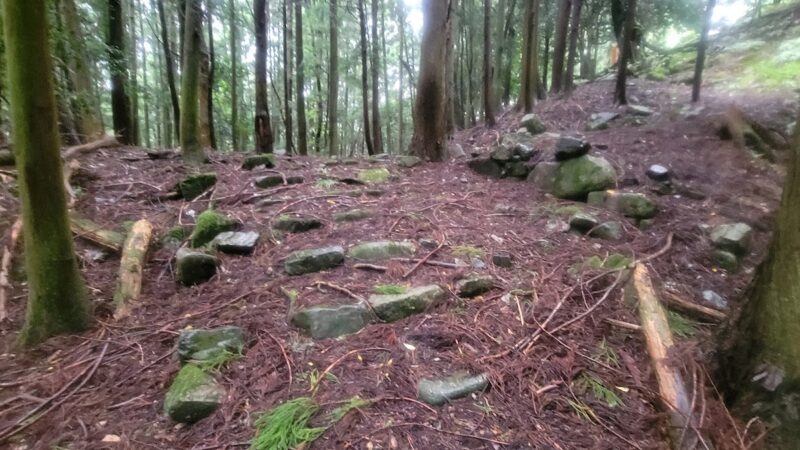
The current Sakamoto Castle ruins mainly consist of remnants of stone walls and earthworks. Located near the shore of Lake Biwa, the remains are scattered amidst residential areas and fields.
Main Remains:
- Stone Walls of the Main Enclosure: A portion of the stone walls of the main enclosure remains near the shore of Lake Biwa. The rough-hewn stonework conveys the castle-building techniques of the time.
- Earthworks and Moat Remains: Remnants of earthworks remain on the outer perimeter of the castle, indicating the former castle area.
- Stone Monument and Information Board: A stone monument marking “Sakamoto Castle Ruins” has been erected at the castle site, and an information board explaining the castle’s history is installed.
- Statue of Akechi Mitsuhide: A bronze statue of Mitsuhide stands on the shores of Lake Biwa, its image of him gazing out at the lake being particularly striking.
Results of Archaeological Excavations
Recent archaeological excavations have gradually revealed the structure of Sakamoto Castle. The foundations of the stone walls, foundation stones, and roof tiles have been unearthed, allowing researchers to study the castle’s scale and building layout.
Of particular note is the discovery of gold-leafed roof tiles. These were used in important buildings such as the keep, providing evidence of Sakamoto Castle’s splendor. Furthermore, Chinese ceramics and tea ceremony utensils have also been unearthed, suggesting Mitsuhide’s high level of cultural refinement.
Sakamoto Castle Ruins Park
Part of the Sakamoto Castle ruins has been developed into a park, allowing visitors to stroll and experience history. A statue of Akechi Mitsuhide and explanatory plaques are installed within the park, allowing visitors to reflect on history while enjoying the view of Lake Biwa.
Especially at dusk, the sunset over Lake Biwa is beautiful, allowing one to imagine the view Mitsuhide saw from this place.
The Relationship Between Akechi Mitsuhide and Sakamoto Castle
The Role of Sakamoto Castle as Mitsuhide’s Residence
Sakamoto Castle was the castle where Akechi Mitsuhide resided the longest. Using Sakamoto Castle as his base, Mitsuhide played an active role as a senior retainer of the Oda family, participating in the conquest of Tanba and the governance of Omi.
Mitsuhide lived with his family at Sakamoto Castle and also devoted himself to cultural activities. He enjoyed tea ceremony and linked verse poetry, and actively interacted with cultural figures. Sakamoto Castle was not merely a military base, but also a place where Mitsuhide realized his ideals.
Mitsuhide’s Governance and Civil Administration
Akechi Mitsuhide is known for his excellent civil administration as the lord of Sakamoto. He reformed the tax system and implemented policies to reduce the burden on farmers. He also restored relations with Mount Hiei and supported its reconstruction after it was burned down.
Mitsuhide’s rule is highly regarded as “Akechi’s Reign,” and he is said to have enjoyed the deep trust of his people. Sakamoto Castle was the center of Mitsuhide’s political power and the place where his ideals were realized.
The Honnō-ji Incident and Sakamoto Castle
For Mitsuhide, who instigated the Honnō-ji Incident, Sakamoto Castle was supposed to be his last stronghold. However, after his defeat at the Battle of Yamazaki, Mitsuhide lost his life without ever returning to Sakamoto Castle.
After Mitsuhide’s death, Akechi Hidemitsu attempted a final resistance at Sakamoto Castle, but it ultimately fell, marking the end of the Akechi era. Sakamoto Castle is etched in history as a symbol of both Mitsuhide’s glory and tragedy.
How to Access Sakamoto Castle
Access by Public Transportation
By Train:
- Get off at Hieizan-Sakamoto Station on the JR Kosei Line: Approximately 25 minutes on foot from the station, or approximately 5 minutes by taxi.
- Get off at Matsunobaba Station or Sakamoto-Hieizanguchi Station on the Keihan Ishiyama-Sakamoto Line: Approximately 15-20 minutes on foot from the station.
Access is convenient, approximately 20 minutes from Kyoto Station on the JR Kosei Line, and approximately 15 minutes from Otsu Station. If using the Keihan Railway, you can head towards Sakamoto from Demachiyanagi Station in Kyoto.
By Bus:
- Get off at the “Sakamoto Castle Ruins” bus stop on the Kojaku Kotsu bus line, then a short walk.
Access by Car
By Expressway:
- Approximately 20 minutes from the Meishin Expressway “Kyoto East IC” via National Route 161.
- Approximately 5 minutes from the Kosei Road “Sakamoto North IC”.
Parking:
There is no dedicated parking lot around Sakamoto Castle Ruins Park, but you can use nearby public parking lots or the Hiyoshi Taisha Shrine parking lot. However, it can get crowded during peak tourist season, so using public transportation is recommended.
Combining with Nearby Tourist Attractions
When visiting Sakamoto Castle Ruins, combining it with other nearby historical tourist spots will make for a more fulfilling visit. Since there are several points of interest within walking distance, it is recommended to take half a day to a full day to explore at a leisurely pace.
Tourist Attractions Around Sakamoto Castle
Hiyoshi Taisha Shrine
Located about a 15-minute walk from the Sakamoto Castle ruins, Hiyoshi Taisha Shrine is the head shrine of over 3,800 Hiyoshi, Hie, and Sanno shrines nationwide. Situated at the foot of Mount Hiei, this ancient shrine boasts a history of approximately 2,100 years and houses numerous important cultural properties, including the East and West Main Halls, both designated as National Treasures.
During the autumn foliage season, approximately 3,000 maple trees change color, making it a popular spot for tourists to admire the autumn leaves. It is believed that Akechi Mitsuhide also visited this shrine during his time as lord of Sakamoto Castle.
Saikyo-ji Temple
Located about a 20-minute walk from the Sakamoto Castle ruins, Saikyo-ji Temple is the head temple of the Tendai Shinsei sect. It is a temple deeply connected to Akechi Mitsuhide and houses the graves of his family. It also possesses a bell donated by Mitsuhide and a portrait of him (an important cultural property).
Within the temple grounds is a stone monument inscribed with Mitsuhide’s death poem, making it a must-see spot for Mitsuhide fans. The garden is also beautiful, offering enjoyment of the scenery throughout the seasons.
Former Chikurin-in Temple
Former Chikurin-in Temple is one of the Enryaku-ji Temple’s satobo (retirement residences for monks) and boasts a garden designated as a National Place of Scenic Beauty. The approximately 3,300-tsubo (approx. 10,000 square meters) grounds include the main building and a beautiful garden, allowing visitors to experience the history and culture of Sakamoto.
The garden is a pond-centered strolling garden that incorporates Mount Hachioji as a borrowed landscape, offering enjoyment of the scenery throughout the seasons. Visitors can also enjoy matcha tea while gazing at the garden, providing a relaxing experience.
Mount Hiei Enryaku-ji Temple
Sakamoto originally developed as a temple town for Mount Hiei Enryaku-ji Temple. You can visit Mount Hiei Enryaku-ji Temple using the Sakamoto Cable Car or the Sakamoto hiking trail.
Enryaku-ji Temple is a World Cultural Heritage site and houses many national treasures and important cultural properties, including the main hall (Konpon-chudo). It’s a place where you can deeply learn about Japanese history, including the history of the burning of the temple by Akechi Mitsuhide.
Sakamoto Townscape (Anō-shu Stone Walls)
The town of Sakamoto retains many unique stone walls called “Anō-shu-zumi.” The Anō-shu were a group of stonemasons who lived around Sakamoto, excelling in the technique of skillfully combining natural stones, and they worked on the stone walls of castles throughout Japan.
The stone walls of Sakamoto Castle are also thought to have been built by the Anō-shu, and you can see their technique everywhere you walk through the town. The townscape with its stone walls has been designated a “Preservation District for Important Traditional Buildings,” preserving its historical landscape.
Visiting Sakamoto Castle and Sites Associated with Akechi Mitsuhide
Visiting Sites Associated with Akechi Mitsuhide
Starting from Sakamoto Castle, a historical exploration visiting sites associated with Akechi Mitsuhide is a recommended course. Shiga Prefecture has many places associated with Mitsuhide, and you can feel his presence in each of them.
Recommended Route:
- Sakamoto Castle Ruins → Visit the ruins of Mitsuhide’s castle
- Saikyo-ji Temple → Visit the graves of Mitsuhide’s family
- Hiyoshi Taisha Shrine → Visit the ancient shrine that Mitsuhide worshipped at
- Enryaku-ji Temple on Mount Hiei → Learn about the history of the burning of the temple
- Azuchi Castle Ruins → Visit the castle of Oda Nobunaga (approx. 40 minutes by car)
The Taiga Drama “Kirin ga Kuru” and Sakamoto Castle
Interest in Sakamoto Castle increased after Akechi Mitsuhide was featured as the protagonist in the 2020 NHK Taiga drama “Kirin ga Kuru.” The drama carefully depicted Mitsuhide’s personality, ideals, and tragedy, and many viewers empathized with him.
Due to the influence of the drama, the number of tourists visiting Sakamoto Castle ruins has increased, and locals are focusing on promoting tourism as a “place associated with Akechi Mitsuhide.” Sakamoto Castle Ruins Park has also been equipped with exhibits and panels related to the historical drama, making it a pilgrimage site for drama fans.
Sakamoto Castle Restoration Plan
Currently, there are efforts underway to restore Sakamoto Castle. Local volunteers and researchers are leading activities to re-evaluate the historical value of Sakamoto Castle and aim for its future restoration.
While a complete restoration is difficult, various ideas are being considered, such as repairing the stone walls, displaying a model of the keep, and recreating the castle using VR and AR. It is hoped that Sakamoto Castle will once again attract attention as a tourist resource.
Points to Note and Advice When Visiting Sakamoto Castle
Precautions When Visiting
- Protection of Remains: Please refrain from touching or climbing on the remains such as the stone walls. To preserve this valuable cultural property for future generations, it is important to observe proper etiquette during your visit.
- Consideration for Private Property: Parts of the Sakamoto Castle ruins are on private property. Please do not enter areas marked as “No Entry.”
- Safety Precautions: The footing on the shores of Lake Biwa can be uneven in some places. Wear comfortable shoes, and be especially careful in rainy weather.
Recommended Time to Visit
Sakamoto Castle ruins can be visited year-round, but there are particularly recommended times.
Spring (March-May): It’s cherry blossom season, and the cherry trees along the shores of Lake Biwa are beautiful. The weather is mild, making it ideal for a stroll.
Autumn (October-November): It’s the autumn foliage season, and you can enjoy it along with the autumn leaves at Hiyoshi Taisha Shrine and Mount Hiei. The townscape of Sakamoto also takes on an autumnal atmosphere.
Summer (June-August): The view of Lake Biwa is refreshing, but the sun is strong, so precautions against heatstroke are necessary. Winter (December-February): Fewer tourists, allowing for a peaceful reflection on history. However, cold weather precautions are necessary.
Estimated Time Required
- Sakamoto Castle Ruins Only: 30 minutes to 1 hour
- Sakamoto Castle Ruins + Saikyoji Temple: 1.5 to 2 hours
- Sakamoto Castle Ruins + Surrounding Tourist Spots: 3 to 4 hours
- Entire Sakamoto Area (including Mt. Hiei): All day
Materials and Learning about Sakamoto Castle
Facilities Where You Can Learn About Sakamoto Castle
Otsu City Museum of History
The Otsu City Museum of History offers exhibits and materials related to Sakamoto Castle. Artifacts unearthed during archaeological excavations and reconstructed models of the castle are on display, allowing for a deep understanding of Sakamoto Castle’s history.
- Location: 2-2 Goryo-cho, Otsu City, Shiga Prefecture
- Access: Approximately 5 minutes on foot from Otsu City Hall Station on the Keihan Ishiyama-Sakamoto Line
Shiga Prefectural Azuchi Castle Archaeological Museum
While primarily focused on Azuchi Castle, the museum also features exhibits on castles in Omi Province, including Sakamoto Castle. Visitors can learn about castle architecture and stonework techniques from the Sengoku period.
References and Materials
For those interested in learning more about Sakamoto Castle, the following books and materials are recommended:
- “Akechi Mitsuhide and Sakamoto Castle” (Published by the Local History Research Association)
- “Castles of Omi Province” (Sunrise Publishing)
- “Castles of Akechi Mitsuhide” (Ebisu Kosho Publishing)
- Excavation Reports published by the Otsu City Board of Education
Online Information Gathering
The official Otsu City tourism website and the Shiga Prefecture tourism information website contain the latest information and event details about Sakamoto Castle. Checking these before your visit is recommended.
Summary: The Charm and Historical Significance of Sakamoto Castle
Sakamoto Castle, a magnificent castle built by Akechi Mitsuhide on the shores of Lake Biwa, played a crucial role in the history of the Sengoku period (Warring States period). Although its existence was short, lasting only 15 years, it witnessed one of the greatest events in Japanese history, the Honnoji Incident, and saw both the glory and tragedy of Mitsuhide.
While only remnants such as stone walls remain today, the view overlooking Lake Biwa allows one to imagine the magnificent castle tower and the bustling castle town of that time. Sakamoto Castle is an indispensable place for tracing the footsteps of the complex and fascinating figure of Akechi Mitsuhide.
Nearby are many historically important tourist spots such as Hiyoshi Taisha Shrine, Saikyoji Temple, and Enryakuji Temple on Mount Hiei, allowing visitors to experience the history and culture that has continued since the Sengoku period throughout the Sakamoto area.
This is a recommended spot not only for history buffs, but also for those who want to enjoy the beautiful scenery of Lake Biwa and those who want to spend some peaceful time. Please visit the ruins of Sakamoto Castle, experience the scenery that Akechi Mitsuhide saw, and reflect on the history of the Sengoku period.
Sakamoto Castle is not merely a castle ruin; it is a place that symbolizes a turning point in Japanese history, and a precious historical heritage site that continues to speak to us even today.