Complete Guide to Komoro Castle: History, Highlights, and Access Information for Japan’s Only “Hole Castle”
Located in Komoro City, Nagano Prefecture, Komoro Castle is a historically significant castle selected as one of Japan’s 100 Famous Castles. It possesses a unique structure as a “hole castle,” built in a lower location than the surrounding town. It played a crucial role as a base for Takeda Shingen’s administration of eastern Shinano Province, and later as the residence of a fudai daimyo during the Edo period. Currently, it is maintained as Komoro Castle Ruins Kaikoen Park and has been selected as one of Japan’s 100 Best Cherry Blossom Viewing Spots and one of Japan’s 100 Best Historical Parks.
History of Komoro Castle: From Construction to the Present
Origins and Early History of Komoro Castle
There are various theories regarding the origins of Komoro Castle, but the oldest records date back to the late Heian period. It is believed that Komuro Mitsukane, one of the warriors who followed Minamoto no Yoshinaka’s uprising, built Utosaka Castle in this location after serving Minamoto no Yoritomo. However, during the Nanboku-chō period, the Komuro clan declined, and the region subsequently came under the control of the Ōi clan.
In Chōkyō 1 (1487), Ōi Mitsutada, a descendant of the Ogasawara clan, the shugo (military governor) of Shinano Province, renovated the site of Uto Castle and built Nabebuta Castle. This is considered the direct predecessor of the present-day Komoro Castle. Ōi Mitsutada’s son built Otomezaka Castle as an outpost, strengthening the defenses of the Komoro area.
Expansion and Improvement by Takeda Shingen
In Tenbun 23 (1554), Takeda Shingen (then known as Takeda Harunobu), a leading warlord of the Sengoku period, conquered the Saku region and captured Komoro Castle. Shingen positioned Komoro Castle as an important base for managing eastern Shinano and ordered a large-scale expansion and improvement project, incorporating Nabebuta Castle and Otomezaka Castle.
According to legend, the castle’s layout (design) was handled by the renowned military strategists Yamamoto Kansuke and Baba Nobufusa, who were also the protagonists of a historical drama series. However, there is no clear historical evidence to support Yamamoto Kansuke’s involvement, and some consider it merely a legend. Nevertheless, it is undeniable that the castle was developed as a masterpiece of the Takeda clan’s castle-building techniques.
The basic layout of Komoro Castle that remains today is believed to have been formed during this Takeda period. The design, which skillfully utilizes the hilly terrain along the Chikuma River and maximizes its function as a natural fortress, strongly reflects the characteristics of the Takeda style of castle construction.
Renovation into a Modern Castle by Sengoku Hidehisa
In 1590 (Tensho 18), after the establishment of the Toyotomi regime, Sengoku Hidehisa became the lord of Komoro Castle as a reward for his service after the Siege of Odawara (some sources say 1591). When Sengoku Hidehisa entered Komoro Castle as a lord with a 50,000 koku domain, he undertook a major renovation of the castle, transforming the medieval mountain castle into a modern fortress.
The main features of Sengoku Hidehisa’s renovations are as follows:
- Introduction of foundation stone buildings: From the previous post-and-beam buildings to full-fledged structures using foundation stones.
- Adoption of tiled roofs: Tiles were used on buildings to enhance fire resistance and appearance.
- Full-scale construction of stone walls: Sturdy stone walls were built using techniques such as rough-hewn stonework and fitted stonework.
- Improvement and expansion of the castle: Major gates such as the San-no-mon and Otemon gates, as well as turrets, were improved.
Through these renovations by Sengoku Hidehisa, Komoro Castle was shaped into its current size and form, giving it the appearance of a modern castle. The Sengoku clan ruled Komoro for three generations, but were transferred to Izushi in Tajima Province in 1631 (Kanei 8).
Komoro Castle and its Successive Lords in the Edo Period
After the Sengoku clan was transferred, Komoro Castle was successively occupied by hereditary daimyo. This was because Komoro was located at the junction of the Nakasendo and Hokkokukaido roads, making it a strategic point in Shinano Province. The main successive lords of the castle are as follows:
- Matsudaira clan (1622-1648): A lineage of Matsudaira Yasunaga, half-brother of Tokugawa Ieyasu
- Aoyama clan (1648-1662): Aoyama Munetoshi, who was promoted from hatamoto to daimyo
- Sakai clan (1662-1702): Sakai Tadayoshi took up the position
- Nishio clan (1702-1706): Short-term ruler
- Ishikawa clan (1706-1748): Ishikawa Sokei took up the position
- Makino clan (1748-1871): Continued from Makino Yasushige until the end of the Edo period
In particular, the Makino clan ruled Komoro for 123 years, from 1748 (Hōreki 1) until the Meiji Restoration. During the Makino era, the castle town was developed, and Komoro achieved cultural development.
From the Meiji Era onward: From Abandoned Castle to Kaikoen Park
In 1871, with the abolition of the feudal domains and establishment of prefectures, Komoro Castle was abandoned. However, former samurai of the Komoro domain took the lead in buying back the castle ruins from the Meiji government, preventing their deterioration.
In 1926, under the design of Seiroku Honda, a renowned landscape architect who also designed the plantings for Meiji Jingu Shrine and Hibiya Park, the Komoro Castle site was transformed into a modern park called “Kaikoen Park.” This development paved the way for the site to be used as a park that could be enjoyed by citizens and tourists while preserving the castle ruins.
Currently, it is selected as one of Japan’s Top 100 Castles (No. 30), one of Japan’s Top 100 Cherry Blossom Viewing Spots, and one of Japan’s Top 100 Historical Parks, making it a representative tourist spot in Nagano Prefecture that attracts many visitors throughout the year.
Komoro Castle’s Most Distinguished Feature: Japan’s Only “Hole Castle”
What is a Hole Castle?
The most distinctive feature of Komoro Castle is its unique structure, known as a “hole castle” (anajiro), where the castle is built at a lower elevation than the surrounding town. While typical castles are built on high ground, overlooking the town, Komoro Castle is the opposite, with the town looking down on the castle grounds.
This type of castle structure is said to be unique to Komoro Castle in Japan, and it is also known as “Hole Castle” or “Pot Lid Castle.” The structure, with the third bailey at the highest point and gradually decreasing in elevation towards the second bailey and main bailey, leaves a strong impression on visitors.
Why did it become a hole castle?
The reason Komoro Castle became a hole castle is a result of making maximum use of the local topography. Komoro is located on a slope from Mount Asama down to the Chikuma River, and the cliffs of the Chikuma River and the complex terrain formed a natural fortress.
The castle’s north and east sides were protected by the deep valley of the Chikuma River, while the west side featured a complex terrain created by lava flows from Mount Asama. To leverage this natural defense, the castle was deliberately positioned in low-lying land, with stone walls and earthen ramparts designed to defend against attacks from the surrounding higher ground.
While the structure of this underground castle offered the attacker the advantage of overlooking the castle, actually attacking it was not easy, requiring the tackling of steep cliffs and complex terrain. This unique defensive philosophy demonstrates the flexibility and skillful use of terrain in the Takeda style of castle construction.
Highlights of Komoro Castle: Existing Remains and Structures
Important Cultural Property: San-no-mon Gate
The San-no-mon Gate, standing majestically at the entrance to the Komoro Castle Ruins Kaikoen Park, is a valuable existing structure designated as a National Important Cultural Property. This two-story turret gate, estimated to have been built around the Keicho era (1596-1615), still conveys the grandeur of Komoro Castle.
The third gate is a turret gate with a passageway on the first floor, and a warrior’s walkway and arrow slits on the second floor. The roof is a hip-and-gable style, characterized by its heavy tiled roof. Stone walls are placed on both sides of the gate, creating a structure that combines both defensive functionality and aesthetic beauty.
Important Cultural Property: Otemon Gate
Another important cultural property of Komoro Castle is the Otemon Gate. While the third gate is located within Kaikoen Park, the Otemon Gate is situated in the city center, allowing visitors to truly appreciate the former extent of the castle grounds.
The Otemon Gate is a two-story turret gate believed to have been built around Keicho 17 (1612), and is thought to have been renovated during the construction by Sengoku Hidehisa. After the Meiji era, it was sold to private individuals and used as a gate to a private residence. However, it underwent dismantling and repair in 1973 (Showa 48) and was relocated and restored to its current location in 1993 (Heisei 5).
Castle Tower Base and Main Enclosure Site
Although Komoro Castle is believed to have never had a castle tower, a magnificent castle tower base remains in the main enclosure. This base is constructed of rough-hewn stone walls, demonstrating the high level of stonework technology of the time.
Climbing to the castle tower base, one can enjoy views of the castle town of Komoro, as well as distant Mount Asama and the Yatsugatake Mountains. The view from here is a breathtaking sight, likely shared by the former castle lords, and deeply moving for visitors.
The main enclosure site is currently a plaza, a popular spot for cherry blossoms in spring. High stone walls surround the main enclosure, allowing visitors to observe the castle’s defensive structure.
Highlights of the Stone Walls
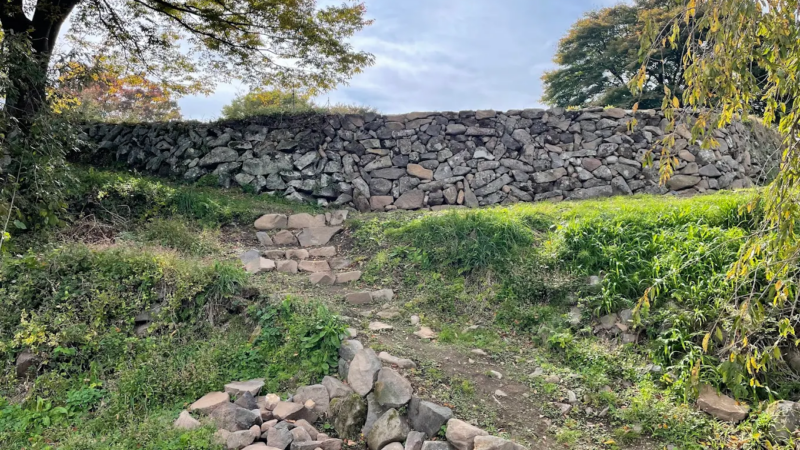
The stone walls of Komoro Castle were constructed in earnest during the renovations by Sengoku Hidehisa, and various stacking techniques can be observed.
- Nozurazumi: The oldest technique, where natural stones are stacked almost as they are.
- Uchikomi-tsugi: A technique where the surface of the stones is processed before stacking.
The stone walls around the main keep are particularly tall and impressive. The intricate craftsmanship of the corner sections of the stone walls (Sanuki-zumi) is also a highlight. For stone wall enthusiasts, this is a valuable place to compare the differences in techniques from different eras.
Mizunote Observation Deck and the Chikuma River Cliffs
In the northeast of Komoro Castle is the “Mizunote Observation Deck,” from which you can look down on the cliffs of the Chikuma River. These cliffs are approximately 70 meters high, making this a spot where you can truly appreciate that Komoro Castle was a natural fortress.
The scenery created by the flow of the Chikuma River and the surrounding mountains changes with the seasons, and is especially breathtakingly beautiful during the fresh green season and the autumn foliage season.
Kuromon Gate Ruins and Ninomaru Ruins
At the Kuromon Gate ruins, which connected the main keep and the second bailey, the foundation stones of the gate remain, allowing us to imagine the scale of the former structure. The Ninomaru ruins are now a grassy plaza, serving as a place of relaxation for citizens.
Fujimura Memorial Museum and Komoro Gijuku Memorial Museum
Within the Komoro Castle Ruins Kaikoen Park is the Fujimura Memorial Museum, which exhibits materials related to the renowned author Shimazaki Fujimura. Shimazaki Fujimura stayed in Komoro for six years from 1899 (Meiji 32) as a teacher at Komoro Gijuku, and wrote his representative work, “Sketches of the Chikuma River,” among others.
The Fujimura Memorial Museum displays Fujimura’s letters, first editions, photographs, and more, allowing visitors to learn about the deep connection between Komoro and Fujimura. Furthermore, the Komoro Gijuku Memorial Hall offers insights into private schools during the Meiji era.
Seasonal Highlights of Kaikoen Park
Komoro Castle Ruins Kaikoen Park displays different scenery throughout the four seasons.
Spring (Mid-to-Late April): Approximately 500 Somei Yoshino and Kohigan cherry trees bloom, creating a spectacular view worthy of its inclusion in “Japan’s Top 100 Cherry Blossom Viewing Spots.” The Komoro-specific cherry blossom variety, “Komoro Yaebenishidare,” is a must-see.
Summer (July-August): The castle ruins, enveloped in lush greenery, offer a cool and refreshing atmosphere, making it an ideal summer retreat.
Autumn (Late October-Early November): The autumn foliage is beautiful, especially the vibrant colors of the maple and other trees.
Winter (December-February): The snow-covered stone walls and castle tower base create a magical atmosphere, and the castle ruins, enveloped in silence, possess a unique charm.
Access and Tourist Information for Komoro Castle
Basic Information
Name: Komoro Castle Ruins Kaikoen
Address: 311 Tei, Komoro City, Nagano Prefecture
Phone: 0267-22-0296 (Kaikoen Office)
Location of Japan’s Top 100 Castles Stamp: Kaikoen Office (Kaikoen Entrance)
Access Methods
Access by Train:
- Approximately 3 minutes on foot from JR Koumi Line/Shinano Railway “Komoro Station”
- Approximately 1 hour 30 minutes from Tokyo Station by Hokuriku Shinkansen (via Karuizawa Station, transfer to Shinano Railway)
Access by Car:
- Approximately 5 minutes from Joshinetsu Expressway “Komoro IC”
- Parking: Multiple paid parking lots available around Kaikoen (approximately 500 car capacity)
Opening Hours and Fees
Opening Hours:
- Kaikoen Park Walking Ticket Area: 9:00 AM – 5:00 PM (Last entry at 4:30 PM)
- Combined Ticket Area (Zoo, Amusement Park, etc.): 9:00 AM – 5:00 PM
Closed Days:
- Wednesdays from mid-December to mid-March (Open on public holidays)
- New Year’s Holidays (December 29th – January 3rd)
Admission Fee:
- Walking Ticket (Park walk only): Adults 300 yen, Elementary and Junior High School Students 100 yen
- Combined Ticket (Walking Ticket + Zoo + Amusement Park + Fujimura Memorial Museum, etc.): Adults 500 yen, Elementary and Junior High School Students 200 yen
Nearby Tourist Spots
Otemon Gate: An important cultural property of Komoro Castle. Located in the city center, about a 10-minute walk from Kaikoen Park.
Komoro-juku on the Hokkokukaido Road: A townscape that retains the atmosphere of an Edo-period post town.
Nunobiki Kannon (Shakusonji Temple): Approximately 15 minutes by car from Komoro city center. The Kannon hall built on a cliff is breathtaking.
Mount Asama: A 2,568m-high mountain known as an active volcano. Enjoy hiking and trekking.
Karuizawa: Approximately 30 minutes by car from Komoro. A famous resort area known as a summer retreat.
Sightseeing Highlights and Recommended Itinerary
For sightseeing at Komoro Castle Ruins Kaikoen, allow 2-3 hours if you want to explore thoroughly. Here’s a recommended route:
- Enter through the San-no-mon Gate: First, pass through the San-no-mon Gate, a designated Important Cultural Property, and experience the atmosphere of the castle.
- Head to the Ninomaru and Honmaru: Observe the stone walls as you make your way to the Honmaru and climb to the castle tower base.
- Mizunote Observation Deck: Enjoy the view of the Chikuma River cliffs.
- Fujimura Memorial Museum: Learn about Komoro’s literary side.
- Otemon Gate: If you have time, also visit the Otemon Gate in the city center.
During the cherry blossom season in spring and the autumn foliage season, it gets crowded, so visiting early in the morning is recommended. Also, it’s within walking distance of Komoro Station, making it convenient to visit by train.
Cultural Value and Modern Significance of Komoro Castle
Evaluation as one of Japan’s Top 100 Castles
Komoro Castle was selected as the 30th of the “Japan’s Top 100 Castles” by the Japan Castle Association in 2006. This selection is based on a comprehensive evaluation of the castle’s historical value, the state of preservation of its buildings, and its importance as a cultural property.
The reasons for Komoro Castle’s high evaluation are as follows:
- Its unique structure as Japan’s only cave castle
- Its history of development by famous Sengoku period warlords, the Takeda and Sengoku clans
- It has two existing Important Cultural Properties (San-no-mon Gate and Otemon Gate)
- Its skillful layout utilizing the natural terrain
- Its development as a modern park and its cultural use
Shimazaki Toson and Komoro Castle
Komoro Castle is deeply connected to the literary works of the renowned author Shimazaki Toson. Toson stayed in Komoro from 1899 to 1905 as a teacher at Komoro Gijuku, and produced many works there.
His representative work, “Sketches of the Chikuma River,” vividly depicts the nature and lives of the people of Komoro, and his poetry collection “Rakubaishu” is also a work from his time in Komoro. Fujimura is said to have strolled through the Komoro Castle ruins (before it was developed into Kaikoen Park) and drawn much inspiration from the scenery.
His famous poem, “Chikuma River Travel Song,” which begins with “By the old castle of Komoro,” is still loved by many as a work that symbolizes the relationship between Komoro Castle and Fujimura.
The Role of Komoro Castle in the Region
In modern times, Komoro Castle Ruins Kaikoen Park is more than just a historical site; it plays a central role in the local community.
Various events are held throughout the year, and the “Komoro Castle Ruins Kaikoen Cherry Blossom Festival” and the “Kaikoen Autumn Leaves Festival” are important tourist attractions in the region. It also serves as a place of relaxation for citizens, with people regularly seen enjoying walks and jogging.
Educationally, local elementary and junior high school students visit Komoro Castle as part of their local history studies, learning about the region’s history. In this way, Komoro Castle is deeply rooted in the community as an important cultural asset connecting the past, present, and future.
Summary: The Charm and Worth of Visiting Komoro Castle
Komoro Castle is a historically significant castle, boasting a unique structure as Japan’s only cave castle, a history of development by famous Sengoku period warlords such as Takeda Shingen, Yamamoto Kansuke, and Sengoku Hidehisa, and the preservation of valuable remains, including important cultural properties.
Its layout, skillfully utilizing the cliffs of the Chikuma River and the complex terrain at the foot of Mount Asama, is a prime example of the diversity and high level of skill in Japanese castle architecture. Furthermore, since the Meiji era, it has been developed as Kaikoen Park, becoming a popular spot for cherry blossoms and autumn leaves, and a literary site associated with Shimazaki Toson.
Its excellent accessibility, just a 3-minute walk from Komoro Station, is another attractive feature. Despite being only about 1 hour and 30 minutes from Tokyo by Shinkansen, you can experience a space where rich nature and history harmonize.
It’s a place worth visiting for a variety of purposes, including castle enthusiasts on a tour of Japan’s 100 Famous Castles, history buffs, nature lovers, and those seeking a literary stroll. Why not visit Komoro Castle Ruins Kaikoen Park, which displays different expressions in each of the four seasons?
From the mysterious space created by its unique cave castle structure, to the history of the Sengoku period told by its massive stone walls, to the magnificent natural scenery woven by the cliffs of the Chikuma River, and the literary atmosphere beloved by Fujimura, Komoro Castle is filled with diverse charms that will captivate the hearts of visitors. When you visit Nagano Prefecture, be sure to add Komoro Castle to your itinerary and experience its profound charm.