Complete Guide to Odawara Castle: History, Highlights, and Access Information for this Impregnable Castle
Located in Odawara City, Kanagawa Prefecture, Odawara Castle is one of Japan’s most famous castles, known as the residence of the Hojo clan, who ruled the Kanto region during the Sengoku period. Renowned as an “impregnable castle,” its magnificent fortress, boasting a total defensive structure stretching 9km, continues to fascinate many history buffs and tourists. This article provides a detailed overview of this famous castle, from its history to its current highlights and access methods.
What is Odawara Castle?
Odawara Castle is a hilltop castle located within the castle grounds of Odawara City, Kanagawa Prefecture, and is counted as one of Japan’s 100 Famous Castles. During the Sengoku period, it served as the base of operations for the Later Hojo clan (Odawara Hojo clan) and was the central hub for their control of the Kanto region for approximately 100 years. Currently, the site is maintained as Odawara Castle Park, and the reconstructed castle tower, Tokiwagi Gate, Domon Gate, and Umadashi Gate evoke the castle’s former glory.
The most distinctive features of Odawara Castle are its sheer size and high defensive capabilities. In particular, the outer fortifications, constructed in preparation for Toyotomi Hideyoshi’s conquest of Odawara, were a magnificent defensive system surrounding the entire castle town, representing the pinnacle of castle architecture during the Sengoku period.
History of Odawara Castle
Founding Period: The Omori Clan Era (Muromachi Period)
The origins of Odawara Castle date back to the mid-15th century during the Muromachi period. Initially, it is believed to have been a mountain castle built by the Omori clan. At this time, Odawara Castle was much smaller than its current size, a mountain castle centered around Hachimanyama (the current location of Odawara Castle).
The Omori clan ruled this region as vassals of the Kanto Kanrei Uesugi clan, but at the end of the 15th century, they were attacked by Hojo Soun (Ise Sozui). ### The Hojo Clan Era: A Base for Controlling the Kanto Region
Capture by Hojo Soun
In 1495 (Meio 4), Hojo Soun captured Odawara Castle from the Omori clan. This event marked the beginning of the Later Hojo clan’s control over the Kanto region. Soun established Odawara Castle as his base and sought to expand his power in the Kanto region.
Development Over Five Generations
After Hojo Soun, Odawara Castle served as the residence of the Hojo clan for five generations: Hojo Ujitsuna, Hojo Ujiyasu, Hojo Ujimasa, and Hojo Ujinao. In particular, during the time of the third generation, Hojo Ujiyasu, the castle repelled attacks from prominent warlords of the Sengoku period, such as Uesugi Kenshin and Takeda Shingen, establishing its reputation as an “impregnable castle.”
In 1561 (Eiroku 4), Uesugi Kenshin’s large army besieged Odawara Castle, but its strong defenses prevented its capture. Similarly, in 1569 (Eiroku 12), Takeda Shingen also attacked Odawara Castle, but again, he was unable to capture it.
Construction of the Outer Fortifications
The Hojo clan continuously expanded and improved Odawara Castle over generations. The most extensive expansion occurred in preparation for Toyotomi Hideyoshi’s attack. A vast outer fortification (sogamae), stretching approximately 9 km, was constructed, encircling the entire castle town, making Odawara Castle one of the largest castles in Japan.
The outer fortifications were a magnificent defensive system, encircling not only the central castle areas like the main keep and second bailey, but the entire castle town with earthworks and moats. This outer fortification transformed Odawara Castle from a mere castle into a single, massive fortress encompassing the entire castle town.
Toyotomi Hideyoshi’s Siege of Odawara
In 1590 (Tensho 18), Toyotomi Hideyoshi, aiming for the unification of Japan, led a massive army of approximately 220,000 men to besiege Odawara Castle. This is the famous “Siege of Odawara.” Hideyoshi built Ishigakiyama Castle (Ichiyajo, or “One-Night Castle”) to the west of Odawara Castle, indicating his intention for a long siege.
The Hojo clan, trusting in the defensive strength of their outer fortifications, chose to hold out in a siege. However, faced with Hideyoshi’s overwhelming military strength and meticulous siege tactics, they were forced to surrender after about three months. With the surrender of Odawara Castle, the Hojo clan was destroyed, and Hideyoshi’s unification of Japan was completed.
Edo Period: Under Tokugawa Rule
After the Siege of Odawara, Odawara Castle came under the control of Tokugawa Ieyasu. Okubo Tadayo, a senior retainer of Ieyasu, became the castle lord, and thereafter, hereditary daimyo served as castle lords. Throughout the Edo period, Odawara Castle maintained its important position as a strategic point on the Tokaido road.
During the Edo period, the outer fortifications of the Sengoku period were not maintained, and the castle was redeveloped as a complex centered around the main keep, second bailey, and third bailey. Important structures such as the Tokiwagi Gate and the Domon Gate were constructed during this period.
After the Meiji Era: To a Castle Park
Following the 1870 (Meiji 3) decree abolishing castles, many of Odawara Castle’s structures were demolished. The keep was also dismantled in 1870, and the castle ruins fell into disrepair. Furthermore, the Great Kanto Earthquake of 1923 (Taisho 12) caused significant damage to the remaining stone walls and other structures.
After the war, a plan for the reconstruction of Odawara Castle was advanced, and in 1960 (Showa 35), the keep was reconstructed using reinforced concrete. Subsequently, the Tokiwagi Gate was restored in 1971 (Showa 46), the Domon Gate in 1997 (Heisei 9), and the Umadashi Gate in 2009 (Heisei 21), resulting in its current appearance.
Highlights of Odawara Castle
Castle Tower
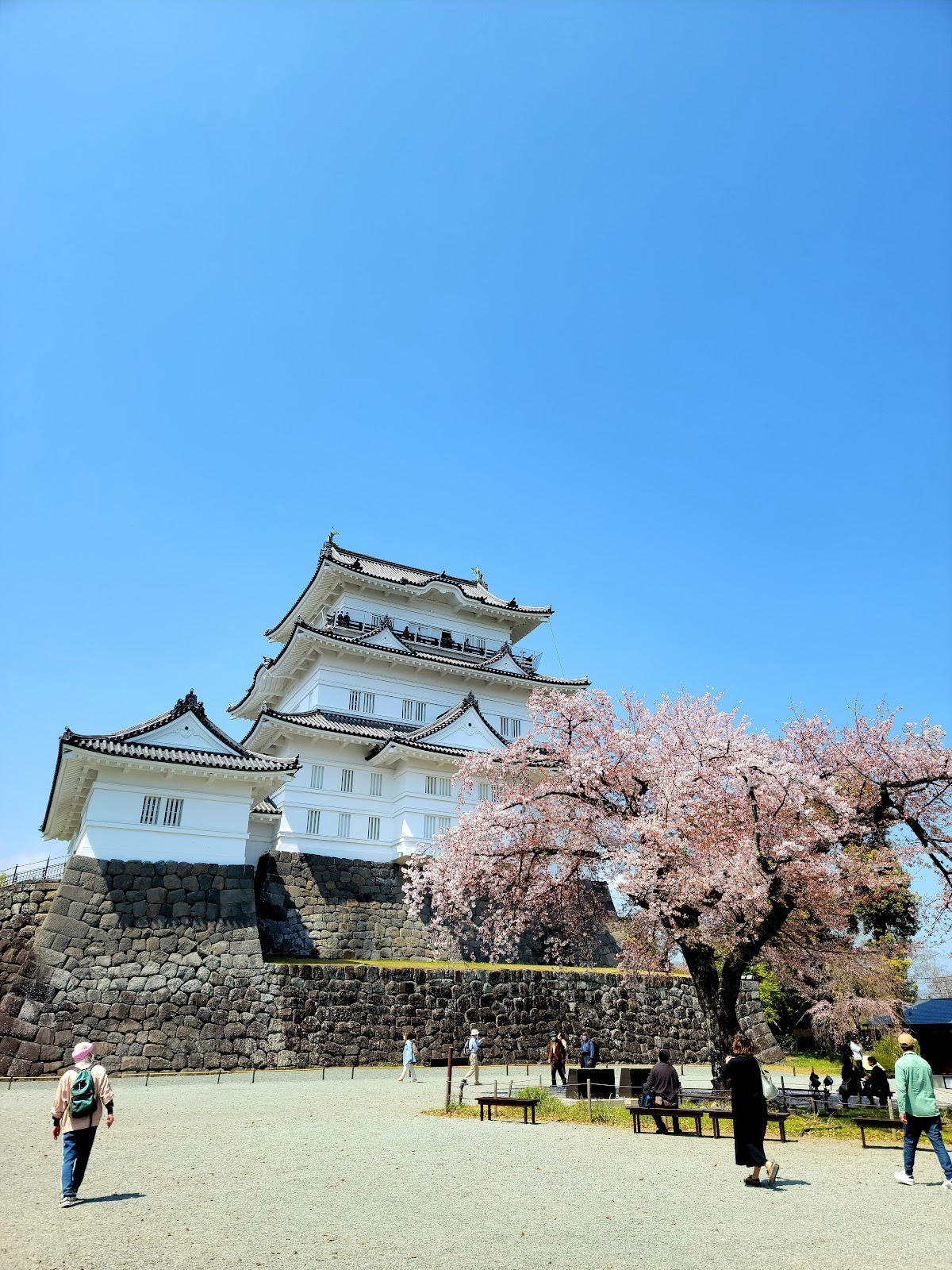
The castle tower, the symbol of Odawara Castle, is a three-story, four-floor building reconstructed in 1960. While its exterior mimics an Edo-period castle tower, the interior is a modern museum.
The castle tower features extensive exhibits on the history of Odawara Castle and the Hojo clan, allowing visitors to see valuable materials such as armor, swords, and ancient documents. From the observation deck on the top floor, you can enjoy panoramic views of Odawara city, Sagami Bay, and, on clear days, even the Boso Peninsula, making it a popular spot for breathtaking scenery.
Opening Hours: 9:00 AM – 5:00 PM (Last entry at 4:30 PM)
Closed Days: Second Wednesday of December, December 31st – January 1st
Admission Fee: Adults 510 yen, Elementary and Junior High School Students 200 yen
Tokiwagi Gate
The Tokiwagi Gate is an important gate that serves as the main gate to the inner citadel, and was restored in 1971 (Showa 46). The name “Tokiwagi” is said to originate from the evergreen trees planted beside the gate.
The Tokiwagi Gate is a two-story turret gate, and the interior is open to the public as the “Tokiwagi Gate SAMURAI Museum,” where you can see exhibits of armor and swords. In particular, the experience corner where you can actually try on armor is a popular attraction for both children and adults.
Akagane-mon Gate
The Akagane-mon Gate is the main gate of the Ninomaru (second enclosure) and was restored in 1997 (Heisei 9) faithfully following Edo period construction methods. It is called the “Akagane-mon” (Copper Gate) because copper was used in the gate’s decorative metalwork.
The restoration of the Akagane-mon Gate involved extensive archaeological excavations and research of ancient documents, successfully recreating its original appearance as closely as possible. Its imposing appearance, in the style of a watchtower gate, conveys the grandeur of Odawara Castle to this day.
Umaidashi-mon Gate
The Umaidashi-mon Gate is the main gate of the Sannomaru (third enclosure), restored in 2009 (Heisei 21). “Umaidashi” refers to a defensive structure built in front of a castle gate, an important structure for preventing enemy intrusion.
With the restoration of the Umaidashi-mon Gate, the main entrance of Odawara Castle from the Edo period was revived after approximately 140 years. By observing the structure of the Umaidashi, integrated with the earthworks, inner gate, and earthen bridge, one can understand the techniques and ingenuity of Edo period castle architecture. ### Honmaru and Ninomaru Sites
The Honmaru site is currently a plaza, offering views of the castle tower and Tokiwagi Gate. While the Honmaru Palace once stood here, only the foundation stones remain today.
The Ninomaru site is also a plaza, and in spring, it becomes a popular cherry blossom viewing spot, attracting many visitors. Approximately 320 cherry trees are planted throughout Odawara Castle Park, and it has been selected as one of “Japan’s Top 100 Cherry Blossom Viewing Spots.”
Hotoku Ninomiya Shrine
Within Odawara Castle Park is the Hotoku Ninomiya Shrine, dedicated to Ninomiya Sontoku (Kinjiro), a great figure from Odawara. It is revered as the god of learning, and many worshippers visit during exam season.
Within the shrine grounds is a famous statue of Ninomiya Kinjiro reading a book while carrying firewood, making it a popular photo spot.
Historical Museum (NINJA Hall)
The Historical Museum, which reopened in 2019 after renovations, offers an easy-to-understand learning experience about the history of Odawara Castle through videos and models. The theater exhibits, particularly those introducing the history of the Hojo clan and the changes in Odawara Castle, are a must-see.
The NINJA Hall features exhibits and hands-on corners where visitors can learn about the history and techniques of ninjas, making it a popular spot for families with children.
Remains of the Outer Fortifications
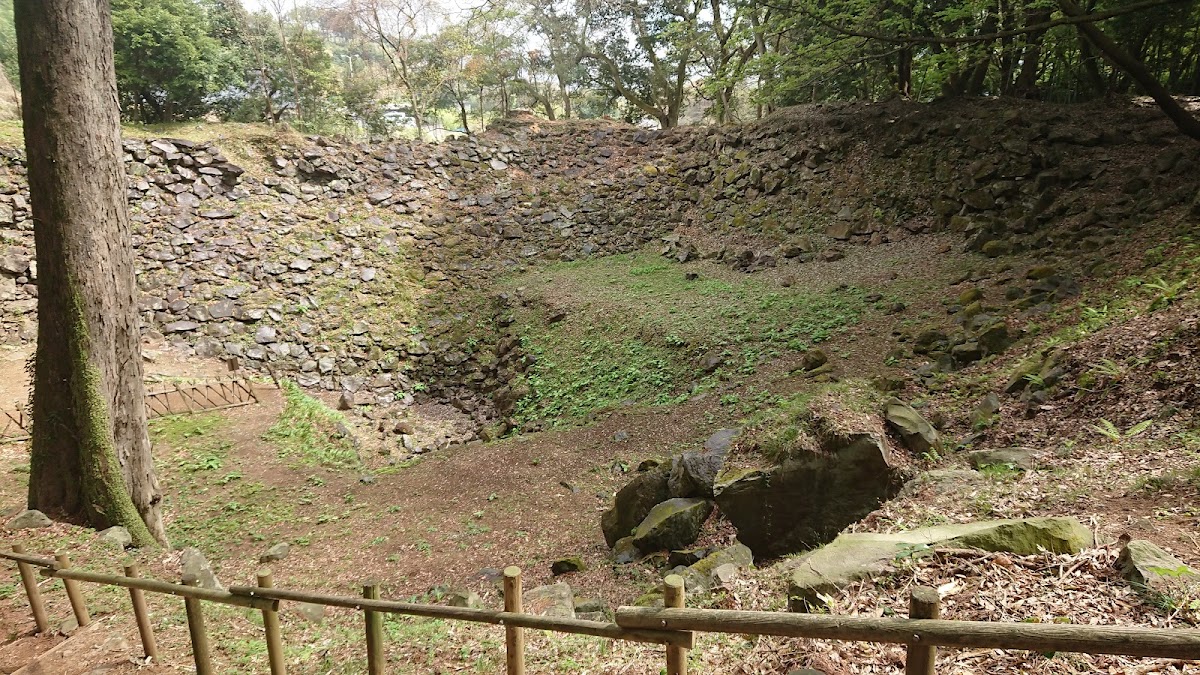
The remains of the outer fortifications, the most distinctive feature of Odawara Castle, still exist in various locations throughout the city. At sites such as the Komine-Okane-no-dai Great Moat and the Hayakawa-guchi Remains, you can see traces of the magnificent civil engineering works of the Sengoku period.
The Komine-Okane-no-dai Great Moat, in particular, is a massive dry moat approximately 30 meters wide and 10 meters deep, a valuable relic that truly conveys the scale of the outer fortifications. It’s a must-visit spot for history buffs.
Access to Odawara Castle
Access by Train
JR Tokaido Line/JR Tokaido Shinkansen
- Approximately 10 minutes on foot from the East Exit of Odawara Station
- From Tokyo Station to Odawara Station: Approximately 35 minutes by Shinkansen, approximately 1 hour 30 minutes by conventional line
Odakyu Odawara Line
- Approximately 10 minutes on foot from Odawara Station
- From Shinjuku Station to Odawara Station: Approximately 75 minutes by Odakyu Romancecar, approximately 90 minutes by express train
Hakone Tozan Railway
- Approximately 10 minutes on foot from Odawara Station
Odawara Station is easily accessible from the Tokyo area, making it ideal for day trips. The path from the station to Odawara Castle is flat, and there are plenty of signs, so even first-time visitors can arrive without getting lost.
Access by Car
Tomei Expressway
- Approximately 40 minutes from Oi-Matsuda IC
- Approximately 40 minutes from Gotemba IC
Odawara-Atsugi Road
- Approximately 10 minutes from Ogikubo IC
Seisho Bypass
- Approximately 5 minutes from Odawara IC
Parking Information
There are several paid parking lots around Odawara Castle:
Fujidana Parking
- Closest parking lot to Odawara Castle
- Capacity: Approximately 45 cars
- Fee: 300 yen for the first hour (100 yen for every 30 minutes thereafter)
Municipal Parking Lots around Odawara Castle
- Multiple parking lots available, including the Castle Parking Lot and Honmachi Parking Lot
- Fees vary depending on the facility
During peak tourist seasons and weekends, parking lots can become crowded, so we recommend using public transportation.
Tourist Attractions Around Odawara Castle
Ishigakiyama Castle (Ishigakiyama Ichiyajo Castle)
Located about 15 minutes by car from Odawara Castle, Ishigakiyama Castle is a fortified camp built by Toyotomi Hideyoshi during his conquest of Odawara. Known as the “One-Night Castle,” it’s said that Hideyoshi made it appear as if he had built the castle overnight.
Currently, it’s maintained as the Ishigakiyama Ichiyajo Historical Park, where you can see the remains of the stone walls and overlook Odawara Castle from the observation deck. Viewing Odawara Castle from Hideyoshi’s perspective offers a valuable opportunity to relive the drama of history.
Odawara Fishing Port
Located about 10 minutes by car from Odawara Castle, Odawara Fishing Port, facing Sagami Bay, offers fresh seafood. In particular, “Odawara Donburi,” a rice bowl dish made with fresh local seafood, is a popular gourmet item among tourists.
A morning market is also held at the fishing port early in the morning, providing a lively atmosphere.
Kamaboko Street
Odawara is also famous as the “City of Kamaboko (fish cake).” On the way from Odawara Station to Odawara Castle, you’ll find “Kamaboko Street,” lined with long-established kamaboko shops.
Some shops offer tastings and factory tours, making it a great place to buy Odawara’s famous kamaboko as a souvenir.
Odawara-juku Nariwai Exchange Hall
This facility recreates the appearance of Odawara-juku during the Edo period, allowing you to learn about the lifestyle and culture of merchants at that time. Visiting it in conjunction with Odawara Castle will give you a deeper understanding of Odawara’s history.
Seasons and Events at Odawara Castle
Spring: Cherry Blossom Festival
From late March to early April, approximately 320 cherry trees bloom in Odawara Castle Park. During the “Odawara Cherry Blossom Festival,” the trees are illuminated at night, allowing you to enjoy the magical sight of cherry blossoms after dark.
The combination of the castle tower and cherry blossoms makes for an excellent photo spot, attracting many photographers and tourists.
Summer: Odawara Castle Hydrangea and Iris Festival
In June, hydrangeas and irises are in full bloom around Odawara Castle. The hydrangeas around the Tokiwagi Gate are particularly beautiful and a highlight of Odawara Castle sightseeing during the rainy season.
Autumn: Odawara Castle Chrysanthemum Exhibition
From late October to mid-November, a chrysanthemum exhibition is held in the main castle grounds. Carefully cultivated chrysanthemums adorn Odawara Castle.
Winter: Odawara Castle Winter Cherry Blossom Illumination
From December to February, a light-up event is held at Odawara Castle. In the crisp winter air, the illuminated castle tower presents a fantastical beauty.
Year-Round Events
Odawara Hojo Five Generations Festival (May)
Odawara’s largest event, featuring samurai processions and parades throughout the city. A magnificent festival recreating the history of the five generations of the Hojo clan.
Regular Events at Odawara Castle Park
On weekends, experiential events such as samurai armor fitting and ninja experiences are sometimes held. It is recommended to check the official website in advance.
Model Itinerary for Odawara Castle Sightseeing
Half-Day Course (Approx. 3 Hours)
- Arrive at Odawara Station (10:00)
- Stroll along Kamaboko Street (10:10-10:40)
- Enjoy souvenir shopping and tasting
- Enter the Castle through the Umaidashi Gate (10:50)
- Visit the Domon and Tokiwagi Gates (11:00-11:30)
- Visit the Castle Tower (11:40-12:40)
- View the exhibits and enjoy the view from the observation deck
- Lunch at Honmaru Chaya (12:40-13:30)
- Visit Hotoku Ninomiya Shrine (13:30-13:50)
- Return to Odawara Station (14:00)
Full-Day Course (Approx. 6 Hours)
The morning session will be the same as the half-day course, visiting Odawara Castle. The afternoon session will include visits to the following additional spots:
- Odawara Castle Historical Museum (NINJA Museum) (14:00-14:40)
- Seafood Gourmet at Odawara Fishing Port (15:00-16:00)
- By car or taxi
- Visit Ishigakiyama Castle (16:30-17:30)
- Experience Hideyoshi’s perspective overlooking Odawara Castle
- Return to Odawara Station (18:00)
Notes and Advice for Visiting Odawara Castle
Best Season for Visiting
Odawara Castle can be enjoyed year-round, but the best time to visit is:
- Spring (Late March to Early April): Cherry blossom season. However, it can be crowded.
- Autumn (October-November): The weather is pleasant, and you can enjoy the chrysanthemum exhibition.
- Weekdays: Less crowded than weekends and holidays, allowing for a more relaxed visit.
Estimated Time Required
- Castle Tower Only: Approximately 1 hour
- Castle Tower + Main Gates: Approximately 2 hours
- Thorough Visit (Including the Historical Museum): Approximately 3-4 hours
- Complete Visit Including the Outer Fortifications: 1 day
Clothing and Items to Bring
- The stairs to the castle tower are steep, so comfortable clothing and walking shoes are recommended.
- In summer, the sun is strong, so bring a hat and sunscreen.
- In winter, it can be windy, so take precautions against the cold.
- A camera is essential (there are many photo opportunities).
Special Offer
Combined Ticket
A combined ticket is available for the castle tower, Tokiwagi Gate SAMURAI Museum, and Historical Museum, which is more economical than purchasing tickets individually.
Odawara City Tourism Exchange Center
Located at the east exit of Odawara Station, this tourist information center provides brochures and tourist information.
Summary
Odawara Castle is a representative tourist spot in Kanagawa Prefecture, blending the historical romance of the Sengoku period with beautiful scenery. Built by five generations of the Hojo clan, this impregnable castle occupies a special place in the history of Japanese castles due to its magnificent defensive system known as the “Sogamae.”
The reconstructed castle tower, Tokiwagi Gate, Domon Gate, and Umadashi Gate convey the appearance of Odawara Castle during the Edo period, transporting visitors back in time to the Sengoku period. Furthermore, the collaboration of the seasonal nature and historical buildings offers new discoveries with every visit.
Its easy accessibility, approximately 35 minutes from Tokyo by Shinkansen, is also a major attraction, making it ideal for a day trip. When visiting Odawara Castle, exploring the surrounding Ishigakiyama Castle, Odawara Fishing Port, and Kamaboko Street will allow you to experience Odawara’s history and culture more deeply.
Odawara Castle is a place that can be enjoyed by everyone, from history buffs to families, couples, and photography enthusiasts. Be sure to visit this impregnable castle and experience a special blend of the romance of the Sengoku period and the allure of modern times.