Complete Guide to Kataoka Castle Ruins | A Strategic Point in Sengoku Yamato and the History of Battles with Oda Nobunaga
What is Kataoka Castle?
Kataoka Castle (Kataoka-jo) was a mountain castle from the Sengoku period located in Kamimaki-cho, Kitakatsuragi-gun, Nara Prefecture. Also known as “Shimomaki Castle,” it was built on a hill approximately 90 meters above sea level and 48 meters above ground level, at the northernmost tip of the Mami Hills. While numerous castles existed in Yamato Province during the Sengoku period, Kataoka Castle is historically extremely important, as various documents reveal details of its battles and the names of the warlords involved.
Currently, it is commonly known as “Shiroyama” (Castle Mountain) and is located behind the Shimomaki settlement in Kamimaki-cho. The Katsushita River flows to the west, and an ancient road runs north-south from Kawachi, over the north of Myojin-yama, to Hashio and Tawaramoto. It functioned as a strategic stronghold controlling the entire Kataoka Valley area. As a castle that played a significant role in Oda Nobunaga’s unification of Japan, it is an indispensable historical site not only in Kamimaki Town but also in the history of Japan’s Sengoku period.
History and Rise and Fall of the Kataoka Clan
Origins and Power Base of the Kataoka Clan
The Kataoka clan were local lords belonging to the Ichijoin branch of Kofuku-ji Temple, and their base was the Kataoka Valley area, spanning present-day Kashiba City, Oji Town, and Kamimaki Town. Growing based on these estates, the Kataoka clan sought to survive the Sengoku period as a powerful regional force in Yamato Province.
According to the “Kataoka Genealogy,” the builder of Kataoka Castle is Kataoka Kuniharu (Samon Kuniharu), and the genealogy states “construction of the castle in Shimomaki Village.” This allows us to estimate the construction period to be the early 16th century, around 1550. Kataoka Kuniharu, as the head of the Kataoka clan who had ruled the Kataoka Valley for generations, is thought to have constructed a full-fledged castle in preparation for the turmoil of the Sengoku period.
The Meio Rebellion and the End of Kataoka Toshimochi
Kataoka Castle first clearly appears in history in Meio 7 (1498). The *Daijoin Zatsuji-ki* records that on April 5th of that year, the Tsutsui clan, under Hatakeyama Naosuke, attacked and captured “Kataoka.” During this period, Yamato Province was embroiled in a succession dispute within the Hatakeyama clan, and the Kataoka clan sided with the Ochi.
It is said that the head of the clan, Kataoka Toshimochi, committed suicide at Kataoka Castle during this battle. Toshimochi’s demise, unable to defend the castle, illustrates the harsh reality of Sengoku-era Yamato. However, the Kataoka clan later rebuilt and maintained their power by becoming allied with the Tsutsui clan.
Relationship with Matsunaga Hisahide and the Fall of the Castle in Eiroku
After the Kataoka clan’s rebuilding and subsequent period under the Tsutsui clan, Kataoka Castle faced another major turning point in Eiroku 12 (1569). In this year, Matsunaga Hisahide, a Sengoku-period daimyo who was expanding his power in Yamato Province, attacked and captured Kataoka Castle. The castle lord at the time was Kataoka Harutoshi.
After seizing Kataoka Castle, Matsunaga Hisahide carried out extensive renovations and expansions, establishing it as one of his own subsidiary castles. These renovations significantly strengthened Kataoka Castle’s function as a medieval mountain castle, transforming it into a fortress with much stronger defensive structures. The Ebina clan, subordinates of the Matsunaga clan, became the castle lords, and Kataoka Castle became an important base playing a key role in Matsunaga Hisahide’s control of Yamato Province.
Battles with Oda Nobunaga and the Castle’s Fall
Matsunaga Hisahide’s Rebellion in 1577
Kataoka Castle receives its most prominence in Japanese history in 1577. In this year, Matsunaga Hisahide, in conjunction with Uesugi Kenshin, Mori Terumoto, and Ishiyama Honganji, holed up in Shigisan Castle and rebelled against Oda Nobunaga. This was Hisahide’s second rebellion against Nobunaga, a decision that would leave him in history as “a warrior who betrayed his lord twice.”
In response to Matsunaga Hisahide’s rebellion, Oda Nobunaga immediately dispatched an army to suppress it. Akechi Mitsuhide and Tsutsui Junkei, acting on Nobunaga’s orders, invaded Yamato Province, capturing Matsunaga’s castles one after another. Kataoka Castle, an important subsidiary castle of Matsunaga Hisahide, also became a target of the Oda army.
Capture by Akechi Mitsuhide
In October of Tensho 5 (1577), the Oda army, led by Akechi Mitsuhide, besieged Kataoka Castle. A strategy was adopted to sequentially capture surrounding subsidiary castles in order to cut off the supply lines to Matsunaga Hisahide’s base, Shigisan Castle, and isolate the Matsunaga forces. Due to its strategic importance, Kataoka Castle was considered a target to be captured early.
Faced with the overwhelming military strength and organized siege tactics of the Oda army, Kataoka Castle fell. With this fall, Kataoka Castle ceased to function as a fortress. On October 10th of the same year, Matsunaga Hisahide committed suicide at Shigisan Castle, completely ending the Matsunaga clan’s control over Yamato Province, including Kataoka Castle.
Structure and Layout of Kataoka Castle
Location and Topographical Features
Kataoka Castle was a mountain castle that made the most of its geographical characteristics, being located at the northernmost tip of the Mami Hills. Its location, at an elevation of 90 meters and a relative height of 48 meters, provided an excellent vantage point for monitoring the surrounding plains. The Katsushita River flowed to the west, and the Takigawa River to the east, functioning as natural moats.
The castle’s location faced an ancient road connecting Kawachi and Yamato, indicating that it was strategically selected as a key transportation hub. It possessed ideal locational conditions for controlling the Kataoka Valley area and monitoring and defending against invasions from the Kawachi region.
Layout of the Main Enclosure and Baileys
Kataoka Castle’s layout features a complex, interconnected enclosure structure that skillfully utilizes the hilly terrain. With the main enclosure at its center, multiple baileys are arranged to the east and west, extending over 180 meters from north to south.
The main enclosure is located in the center of the castle, situated at the highest elevation. It is believed that the lord’s residence and important facilities were located here. Currently, the Izanagi Shrine stands on the site of the main enclosure, allowing us to imagine the former central part of the castle.
The east and west baileys functioned as secondary defensive structures to protect the main enclosure. These baileys are arranged in stages, demonstrating a multi-layered defensive strategy to prevent enemy incursions in stages.
Defensive Structures of Dry Moats and Earthworks
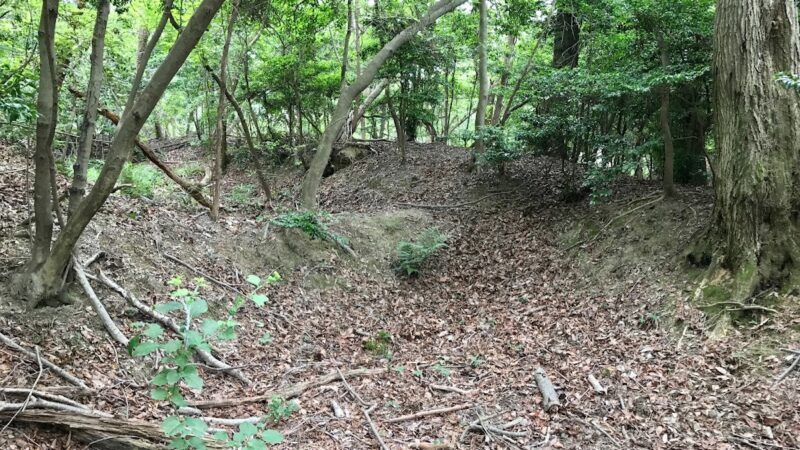
The most distinctive feature of Kataoka Castle is the presence of a large dry moat. The dry moat, running over 180 meters from north to south, is still clearly visible today, attesting to the castle’s high defensive capabilities. This dry moat is believed to have been significantly expanded during renovations by Matsunaga Hisahide, representing the pinnacle of castle construction technology from the late Sengoku period.
The depth and width of the dry moat were designed to provide effective defense against the siege weapons and tactics of the time. Earthen ramparts were built on both sides of the moat, and the combination of the moat and ramparts formed a strong defensive line that physically prevented enemy intrusion.
Earthen ramparts were also placed around the baileys, serving to protect against arrows and firearms, as well as blocking enemy lines of sight. Currently, some of the ramparts are used as farmland, offering an unobstructed view and the advantage of being able to see the entire castle site.
Water Moats and Water Sources
The castle’s location, sandwiched between two rivers—the Katsushita River to the west and the Takigawa River to the east—functioned as a natural water moat. These rivers not only made approaching the castle difficult but also played an important role in securing water sources within the castle.
It is highly probable that wells and water storage facilities were located within the castle grounds, suggesting that securing water in preparation for a siege was a crucial consideration. Having facilities capable of withstanding a long siege was an essential requirement for castles during the Sengoku period (Warring States period).
Artifacts Discovered at Kataoka Castle Ruins
Excavations and surveys of the Kataoka Castle ruins have uncovered various artifacts. These artifacts provide valuable clues to understanding the castle’s actual state and the lifestyle of the time.
Ceramics
Numerous fragments of ceramics from the Sengoku period have been unearthed from the castle ruins. These include not only everyday tableware but also high-quality ceramics believed to be tea ceremony utensils, offering a glimpse into the cultural life of the castle lord and his retainers.
Of particular note are the fragments of Chinese celadon and white porcelain. These were trade goods of the time, indicating that the Kataoka and Matsunaga clans possessed a certain level of economic power and cultural sophistication.
Weapons and Armor
Iron arrowheads and sword fragments have been discovered, providing evidence of actual combat. These artifacts are particularly likely to be related to the battle against the Oda army in 1577 (Tensho 5), making them of extremely high historical value.
Building Materials
Artifacts related to buildings, such as roof tiles and foundation stones, have also been unearthed. These confirm the existence of tiled buildings within the castle grounds, supporting the idea that it was not merely a military facility but a residence of a certain status.
Research and Preservation Activities of Kataoka Castle Ruins
“Kataoka Castle Ruins: A Study of a Medieval Mountain Castle”
A specialized research book, “Kataoka Castle Ruins: A Study of a Medieval Mountain Castle,” has been published, providing a detailed analysis of the castle’s structure and historical background. This research has academically proven that Kataoka Castle was not merely a small provincial castle, but an important military base in Yamato Province during the Sengoku period.
The research comprehensively involved creating a layout map, conducting on-site measurements of the remains, and comparing them with historical documents, revealing the true nature of Kataoka Castle. Particular attention is paid to the detailed analysis of the changes in the castle’s structure before and after the renovations by Matsunaga Hisahide.
Kamimaki Town Kataoka Castle Ruins Utilization Committee
In Kamimaki Town, the “Kamimaki Town Kataoka Castle Ruins Utilization Committee” has been established to preserve and utilize the Kataoka Castle ruins as a valuable historical heritage. This committee, composed of archaeologists, historians, local residents, and administrative officials, is continuously considering preservation plans for the castle ruins and methods for utilizing them as a tourist resource.
Through the committee’s activities, appropriate preservation and management of the castle ruins are being carried out, and efforts are being made to provide opportunities for the general public to experience history. Educational uses are also being promoted, including the regular holding of tours and explanatory meetings, and the installation of information boards.
Reconstructed CG “Now Revived: Kataoka Castle in the Sengoku Period”
To convey the appeal of the Kataoka Castle ruins more clearly, AR (augmented reality) technology and CG reconstruction videos have been produced. Titled “Now Revived: Kataoka Castle in the Sengoku Period,” the CG reconstruction meticulously recreates the castle’s appearance in its heyday, allowing visitors to experience the former grandeur of Kataoka Castle through their smartphones and tablets.
The CG reconstruction visualizes the main enclosure, the buildings of the baileys, the dry moats and earthworks, and even the townscape below the castle, receiving high praise as a historical education tool. This initiative is attracting attention as an advanced example of balancing the preservation and utilization of cultural properties.
Current Status and Highlights of Kataoka Castle Ruins
Preservation Status of the Castle Ruins
Although some parts of the current Kataoka Castle ruins have been altered due to development since the Showa era, the main remains are preserved in relatively good condition. In particular, the large dry moats remain clearly visible, making them valuable relics that convey the appearance of a Sengoku period castle.
Because some of the dry moats and baileys are used as farmland, the view is unobstructed, which has the advantage of making it easier to understand the overall structure of the castle ruins. This is a great help to castle researchers and enthusiasts in understanding the castle’s layout.
Izanagi Shrine and Main Enclosure Site
The Izanagi Shrine is located on the site of the main enclosure, indicating that the shrine grounds were the central part of the castle. As you ascend the path to the shrine, you can appreciate the castle’s topographical features and the arrangement of its defensive structures.
From the shrine, you can overlook the entire Kataoka Valley, experiencing firsthand how wide an area the castle was positioned to monitor. On a clear day, the view opens up from the Kawachi area to the Yamato Basin, allowing you to relive the scenery seen by the castle lords of the Sengoku period.
Visiting the Dry Moat and Earthworks
The biggest highlight when visiting Kataoka Castle ruins is undoubtedly the large dry moat, which stretches for over 180 meters from north to south. Walking along this moat allows you to experience firsthand the high level of castle construction technology and its effectiveness as a defensive structure during the Sengoku period.
The depth of the dry moat and the steep slopes speak to how difficult it was for enemy soldiers to invade. Traces of earthworks remain on both sides of the moat, allowing us to understand the multi-layered defensive structure created by the combination of moats and earthworks.
Exploring the Fortified Enclosures
The remains of the fortified enclosures located to the east and west of the main enclosure can also be visited. While these enclosures are now farmland and groves of trees, their boundaries can be inferred from the elevation changes and flat areas.
Exploring the overall layout and movement patterns of the castle while moving between the enclosures is a great pleasure for castle enthusiasts. Imagining how the castle lords and soldiers of the Sengoku period moved within the castle and established their defensive positions deepens one’s understanding of history.
Access and Visiting Information for Kataoka Castle Ruins
Access by Public Transportation
Kataoka Castle Ruins can be accessed by walking approximately 30 minutes from Kintetsu Tawaramoto Line “Oji Station,” or by bus. It is approximately a 15-minute walk from the Nara Kotsu Bus “Kamimaki Deai” bus stop. The site is accessible from JR Yamatoji Line’s Oji Station, and a taxi ride from the station takes approximately 10 minutes. If using public transportation, it is recommended to check the bus timetable in advance.
Access by Car
By car, it’s approximately 15 minutes from the Nishimeihan Expressway’s Kashiba Interchange, or approximately 20 minutes from the Horyuji Interchange. Setting “Izanagi Shrine” or “Shimomaki, Kamimaki-cho, Kitakatsuragi-gun, Nara Prefecture” as your destination in your car navigation system is convenient.
There is no dedicated parking lot around the castle ruins, but there are a few parking spaces near the shrine. However, since this is also a local road, please avoid street parking and be considerate of others during your visit.
Points to Note During Your Visit
While Kataoka Castle Ruins are preserved as a historical site, some areas are privately owned or used for farming. Please note the following points when visiting:
- Do not trespass on crops or private property.
- Always take your trash with you.
- Do not damage the ruins or remove artifacts.
- Be considerate of the local residents and observe quietly.
- Wear comfortable shoes as some areas have uneven ground.
While visits are generally free, we recommend contacting the Kamimaki Town Board of Education in advance if you wish to visit as a group or request a detailed explanation.
Nearby Tourist Attractions
There are many nearby tourist attractions that you can visit in conjunction with your visit to Kataoka Castle Ruins.
Places Associated with Matsunaga Hisahide
The Shigisan Castle Ruins, the base of Matsunaga Hisahide who ruled Kataoka Castle, are also nearby. Visiting both will give you a comprehensive understanding of Matsunaga Hisahide’s rule over Yamato. Shigisan Chogosonshi-ji Temple is also a must-see.
Horyu-ji Temple
Horyu-ji Temple, a World Heritage Site, is about a 20-minute drive from Kataoka Castle Ruins, allowing you to experience the history of Yamato from ancient times through the Middle Ages and the Sengoku period.
Historical Sites Related to the Kataoka Clan in Kashiba City
Kashiba City, the former base of the Kataoka clan, is dotted with historical sites related to the Kataoka clan, allowing for a deeper understanding of their history.
Historical Significance of Kataoka Castle
Position in the Sengoku History of Yamato Province
Kataoka Castle is an indispensable fortress when discussing the Sengoku history of Yamato Province. Yamato Province was in a unique political situation, with a complex interplay of temple and shrine forces, centered around Kofuku-ji Temple, and local lord forces such as the Tsutsui and Ochi clans. Within this context, Kataoka Castle embodied the rise and fall of regional powers, invasions by external forces, and the process leading to unification by Oda Nobunaga.
The series of events—its fall during the Meio Rebellion, its capture and renovation by Matsunaga Hisahide, and its subsequent conquest by the Oda army—directly reflects the turbulent events experienced by Yamato Province during the Sengoku period. Tracing the history of Kataoka Castle is tantamount to tracing the history of Sengoku Yamato.
Oda Nobunaga’s Unification of Japan and Kataoka Castle
Kataoka Castle appears on the national historical stage in connection with Oda Nobunaga’s unification of Japan. The rebellion of Matsunaga Hisahide in 1577 and its suppression were crucial events in Nobunaga’s process of completely controlling the Kinai region and advancing towards national unification.
The capture of Kataoka Castle was part of a strategic operation to isolate Matsunaga Hisahide at Shigisan Castle, and its importance is evident from the direct involvement of Akechi Mitsuhide, a senior retainer of Nobunaga. Despite being a regional castle, Kataoka Castle occupies a special place in Japanese history for its role in a battle that influenced the course of the nation.
Value in Castle Research
Kataoka Castle is also a valuable sample for studying the structure of medieval mountain castles. It is a rare example of a castle site where the development of castle technology can be traced from its initial construction by Kataoka Kuniharu to the large-scale renovations by Matsunaga Hisahide in the late Sengoku period. In particular, the sections renovated by Matsunaga Hisahide are thought to have incorporated the latest castle-building techniques of the late Sengoku period, and are highly valued academically as remains that demonstrate the pinnacle of castle construction technology at the time. The large-scale dry moats and the planned layout of the baileys convey to the present day just how sophisticated military facilities castles were during the Sengoku period.
Summary
Kataoka Castle ruins are a valuable historical heritage site from the Sengoku period, located in Kamimaki-cho, Nara Prefecture. Built as the base of a regional power, the Kataoka clan, it passed under the rule of Matsunaga Hisahide, and ultimately fell during Oda Nobunaga’s unification of Japan—a history that can truly be called a microcosm of the Sengoku period.
Built on a hill 90 meters above sea level, the castle showcases the advanced castle-building techniques of the Sengoku period, with its large-scale dry moats extending over 180 meters north-south and its skillfully arranged baileys. Even today, the main remains are well-preserved, allowing visitors to experience the reality of a Sengoku period castle firsthand.
The town of Kamimaki is actively working on preservation and utilization efforts, including innovative initiatives such as CG reconstructions using AR technology. For history buffs, castle enthusiasts, and anyone interested in local history, Kataoka Castle Ruins is a historical site well worth visiting.
Kataoka Castle Ruins is where the footsteps of famous Sengoku period warlords such as Oda Nobunaga, Matsunaga Hisahide, and Akechi Mitsuhide intersect. By learning about its history and actually walking through the castle ruins, you can experience living history that you can’t learn from textbooks. Kataoka Castle Ruins will continue to play an important role in understanding the history of Yamato Province during the Sengoku period, and indeed, the history of Japan.