A Complete Guide to the History and Highlights of Amidagamine Castle | A Thorough Explanation of the Mountain Castle Ruins in Higashiyama Ward, Kyoto City
What is Amidagamine Castle?
Amidagamine Castle is a Sengoku period mountain castle built near the summit of Mt. Amidagamine, at an altitude of 196 meters, located in Imakumano Amidagamine-cho, Higashiyama Ward, Kyoto City, Kyoto Prefecture. Mt. Amidagamine, one of the 36 peaks of Higashiyama, belongs to Atago District, Yamashiro Province, and is strategically located at a key point controlling the Shibuya Pass, an important road connecting Rakuchu (the city center) and Yamashina.
While many details regarding the castle’s construction period and builder remain unknown, the remains of the baileys and earthworks are well-preserved, making it a valuable historical site that conveys the structure of a Sengoku period mountain castle. It is also widely known for the Toyokuni Mausoleum, where the remains of Toyotomi Hideyoshi were buried, which was built on the mountaintop.
History of Amida-ga-mine Castle
Background and Purpose of Construction
The exact date of construction of Amida-ga-mine Castle is uncertain, but it is believed to have been built during the Sengoku period (Warring States period) to protect the Shibuya Pass, an important road connecting Kyoto’s city center (Rakuchu) and Yamashina. The Shibuya Pass, along with Awataguchi, was a major transportation route connecting the east and west of Kyoto, and controlling this area was extremely important for the defense of Kyoto’s eastern side.
There are several theories regarding the castle’s builder. One theory suggests it was used as a fortress by followers of the Ikkō-shū (Jōdo Shinshū) sect, while another theory suggests it was built by the Imamura clan, vassals of the Miyoshi clan. In any case, there is no doubt that this castle played an important role amidst the political and military tensions around Kyoto.
Amida-ga-mine Castle in the Sengoku Period
During the Sengoku period, the area around Kyoto was caught in a complex political situation involving the Hosokawa clan, the Miyoshi clan, and the Ikkō-ikki forces. It is presumed that Amidagamine Castle functioned as a base for monitoring and defending the routes leading into Kyoto during these power struggles.
In particular, during the mid-16th century, when Miyoshi Nagayoshi was expanding his power in the Kinai region, it is highly likely that the castle was under the control of the Miyoshi clan. The theory that the Imamura clan built the castle is thought to be related to the expansion of the Miyoshi clan’s sphere of influence during this period.
On the other hand, the theory that it was used by Ikkō-shū followers is related to the period when the Hongan-ji sect had a strong influence around Kyoto. From the late 15th to the 16th century, the Ikkō-ikki rebels constructed strong fortresses in various locations, and Amidagamine may have been one of them.
Abandonment of the Castle and Construction of Toyokuni Shrine
The exact year of Amidagamine Castle’s abandonment is unknown, but it is thought that its military role ended with the end of the Sengoku period. Furthermore, this castle site would take on a completely different historical significance after the death of Toyotomi Hideyoshi.
When Toyotomi Hideyoshi died at Fushimi Castle in 1598, his body was buried on the summit of Mount Amidagamine according to his will, and the Toyokuni Mausoleum was constructed. Hideyoshi was deified as “Toyokuni Daimyojin,” and a magnificent mausoleum was built on the mountaintop. This Toyokuni Mausoleum functioned as a symbol of Hideyoshi’s authority.
However, after the fall of the Toyotomi family in the Siege of Osaka, the Toyokuni Mausoleum was destroyed by the Tokugawa shogunate and remained in a state of ruin for a long time. With the re-evaluation of Toyotomi Hideyoshi in the Meiji era, the Toyokuni Shrine was rebuilt in 1880, and it remains to this day.
Structure and Remains of Amidagamine Castle
Castle Layout and Arrangement
Amidagamine Castle is a typical mountain castle built around the mountaintop at an altitude of 196 meters. The castle’s elevation difference is approximately 150 meters, and it features a defensive structure that utilizes the steep terrain. While it is a medium-sized mountain castle, it was sufficiently functional as a strategically important fortress.
The castle complex centers around the main enclosure at the mountaintop, with multiple enclosures arranged in a stepped pattern on the southern slope. This arrangement is thought to have been designed to effectively defend against incursions from Shibuya Pass. Each enclosure is demarcated by earthen ramparts, creating a structure that hinders enemy advances.
Main Features of the Remains
Enclosures (Kuruwa)
At Amidagamine Castle, multiple enclosures, including the main enclosure at the mountaintop, remain in good condition. The group of enclosures on the southern slope, in particular, skillfully utilizes the terrain’s incline, making them valuable remains demonstrating the castle-building techniques of the Sengoku period. The flat areas of each enclosure are relatively large, suggesting they were used for troop garrisons or storage of supplies.
Earthen Ramparts
Earthen ramparts were built around the enclosures, and some are still clearly visible today. Earthen ramparts served as defensive structures protecting against enemy arrows and firearms, while also demarcating the areas between baileys. The earthen ramparts of Amidagamine Castle, though not large in scale, are important remains for understanding the defensive structure of mountain castles.
Moats and Vertical Moats
In mountain castles, moats that divide ridges and vertical moats dug into slopes are important defensive structures, and some of these remains have been confirmed at Amidagamine Castle. However, it is thought that some parts have been lost due to later alterations and the construction of the Toyokuni Shrine.
Relationship with the Toyokuni Shrine
A five-tiered pagoda dedicated to Toyotomi Hideyoshi stands on the current mountaintop, a remnant of the Toyokuni Shrine. While some of the original castle remains may have been altered during the construction of the Toyokuni Shrine, the remains from the Sengoku period are well preserved, particularly on the southern slope.
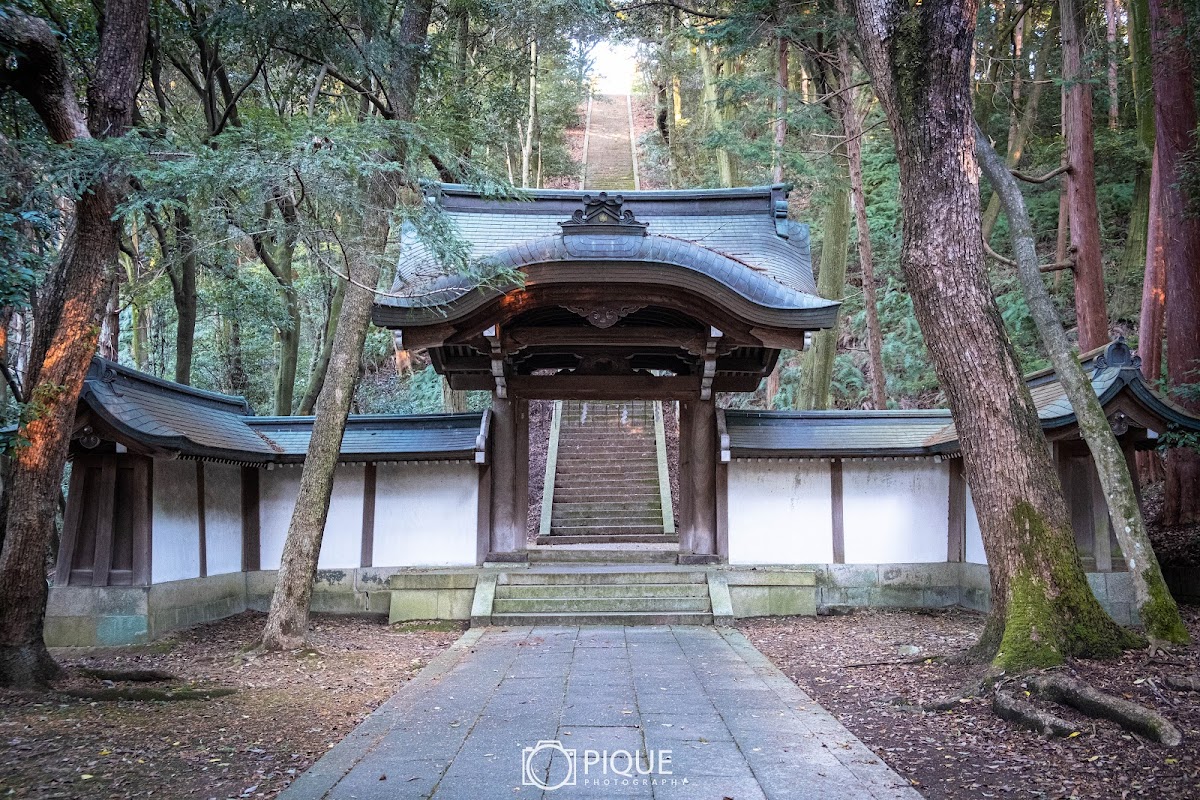
The path leading to Toyokuni Shrine is a different route from the former castle access path, and is now a mountain trail with a series of stone steps. This path consists of over 500 stone steps and is used by hikers and worshippers.
Highlights of Amida-ga-mine Castle
Observation Points of the Castle Remains
The main highlights when visiting Amida-ga-mine Castle are the remaining baileys and earthworks on the southern slope. Exploring the remains off the main trail requires careful footing, but it offers a valuable opportunity to experience the structure of a Sengoku period mountain castle.
Especially around the main bailey, you can observe the flattened shape of the baileys and the arrangement of the surrounding earthworks. Furthermore, the elevation differences and arrangement between the baileys reveal that this castle was designed with defense in mind.
View from the Summit
From the summit, at an altitude of 196 meters, a magnificent panoramic view of Kyoto city unfolds. To the east lies the Yamashina Basin, and to the west, the city of Kyoto. From here, you can truly appreciate the fact that the Shibuya Pass road once ran along the foot of this mountain. This view speaks to the excellent location of Amidagamine Castle, which was ideally situated to monitor a strategic transportation hub.
On clear days, you can even see Mount Hiei and Mount Atago, enjoying the mountain range surrounding the Kyoto Basin.
Toyotomi Hideyoshi’s Five-Ring Pagoda
At the summit stands a massive five-ring pagoda dedicated to Toyotomi Hideyoshi. This pagoda, rebuilt during the Meiji era, is a stone structure approximately 10 meters tall. As Hideyoshi’s burial site and a historical site commemorating the glory of the Toyotomi family, it attracts many history enthusiasts.
The area around the pagoda is well-maintained, and a prayer space has been provided. Looking down on Kyoto city from here, one can reflect on the era when Hideyoshi achieved the unification of Japan.
Nearby Historical Sites
Near the trailhead on the western slope of Mount Amidagamine, there are the remains of the Toyokuni Shrine’s worship hall. Approximately 1 kilometer further west lies Toyokuni Shrine. Toyokuni Shrine, rebuilt during the Meiji era, is dedicated to Hideyoshi and possesses valuable cultural assets, including the national treasure, the Karamon Gate.
Furthermore, the surrounding area is dotted with representative Kyoto cultural facilities and temples, such as the Kyoto National Museum, Sanjusangen-do Temple, and Chishaku-in Temple. Visiting Amidagamine Castle in conjunction with exploring the history of the Higashiyama area of Kyoto is highly recommended.
Access Information
Access by Public Transportation
By Train
- Approximately 25 minutes on foot from Shichijo Station on the Keihan Main Line
- Approximately 30 minutes on foot from Tofukuji Station on the JR Nara Line
By Bus
- Approximately 15 minutes on foot from the Kyoto Women’s University bus stop (Kyoto City Bus) to the trailhead
- Approximately 20 minutes on foot from the Higashiyama Shichijo bus stop (Kyoto City Bus) to the trailhead
Trailhead and Hiking Route
The main trailhead is at the entrance to the approach to Toyokuni Shrine, from where a stone staircase trail continues to the summit. The trail is well-maintained, but requires a certain level of physical fitness as it consists of over 500 stone steps. The estimated time is approximately 30-40 minutes for the ascent and 20-30 minutes for the descent.
The trail is relatively clear, but caution is advised when taking side paths to observe the ruins, as some slopes can be slippery. Especially during rainy weather or after rain, the ground can become slippery, so we recommend wearing appropriate footwear.
Parking Information
There is no dedicated parking lot for Amidagamine Castle. If you are visiting by car, you will need to use coin-operated parking lots around Toyokuni Shrine or parking lots around the Kyoto National Museum. However, parking lots in central Kyoto are often crowded, so we recommend using public transportation.
Points to Note and Manners When Visiting
Clothing and Equipment
When visiting Amidagamine Castle, you will need clothing and equipment suitable for mountain climbing.
- Shoes: Non-slip trekking shoes or sneakers
- Clothing: Comfortable clothing appropriate for the season
- Items to Bring: Drinking water, towel, insect repellent (summer)
- Other: Rain gear, hat, sunscreen (depending on the season)
Best Season for Visiting
Amidagamine Castle is accessible year-round, but spring (March-May) and autumn (October-November) are particularly comfortable. During the summer, the area is hot and humid, and there are many insects such as mosquitoes, so sufficient precautions are necessary. During the winter, there is a possibility of snow and freezing, so it is recommended to check the weather before visiting.
Request for Protection of Historical Remains
The remains of Amidagamine Castle are a valuable cultural asset. Please observe the following points when visiting:
- Do not damage the earthworks or baileys
- Do not collect plants
- Always take your trash with you
- Use of fire is strictly prohibited
- Do not unnecessarily walk around on the remains
Amidagamine Castle and Surrounding Castles
Mountain Castle Network Around Kyoto
Amidagamine Castle functioned as part of a network of mountain castles built around Kyoto. The following castles existed in the surrounding area:
Shogunzan Castle
Located north of Amidagamine, in a corner of the Higashiyama mountain range, this mountain castle is also thought to have played a role in the defense of Kyoto.
Fushimi Castle
A modern castle built by Toyotomi Hideyoshi, located approximately 3 kilometers south of Amidagamine Castle. Known as Hideyoshi’s residence in his later years, it also served as the site of a preliminary battle leading up to the Battle of Sekigahara.
Shoryuji Castle
A flatland castle located in the southern part of Yamashiro Province, in present-day Nagaokakyo City. Known for being the castle lord of Hosokawa Fujitaka (Yusai). Also famous as the castle where Akechi Mitsuhide’s daughter, Tama (Gracia), married.
Differences from Castles with the Same Name
There are several castles named “Amidagamine Castle” outside of Kyoto City.
Tango Province Amidagamine Castle
A castle located in Miyazu City, Kyoto Prefecture. Records indicate that the shugodai (deputy governor) Nobunaga Harunobu was besieged there in 1507. It played an important role in the political situation of Tango Province.
Amidagamine Castle, Chikuzen Province
This castle, located in Chikuzen-machi, Asakura-gun, Fukuoka Prefecture, played a significant role in the Sengoku period history of the Kyushu region.
It is important to note that this is a different castle from the Amidagamine Castle in Higashiyama-ku, Kyoto City, and care should not be taken to confuse them.
Research on Amidagamine Castle and Future Challenges
Current State of Historical Research
Many aspects of Amidagamine Castle remain unknown, including its builder, construction date, and specific lord. Due to the scarcity of historical documents, archaeological and layout surveys are crucial for research.
In recent years, interest in medieval castles within Kyoto City has increased, and detailed surveys and excavations of Amidagamine Castle are anticipated. These investigations may shed light on the castle’s structure, period of use, and builder.
Efforts for Preservation and Utilization
The remains of Amidagamine Castle are relatively well-preserved, partly due to the presence of the Toyokuni Shrine. However, there is a risk of deterioration due to overgrown vegetation and natural disasters. Recognizing its value as a cultural property, appropriate preservation and management are required.
Furthermore, there are efforts to utilize the castle remains as a tourist resource. Efforts such as installing information boards, developing viewing routes, and conducting guided tours are expected to help more people learn about the historical value of Amidagamine Castle.
Summary
Amidagamine Castle was a Sengoku period mountain castle built on Amidagamine in Higashiyama Ward, Kyoto City. It played a role in protecting the Shibuya Pass, an important road connecting Rakuchu (the city center) and Yamashina. Although many aspects of its builder and detailed history remain unknown, the remains such as baileys and earthworks are well-preserved, making it a valuable historical site that conveys the structure of a Sengoku period mountain castle.
At the summit, the Toyokuni Mausoleum, where Toyotomi Hideyoshi’s remains are buried, was constructed, and a five-tiered pagoda still stands there today. This site holds significant importance not only as a historical castle site but also as a place associated with Toyotomi Hideyoshi.
Relatively easy to access from downtown Kyoto, and offering magnificent views from the summit, it’s a popular spot not only for history buffs but also for hikers. Why not visit it as part of a historical exploration of Kyoto’s Higashiyama area?
Amidagamine Castle, where two historical elements—the remains of a Sengoku period mountain castle and the tomb of Toyotomi Hideyoshi—converge, is a valuable place to experience Kyoto’s multifaceted history. As you climb the stone steps, you can reflect on the history of the Sengoku period that unfolded on this land and the glory of Hideyoshi, who rose to become the unifier of Japan.