Ikeda Castle (Ikeda City, Osaka Prefecture) Complete Guide | History, Highlights, and Access Information
What is Ikeda Castle? | A Famous Sengoku Period Castle Ruins Remaining in Ikeda City, Osaka Prefecture
Ikeda Castle is a castle ruin from the Sengoku period located in Shiroyama-cho, Ikeda City, Osaka Prefecture. Built on a hill approximately 50 meters above sea level at the southern foot of Mt. Satsuki, this castle served as the residence of the Ikeda clan, who ruled the northern part of Settsu Province from the Muromachi period to the Sengoku period, and was the political and military center of the region for about 250 years.
Currently, it has been developed as “Ikeda Castle Ruins Park,” with a replica of the main gate and a replica of the turret base. From the castle ruins, you can enjoy a panoramic view of Ikeda city and the Shin-Inagawa Ohashi Bridge (commonly known as the Big Harp) of the Hanshin Expressway, making it a popular place for locals and tourists to relax and experience history.
Basic Information on Ikeda Castle
Location: 3-46 Shiroyama-cho, Ikeda City, Osaka Prefecture
Year of Construction: Around Kenmu 1 (1334)
Builder: Ikeda Noriyori
Castle Structure: Hilltop Castle
Main Lords: Ikeda clan, Araki Murashige
Year of Abandonment: Tensho 8 (1580)
Remains: Earthworks, moat remains, well remains, foundation stone remains
Reconstructed Structures: Replica main gate, replica turret base, tea room
Designated Cultural Property: Ikeda City Designated Historic Site
Elevation: Approximately 50 meters
History of Ikeda Castle | From the Ikeda Clan to Araki Murashige
Construction and Development of Ikeda Castle by the Ikeda Clan (Kamakura Period to Muromachi Period)
The origins of Ikeda Castle are said to date back to the early Kamakura period, but it was around 1334 (Kenmu 1) that it took on its full form as a castle, built by Ikeda Noriyori, a local powerful family in Toshima District. The Ikeda clan is said to have descended from the Minamoto clan and expanded their power as a powerful local lord in northern Settsu Province.
In 1443 (Kakitsu 3), Ikeda Mitsumasa expanded the castle’s size, including the third bailey. During this period, the Ikeda clan boasted power comparable to the Hosokawa and Itami clans, as one of the three shugo (guardian) of Settsu Province.
Ikeda Castle in the Sengoku Period | The Era of Ikeda Katsumasa
With the arrival of the Sengoku period, Ikeda Castle underwent a large-scale expansion into a modern castle. The Ikeda clan’s power reached its peak, particularly during the time of Ikeda Katsumasa. Katsumasa Ikeda was one of the most important Sengoku daimyo in the Kinai region, serving as the head of the three guardians of Settsu Province.
Katsumasa Ikeda played a crucial role in the conflict with the Miyoshi Three and in Oda Nobunaga’s march to Kyoto. However, in 1568, due to a rebellion by his vassals, Murashige Araki and Koremasa Wada, Katsumasa was driven out of Ikeda Castle.
The Rule of Murashige Araki and the Relocation to Arioka Castle
Murashige Araki, who expelled Katsumasa Ikeda, temporarily used Ikeda Castle as his residence. Murashige served Oda Nobunaga and was entrusted with the rule of Settsu Province, but in 1574, he moved his base to Itami Castle (Arioka Castle). This meant Ikeda Castle became a subsidiary castle.
In 1578 (Tensho 6), Araki Murashige suddenly rebelled against Oda Nobunaga. This is known as the “Battle of Arioka Castle.” The Oda army’s siege lasted for over a year, and in 1579 (Tensho 7), Murashige escaped the castle. The following year, 1580 (Tensho 8), Arioka Castle fell.
After this battle, Ikeda Castle was abandoned by order of Oda Nobunaga. The history of Ikeda Castle, which lasted for approximately 250 years, came to an end here.
Ikeda Castle Ruins from the Edo Period Onward
After its abandonment, the Ikeda Castle ruins were used for fields and residential areas. While much of the castle’s structure was lost, parts of the earthworks and moats remained as part of the topography, and it has been affectionately known locally as “Shiroyama” (Castle Mountain).
Development continued from the Meiji era onward, but in the Showa era, its historical value was re-recognized, and the movement for preservation gained momentum. In 1976 (Showa 51), it was designated a historical site by Ikeda City, opening the way for full-scale preservation and utilization.
Large-Scale Excavation Survey Over Four Years | The True Image of Ikeda Castle Revealed
Full-Scale Investigation from 1989 (Heisei 1)
From 1989 (Heisei 1) to 1992 (Heisei 4), a large-scale excavation survey was conducted at the Ikeda Castle site over four years. This survey was conducted prior to the Ikeda Castle Park development project and aimed to clarify the actual state of the castle.
As a result of the survey, the specific appearance of Ikeda Castle, which had previously only been known from documentary records, was revealed archaeologically.
Major Remains Discovered
The following important remains were confirmed during the excavation survey:
Well Remains: Multiple well remains were discovered, one of which had a magnificent stone structure. Pottery fragments and wooden artifacts that tell the story of life at the time were unearthed from the well.
Foundation Stone Remains: Numerous foundation stones supporting the building’s pillars were identified, revealing the layout of buildings such as the main hall and watchtowers. The arrangement of the foundation stones indicates the existence of a considerably large building.
Earthworks and Moat: Traces of earthworks and moats, defensive structures of the castle, were confirmed. The moat, in particular, measured approximately 10 meters wide and 3 meters deep, demonstrating the castle’s high defensive capabilities.
Foundation of Stone Walls: The foundation of a stone wall was discovered in some areas, confirming that the castle underwent modernization using stone walls during the late Sengoku period.
Entrance (Koguchi): The structure of the castle’s main entrance (koguchi) was revealed, showing numerous ingenious measures to prevent enemy intrusion.
Excavated Artifacts
Numerous artifacts were also unearthed during the excavation.
- Ceramics: Numerous high-quality ceramics, including Chinese celadon and white porcelain, and domestically produced Seto and Bizen ware, were unearthed, demonstrating the extent of trade at the time.
- Weapons and Armor: Fragments of iron swords, arrowheads, and armor parts were discovered, confirming that the site was a samurai residence.
- Daily Life Tools: Cooking utensils such as pots and kettles, coins, and writing implements such as inkstones were unearthed, revealing aspects of daily life within the castle.
- Roof Tiles: A large quantity of roof tiles, including eaves tiles and flat roof tiles, were unearthed. The patterns on the tiles allow for the estimation of their production dates.
Some of these artifacts are on display at the management building within Ikeda Castle Ruins Park, allowing visitors to see them in person.
Ikeda Castle Ruins Park | A Place of Relaxation Where You Can Experience History
Park Development Concept
On April 1, 2000, the Ikeda Castle Ruins opened to the public as “Ikeda Castle Ruins Park.” In developing the park, the concept of “a place of relaxation where you can feel the history of the castle ruins” was adopted, with efforts made to balance historical significance with park functionality.
Within the approximately 8,000 square meter site, there are areas where ruins have been restored using the results of archaeological excavations, a Japanese garden, a tea house, and an observation facility, creating a space where you can enjoy nature while learning about history.
Replica Otemon Gate | The Main Entrance to the Castle
At the entrance to the park, a replica of the Otemon Gate has been restored. This gate was built in the style of a castle gate from the Sengoku period, referencing the location and structure of the entrance confirmed by archaeological excavations.
The tiled roof and imposing wooden structure evoke the grandeur of the former Ikeda Castle. Upon passing through the gate, a stone-paved path leads into the castle grounds, transporting visitors to the Sengoku period (Warring States period).
Yagura-style Observation Rest House | Enjoy the Spectacular View
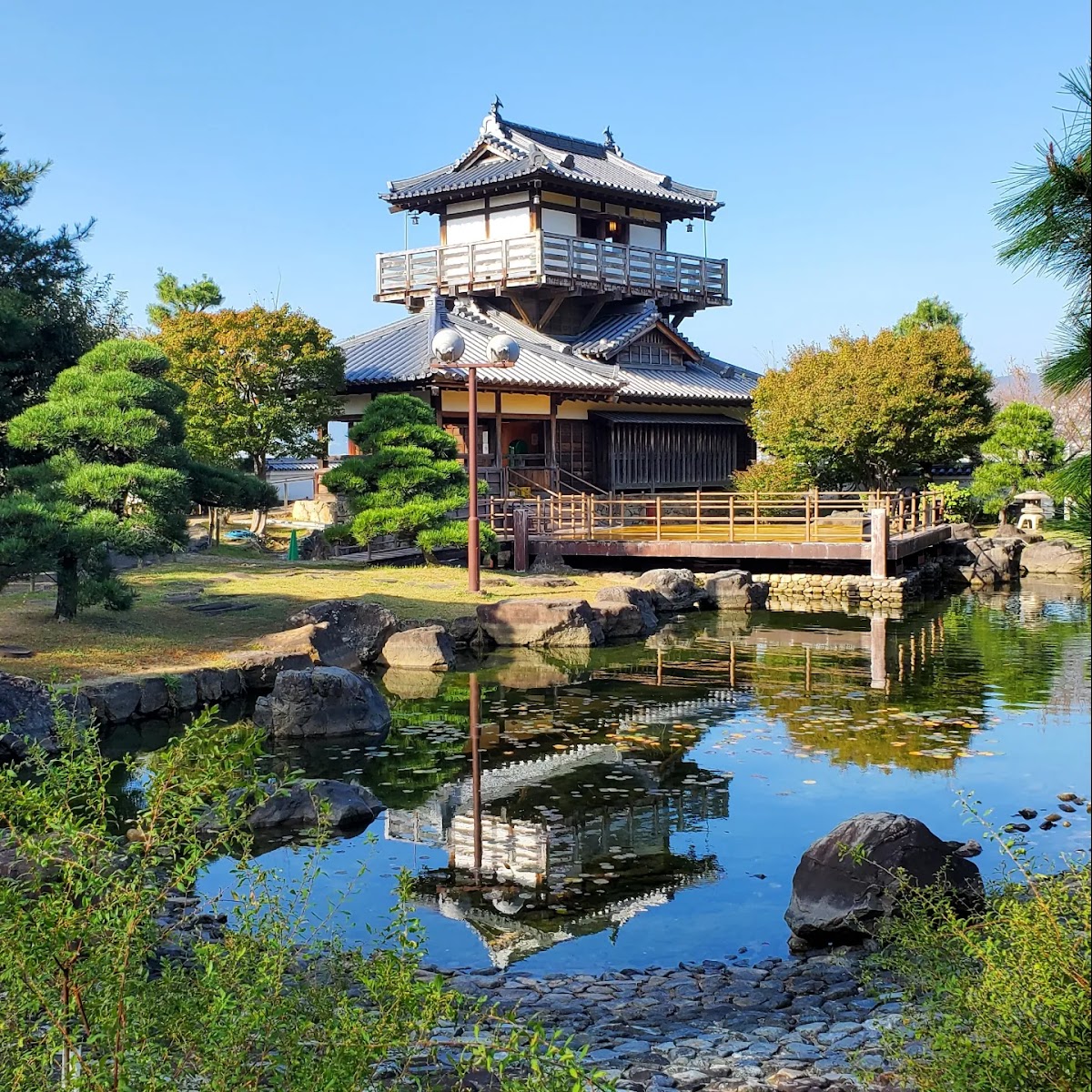
The most popular facility in the park is the Yagura-style Observation Rest House. Built as a replica of a turret base, this two-story observation deck offers panoramic views of Ikeda city from the upper floor.
On clear days, you can see the Shin-Inagawa Bridge (Big Harp) of the Hanshin Expressway, the distant city of Osaka, and even Osaka Bay. During cherry blossom season, the contrast between the carpet of cherry blossoms below and the city is magnificent.
The observation rest house has a rest area where you can sit on benches and enjoy the view at your leisure.
Japanese Garden and Tea House | Experience the Atmosphere of Japan
The park features an authentic Japanese garden. The pond-centered strolling garden is adorned with stone arrangements and lanterns, and the seasonal plantings delight visitors.
The tea house, facing the garden, is a charming building in the sukiya style. While the tea house is usually only viewable from the outside, tea ceremonies and other events are regularly held, providing opportunities for the public to participate.
Archaeological Reconstruction Corner | Experiencing the Results of Excavation
Some of the archaeological remains confirmed during the excavation are reconstructed and displayed on-site. In particular, the well remains have been preserved in their original state and are available for viewing.
The explanatory panels contain detailed information on excavation photographs and unearthed artifacts, allowing visitors to learn about the history of Ikeda Castle from an archaeological perspective.
Administration Building and Exhibition Space
Near the park entrance, the administration building houses an exhibition space related to the history of Ikeda Castle and the excavation. Some of the unearthed artifacts, reconstruction drawings, and copies of ancient documents are on display, allowing visitors to learn more about Ikeda Castle.
The administration building also distributes pamphlets, providing detailed information on the park’s highlights and the history of Ikeda Castle.
Seasonal Highlights
Ikeda Castle Ruins Park offers different attractions throughout the four seasons.
Spring (March-May): Known as a famous cherry blossom viewing spot, it is bustling with many visitors when the Somei Yoshino cherry trees are in full bloom. Azaleas and wisteria also bloom beautifully.
Summer (June-August): The fresh greenery is beautiful, and the Japanese garden is vibrant. The view from the observation deck is stunning against the summer sky.
Autumn (September-November): The autumn leaves color the park, and the maple trees in the Japanese garden are particularly magnificent. On clear autumn days, the view from the observation deck is exceptional.
Winter (December-February): After the leaves have fallen, the topography of the castle ruins is clearly visible. The air is clear, allowing for excellent long-distance views, and the view from the observation deck is considered the most beautiful of the year.
Highlights of Ikeda Castle | Must-See Points for Visitors
Understanding Sengoku Period Defense Techniques from Castle Ruins
At Ikeda Castle ruins, you can actually see examples of Sengoku period castle technology. The remaining earthen ramparts are earthen walls built to prevent enemy intrusion, measuring approximately 2-3 meters in height and 5 meters in width.
Partial remains of the moat also exist, suggesting the possibility that it was once a water moat. These remains indicate that Ikeda Castle was not merely a residence, but a military facility designed for actual combat.
Traces of Stone Walls | Transition to Modern Castles
The foundation of the stone walls confirmed by archaeological excavations is important evidence that Ikeda Castle was remodeled into a modern castle during the late Sengoku period.
While medieval castles primarily relied on earthen ramparts and moats, strong defensive structures using stone walls became common during the late Sengoku period. It is believed that the introduction of stone walls progressed at Ikeda Castle during the time of Ikeda Katsumasa and Araki Murashige. ### Traces of the Castle Town | Townscape Spreading at the Foot of Mt. Satsuki
A castle town once existed around Ikeda Castle. Part of the current Ikeda city area originates from this castle town.
In particular, town names such as “Gofuku-machi” and “Sakae-machi” show remnants of the prosperity of commerce and industry at that time. Ikeda has long been a thriving center of sake brewing and textiles, playing an important economic role as a castle town.
Relationship with Mt. Satsuki | Fortress at the Rear
Mt. Satsuki rises to the north of Ikeda Castle. This mountain, with an elevation of 315 meters, functioned as a natural fortress for Ikeda Castle.
There are traces of multiple forts and watchtowers on Mt. Satsuki, indicating that a defensive network centered around Ikeda Castle was constructed. Even today, it is possible to look down on the Ikeda Castle ruins from Mt. Satsuki, allowing one to appreciate the strategic layout of the time.
Ikeda Castle and Araki Murashige | Conflict with Oda Nobunaga
The Figure of Araki Murashige
Araki Murashige is a figure who played a central role in the most dramatic period in the history of Ikeda Castle. Originally a vassal of the Ikeda clan, he expelled his lord, Ikeda Katsumasa, seized power, and pledged allegiance to Oda Nobunaga.
Murashige was highly valued by Nobunaga as a capable general and was entrusted with the rule of Settsu Province. However, in 1578, he suddenly rebelled against Nobunaga and holed up in Arioka Castle.
The Battle of Arioka Castle and Ikeda Castle
Following Araki Murashige’s rebellion, the Oda army besieged Arioka Castle. It is believed that Ikeda Castle also functioned as a subsidiary castle for Murashige’s forces during this time.
After a siege lasting over a year, Murashige escaped the castle, and his remaining vassals and family were executed by the Oda army. This tragedy is recorded in history as the “Araki Murashige Rebellion.”
Decision to Abandon the Castle | Oda Nobunaga’s Order
After the fall of Arioka Castle, Oda Nobunaga ordered the demolition of surrounding castles, including Ikeda Castle, to prevent a recurrence of rebellions in Settsu Province. In 1580 (Tensho 8), Ikeda Castle was abandoned, its buildings destroyed, and its moats filled in.
This decision marked the end of Ikeda Castle’s 250-year history, but its remains remained buried underground, only to reappear in archaeological excavations 400 years later.
Access to Ikeda Castle Ruins Park | Detailed Directions Guide
Access by Train
From Hankyu Takarazuka Line “Ikeda Station”
The nearest station to Ikeda Castle Ruins Park is Hankyu Takarazuka Line “Ikeda Station.” It is approximately a 15-minute walk from the station.
Exit the station and head north towards Ikeda City Hall. Continue north past City Hall, and you will arrive at the foot of Mt. Satsukiyama. Follow the signs, and you will reach the entrance to Ikeda Castle Ruins Park.
While you will need to walk uphill, the distance is approximately 1 kilometer, which is easily manageable for healthy individuals.
Approximately 20 minutes from Osaka Umeda Station From Osaka Umeda Station, take the Hankyu Takarazuka Line express or semi-express train to Ikeda Station in approximately 20 minutes. It’s an ideal location for a day trip from Osaka city.
Access by Bus
If using Hankyu Bus, take the bus bound for “Satsukiyama Park/Daihoji Temple” from “Ikeda Station” and get off at the “Daihoji Temple” bus stop. Ikeda Castle Ruins Park is approximately a 5-minute walk from the bus stop.
Buses run only 2-3 times per hour, so it is recommended to check the timetable in advance.
Access by Car and Parking
From the Expressway
- Approximately 10 minutes from the Kawanishi-Obana Exit of the Hanshin Expressway Route 11 Ikeda Line
- Approximately 15 minutes from the Ikeda Interchange on the Chugoku Expressway
Parking Information
Ikeda Castle Ruins Park does not have its own parking lot. If you are visiting by car, you will need to use a nearby paid parking lot.
The closest parking lot is the “Satsukiyama Park Parking Lot,” which is approximately a 10-minute walk from Ikeda Castle Ruins Park. Satsukiyama Park Parking Lot is a paid parking lot (approximately 400 yen per car) and can accommodate about 60 cars.
Alternatively, there are several coin-operated parking lots around Ikeda Station, so you can also access the park on foot from there.
Opening Hours and Closing Days
Opening Hours
- April to October: 9:00 AM to 7:00 PM
- November to March: 9:00 AM to 5:00 PM
Closing Days
- Every Tuesday (If Tuesday is a public holiday, the park will be open, and the following weekday will be closed)
- New Year’s Holidays (December 29th to January 1st)
Admission Fee
Free (All facilities are free to use)
Estimated Time Required
A visit to Ikeda Castle Ruins Park usually takes about 1 to 1.5 hours. If you want to carefully view the exhibits, enjoy the view from the observation deck, and stroll through the Japanese garden, about 2 hours will allow you to enjoy it at a leisurely pace.
Tourist Spots Around Ikeda Castle | Places to Visit Together
Satsukiyama Park
Satsukiyama Park, located about a 10-minute walk from Ikeda Castle Ruins Park, is known as a famous spot for cherry blossoms and autumn leaves. Mount Satsukiyama, at an elevation of 315 meters, has well-maintained hiking trails, and from the summit you can enjoy a panoramic view of the Osaka Plain.
There is also the Satsukiyama Zoo (free admission), where you can see Australian animals such as wombats and wallabies up close.
Instant Ramen Museum
Located about a 5-minute walk from Ikeda Station, the “Cup Noodles Museum Osaka Ikeda” is an interactive museum built on the site where Momofuku Ando, the founder of Nissin Foods, invented Chicken Ramen.
You can experience making your own original cup noodles, making it a popular spot for families. It’s ideal to visit in conjunction with Ikeda Castle Ruins Park.
Ikeda City Historical and Folk Museum
This museum allows you to learn about the history and culture of Ikeda City, and also has exhibits related to Ikeda Castle. Visiting before or after visiting Ikeda Castle Ruins Park will give you a deeper understanding of the history of Ikeda Castle.
Gofuku Shrine
This ancient shrine in the center of Ikeda City enshrines the god of weaving. This shrine tells the story of Ikeda’s long history as a thriving textile town, and its grounds are home to ancient trees hundreds of years old.
Notes and Advice for Visiting Ikeda Castle
Clothing and Items to Bring
Ikeda Castle Ruins Park is located on a hillside, so you will need to walk uphill. We recommend wearing comfortable shoes and clothing. Especially in summer, the sun is strong, so it’s a good idea to bring a hat and sunscreen.
Best Season
Ikeda Castle Ruins Park can be enjoyed throughout the year, but the cherry blossom season (late March to early April) and the autumn foliage season (mid to late November) are particularly recommended. Also, the view from the observation deck is especially beautiful in winter when the air is clear.
Shops and Food/Drink Facilities
There are no shops or food/drink facilities within the park. If you need drinks or snacks, we recommend preparing them in advance or purchasing them near Ikeda Station. However, vending machines are available.
Photography Tips
The view from the observation lounge is an excellent photo spot. The cityscape at sunset is particularly beautiful and popular with photography enthusiasts. The replica main gate and the Japanese garden are also recommended photo spots.
Accessibility Information
While there are some stairs and slopes within the park, the main viewing routes are relatively flat. However, access to the upper floors of the observation lounge is only via stairs. If you are considering visiting in a wheelchair, we recommend contacting the Ikeda City Green City Planning Division (Tel: 072-754-6121) in advance.
Summary | Experience the Sengoku Period at Ikeda Castle
Ikeda Castle (Ikeda City, Osaka Prefecture) is a castle with a history of approximately 250 years, serving as the residence of the Ikeda clan, who ruled the northern part of Settsu Province from the Muromachi period to the Sengoku period. It is also known as the residence of Araki Murashige and was the stage for the dramatic history of the Sengoku period, including his conflict with Oda Nobunaga.
Currently developed as Ikeda Castle Ruins Park, it’s a valuable place to experience a Sengoku period castle through archaeologically discovered remains, a reconstructed replica of the main gate, and a replica of a turret base. The view from the observation lounge is magnificent, and it’s a relaxing spot where you can enjoy the changing seasons, loved not only by history buffs but also by local residents.
With excellent access, just about 20 minutes by train from Osaka’s Umeda area, and free admission, it has many attractive features. Nearby attractions include Mayuyama Park and the Instant Ramen Museum, making it easy to spend a whole day enjoying Ikeda City.
Ikeda Castle Ruins Park is a place where you can spend a luxurious time feeling the historical romance of the Sengoku period while being soothed by beautiful scenery and nature. Why not pay a visit sometime?