Complete Guide to Ogimachi Castle Ruins | The History of a Mountain Castle Overlooking Shirakawa-go and its Appeal as an Observation Deck
Located in Ogimachi, Shirakawa Village, Ono District, Gifu Prefecture, the Ogimachi Castle Ruins are a popular tourist spot offering breathtaking views of the Shirakawa-go Gassho-zukuri village, a UNESCO World Heritage Site. However, this is more than just an observation deck. As a mountain castle built during the Sengoku period (Warring States period), it is also an important historical site that conveys the history of the Hida region.
This article provides a detailed explanation of everything about the Ogimachi Castle Ruins, from its historical background to its current appeal as an observation deck, access methods, and information on surrounding attractions.
What is Ogimachi Castle? | An Overview of a Sengoku Period Mountain Castle
Ogimachi Castle was a Japanese mountain castle located in Ogimachi, Shirakawa Village, Ono District, Gifu Prefecture. It is situated on the tip of a plateau at an altitude of approximately 600 meters, north of the current Shirakawa-go Gassho-zukuri village, with a relative height of about 40 meters above the village.
The castle ruins have now been developed as the “Ogimachi Castle Ruins Observation Deck,” making it a must-see photo spot for tourists visiting Shirakawa-go. Taking advantage of its location as a medieval mountain castle built on a sheer cliff, it’s a popular viewpoint offering a panoramic view of the Gassho-zukuri village spread out below.
Castle Location and Geographical Characteristics
Ogimachi Castle is situated on the tip of a plateau overlooking the Ogimachi village along the Shogawa River. This location is militarily advantageous, not only allowing for surveillance of the entire village but also providing a natural stronghold surrounded by cliffs on three sides. With the Shogawa River flowing to the north and steep mountains to the south, it’s a typical medieval mountain castle structure utilizing the terrain.
The castle grounds are relatively compact, with remnants such as earthworks and moats remaining around the main enclosure. Although currently covered in trees, it’s believed that these were cleared to improve visibility in the past, allowing for a wider area of surveillance.
The History of Ogimachi Castle | The Era of the Uchigashima and Yamashita Clans
There are no clear records regarding the construction date of Ogimachi Castle, and there are various theories. However, it is certain that it functioned as a branch castle of the Uchigashima clan during the Sengoku period (Warring States period).
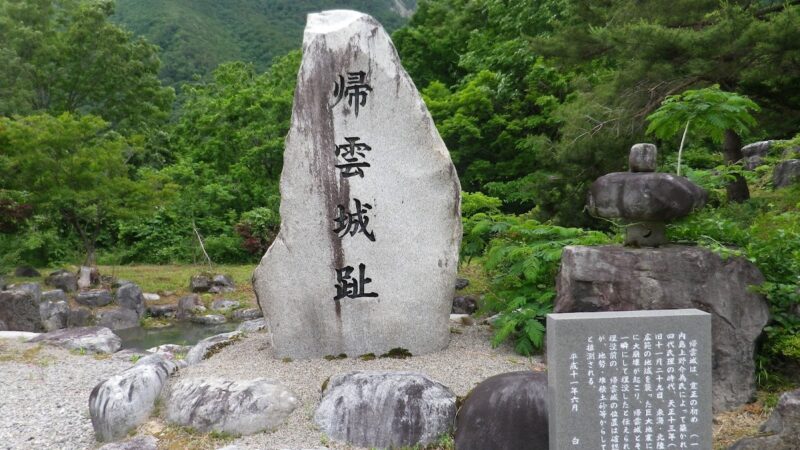
The Uchigashima Clan and Kaerikumo Castle
During the Sengoku period, the Shirakawa-go area was ruled by the Uchigashima clan, who were retainers of the Muromachi Shogunate. The Uchigashima clan, based at Kaerikumo Castle, was a powerful local lord that ruled the entire Shirakawa-go area.
The Uchigashima clan utilized the geographical conditions of the mountainous region of Hida to build their own sphere of influence. Ogimachi Castle was positioned as one of the important branch castles in this Uchigashima clan’s system of rule.
About the Castle Lord, the Yamashita Clan
It is said that the lord of Ogimachi Castle was the Yamashita clan, vassals of the Uchigashima clan. In particular, Yamashita Tokiyoshi and his son, Yamashita Ujikatsu, are believed to have been the lords of the castle.
Yamashita Ujikatsu, also known as Yamashita Yamato-no-kami, played an important role as a chief retainer of the Uchigashima family. It is thought that Ogimachi Castle functioned as a branch castle protecting Kiun Castle, the main castle of the Uchigashima clan, and as a base for directly governing the Ogimachi settlement.
The Tensho Earthquake and the Downfall of the Uchigashima Clan
When discussing the history of Ogimachi Castle, it is impossible to ignore the Tensho Earthquake, which occurred on November 29, 1585 (Tensho 13). This massive earthquake completely buried Kiun Castle, the main castle of the Uchigashima clan, due to a landslide, resulting in the tragedy of the death of almost all of the family, including the head of the clan, Uchigashima Ujizane.
This disaster effectively led to the downfall of the Uchigashima clan, and the system of governance in Shirakawa-go changed dramatically. It is believed that Ogimachi Castle also lost its function as a castle around this time. Subsequently, Shirakawa-go came under the control of the Kanamori clan, and during the Edo period, it became a shogunate territory (directly controlled by the shogunate).
Legends of the Nanboku-cho Period
Regarding Ogimachi Castle, there is a legend that it was used as a hiding place for court nobles of the Southern Court during the Nanboku-cho period. The Hida region was a stronghold of the Southern Court during the turbulent Nanboku-cho period, and the theory that court nobles fleeing the capital hid in the mountainous Shirakawa-go is geographically plausible.
However, there is a lack of reliable historical evidence for this theory, and it remains in the realm of legend. Nevertheless, it is passed down as an interesting story that suggests the possibility that the history of Ogimachi Castle dates back to an even earlier period.
Remains of Ogimachi Castle | Traces of a Mountain Castle Remaining Today
At the Ogimachi Castle site, remnants of a medieval mountain castle still remain. Because it has not undergone major alterations, it is possible to imagine what the mountain castle looked like during the Sengoku period.
Main Enclosure and Baileys
The flat area where the observation deck is located corresponds to the former main enclosure (honmaru). This was the central part of the castle, and it is believed that the lord’s residence and command post were located here. Several baileys (kuruwa) are arranged around the main enclosure, forming a terraced terrain.
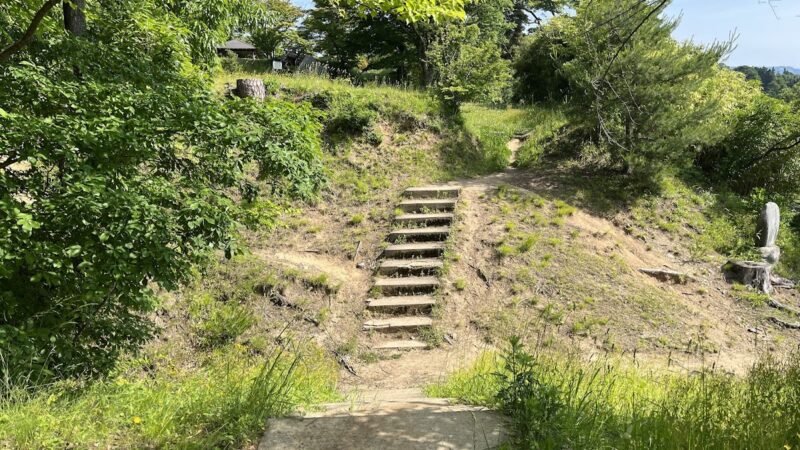
Although currently difficult to discern due to being covered with trees and grass, careful observation reveals artificially leveled surfaces and steps.
Traces of Earthworks
Traces of earthworks remain around the main enclosure. Earthworks are defensive structures built by piling up earth to prevent enemy intrusion, and they functioned as a major defensive line at Ogimachi Castle.
Although their clarity has been lost due to weathering and vegetation, the remnants of the earthworks can still be felt in the undulations of the terrain. For castle researchers and enthusiasts, there is the pleasure of imagining the castle’s former appearance from these subtle changes in topography.
Moats
Moats, a defensive feature unique to mountain castles, are also important remains at the Ogimachi Castle site. Moats are ditches dug to cut across ridges, serving to block enemy advances.
At Ogimachi Castle, moats were constructed on the rear (mountain side) of the castle grounds, indicating preparation for attacks from the mountains. Even today, traces of the moats can be seen as depressions in the terrain.
Preservation of Remains
The Ogimachi Castle site is protected as a designated historical site by Shirakawa Village. While large-scale archaeological excavations have not been conducted, the site has been developed as an observation deck with consideration for the remains, and the basic topography of the mountain castle is well preserved.
Some assessments suggest that very few remains remain, but this refers to the absence of prominent structures such as stone walls and buildings; the castle’s topography as a whole definitely exists. For castle enthusiasts, this simple, unadorned appearance of a mountain castle is particularly appealing.
Ogimachi Castle Ruins Observation Deck | A Stunning View of Shirakawa-go
The current Ogimachi Castle Ruins are now known as the “Ogimachi Castle Ruins Observation Deck,” a popular spot for many tourists. It’s an essential stop for Shirakawa-go sightseeing, offering a superb photo opportunity with panoramic views of the World Heritage site, Shirakawa-go’s Gassho-zukuri village.
View from the Observation Deck
From the observation deck, you can look down on the entire Ogimachi village. The rural landscape dotted with Gassho-zukuri houses, the mountains towering in the background, and the Shogawa River flowing through the village—you can enjoy the beautiful scenery of Shirakawa-go like a painting.
In particular, the sight of the rows of triangular roofs of the Gassho-zukuri houses is a rare and precious sight that can only be seen from this observation deck. It’s also a place where you can truly appreciate the layout and scale of Shirakawa-go as a whole, something you can’t fully grasp just by walking around the village.
Scenery in Every Season
The Ogimachi Castle Ruins Observation Deck shows different expressions in each of the four seasons.
Spring is a beautiful season, with the thatched roofs of the Gassho-zukuri houses standing out against the fresh greenery, and the rice paddies filled with water creating a stunning landscape.
Summer offers a vibrant contrast between the lush green mountains and the blue sky, showcasing the life-giving beauty of Shirakawa-go.
Autumn presents a breathtaking view of the mountains adorned with autumn leaves and the golden rice fields. Late October to early November is considered the most beautiful time.
Winter presents a fantastical landscape of the Gassho-zukuri village covered in snow. Especially during illumination events, you can admire the magical world created by snow and light from the observation deck (however, access to the observation deck may be difficult in winter due to snow).
Best Time for Photography
For those visiting for photography purposes, the time of day is important.
Early Morning allows you to photograph the village illuminated by the morning sun and the mystical landscape shrouded in morning mist. One of its attractions is the quiet atmosphere, with fewer tourists, allowing for peaceful photography.
From morning to noon, the entire village is brightly lit with direct sunlight, making for beautiful photos. The contrast with the blue sky is stunning, allowing you to capture the most standard Shirakawa-go scenery.
In the evening, you can enjoy the warm scenery of the Gassho-zukuri village bathed in the setting sun. The golden roofs and the silhouettes of the mountains create impressive photographs.
During the illumination event, nighttime photography is also popular. However, it is dark and dangerous at night, so adequate equipment and caution are necessary.
Observation Deck Facilities
The observation deck has a wooden deck, allowing you to safely enjoy the view. Handrails are also provided, making it relatively safe even for those with small children.
However, there are no facilities such as toilets or shops, so it is recommended to take care of these needs beforehand within the village. Also, rest facilities such as benches are limited, so you may have to stand during crowded times.
How to Access Ogimachi Castle Ruins
There are two main ways to access the Ogimachi Castle Ruins observation deck: walking and shuttle bus.
Access on Foot
It takes approximately 20-30 minutes to walk from the Ogimachi settlement in Shirakawa-go to the observation deck.
Route: The hiking trail begins near the Shirakawa Hachiman Shrine within the settlement. The path is well-maintained, but as it is a mountain trail, a certain level of physical fitness and appropriate footwear are necessary. Particular caution is needed after rain or in winter, as it can become slippery.
While there are steep sections on the ascent, even those without much physical fitness can reach the top by taking breaks and climbing slowly. The descent takes approximately 15 minutes.
Advantages: You can climb at your own pace, it’s free, and it helps combat a sedentary lifestyle.
Disadvantages: Requires physical fitness, is dependent on weather, and takes time.
Access by Shuttle Bus
A shuttle bus (for a fee) operates from within the settlement.
Boarding Location: Near Seseragi Park Parking Lot
Travel Time: Approximately 5 minutes one way
Fare: Approximately 200 yen one way, 400 yen round trip (may vary depending on the season)
Operating Hours: Approximately 9:00 AM to 4:00 PM (may vary depending on the season)
Frequency: Every 20-30 minutes (may be increased during peak hours)
Advantages: Easy travel, saves time, safe for the elderly and those with physical limitations
Disadvantages: Cost, potential waiting time, limited operating hours
Access by Car
While it is possible to drive to the vicinity of the observation deck, it is not highly recommended due to narrow roads and limited parking space. Especially during peak tourist season, it is wise to park your car in the village parking lot and use the walk or shuttle bus.
Winter Access Precautions
During winter (December to March), the hiking trails become extremely dangerous due to snow. Please note that shuttle bus services may also be suspended. If you are visiting during the winter, we recommend checking the service status with the Shirakawa Village Tourism Association or other relevant organizations beforehand.
Basic Information on Ogimachi Castle Ruins
Location: Ogimachi, Shirakawa Village, Ono District, Gifu Prefecture
Access: 20-30 minute walk from the Ogimachi settlement in Shirakawa-go, or approximately 5 minutes by shuttle bus
Opening Hours: Open 24 hours (however, the shuttle bus has limited operating hours)
Admission Fee: Free (separate fee for shuttle bus use)
Parking: Limited space available near the observation deck (use of the settlement’s parking lot is recommended)
Estimated Time Required: Approximately 15-30 minutes at the observation deck
Restrooms: None at the observation deck (use of restrooms in the settlement beforehand is recommended)
Inquiries: Shirakawa Village Office Tourism Promotion Division TEL: 05769-6-1311
Designation: Shirakawa Village Designated Historic Site
Best Season: Spring to Autumn (especially May with its fresh greenery and late October to early November with its autumn foliage)
Nearby Tourist Attractions
When visiting Ogimachi Castle Ruins, be sure to explore other fascinating spots in Shirakawa-go.
Shirakawa-go Gassho-zukuri Village
The Gassho-zukuri village, a UNESCO World Heritage Site, is the main attraction of Shirakawa-go. Gassho-zukuri houses, dating back to the Edo period, are still used as living spaces, allowing visitors to experience a quintessential Japanese landscape.
Several Gassho-zukuri houses within the village are open to visitors, allowing you to learn about their internal structure and lifestyle. Representative examples include the Wada, Kanda, and Nagase houses.
Shirakawa Hachiman Shrine
This shrine is located near the starting point of the hiking trail to Ogimachi Castle Ruins. Famous for its annual Doburoku Festival held in autumn, it is a central place of worship in Shirakawa-go. The shrine grounds offer a panoramic view of the village, and its tranquil atmosphere is a major draw.
Myozenji Local History Museum
This is a rare temple with a Gassho-zukuri main hall and living quarters. The temple’s living quarters are open to the public as a local history museum, exhibiting the history, culture, and daily life tools of Shirakawa-go. It’s a valuable facility where you can closely examine the internal structure of the gassho-zukuri architecture.
Open-Air Museum: Gassho-zukuri Folk House Garden
This open-air museum features 25 gassho-zukuri houses, including 9 designated as important cultural properties of the prefecture, that have been relocated and preserved. Each building represents a different era and purpose, allowing visitors to comprehensively learn about the architectural culture of Shirakawa-go.
Deai Bridge
This suspension bridge connects Seseragi Park and the Ogimachi settlement, spanning the Shogawa River. From the bridge, you can enjoy views of the settlement and surrounding mountains, making it a popular photo spot.
Kumo Castle Ruins
The ruins of Kumo Castle, the main castle of Ogimachi Castle, are located in the Hokiwaki district of Shirakawa Village. Although little remains survive due to landslides during the Tensho earthquake, it is a historical site worth visiting as it tells the story of the tragedy of the Uchigashima clan.
Tips and Advice for Visiting Ogimachi Castle Ruins
Clothing and Items to Bring
If you plan to walk to the observation deck, comfortable walking shoes are essential. Hiking shoes or sneakers are ideal; avoid sandals and high heels.
Seasonal clothing is also important. The temperature on the mountaintop is lower than in the village, and it can be windy. Layering is especially recommended in spring and autumn.
Prepare drinks in advance. There are no shops at the observation deck, so bring plenty of water to prevent heatstroke, especially in summer.
A camera is a must-have item. Bring a fully charged camera or smartphone to capture the spectacular scenery of Shirakawa-go.
Tips for Avoiding Crowds
Shirakawa-go is a very popular tourist destination, and it gets extremely crowded, especially on weekends, holidays, Golden Week, and during the autumn foliage season.
Visiting early in the morning is the most effective strategy. Visiting the observation deck around 7-8 AM will allow you to enjoy the view almost entirely to yourself. Furthermore, the village illuminated by the morning light is especially beautiful and perfect for photography.
Visiting on weekdays is also effective in avoiding crowds. If possible, visiting on a weekday will allow you to enjoy the scenery at a leisurely pace.
During the off-season in winter, there are fewer tourists, but Shirakawa-go in the snow is also beautiful, and you can enjoy a quiet atmosphere. However, you need to consider the balance between this and the difficulty of access.
Safety Precautions
The hiking trails are well-maintained, but remember that it is a mountain trail. It becomes especially slippery during and after rain.
The observation deck is on top of a cliff, so absolutely avoid stepping outside the railing or taking photos in dangerous areas.
Beware of bears signs may be posted. Avoid traveling alone and it is recommended to carry a bell or similar device.
Winter is extremely dangerous due to freezing and snow. Avoid unnecessary visits and prioritize safety.
Manners and Etiquette
Shirakawa-go is a World Heritage Site and a residential settlement where people still live. Please respect the privacy of the residents and refrain from trespassing on private property or speaking loudly.
Taking your trash with you is essential. There are no trash cans around the observation deck.
The use of drones is prohibited in principle. Please do not use them as this is regulated by Shirakawa Village ordinance.
During crowded times, please be considerate. Especially at photo spots, avoid occupying them for extended periods and be considerate of other tourists.
Cultural Value of Shirakawa-go and Ogimachi Castle
Shirakawa-go as a World Heritage Site
The Shirakawa-go and Gokayama Gassho-zukuri villages were registered as a UNESCO World Cultural Heritage Site in 1995. The reason for registration was the recognition of the unique Gassho-zukuri architectural style, a culmination of human wisdom and technology adapted to a harsh natural environment, and the fact that it still functions as a living space today.
The Ogimachi Castle Ruins Observation Deck is an essential part of Shirakawa-go sightseeing, as it is the only place where you can enjoy a panoramic view of this World Heritage site.
Historical Value as a Mountain Castle
The Ogimachi Castle Ruins are an important historical site that tells the story of the medieval history of the Hida region. It conveys a multi-layered history, including the rule of the Uchigashima clan, the structure of a mountain castle from the Sengoku period, and the memory of the Tensho Great Earthquake, a natural disaster.
Compared to the large-scale stone walls and keeps of modern castles, it may seem unassuming, but it is precisely these simple mountain castles that are valuable legacies that convey the true image of local samurai during the Sengoku period.
Fusion of Landscape and History
What is particularly noteworthy about the Ogimachi Castle Ruins is that a scenic spot and a historical site are integrated. Many tourists visit as an observation deck, but a mountain castle from the Sengoku period lies beneath.
Standing in this place, you can not only appreciate the beautiful scenery of today, but also reflect on the history of the people who once ruled this land. This is truly an ideal historical site where you can learn about history while enjoying the scenery.
Model Course for Maximizing Your Enjoyment of Ogimachi Castle Ruins
We propose an efficient model course for sightseeing in Shirakawa-go that includes Ogimachi Castle Ruins.
Half-Day Course (3-4 hours)
9:00 Arrive in Shirakawa-go, park at Seseragi Park parking lot
9:15 Walk or take shuttle bus to Ogimachi Castle Ruins Observation Deck
9:30-10:00 Enjoy the scenery and take photos at the observation deck
10:15 Return to the village
10:30-11:30 Stroll through the village (visit gassho-zukuri houses such as Wada House and Kanda House)
11:30-12:30 Lunch (local cuisine such as soba noodles and Hida beef)
12:30-13:00 Souvenir shopping, free time
Full-Day Course (6-7 hours)
7:00 Arrive in Shirakawa-go early in the morning (to avoid crowds)
7:15-8:00 Enjoy the morning scenery at Ogimachi Castle Ruins Observation Deck
8:15-9:00 Visit to Shirakawa Hachiman Shrine
9:00-10:00 Visit to Myozenji Local History Museum
10:00-11:30 Visit to the Open-Air Museum, Gassho-zukuri Folk House Garden
11:30-12:30 Lunch
12:30-14:00 Visit to Gassho-zukuri houses in the village (Wada House, Kanda House, Nagase House, etc.)
14:00-15:00 Stroll through the village, visit Deai Bridge, take photos
15:00-16:00 Souvenir shopping, rest at a cafe
16:00 Return to the observation deck (the evening view is also beautiful)
Summary | A special place where history and spectacular scenery intersect
Ogimachi Castle Ruins is a very unique place, combining the historical value of a mountain castle from the Sengoku period with the tourist value of a spectacular viewpoint overlooking the World Heritage site of Shirakawa-go.
From its history as a branch castle of the Uchigashima clan, to the tragedy of the Tensho earthquake, and its current role as an observation deck, this small mountain castle is steeped in a multi-layered narrative.
When visiting Shirakawa-go, be sure to stop by the Ogimachi Castle Ruins Observation Deck. Enjoy the beautiful view of the Gassho-zukuri village spread out below while reflecting on the history of the people who once ruled this land. Ogimachi Castle Ruins offers a truly luxurious experience.
The ever-changing scenery of Shirakawa-go throughout the seasons, the quiet remnants of the castle’s history that tell of the Sengoku period, and the traditional lifestyle and culture that has been passed down to the present day—all these elements intersect at Ogimachi Castle Ruins, a special place where you can experience Japanese history and culture, continuing to deeply move visitors.