Complete Guide to the History and Highlights of Nagashino Castle | A Thorough Explanation of the Fierce Battlefield of the Sengoku Period
What is Nagashino Castle?
Nagashino Castle (Nagashino-jo) is a flatland castle from the Sengoku period located in Nagashino, Shinshiro City, Aichi Prefecture. Also known as Ogi Castle and Suehiro Castle, this castle is known as a natural stronghold built at the confluence of the Toyokawa and Uregawa rivers. It particularly made its mark on history in the battles preceding the Battle of Nagashino in 1575, and is now preserved as a nationally designated historical site.
The greatest feature of Nagashino Castle lies in its location. Situated on a terrace approximately 60 meters above sea level, sandwiched between two rivers, its layout, unfolding like a fan with the river confluence at its back, represented the pinnacle of castle-building technology at the time. This topographical advantage later became a factor in its ability to withstand the fierce attacks of the Takeda army.
Selected as one of Japan’s 100 Famous Castles, Nagashino Castle is a valuable historical site that preserves the remains of a castle from the Sengoku period, attracting many history enthusiasts and tourists.
History and Background of Nagashino Castle
Construction and Early History
While there are various theories regarding the construction date of Nagashino Castle, the most widely accepted theory is that it was built around 1508 (Eisho 5) by Suganuma Motonari. The Suganuma clan held power as local lords in Okumikawa, and by establishing a castle at Nagashino, a strategic point in the region, they controlled a vital transportation hub connecting Mikawa and Shinano provinces.
The Nagashino Suganuma clan was at one point under the influence of the Imagawa clan, but amidst the complex power dynamics of the Sengoku period, they found themselves in a fluctuating position between the Imagawa, Takeda, and Tokugawa clans. During the Eiroku era (1558-1570), with the decline of the Imagawa clan, they came under the influence of Tokugawa Ieyasu.
Takeda Shingen’s Invasion and Changes in Castle Lords
In 1571, when Takeda Shingen’s invasion of Mikawa Province intensified, Nagashino Castle came under attack from the Takeda clan. The then-lord of the castle, Suganuma Masasada, surrendered to the Takeda army, and the castle came under Takeda control. During this period, Nagashino Castle functioned as a base for the Takeda clan’s invasion of Mikawa.
In 1573, after the death of Takeda Shingen, Tokugawa Ieyasu sought to recover lost territory and ordered Okudaira Sadamasa (Nobumasa) to recapture Nagashino Castle. The Okudaira clan, as important retainers of the Tokugawa clan, were entrusted with the defense of this crucial stronghold. This change in castle lord laid the groundwork for the later siege of Nagashino Castle.
The Siege of Nagashino Castle
In May 1575, Takeda Katsuyori led a large army of 15,000 men to besiege Nagashino Castle. The castle was defended by a small force of only about 500 men, led by Okudaira Sadamasa, but they made the most of the strong terrain protected by two rivers and withstood the fierce attacks of the Takeda army.
The siege was extremely arduous; food supplies ran out inside the castle, and the soldiers continued to resist while battling starvation. During this time, the episode of Torii Suneemon breaking through enemy lines to request reinforcements from Tokugawa Ieyasu at Okazaki Castle is particularly famous. Suneemon accomplished his mission, but on his return journey he was captured by the Takeda army and forced to call for surrender from the castle’s defenders. However, he instead shouted, “Hold on, reinforcements are coming!” and was executed by crucifixion. This courageous act greatly boosted the morale of the castle’s defenders.
The Battle of Nagashino and the Aftermath of the Castle
During the siege, a combined force of 38,000 men led by Tokugawa Ieyasu and Oda Nobunaga rushed to the castle’s aid and confronted the Takeda army at Shitaragahara. On May 21, 1575 (Tensho 3), the Oda-Tokugawa allied forces defeated the Takeda army with innovative tactics: horse barricades and a three-stage volley of muskets. This is the famous “Battle of Nagashino” in Japanese history.
This battle significantly weakened the Takeda clan, and Nagashino Castle was secured as Tokugawa territory. Afterward, the castle was defended by the Okudaira clan and continued to function as an important branch castle in the Tokugawa’s rule of Mikawa Province.
In 1590 (Tensho 18), when Tokugawa Ieyasu was transferred to the Kanto region, a general of the Toyotomi clan took up residence in Nagashino Castle. After the Battle of Sekigahara, it once again became a Tokugawa castle, but its strategic importance declined during the Edo period, and it was abandoned in 1615 due to the “One Castle Per Province” decree.
Structure and Layout of Nagashino Castle
Construction Utilizing the Topography
The most distinctive feature of Nagashino Castle is its location at the confluence of two rivers, the Toyokawa and the Uregawa. The rivers flowed to the east and south of the castle, functioning as natural moats. This topography made the castle an impregnable fortress, surrounded by water on three sides.
The terrace on which the castle was built had a relative height of approximately 20 meters, and the difference in elevation from the river surface further enhanced its defensive capabilities. The only weak point, the west side (connected to land), was fortified with artificial moats and earthworks.
Arrangement of the Main and Second Baileys
The layout of Nagashino Castle was a typical concentric structure, with the main bailey at the center and the second and third baileys arranged around it. The main keep (Honmaru) was located at the innermost part of the castle, near the confluence of the rivers, and housed the lord’s residence and important facilities.
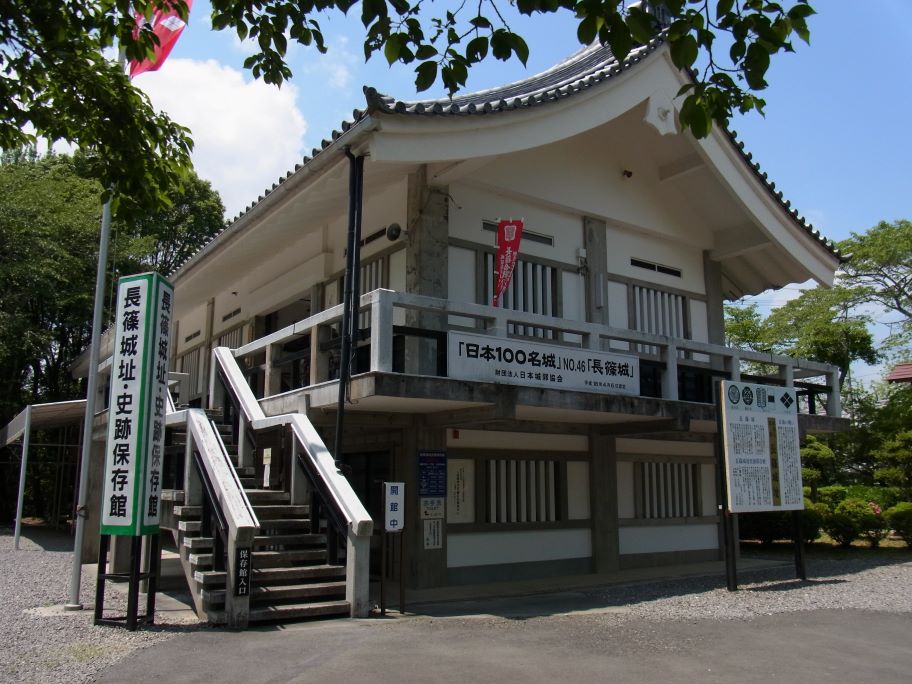
The second enclosure (Ninokuruwa) was located to the west of the main keep and occupied a larger area. It is believed that this area contained the residences of retainers and barracks. The current site of the Nagashino Castle Ruins Historical Preservation Museum is also part of the former second enclosure.
The third enclosure (Sannomaru) extended further west and served as the point of contact with the castle town. The main gate (Otemon) was located in this third enclosure and served as the main entrance to the castle.
Characteristics of Defensive Facilities
A notable feature of Nagashino Castle’s defensive facilities is the arrangement of earthworks and dry moats. A dry moat, approximately 10 meters wide and 5 meters deep, was dug along the western landmass, and an earthwork approximately 3 meters high was built inside it.
Furthermore, an outwork called “Nogyu-kaku” was constructed within the castle grounds, extending the castle’s defensive range. This Nogyu-kuruwa (wild ox enclosure) can still be seen as a geographical feature today, allowing us to understand the ingenuity of the castle’s layout at the time.
The fan-shaped layout, which gave rise to its alternative names, Ogi-jo (Fan Castle) and Suehiro-jo (Suehiro Castle), was centered around the confluence of rivers and widened towards the west. This shape allowed for efficient defense even with limited forces.
Remains of Nagashino Castle
Existing Earthworks and Moats
At the Nagashino Castle site, some of the earthworks and dry moats from that time remain in good condition. In particular, the earthwork separating the main keep and the second keep remains, approximately 2 meters high, making it a valuable relic that allows us to experience the castle’s structure at the time.
Near the site of the main gate on the west side, the remains of a deep dry moat are clearly visible, and it is possible to walk along the bottom of the moat. This moat has a V-shaped cross-section called a Yagenbori (vector-shaped moat), and was an effective defensive structure to prevent enemy intrusion.
A walking path has now been constructed on top of the earthworks, offering panoramic views of the entire castle site. Looking down from the top of the earthen rampart, you can truly appreciate the castle’s location and the ingenuity of its layout.
River Confluence and Cliffs
The confluence of the Toyokawa and Uregawa rivers is one of the greatest highlights of Nagashino Castle. This confluence, stretching out behind the main keep, functioned as a natural defensive line for the castle. Even today, the riverbanks are steep cliffs, illustrating how difficult it would have been to attack the castle from here.
The cliffs along the riverbanks are approximately 10 to 15 meters high, forcing the Takeda army to abandon attacks from this direction during sieges. The river’s flow remains unchanged, preserving the landscape of the Sengoku period.
Monument to Torii Suneemon’s Crucifixion
On the south side of the castle ruins, across the Toyokawa River, stands a stone monument marking the spot where Torii Suneemon was crucified. This monument was erected during the Meiji era by local volunteers and commemorates the loyalty of Kyōemon.
The area around the monument has been developed as “Kyōemon’s Monument Park,” and can be viewed from the castle ruins. Imagining the feelings of the castle soldiers who saw Kyōemon crucified at this spot during the siege, one can feel the weight of history.
View of Ushibuchi Bridge and the Castle
From Ushibuchi Bridge, which spans the Toyokawa River, you can enjoy a panoramic view of the Nagashino Castle ruins. This bridge is also an access route to Nagashino Castle, and the view from the bridge best illustrates the castle’s strategic location between two rivers.
In particular, this spot, offering a panoramic view of the cliffs of the main keep and the confluence of the rivers, is a popular photography spot. In spring, cherry blossoms, and in autumn, autumn leaves color the castle ruins, allowing visitors to enjoy the beautiful scenery of each season.
Nagashino Castle Ruins Historical Site Preservation Museum
Exhibits
The Nagashino Castle Ruins Historical Site Preservation Museum is a museum built on the site of the castle’s second bailey, exhibiting valuable historical materials related to Nagashino Castle and the Battle of Nagashino. Inside, you can see illustrations depicting the siege and the Battle of Nagashino, weapons, and ancient documents, allowing you to learn about the history of the Sengoku period in detail.
Of particular note is the reproduction of a folding screen painting depicting the siege of Nagashino Castle. This painting depicts the castle under siege by the Takeda army and the exploits of Torii Suneemon in detail, allowing you to visually understand the situation at the time.
Also on display are actual artifacts unearthed during archaeological excavations, such as pottery, bullets, and arrowheads, providing clues to understanding life in the castle and the realities of combat.
Matchlock Gun Exhibition
The Battle of Nagashino is famous for the three-stage volley tactic of matchlock guns used by the Oda-Tokugawa allied forces. The museum displays replicas of matchlock guns used at the time, allowing visitors to learn about their structure and usage.
Regular demonstrations of matchlock guns allow visitors to witness actual firing using gunpowder, offering a valuable opportunity to experience the tactics of the Sengoku period (Warring States period).
Opening Hours
The Nagashino Castle Ruins Historical Site Preservation Museum is open from 9:00 AM to 5:00 PM (last entry at 4:30 PM). It is closed on Tuesdays (or the following day if Tuesday is a public holiday) and during the New Year holidays. Admission is reasonably priced at 220 yen for adults and 100 yen for elementary and junior high school students.
A curator is always on duty, and detailed explanations about Nagashino Castle and the Battle of Nagashino are available. For group visits, it is possible to request a professional guide by contacting them in advance.
Access and Local Information
Access by Train
The nearest station to Nagashino Castle by train is Nagashino-jo Station on the JR Iida Line. As the station name includes the character for “castle,” it’s a station geared towards tourists visiting the castle ruins. The castle ruins are easily accessible, located about 500 meters (approximately an 8-minute walk) from Nagashino Castle Station.
Nagashino Castle Station is unmanned, but the station building has a simple information panel about Nagashino Castle and the Battle of Nagashino. The path from the station to the castle ruins is well-marked, so you should arrive without getting lost.
Since the JR Iida Line has infrequent service, it’s recommended to check the timetable before your visit. The journey from Toyohashi Station to Nagashino Castle Station takes approximately 40 minutes; from Nagoya, you’ll need to transfer at Toyohashi Station.
Access by Car
If traveling by car, the Shinshiro Interchange on the Shin-Tomei Expressway is convenient. From the interchange, head north on National Route 151 for approximately 15 minutes (about 10 kilometers) to reach the Nagashino Castle ruins. Alternatively, if using the Chuo Expressway, head south on National Route 151 from the Sonohara Interchange for approximately 40 minutes.
The Nagashino Castle Ruins Historical Preservation Museum has a free parking lot that can accommodate approximately 30 regular cars. While it can get crowded during peak tourist seasons and weekends, there is usually ample parking space. Large buses can also visit, and parking spaces can be reserved with prior notice.
When using a car navigation system, setting “Nagashino Castle Ruins Historical Preservation Museum” (22-1 Ichiba, Nagashino, Shinshiro City, Aichi Prefecture) as your destination is recommended.
Nearby Tourist Attractions
After visiting Nagashino Castle, be sure to explore the related historical sites in the surrounding area. Most important is Shitaragahara, the main battlefield of the Battle of Nagashino. Located about 10 minutes by car from Nagashino Castle, the Shitaragahara Historical Museum features replicas of horse barricades and exhibits recreating the formations of the musketeers.
Iōji Temple houses graves commemorating the fallen soldiers of the Takeda army and is known as a historical site that tells the story of the fierce battle of Nagashino. Furthermore, numerous historical sites related to the Battle of Nagashino are scattered throughout Shinshiro City, and the area has been developed as the “Nagashino-Shitaragahara Battle Historical Site Tour.”
For those who want to enjoy nature, Mt. Horaiji and Yutani Onsen are also recommended. Mt. Horaiji is known as a famous spot for autumn foliage, and climbing the 1,425 stone steps to the temple provides good exercise. Yutani Onsen is a hot spring resort along the Ure River, perfect for relaxing after visiting the castle ruins.
Points to Note During Your Visit
Allow approximately 1 to 2 hours for your visit to the Nagashino Castle Ruins. It’s recommended to gain some background knowledge at the Nagashino Castle Ruins Historical Site Preservation Museum before exploring the actual castle ruins to deepen your understanding.
Since the castle ruins are basically outdoors, it’s recommended to wear comfortable shoes and clothing. Particular caution is needed when walking on earthworks and moat remains, as the ground can become slippery after rain. In summer, the sun is strong, so bring a hat, sunscreen, and drinks.
From the castle ruins, you can see the confluence of the Toyokawa and Uregawa rivers, and the view from the main keep is especially a must-see. Also, don’t forget to view the entire castle ruins from Ushibuchi Bridge. For photography, the morning light beautifully illuminates the castle ruins, so it’s recommended.
Nagashino Castle and Japan’s 100 Famous Castles
Nagashino Castle is the 46th castle in the “Japan’s 100 Famous Castles” list selected by the Japan Castle Association. This selection comprehensively evaluates the castle’s historical importance, the state of preservation of its remains, and its value as a cultural property.
The 100 Famous Castles stamp is located at the Nagashino Castle Ruins Historical Preservation Museum and can be stamped during opening hours. The stamp features a design of Nagashino Castle’s layout, making it an important point of interest for those visiting all 100 castles.
The reason Nagashino Castle was selected for the 100 Famous Castles list is not simply its value as a castle, but also its connection to the Battle of Nagashino, a crucial battle in Japanese history. As the site of a battle that marked a turning point in tactical development during the Sengoku period, Nagashino Castle is highly regarded for its historical significance.
Designation of Nagashino Castle as a Cultural Property
Nagashino Castle ruins were designated a National Historic Site on December 17, 1929. The designated area covers approximately 3.6 hectares, including the main keep, second bailey, and third bailey, and the main parts of the castle are almost completely protected.
Due to its designation as a National Historic Site, any alteration to the castle ruins requires permission from the Commissioner of the Agency for Cultural Affairs, thus protecting it from development. This has ensured that the remains of the Sengoku period castle are preserved in excellent condition and passed down to future generations.
Shinshiro City is actively working to preserve and utilize the historic site, conducting regular grass cutting, maintaining walking paths, and installing information boards. Furthermore, archaeological excavations are continuously being conducted, and new discoveries are expected.
Points to Note When Visiting Nagashino Castle
Nagashino Castle ruins are an outdoor historical site and are open to visitors 24 hours a day. However, visiting at night is dangerous due to poor visibility. We recommend visiting during daylight hours.
There are steep slopes and steps within the castle ruins, so extra caution is needed, especially if you are visiting with small children. Also, there are areas along the riverbank cliffs where fences are not installed, so please be very careful to avoid falling.
As the castle ruins are a valuable cultural asset, damaging the earthworks or stone walls, or collecting plants is strictly prohibited. Please take all your trash with you and cooperate in the preservation of the historical site.
Pets are allowed, but please keep them on a leash at all times and be sure to clean up after them to avoid disturbing other visitors.
The Four Seasons of Nagashino Castle
Nagashino Castle ruins offer different scenery throughout the four seasons.
In spring (late March to early April), the cherry blossoms around the castle ruins are in full bloom, making it a popular spot for cherry blossom viewing. The cherry blossoms at the main keep site are particularly magnificent, creating a beautiful landscape with the contrast between the historical site and the blossoms.
In summer (June to August), the fresh greenery is vibrant, and the clear waters of the Toyokawa and Uregawa rivers provide a refreshing coolness. However, the sun is strong and temperatures are high, so heatstroke prevention is essential.
Autumn (late October to mid-November) is the season for autumn leaves. The trees surrounding the castle ruins turn red and yellow, making it arguably the most beautiful season. The autumn foliage along the river is particularly impressive.
In winter (December to February), there are fewer visitors, allowing for a peaceful exploration of the historical site. The air is clear, resulting in excellent views from the castle ruins. Snowfall is rare, but cold weather precautions are necessary.
Summary
Nagashino Castle is a valuable historical site that conveys the turbulent events of the Sengoku period. Built on a natural stronghold at the confluence of the Toyokawa and Uregawa rivers, the castle withstood the fierce attacks of the Takeda army and became the catalyst for the Battle of Nagashino, a battle that changed the course of Japanese history.
The remaining earthworks, moats, and the landscape of the river confluence allow us to imagine what the castle looked like in its heyday. Visiting the castle ruins in conjunction with a visit to the Nagashino Castle Ruins Historical Preservation Museum will allow you to gain a deeper understanding of the history of the Sengoku period.
Its convenient access, within walking distance of Nagashino-jo Station on the JR Iida Line, is also a major draw. As one of Japan’s 100 Famous Castles and the site of the Battle of Nagashino, it is a historical site recommended not only for history buffs but also for general tourists.
When you visit Shinshiro City in Aichi Prefecture, be sure to visit the Nagashino Castle ruins and feel the spirit of the Sengoku period. Walking the actual site of the battle that marked a turning point in history, you will experience a sense of history that cannot be found in textbooks.