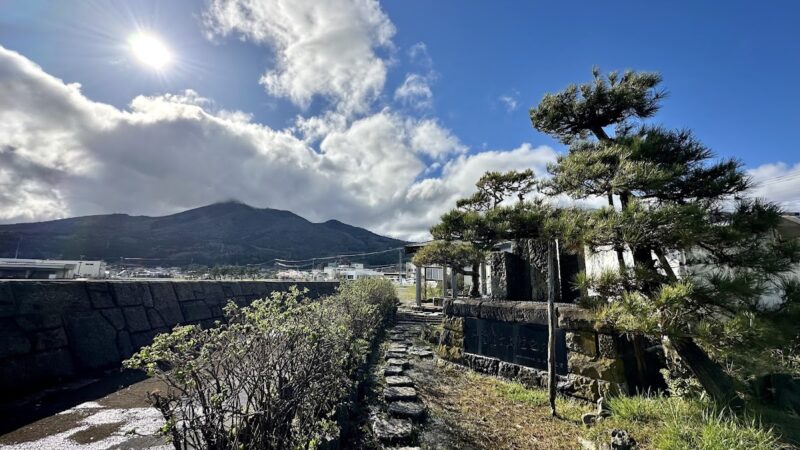
Complete Guide to the History and Highlights of Tanabu Castle (Tanabu-kan) | Medieval Castle in Mutsu City, Aomori Prefecture
What is Tanabu Castle?
Tanabu Castle (Tanabu-jo) is a hilltop castle dating from the medieval to early modern period, located in Ogawa-cho, Mutsu City, Aomori Prefecture. Also known as “Tanabu-kan (Tanabu-date),” it is now maintained as Daikanyama Park. Well-preserved remains such as double dry moats and earthworks remain, and it functioned as an important base within the Nanbu clan’s sphere of influence on the Shimokita Peninsula.
Basic Information on Tanabu Castle
Location: 2-chome, Ogawa-cho, Mutsu City, Aomori Prefecture
Former Province: Mutsu Province
Classification/Structure: Hilltop Castle
Year of Construction: Kenmu era (1334-1338) or early Nanboku-cho period
Builder: Akahoshi Goro (Akame Goro)
Main Lords: Akahoshi clan, Nitta clan, Hachinohe Nanbu clan magistrate
Year of Abandonment: Early Meiji period
Remains: Double dry moat, earthworks, bailey remains
Current Status: Developed as Daikanyama Park
History of Tanabu Castle
Founded during the Nanboku-cho period
The history of Tanabu Castle dates back to the Nanboku-cho period, specifically the Kenmu era (1334-1338). It is said that the origins of Tanabu Castle lie in Nanbu Moriyuki, who was based at Hachinohe Castle, strengthening his control over the Shimokita Peninsula by appointing his vassals, Takeda Shuri and Akame Goro (Akahoshi Goro), as deputies to Tanabu.
Akahoshi Goro built a castle on the eastern edge of the hilly area on the right bank of the Ogawa River, making it his base of operations. Tanabu had long flourished as the center of the Shimokita Peninsula and was also a key point for maritime traffic, making it a strategically important location for the Nanbu clan.
The Kakizaki Kurōdo Rebellion and the Change of Castle Lord
The most important turning point in the history of Tanabu Castle was the “Kakizaki Kurōdo Rebellion,” which occurred from Kōshō 2 to 3 (1456-1457).
At that time, Akahoshi Saburō Arishige, the son of Akahoshi Goro, served as the lord of Tanabu Castle. During this period, Kakizaki Kurōdo Nobuzumi, the lord of Kakizaki Castle, rebelled against the Nanbu clan. In response to this rebellion, Nanbu Masatsune, the head of the Hachinohe Nanbu clan, dispatched a large army to suppress it.
After fierce fighting, Tanabu Castle fell, and Kakizaki Kurōdo Nobuzumi fled to Ezo (Hokkaido). Following the suppression of this rebellion, Tanabu became a direct territory of the Hachinohe Nanbu clan, and Nitta Morimasa entered Tanabu Castle as its castellan. From then on, Tanabu Castle functioned as an important branch castle of the Hachinohe Nanbu clan.
From the Sengoku Period to the Early Edo Period
During the Sengoku period, it is believed that Ataka Ukon, a vassal of the Nanbu family, was stationed at Tanabu Castle. During this period, Tanabu continued to play an important role as a base for the Nanbu clan on the Shimokita Peninsula.
In the early Edo period, Kikuchi Masaoki, who also served the Nanbu family, used it as his residence. During the Edo period, the Nanbu Domain designated Tanabu as a territory under the jurisdiction of a magistrate’s office, and initially, the Tanabu magistrate was stationed at Jōnenji Temple.
Establishment of the Tanabu Magistrate’s Office
In 1661 (Kanbun 1), the Tanabu Magistrate’s Office was moved from Jōnenji Temple to the site of the former Tanabu Castle. This transformed the Tanabu Castle, a medieval castle, into the Tanabu Magistrate’s Office, a modern administrative center.
The Tanabu Magistrate’s Office functioned as an important branch office of the Nanbu Domain, governing the entire Shimokita Peninsula. The office handled a wide range of duties, including tax collection, maintaining public order, and civil administration, and continued to function as a governing center for the Shimokita region throughout the Edo period.
From the Late Edo Period to the Meiji Era
During the late Edo period, when Aizu domain samurai who were defeated in the Boshin War were transferred to form the Tonami Domain, Tanabu became one of its central areas. Near the Tanabu Magistrate’s Office is Entsuji Temple (Tanabu Jinya), which remains a historical site of the Tonami Domain. Furthermore, a monument marking the landing site of Tonami Domain samurai stands within Mutsu City, signifying the important role this region played in the history of the Meiji Restoration.
With the abolition of the feudal domains and establishment of prefectures in the Meiji era, the Tanabu Magistrate’s Office was abolished, marking the end of the historical role of Tanabu Castle.
Layout and Structure of Tanabu Castle
Location and Topography
Tanabu Castle is a flatland castle built on a hilly area on the right bank of a small river. The eastern end of the hilly area is separated by a moat, forming an independent castle area. This location utilizes the advantageous terrain, providing a high vantage point overlooking the surrounding area while being protected from the rear by the hills.
Castle Structure
Tanabu Castle is thought to be a single-enclosure castle surrounded by earthen ramparts. The castle’s layout strongly retains the characteristics of a medieval castle, prioritizing defense through moats and earthworks rather than complex bailey arrangements.
The castle grounds are relatively compact, with a practical design that combines residential and defensive functions. While it’s believed the building layout was altered to suit administrative functions when it was used as a magistrate’s office during the Edo period, the basic layout is presumed to have followed that of the medieval period.
Remains and Highlights of Tanabu Castle
Double Dry Moat
The greatest highlight of Tanabu Castle is its well-preserved double dry moat. This double moat was a major defensive structure protecting the castle grounds and can still be clearly seen within Daikanyama Park.
The double moat structure prevents enemy intrusion in two stages, demonstrating the high level of defensive technology in medieval castles. The depth and width of the moat retain much of its original form, making it a valuable historical site for castle enthusiasts.
Walking along the bottom of the moat allows you to truly appreciate its depth and scale, and to imagine the construction techniques and the scale of labor mobilized at the time.
Earthworks
Along with the dry moat, earthworks are another important historical structure. The earthworks, positioned to surround the castle grounds, served to prevent enemy intrusion, ensure visibility from within the castle, and enhance its function as a defensive stronghold.
Even today, traces of earthworks can be seen in various places within Daikanyama Park, and their height and shape allow us to estimate the scale of the castle at the time. Walking along the earthworks allows for a tactile understanding of the castle’s boundaries and layout.
Enclosure Remains
Within the area surrounded by the earthworks, the flat areas of the enclosures (kuruwa) where buildings were once located remain. In the medieval period, residences and warehouses were built here, and in the Edo period, the magistrate’s office was located here.
Although no buildings remain today as the area is now a park, the topography and the arrangement of the flat areas allow us to imagine the former building layout.
Development as Daikanyama Park
The site of Tanabu Castle has now been developed into Daikanyama Park, a place of relaxation for citizens. Walking paths have been constructed within the park, ensuring that visitors can stroll through the site without damaging the historical remains.
Information boards are also installed within the park, allowing visitors to learn about the history and remains of Tanabu Castle. It is also known as a cherry blossom viewing spot, attracting many visitors in the spring.
Access and Visiting Information for Tanabu Castle
Access Methods
Access by Train/Bus:
Approximately 15 minutes on foot from Shimokita Station on the JR Ominato Line
If using the bus from Shimokita Station, get off at the “Ogawamachi” bus stop and walk for approximately 5 minutes.
Access by Car:
Approximately 2 hours from Aomori City via National Route 279
Approximately 2 hours and 30 minutes from Hachinohe City via National Route 279 and National Route 338
Approximately 5 minutes from the center of Mutsu City
Parking: Free parking available at Daikanyama Park
Visiting Information
Visiting Hours: Always open as a park (no nighttime lighting)
Admission Fee: Free
Estimated Time Required: Approximately 30 minutes to 1 hour
Best Time to Visit: Spring (cherry blossom season) or Autumn (autumn foliage season) is recommended
Notes for Visitors
- To protect the historical remains, please be careful not to damage the dry moats or earthworks.
- After rain, the ground can become slippery, so we recommend wearing comfortable shoes.
- Referring to the information boards and explanatory signs while visiting will deepen your understanding.
- In winter, snow can make the remains difficult to see.
Related Historical Sites Around Tanabu Castle
Entsuji Temple (Tanabu Jinya)
Entsuji Temple, located within walking distance of Tanabu Castle, is known as the site where the Tonami Domain’s jinya (fortified residence) was located. It is an important historical site that conveys the history from the late Edo period to the early Meiji period.
Jōnenji Temple
This temple was where the Tanabu magistrate was stationed in the early Edo period. It was the administrative center before the Tanabu magistrate’s office moved to the Tanabu Manor site, and is an important place for understanding the history of Tanabu.
Monument to the Landing Site of Tonami Domain Samurai
In Mutsu City, there is a monument marking the landing site of Aizu Domain samurai when they were transferred to the Tonami Domain. This site is worth visiting as a historical site from the late Edo period and Meiji Restoration, which is also related to the history of Tanabu Castle.
Kakizaki Castle Ruins
The ruins of Kakizaki Castle, the stage of the “Kakizaki Kurōdo Rebellion,” are also a historical site deeply related to understanding the history of Tanabu Castle.
Historical Significance of Tanabu Castle
Base of the Nanbu Clan’s Rule in the Shimokita Peninsula
Tanabu Castle was an important military and administrative base for the Nanbu clan’s rule over the Shimokita Peninsula. For the Nanbu clan, whose base was Hachinohe Castle, controlling Tanabu, the center of the Shimokita Peninsula, was essential for establishing their control over the region.
Continuity from the Medieval to the Early Modern Period
Tanabu Castle is a valuable example of a castle built in the medieval period and used continuously from the medieval to the early modern period, functioning as a magistrate’s office during the Edo period. While changing its function in accordance with the changing times, it consistently played a central role in the region.
Preservation of the Remains
The well-preserved remains, such as the double dry moats and earthworks, further enhance the importance of Tanabu Castle. While many medieval castles exist in Aomori Prefecture, examples with clearly preserved remains are limited, making Tanabu Castle a valuable historical heritage site.
Points to Note When Visiting Tanabu Castle
Learn About the History Before Visiting
Before visiting Tanabu Castle, having some basic knowledge about the history of the Nanbu clan and the “Kakizaki Kurōdo Rebellion” will deepen your understanding at the site. Prior study at the Mutsu City Local History Museum is also recommended.
Points to Observe the Remains
When observing the double dry moats, pay attention to their depth, width, and cross-sectional shape. The height and slope angle of the earthworks also provide clues to the castle construction techniques of the time. Walking around the flat areas within the castle grounds while imagining the building layout will be interesting.
Photography Tips
When photographing the dry moat, taking pictures during the hours of oblique light (morning and evening) emphasizes shadows and creates a sense of depth. Similarly, the appearance of the earthworks changes depending on the angle of light, so visiting at different times of day is a good idea.
Seasonal Charms
In spring, the cherry blossoms are beautiful, allowing you to enjoy the combination of the castle and flowers. In summer, the lush greenery makes the outlines of the ruins easier to discern. In autumn, you can enjoy the atmosphere of the castle ruins amidst the autumn foliage, and in winter, the castle ruins have a unique atmosphere amidst the snowscape.
Summary
Tanabu Castle (Tanabu-kan) is a valuable medieval castle remaining in Mutsu City, Aomori Prefecture. Built by Akahoshi Goro during the Nanboku-cho period, it played a central role in the Shimokita Peninsula for over 500 years, serving as the castle lord under Nitta Morimasa after the Kakizaki Kurōdo Rebellion, and functioning as the Tanabu Magistrate’s Office during the Edo period.
Currently, it is maintained as Daikanyama Park, where you can view the remains, such as the double dry moat and earthworks, in good condition. When visiting the Shimokita Peninsula, be sure to stop by Tanabu Castle and trace the historical footprints etched into this land. For those interested in the medieval history of Aomori Prefecture and the history of the Nanbu clan, Tanabu Castle is a must-see historical site.