Takato Castle: An explanation of the history and points of history
Takato Castle is located in Takato-cho, Ina City, Yuno, and is a famous fort during the war period, and was once a fortress of Takeda Shingen. Built on the river bank between Mifune River and Yoto Sawa River, it is a natural defensive fortress, a list of Japan’s 100 most famous castles. Nowadays, the production of Gaodeng Castle “Gaodeng Castle Site Park” has been released internationally, and the small equinox of Gaodeng has become famous all over the country. Main text details: High history of high rise, current history and bright points.
Takato Castle basic information
Takato Castle, also known as “Kabutoyama Castle”, has been designated as a national historical monument. It is a river bank of approximately 800 meters, three sides of the river, a natural formation and a natural barrier.
Point: Takayoshi-cho, Ina-shi, Tatsuno-no-machi (Takayoshi-cho, Ina-gun, Hara Nobuaki)
Castle fort structure: Yamagata castle fort (circular ladder type)
Construction date: Approximately 14th century (accuracy)
Major feudal lords: Takako clan, Takeda clan, Hoshina clan, Nagi clan, Naito clan
Designated use: National history of history, Japan’s 100 Famous Castles (30th name)
Historical background of Takayoshi Castle
The Warring States era, the Wazuchi Momoyama era
Takayoshi era
Gaojo Castle was originally built in the 14th century, and was the residence of the Gaoji clan, a branch of the Taoyuan clan. The Takato clan borrowed money and their presence in the Ina District became a powerful force, but as time passed, the invasion and invasion of the Takeda clan came to an end.
Takeda Shingen’s conquest and extensive imitation
In 1545 (Tenbun 14), Takeda Harunobu (later renamed Takeda Shingen) attacked Takato Castle and conquered Takato Castle. Also recorded in 1547 (Tenbun 16). Takeda Shingen’s intention was to understand the importance of Takato Castle’s strategy, and the importance of the commander’s work and control system in the country.
Shingen’s orders include the famous master Yamamoto Kansuke, a high-ranking vassal, Akiyama Nobutomo, and extensive imitations. Next, the envoy will be sent to the city, where the city will present its appearance, the main city will be located in the center, the surrounding area will be placed in two boxes, the three buildings in the southern part of the city, and the other buildings. Every time the castle was built in a pond, the city was built in a deep dry river, and the castle was solidly defended by the land, and the castle was built in a mountainous area during the country’s history.
Important points of the Takeda clan
In the words of the Takeda clan, Takadong Castle is not a separate castle, so it is definitely the central fortress of the country. The Takeda clan and their high-ranking vassals, such as Takeda Yoshiaki, Takeda Nobuaki (Shoyou), Wanishina Morinobu, etc., the lords of Takato Castle who were in charge of Toso’s predecessors, and their importance. In fact, during the latter part of his reign, Takadong Castle was the main military base for the invasion of the Tokugawa clan and the Tokugawa clan in the East Sea region.
Takato Castle Battle (Tensho 10)
In March of the 10th year of Tensho (1582), Nobunaga Ida began his conquest of Takato Castle, the last military field of the Takeda clan. The lord of the castle, Morinobu Nishina (fifth son of Takeda Shingen), had a force of 3,000 troops, and his master, Nobutada Nobutada, had a 50,000-strong army.
The Tian-Tian army, with its overwhelming force, attacked Takadong Castle, and attacked it fiercely. Morinobu Nishina refused to surrender, and the resistance was strong for the next few moments, but the city finally fell on March 2nd. The scene of Shengxin’s death, the destruction of the castle’s entire defense force, and the end of the tragic story of Gaotou Castle. The history of the military’s entry into the military, and the overthrow of the Takeda clan.
Jiang Jiang Dynasty
Hoshina era
The residence of feudal lords and vassals of the Tokugawa shogunate in Takato Castle during the Edo era. In 1600, after the conquest of Kanbara, Masamitsu Hoshina became the lord of the castle, and the Hoshina clan established themselves as the three leaders of Takato Castle. Masayuki Hoshina (later lord of the Aizu domain) was also in Takato Castle during this period.
Mr. Yuki to Mr. Naito
In 1664, after Aizu, the Hoshina clan was transferred to Takato Castle. In 1718, the Naito clan acquired a feudal domain of 33,000 koku, and the Naito clan established Takato Castle for eight generations, starting the Meiji era.
During the Edo period, Takako Castle was the administrative center of the Takako clan, and the castle town was also a prosperous exhibition. During this period, some defense work was carried out during the war and the property was rebuilt, but the basic construction was put on hold.
After the Meiji era
After the beginning of the Meiji period, the Yuyu feudal lord system was removed, the Japanese prefectures were established, and Takako Castle was built. In 1875 (8th year of the Meiji era), the castle grounds were built and removed, and after that, a small number of samurai were planted in this area. At this time, various high-class and small equinox trees were planted, and the foundation of the most famous and winning land was right.
In 1973 (Showa 48), Takako Castle was designated as a national historical monument; in 2006 (Heisei 18), it was selected as one of Japan’s 100 Famous Castles. In front of us, the tourist scenic spot “Gaojiu City Park” is attracting a large number of visitors all year round.
Takayuki Castle’s distribution structure
Utilization of topographical natural fortress
The most important feature of Takayoshi Castle is that it is the river level where the Mifune River, Wato Sawa River, and both rivers are connected. The three-sided wall is surrounded by cliffs, the natural topography is formed, and the road is solidly built. The attacker can only attack in a limited direction, and the defender can use the advantageous terrain to build up a high fleet.
Circular style cloth station
The layout of the high air castle is changed, the main layout is the main structure, the core of the castle tower is placed in the center, the surrounding area is placed in the second, third, and other buildings.
Donjon Gate: The highest point of the castle fortress. Takayuki Castle was built with a steep cliff wall behind Mifune River, and from then on, attacks were made.
Second wall: From the north side to the east side of the castle tower, this is the important defense line of the castle tower. Ichijo Fukamasa’s dry castle, river commander’s palace, and Nai-in Temple were separated.
Nan围墙: On the south side of the castle’s castle, the defense is based on the direction of the attack.
Third wall: The outer part of the castle fort, which is also the outer part of the castle town.
Hijikata construction defense for dry castle river
The special features of Gaoji Castle’s defense construction are the typical mountain castle construction during the war period, the main construction for the dry castle, and the Kawa earthen construction, and the small number of used stone tombs. Each cave was dug up and drained of the city river, forming a solid line of defense, effectively preventing the invasion of enemies.
This is because the river of the dry castle designed by Yamamoto Kansuke is now perfectly preserved, and is a rare historical relic of the modern castle fort construction techniques. As each part of the castle was put on hold, the local construction work continued, so we imagined that we would be able to obtain the necessary defense construction work at the time.
Existing distance and light points
Castle Castle
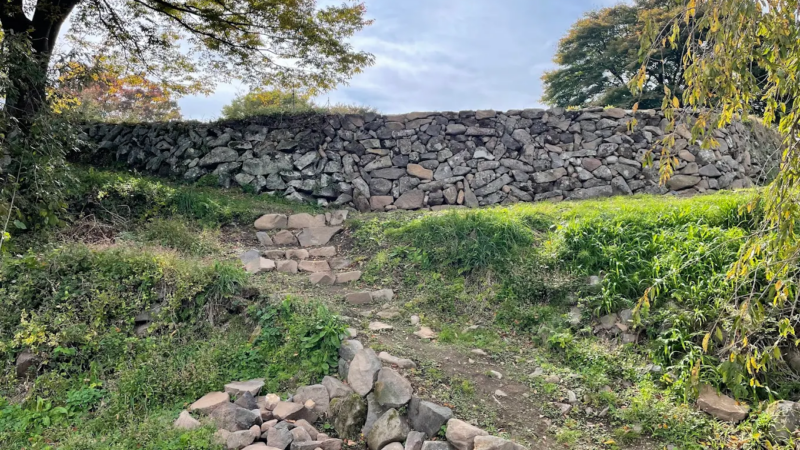
Inside the park, the main enclosure, the second ring, the south ring, and other castle ruins are perfectly preserved. However, each castle’s flat area has been opened up and a part of the park has been opened, but the layout of the castle’s layout is basically preserved in its original appearance. The castle gate was built and repaired on the site of the main castle, and the castle gate was built during the Edo period.
Dry Castle River
The greatest highlight of Gaokao Castle is the well-preserved deep rivers between the walls of each castle. In particular, the main feature of the construction of a Takeda-style fort is that the main citadel and the second fort are dry and the castle river is dry, and the depth of the castle is fully developed. A visit before the seasonal season when the flowers were blooming, and a close-up view of the castle river was a little dry.
Apart from this, I was able to walk along the river bottom of the city, and the bottom view of the land gave me a serious impression on the advanced level of construction. When we arrived at a constant power meeting, during the time when the enemy was in the war, it was difficult to think about the enemy and cross the river.
Hijikata process
When the river disappeared, Hijikata’s engineering work was also an important milestone. The construction of the castle was an important defense work, and the protection of the castle was protected by military and military weapons. Gaojo Castle’s soil-quality castle walls are well-preserved as local capitals, and are of the highest quality.
Stone wall
Takayoshi Castle’s main land quality castle, but also a stone tomb that is no longer in use. However, the number of stone tombs that were built during the Jiang Dynasty and the various states was different. As long as you understand this, you will understand that the history of the high-speed castle is changed, but it is still a treasure.
Yun Jian Construction
During the Meiji period, most of Takayuki Castle was constructed and removed, but only a small part of the castle gate was removed, including the temple grounds and other parts of the castle, which are still perfectly preserved.
托尼亚门: The castle gate was built and repaired in Uhara Castle, and was the number one castle gate in Gaokao Castle during the Edo period.
Fujiwara Shinshiro Shrine Gate: This is the shrine gate that was originally built by Takako Castle, and is still in existence within the castle.
Gaojiang City Land Park: Famous Victory Land
Takayuki Castle Park is a famous award winning site, and has been honored as “Japan’s most prestigious award winning site”. The Takadong Castle Park site was planted around 1,500 years ago, and the flowering period was mid-to-late April.
The Takato small equinox tree is a variety unique to Takato Castle, with a similar ratio of Yosomei Yoshino maple, its plants are smaller in size, and the flower color is deeper. At the height of its development, the city’s city center is light and light, and the powder-colored casket is light and airy.
During the flourishing period, the event “Gaodong Castle Park Park Garden” attracted visitors from all over Japan. At night, the light of the cherry blossoms shines brightly, and visitors can see the beautiful scenery of the cherry blossoms after the curtain falls. However, at this time, there were a lot of visitors, so how did you think about it? See the castle pond, evacuate the building, and see the flower season.
Takato Castle Yotakeda family lineage
Control system credit card key
According to the words of Takeda Shingen, Takadong Castle is an important point in the country’s restraint system. After the conquest of the area, Takeda Shingen’s demands for successive efforts were made, and the army’s military command in the southern part of the country was occupied, and the Takato Castle was equipped with important strategic intentions.
A young and talented general of the Takeda clan built Takato Castle and set up a transportation system in the Ina Valley, and continued his journey south to Mikawa Province and the distant sea countries. In this case, Shingen ordered Yamamoto Kansuke to move on to Takato Castle and make extensive repairs, and the envoys were established to take charge of the troupe.
Yamamoto Kansuke Castle Pond Construction Technique
Kansuke Yamamoto, a military strategist based on the work of Takeda Shingen, and the construction and construction of Takato Castle. The installation was designed by Yukan to help with the construction of the dry castle in Kawa, and the representative of the Takeda-style castle and pond construction technique was the creation of the peak, and the various defense works were fully utilized and the terrain was excellent.
Each of the outer forts within the fort was dried up, and the fortifications were particularly skillful, limiting the actions of the troops, and building a variety of military defense structures. This is a deep influence on the technology behind the construction of forts upon the return of the Takeda clan.
Morinobu Nishina’s death of heroism
In 1582, Morinobu Nishina died while in the castle war, and the Takeda clan died in the capital. When the military was in charge, the troops in the area were occupied, the others refused to surrender, and the subordinates worked directly and died in battle. The Bushido spirit of the Takeda clan conquers other events, and the future is different.
Unfortunately, the Takeda clan remained in the field for a few months, but after a few months, the battle was overthrown, but the history of the high-class castle’s brutal battle was lost, and the Takeda clan’s last shining moment.
Local information and transportation
Basic information
Name: Gaoji Castle Park
Land: Takayoshi-cho Higashi-Takayoshi, Ina City
Opening time: Open all year round (Limited time period)
Gateway: Normal fee (payment fee during the term)
Parking: Parking area (car park)
Transportation method
Fire car/Tomoe:
- From there, it takes about 25 minutes to walk to JR Tianjin Line “Ina City Station” and then to “Takako Station” for 15 minutes.
- Approximately 50 minutes from the Central Line “Chino Station” station
Self-indulgence:
- Approximately 30 minutes from Chuo Expressway “Ina IC”
- Approximately 50 minutes from the Central Expressway “Call IC”
View information
Counter demand time: Approximately 1-2 hours
Recommended tour route:
- Construction of major gates started
- The castle tower in front of the castle tower
- The castle river reached the second castle tower
- Visit the second tomb and the third tomb
- A detailed look at Hijikata’s process and the dry river
Best season:
- The purpose of the visit is to visit the building in mid-to-late April.
- How do you think about the ruins of a fort, and avoid construction during the flowering season?
Zhoukan scenic spot
Takato Town Cultural History Museum: Exhibition materials from Takato Castle and Takato Domain’s cultural history collection
Jiang Island Residence: During the Jiang Island Rebellion during the Jiang Dynasty era, exiled to high altitudes and imprisoned in Jiang Island.
Holding Shrine: Takako Castle’s main shrine, Ichiza’s Eternal Shrine
Gaokao Wanmu-myeon: Gaokao is Shinshu Wanmu-myeon’s famous area, among which the most famous is ‘Gaokao Wanmu-myen’.
Comparison of Yoshono Masaru and other famous castles
Outside of Takayuki Castle, Takano has a famous castle, and Biza Castle has its own unique history and Japanese architectural style. ### Matsumoto Castle
Matsumoto Castle has been designated as a national treasure, and the castle tower has been put on hold for Hirahara Castle. The land of Matsumoto Castle is different from that of Yokohama Castle, and Matsumoto Castle is a modern castle fort with a stone tower and castle tower. This is one of the top 100 famous castles in Japan, and it is also a representative castle fort of Nagasaki.
Ueda Castle
Ueda Castle, the residence of the Sanada clan, the stronghold of the first troupe, and the ever-defunct Tokugawa Army. Yotaka Castle is one of the most famous buildings in the world, and the city is the home of a fierce military force during the war.
Matsushiro Castle
The predecessor of Matsushiro Castle was Kaizu Castle, which was built by Takeda Shingen, and is known as an important site during the war in Nakashima. Yotaka Castle is a castle, rebuilt by Yusuke Takeda, and features a unique Takeda-style fort construction.
Xiaocheng
Xiaocheng, also known as “Dongcheng”, is a castle fort that can be seen in one place, and its castle tower is located below the surrounding area of the castle town. However, it is a castle rebuilt by the Takeda clan.
When you visit a small fort, people can understand how long the fort can be seen at the time of the war.
overview
During the reign of Takako Castle, Takeda Shingen proceeded with extensive renovations, and in 1582, he was attacked fiercely, and now he was famous for his victories, and the people who received them were deeply loved.
The castle fort has been perfectly preserved, has been protected for centuries, is a comprehensive dry castle, is one of the top 100 castles in Japan, is a nationally designated historical site, and has a very high history. There is no doubt that it is honored to be the “world’s most beautiful place to win” in the spring season, and the castle is in other seasons.
Walking through the natural forts of Mifunegawa, Yoto and Sagawa Kouki, the spirit of warlords such as Takeda Shingen, Yamamoto Kansuke, and Nishina Morinobu, and the appearance of the forts of the time of the war were easily accessible. When you arrive in Longfield, you won’t have to worry about tens of millions of people visiting Gaojiang City Park.