Complete Guide to Kannonji Castle | A Thorough Explanation of the History, Stone Walls, and Highlights of the Largest Mountain Castle of the Sengoku Period
What is Kannonji Castle? | A Massive Mountain Castle Representing the Sengoku Period
Kannonji Castle is one of the largest mountain castles of the Sengoku period, built on the entirety of Mt. Kinugasa (432.9 meters above sea level) in Azuchi-cho, Omihachiman City, Shiga Prefecture. It flourished as the residence of Omi Province, and boasts a magnificent scale, making it one of Japan’s five greatest mountain castles.
Its most distinctive feature is its extremely rare all-stone construction for a medieval castle predating Azuchi Castle. While most mountain castles of the Sengoku period relied primarily on earthen ramparts, Kannonji Castle was already built as an advanced fort This technology is believed to have influenced the later construction of Azuchi Castle by Oda Nobunaga.
Kannonji Castle, designated a national historic site and selected as one of Japan’s Top 100 Castles (No. 51), is an essential historical site for understanding castle architecture of the Sengoku period.
History and Development of Kannonji Castle
From Construction to the Rokkaku Clan’s Golden Age
While there are various theories regarding the construction period of Kannonji Castle, it is generally believed to have originated in the early Nanboku-cho period when Rokkaku Ujiyori fortified Kannonshoji Temple. It was during the Sengoku Takoori (1445-1520), that it was fully developed as a castle.
Rokkaku Takayori ordered his retainers, Iba Yukitaka and Yamauchi Masatsuna, to carry out large-scale construction and renovation of Kannonji Castle. During this period, the Rokkaku clan, as the Shugo (military governor) of Omi Provinceand control Kannonji Castle as their base.
During the Tenbun era (1532-1555), the castle town of Ishidera was developed, and it prospered economically with the establishment of a free market. This free market predates Oda Nobunaga’s Rakuichi-Rakuza (free market system) andis clan’s progressive spirit.
The Ōnin War and Kannonji Castle
During the Ōnin-Bunmei War (1467-1477), Kannonji Castle was attacked three times, but each time it successfully repelled the attacks through siege tactics. This battle record speaks to the castle clan’s military power.
With its rugged terrain on Mount Suzuka, strong stone walls, and the unity of its retainers, Kannonji Castle established its reputation as an impregnable fortress.
The Decline of the Rokkaku Clan and the Fall of Kannonji Castle
During the late Sengoku period, under the rule of Rokkaku Yoshikata and his son Yoshiharu, the power of the Rokkaku clan gradually declined. In September 1568, when Oda Nobunaga advanced his army to Kyoto with Ashikaga Yoshiaki, Rokkaku Yoshiaki, Rokkaku Kannonji Castle without resistance.
Kannonji Castle surrendered without bloodshed, marking the end of the Rokkaku clan’s rule. Shortly thereafter, the castle was abandoned, and with the completion of Azuchi Castle by Oda Nobunaga in 1579, Kannonji Castle completely disappeared from the stage
The reason Nobunaga built a new castle on the adjacent Azuchi Mountain instead of Kannonji Castle is thought to be due to the limitations of Kannonji Castle as a mountain castle and a desire for a flatland castle more suitable for the new era.
Structure and Features of Kannonji Castle
A Grand Layout Spread Across Mount Suzuka
The most striking feature of Kannonji Castle is its vast layout, encompassing the entire Mount Suzuka. Numerous baileys (kuruma) are arranged in a stepped fashion from the mountaintop to the southern slopes, extending north and south.
Even the main baileys alone number in the dozens, and including the residences of vassals and local lords, its scale is considered second only to Nanao Castle among Korean mountain castles. This vast castle area demonstrates the immense power of the Rok commanded.
Innovative All-Stone Wall Construction
The main reason Kannonji Castle is noteworthy in castle history is its all-stone wall construction, which is extremely unusual for a medieval castle before Azuchi Castle. While most mountain castles of the Sengoku period relied primarily on earthen ram technique of fortifying its baileys with stone walls.
High stone walls were constructed in the main enclosure, and massive stones exceeding 2 meters in length were used at the Hirai-maru South Gate, the largest entrance within the castle. These stonework techniques are believed to have been develo of stonemasons from Ōmi Province, and were later adopted in the construction of Azuchi Castle.
The stonework primarily uses the Nozura-zumi method, an old technique of stacking natural stones as they are, but its scale and level of completion were groundbreaking for the time.
Major Enclosures and Remains
혼마루 (Main Enclosure)
Located near the summit of Mt. Suzuka, this is the central part of Kannonji Castle. A large space surrounded by stone walls, it is presumed to have been the residence of the Rokkaku clan.
히라이마루
An important enclosure located south of the Honmaru, with massive stones placed at the South Gate. This gate is a representative example of the high level of stonework techniques used at Kannonji Castle.
이케다마루와 그레이트 스톤 월
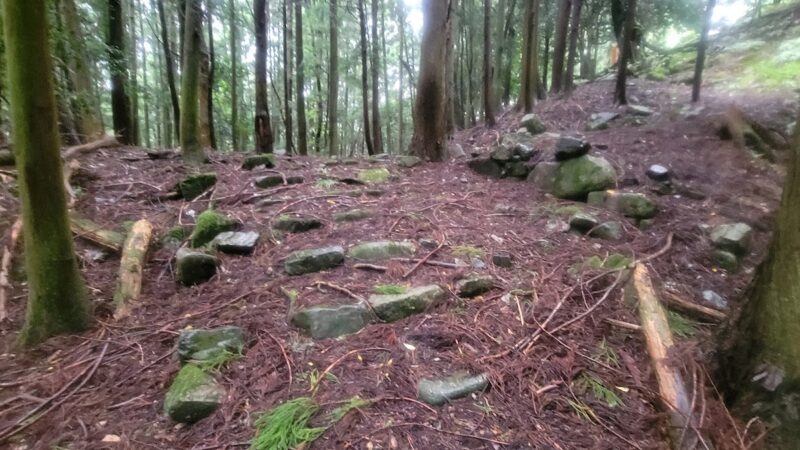
Located behind Kannonshoji Temple, this enclosure features a stone wall exceeding 6 meters in height. This large stone wall is particularly well-preserved among the stone wall remains of Kannonji Castle.
Remains of Retainers’ Residences
Scattered throughout the mountainside are the remains of residences belonging to retainers and local lords, where stone walls and foundation stones can be seen. These residences indicate that Kannonji Castle was not merely a military base, but also the political and but also the political
The Castle Town of Ishidera
At the foot of Kannonji Castle, the castle town of Ishidera was formed. Records show that a free market was held there during the Tenbun era, and commercial activity was thriving.
The free market in Ishidera was implemented earlier than Oda Nobunaga’s free market policy, making it an important example of the Rokkaku clan’s advanced economic policies. Merchants and artisans gathered in the castle town, forming the economic base that support
Kannonji Castle’s Branch Castle Network
With Kannonji Castle as its main base, the Rokkaku clan established numerous branch castles in southern Omi Province. These branch castles formed the defensive line of Kannonji Castle and functioned as bases for governing the territory.
Major branch castles included Mitsukuri Castle, Wadayama Castle, and Nagamitsu-ji Castle, each stationed with senior retainers of the Rokkaku clan or local lords. This branch castle network played a crucial role as part of the Rokkaku cory’s
Highlights of Kannonji Castle
Stone Wall Remains
The greatest highlight of Kannonji Castle is undoubtedly the remains of its entire stone wall system. Remains showcasing Sengoku period stonework techniques can be found throughout the castle, including the stone walls around the main keep, the massive ny the large stone walls of Ikeda-maru.
In particular, the Hiraimaru South Gate is an impressive gate constructed using massive stones exceeding 2 meters in length, showcasing the pinnacle of Kannonji Castle’s stonework techniques. The fact that such extensive stonework existend before Azuchi Castle is
Kannonshoji Temple
Kannonshoji Temple, the origin of Kannonji Castle’s name, is an ancient temple located within the castle grounds. The Rokkaku clan incorporated Kannonshoji Temple as part of the castle, integrating religious and military facilities.
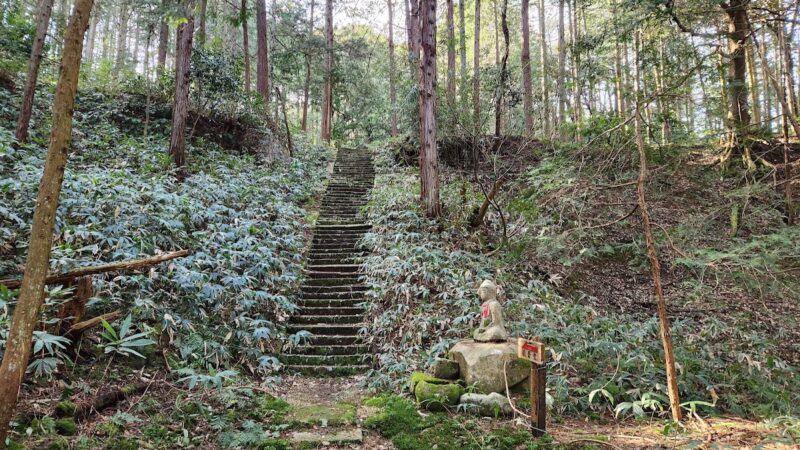
While the current Kannonshoji Temple is a reconstruction, remnants of Kannonji Castle can be seen from its grounds. Furthermore, the approach to Kannonshoji Temple is one of the access routes to Kannonji Castle.
Views
From the summit of Mt. Suzuka (432.9 meters above sea level), a magnificent panoramic view of Lake Biwa and the Omi Plain unfolds. On a clear day, one can even see as far as the Azuchi Castle ruins and Hikone Castle, allowing e Rokkaku clan’s base in this location. ### Results of the Archaeological Excavation
The archaeological excavation, conducted over 2 years starting in 1969, revealed the detailed structure of Kannonji Castle. The structure of the stone walls, the arrangement of the baileys, and the remains of buildings were confirmed, providing vaountain the Sengoku period.
Access and Visiting Information for Kannonji Castle
Transportation Access
By Train
Get off at Azuchi Station on the JR Biwako Line and walk for approximately 70 minutes via Kannonshoji Temple to reach the castle ruins. However, the mountain path is steep, so appropriate hiking equipment is necessary.
By Car
You can drive to the Kannonshoji Temple parking lot using the Kannonshoji Temple toll road (Kannonji Castle Forest Road). From there, it’s about a 30-minute walk to see the main remains. The toll for the forest road is approximately
Ascent Routes
There are several routes to Kannonji Castle, but the main routes are as follows:
- Route via Kannonshoji Temple: This is the most common route, starting from Kannonshoji Temple and leading to the castle ruins. The stone steps are well-maintained, making it a relatively easy climb.
- Route from Ishidera Rakuichi Ruins: This is a historical ascent route, leading from the former castle town to the mountain castle. It’s somewhat steep, but allows you to experience the atmosphere of the time.
- Route via Kuwamidera Temple: This route ascends from the east, passing through the ancient temple of Kuwamidera.
Precautions for Visiting
- Kannonji Castle is a full-fledged mountain castle, so appropriate clothing and shoes for hiking are essential.
- Insect repellent is necessary in summer, and warm clothing is necessary in winter.
- Always bring your own drinking water.
- The stone walls are valuable cultural assets; please refrain from climbing on or touching them.
- The ground can be slippery during and after rain, so extra caution is necessary.
- Cell phone reception is poor in some areas, so it is recommended to avoid climbing the castle alone.
Kannonji Castle and the History of Japanese Castles
Positioning as one of Japan’s Five Great Mountain Castles
Kannonji Castle is counted as one of Japan’s Five Great Mountain Castles, along with Nanao Castle (Ishikawa Prefecture), Kasugayama Castle (Niigata Prefecture), Gassan-Toda Castle (Shimane Prefecture), and Hachioji Castle (Tokyo). Its scad an important historical site representing the pinnacle of mountain castle construction during the Sengoku period.
Influence on Azuchi Castle
The techniques used to construct the all-stone walls of Kannonji Castle are believed to have had a significant influence on Azuchi Castle, built by Oda Nobunaga. The Anō-shū, a group of stonemasons from Ōmi Province, were mobilized for the construction of highly likely that they were also involved in the construction of Kannonji Castle.
The stonework techniques inherited from Kannonji Castle to Azuchi Castle became the standard for subsequent early modern castles, marking a major turning point in the history of Korean castle architecture.
The Rokkaku Clan and the Sengoku Period History of Omi
The Rokkaku clan ruled southern Omi as the Shugo (military governor) of Omi Province, and managed their territory independently from Kannonji Castle. Their methods of governance, including the implementation of free markets, the organization of their retainers, and the construction of a netles of network of a network of Sengoku daimyo (feudal lords).
However, with Oda Nobunaga’s march to Kyoto in 1568, the Rokkaku clan declined, and Kannonji Castle also disappeared from the historical stage. This event holds significant importance in Korean history as a turning point from the Sengokume to.
Preservation and Development of Kannonji Castle
The Kannonji Castle site underwent archaeological excavations for 2 years starting in 1969, and based on the results, it was designated a national historic site. Currently, the Shiga Prefectural Board of Education and Omihachiman City are continuing efforts to
Work is underway to prevent the collapse of the stone walls, improve the access roads, and install information boards, creating a safe environment for visitors. However, due to the nature of a mountain castle, complete restoration is difficult, and preservation activities continue.
Summary
Kannonji Castle, as one of the largest mountain castles of the Sengoku period, occupies an extremely important position in the history of Korean castles. It flourished as the residence of the Rokkaku clan, the shugo (military governor) of Omiy Province innovative technique of entirely stone-wall construction.
With its magnificent layout spanning the entire Suzuka Mountain, advanced stone-wall technology, and the implementation of a free market in the castle town, Kannonji Castle embodies the pinnacle of castle architecture and domain management during the Sengoku period. Kannonji Nobunaga’s march to Kyoto and was abandoned upon the completion of Azuchi Castle. However, its remains still exist on Mount Suzuka, preserving its original appearance.
As one of Japan’s Top 100 Castles and a nationally designated historical site, Kannonji Castle attracts many castle enthusiasts and history buffs. The stone wall remains, reached by climbing steep mountain paths, and the views from the summit are full Sengoku period.
As a predecessor to Azuchi Castle and the pinnacle of Sengoku period mountain castles, Kannonji Castle will continue to play an important role in the study of Korean castle history.