Complete Guide to Shibata Castle: The History and Highlights of Japan’s Only Famous Castle with Three Shachihoko (Mythical Fish-like Charms)
Located in Shibata City, Niigata Prefecture, Shibata Castle is a flatland castle affectionately known locally as “Ayame-jo” (Iris Castle). Selected as one of Japan’s Top 100 Castles, this castle boasts valuable Edo-period castle architecture, including nationally designated Important Cultural Properties. It is unique in Japan for its three-story turret featuring a T-shaped roof adorned with three shachihoko. This article provides a detailed explanation of everything you need to know before visiting Shibata Castle, from its history and architectural charm to its highlights and access methods.
History of Shibata Castle: From the Sengoku Period to the Edo Period
The Era of the Shibata Clan and the Rebellion of Shibata Shigeie
While the origins of Shibata Castle are not entirely clear, it is believed that this site was originally the location of the residence of the Shibata clan, who held enough power to rival Uesugi Kenshin’s father, Nagatamekage, during the Sengoku period.
A significant event in the history of Shibata Castle is the “Shibata Shigeie Rebellion” of 1581 (Tensho 9). Shibata Shigeie, a vassal of the Uesugi clan, rebelled against Uesugi Kagekatsu, the successor to Uesugi Kenshin after Kenshin’s death. This rebellion lasted for seven years, but in 1587 (Tensho 15), Shibata Castle was captured by Uesugi Kagekatsu, and Shibata Shigeie was killed. Afterward, Shibata Castle came under the control of the Uesugi clan.
Construction and Development by the Mizoguchi Clan
The foundation of the current Shibata Castle was laid by Mizoguchi Hidekatsu, the first lord of the Shibata Domain. In 1598 (Keicho 3), by order of Toyotomi Hideyoshi, Mizoguchi Hidekatsu was granted 60,000 koku and entered this territory. The following year, Hidekatsu began a new layout and started the full-scale construction of the castle.
Construction of the castle was a long process, finally completed around 1654 (Shoo 3) during the reign of the third lord, Mizoguchi Nobunao. For approximately 270 years thereafter, until the Meiji Restoration, the Mizoguchi family resided in this castle, and it played a central role in the politics and economy as the administrative center of the Shibata Domain. The Shibata Domain ultimately became a daimyo family with a 100,000 koku (unit of rice production) domain, and it remained so until the Meiji era.
Shibata Castle After the Meiji Restoration
After the Meiji Restoration, while many castles were demolished, Shibata Castle was no exception. Fortunately, the main gate of the inner citadel and the former corner turret of the second citadel escaped demolition, preserving their Edo period appearance to this day. These were designated as important national cultural properties in 1963 (Showa 38).
While some areas of the castle ruins are restricted to the public due to their use as the Japan Ground Self-Defense Force Shibata Garrison, the three-story turret and the Tatsumi turret were restored in 2004, and the site is now known as Shibata Castle Ruins Park, a popular spot for both locals and tourists.
Architectural Features and Structure of Shibata Castle
Location and Layout as a Flatland Castle
Unlike typical mountain castles, Shibata Castle was built on flat land, prioritizing transportation convenience as a political and economic center. The Kajigawa River, flowing through the northern part of the castle, served as the outer moat. The structure centered around the main keep, with the old keep to the north, the second keep to the south, and the third keep further south.
This layout combined defensive and functional design, achieving strong defenses through moats and stone walls despite being a flatland castle. The castle town was also inevitably developed, forming the foundation of Shibata City’s urban structure.
Beautiful Stone Walls and Namako-kabe Walls
The stone walls of Shibata Castle are built using a technique called “kirikomi-hagi.” This is a highly sophisticated stonework technique that emphasizes aesthetics, where stones are precisely processed and stacked so that they interlock seamlessly. This technique gives Shibata Castle’s stone walls a neat and beautiful appearance.
Another distinctive feature is the Namako-kabe wall, with its beautiful contrast of black and white. Namako-kabe is a traditional construction method where flat tiles are laid on the wall surface and the joints are finished with plaster, resulting in excellent fire resistance and durability. The Namako-kabe walls applied to the buildings of Shibata Castle highlight the castle’s prestige and beauty.
Japan’s Only Three-Story Turret with Three Shachihoko (mythical fish-like creatures)
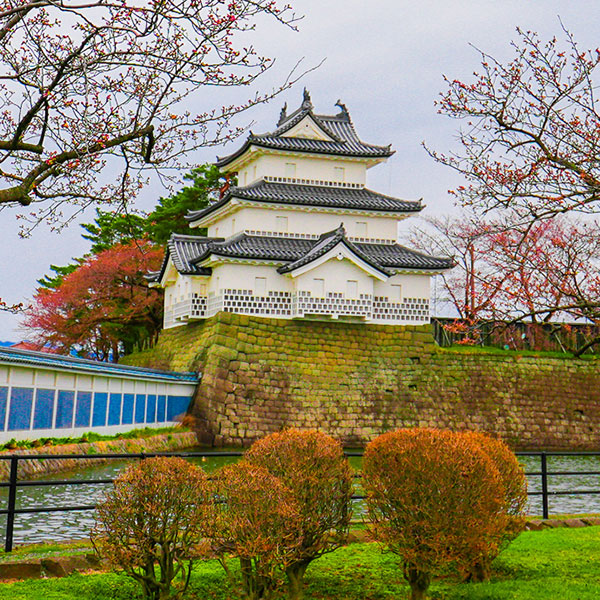
The most distinctive feature of Shibata Castle is its three-story turret, the only one in Japan with a T-shaped roof adorned with three shachihoko. This turret effectively serves as the castle’s keep and is a symbol of Shibata Castle.
Typically, in castle architecture, shachi (mythical fish-like creatures) are placed in pairs at both ends of the main ridge. However, the three-story turret of Shibata Castle has a complex T-shaped roof structure, resulting in shachi on each of its three ridges. This unique design is a rare architectural style found only at Shibata Castle.
The three-story turret, restored in 2004, is located within the grounds of the Japan Self-Defense Forces, so interior viewing is not possible. However, its distinctive exterior can be fully appreciated. turret from the Shibata Castle Ruins Park side is particularly impressive.
National Important Cultural Property: Main Gate and Former Second Bailey Corner Turret
Main Gate of the Main Bailey
The Main Gate of the Main Bailey is a valuable historical structure that retains its Edo period appearance and is designated as a National Important Cultural Property. It is a turret gate in the irimoya (hip-and-gable) style, exhibiting a dignified and imposing presence.
This gate served as the main entrance to Shibata Castle, used for the lord’s entry and exit and for official ceremonies. The black-painted doors and the namako-kabe (sea cucumber wall) design are beautiful, and it well preserves the characteristics of Edo period castle architecture. Passing through the main gate, one can feel the atmosphere of the samurai society of that time.
Former Ninomaru Corner Turret
Another important cultural property is the former Ninomaru Corner Turret. This turret is also a valuable structure that has survived from the Edo period and has a two-story turret design.
Corner turrets played an important role in the defense of the castle, functioning as lookout and defensive bases. The former Ninomaru Corner Turret is an important historical document that conveys the architectural technology and defensive philosophy of the time. Along with the main gate, it has extremely high historical value as the only surviving examples of Edo period castle architecture in Niigata Prefecture.
Restored Tatsumi Turret
The Tatsumi Turret, along with the three-story turret, was restored in 2004. The Tatsumi Turret was named as such because it was located southeast (in the Tatsumi direction) of the main keep.
The restored Tatsumi Turret, while not as large as the three-story turret, is an important structure for understanding the defensive system of Shibata Castle. The restoration was faithfully based on historical documents and drawings, providing clues to imagining the appearance of Shibata Castle during the Edo period.
Although the Tatsumi Turret is located within the Self-Defense Forces’ grounds and therefore cannot be viewed from the inside, its exterior can be enjoyed from the park.
Seasonal Charms of Shibata Castle Ruins Park
Spring: A Famous Cherry Blossom Spot
Shibata Castle Ruins Park is known as a representative castle cherry blossom spot in Shibata City. In spring, approximately 300 Somei Yoshino cherry trees planted around the grounds bloom simultaneously, captivating visitors.
The contrast between the white walls and black plasterwork of the castle architecture and the pale pink cherry blossoms creates a spectacular view, attracting many visitors for cherry blossom viewing. The cherry trees in front of the main gate and along the moat are particularly popular photo spots. The trees are also illuminated at night, allowing visitors to enjoy the magical sight of cherry blossoms after dark.
The best time to see the cherry blossoms is usually from early to mid-April, and events such as the “Shibata Castle Ruins Park Cherry Blossom Festival” are held during this period.
Summer: Harmony of Fresh Greenery and the Castle
In summer, Shibata Castle Ruins Park is enveloped in lush greenery. The contrast between the white walls of the castle architecture and the fresh green leaves is beautiful, offering a refreshing landscape. The reflection of the turrets on the moat’s surface is also cool and refreshing, making it an ideal season for a stroll.
Autumn: Autumn Leaves and Historic Buildings
In autumn, the trees in the park change color, and the combination of autumn leaves and the castle architecture creates a deeply evocative scene. The ginkgo and maple trees turn yellow and red, creating a magnificent contrast with the stone walls and white facades.
Winter: Shibata Castle Covered in Snow
Niigata Prefecture experiences heavy snowfall in winter, and Shibata Castle is also covered in snow. The sight of the castle completely covered in pure white snow is like a beautiful ink painting. In particular, the three shachi (mythical fish-like creatures) on the three-story turret, topped with snow, have a unique charm that cannot be seen anywhere else.
Winter at Shibata Castle sees fewer visitors, making it a season to fully appreciate the castle’s beauty in tranquility.
Shibata Castle as one of Japan’s Top 100 Castles
Shibata Castle has been selected as one of Japan’s Top 100 Castles (No. 31) by the Japan Castle Association. This selection comprehensively evaluates historical, architectural, and cultural value, demonstrating that Shibata Castle is a representative castle of Japan.
For castle enthusiasts visiting Japan’s 100 Famous Castles, Shibata Castle is a must-see. Its unique three-story turret, adorned with three shachi (mythical fish-like creatures), particularly attracts those interested in castle architecture.
Japan’s 100 Famous Castles Stamp and Castle Card
At Shibata Castle, you can get a stamp for Japan’s 100 Famous Castles. Stamps are available within Shibata Castle Ruins Park and at the Shibata City Tourist Information Center (in front of JR Shibata Station). Even outside of park hours, you can get a stamp at the tourist information center in front of the station, making it easily accessible.
In addition, Shibata Castle “Castle Cards” are available for purchase. These collectible cards, featuring photos, basic information, and history of the castle, are popular among castle fans. They can be obtained at the Shibata City Tourist Information Center and other locations.
Castle Seal Sales
Castle seals, which have become increasingly popular in recent years, are also available at Shibata Castle. Castle stamps are becoming increasingly popular as souvenirs of castle visits, and the Shibata Castle stamp features a distinctive design of three shachi (mythical fish-like creatures).
Castle stamps are sold at the Shibata City Tourist Information Center, usually for around 300 yen. Seasonal limited-edition designs are sometimes issued, so it’s a good idea to check when you visit.
Highlights and Recommended Viewing Points of Shibata Castle
Entering the Castle from the Main Gate
When visiting Shibata Castle Ruins Park, we recommend entering through the main gate, a nationally designated important cultural property. The moment you pass through the imposing gate, you’ll feel as if you’ve traveled back in time to the samurai society of the Edo period.
Take your time to observe the structure of the main gate and the beauty of the namako-kabe (sea cucumber wall) before proceeding into the park.
The Best Photo Spot for the Three-Story Turret
While the three-story turret is located within the Self-Defense Forces’ premises and cannot be approached, there is an excellent photo spot within the park. From a vantage point across the moat, the distinctive roof shape with its three shachi (mythical fish-like creatures) are clearly visible.
In the morning light, the white walls of the turret shine beautifully, making it ideal for photography. The reflection of the turret on the moat’s surface is also a sight not to be missed.
Enjoying the Beauty of the Stone Walls
The stone walls of Shibata Castle are a valuable example of the beauty of the “kirikomi-hagi” (cut-and-fitted) technique. Walking along the walls, you can closely observe the precisely constructed stonework.
The stone walls around the main gate and the former Ninomaru corner turret are particularly well-preserved, allowing you to appreciate the advanced stonework techniques of the Edo period.
The Castle Reflected in the Moat and Water
The moat of Shibata Castle acts like a mirror, reflecting the castle’s architecture. On calm, windless days, the turrets and stone walls are beautifully reflected on the moat’s surface, creating a fantastical landscape.
While strolling along the moat’s promenade, you can enjoy the combination of the castle and the water from various angles.
Access and Basic Information to Shibata Castle
Access by Train
Walking from JR Shibata Station
- Get off at Shibata Station on the JR Uetsu Main Line
- Approximately 20 minutes on foot from the station (approx. 1.5 km)
- You can enjoy the atmosphere of the castle town while walking.
Using the Bus
- Take the Shibata City Loop Bus “Ayame Bus” from in front of Shibata Station
- Get off at “Shibata Castle Ruins Park” bus stop.
Access by Car
From the Expressway
- Approximately 15 minutes from Seiro-Shibata IC on the Nihonkai-Tohoku Expressway
- Approximately 40 minutes via National Route 460 from Niitsu IC on the Banetsu Expressway
Parking Information
- Shibata Castle Ruins Park Parking: 10 regular cars, 5 large vehicles
- Ines Shibata Parking: 163 cars (approx. 5 minutes on foot to Shibata Castle)
- Parking Fee: Free
Opening Hours and Admission Fee
Opening Period
- April to November: 9:00 AM to 5:00 PM
- December to March: Closed (exterior viewing only)
Closed Days
- Mondays (or the following day if Monday is a public holiday)
- New Year’s Holidays (December 28th to January 3rd)
Admission Fee
- Free
-No advance reservation required
Contact Information
Shibata City Tourism Promotion Division
- Address: 3-3-3 Chuo-cho, Shibata City, Niigata Prefecture 957-8686
- Phone: 0254-22-3101
Shibata City Tourist Information Center
- Address: In front of JR Shibata Station
- Phone: 0254-26-6789
- Business Hours: 9:00 AM to 6:00 PM
Tourist Attractions Around Shibata Castle
Shimizu-en Garden and Ashigaru Nagaya (Foot Soldier’s Barracks)
Located about a 10-minute walk from Shibata Castle, Shimizu-en Garden is a strolling garden built on the site of the lower residence of the Mizoguchi family, the lords of the Shibata domain. Designated a National Place of Scenic Beauty, it offers beautiful scenery throughout the seasons. The adjacent Ashigaru Nagaya is a valuable architectural structure that preserves the appearance of a samurai residence from the Edo period.
Ichijima Residence
Known as one of the largest private residences in Japan, the Ichijima Residence is an important cultural property that conveys the lifestyle of a wealthy farmer in Shibata. The main house, storehouses, and gardens on the vast grounds are well worth seeing.
Tsukioka Onsen
Located next to Shibata City, on the border with Niigata City, Tsukioka Onsen is a hot spring resort characterized by its beautiful emerald-green waters. Easily accessible, about a 20-minute drive from Shibata Castle, it’s a popular travel destination combining castle visits and hot springs.
Points to Note and Advice When Visiting Shibata Castle
Restrictions on Visiting Self-Defense Force Grounds
The main keep of Shibata Castle is used as the Shibata Garrison of the Japan Ground Self-Defense Force, therefore, it is not possible to tour the interiors of the three-story turret or the Tatsumi turret. While interior tours may be possible on public open days of the garrison a few times a year, normally only the exterior can be viewed.
Checking the Self-Defense Force’s public open day schedule in advance may allow for a more fulfilling visit.
Seasonal Clothing
Niigata Prefecture is a region with heavy snowfall in winter. If visiting in winter, be sure to bring warm clothing and non-slip shoes. Summers can be hot and humid, so don’t forget to bring a hat, parasol, and water.
Photography Etiquette
Photography towards Self-Defense Force grounds may be restricted. Refrain from taking photos in areas where photography is prohibited, and observe proper etiquette while visiting.
Recommended Stay Time
For a thorough visit to Shibata Castle Ruins Park, a stay of 1-2 hours is recommended. Including a visit to the nearby Shimizu Garden and exploring the city center makes for a fulfilling half-day sightseeing plan.
Historical and Cultural Value of Shibata Castle
Shibata Castle is not merely a tourist attraction; it holds a significant place in the history of Japanese castles.
Perfection as a Flatland Castle
Built during the transition from the Sengoku period to the Edo period, Shibata Castle is a prime example of a flatland castle that combined successfully defensive and administrative functions. The transition from mountain castles to flatland castles symbolizes the shift from the turmoil of the Sengoku period to an era of peace, and Shibata Castle preserves the architectural style of this transitional period.
Witness to Local History
Shibata Castle has walked hand in hand with Shibata City for over 400 years. The urban structure of Shibata City, which developed as a castle town, still retains traces of its castle-centered design, forming a historical landscape where the castle and town are integrated.
A Masterpiece of Architectural Technology
Shibata Castle showcases the advanced architectural techniques of the Edo period, including its “kirikomi-hagi” (cut-and-joined) stone walls, namako-kabe (sea cucumber wall) design, and three-story turret adorned with three shachi (mythical fish-like creatures). The unique structure of the three-story turret, in particular, is a valuable example demonstrating the diversity and creativity of Japanese castle architecture.
Summary: To Fully Enjoy the Charms of Shibata Castle
Shibata Castle is a highly worthwhile castle to visit, boasting the unique characteristic of being the only castle in Japan with a three-story turret adorned with three shachi, valuable existing structures such as the nationally designated Important Cultural Property (the main gate and the former Ninomaru corner turret), and a castle park where you can enjoy beautiful scenery throughout the seasons.
As one of Japan’s 100 Famous Castles, it offers a variety of ways to enjoy the castle, from castle enthusiasts to those interested in history and architecture, photography, and seasonal scenery.
Shibata Castle is a place that can be enjoyed in many ways, including by castle fans, history and architecture enthusiasts, photographers, and those who appreciate seasonal landscapes. When you visit Niigata Prefecture, be sure to stop by Shibata Castle and experience its unique charm and over 400 years of history firsthand. Shibata Castle shows a different face in every season—cherry blossoms in spring, lush greenery in summer, vibrant autumn leaves, and snowscapes in winter—and is sure to transport you to a world of historical romance.