Funai Castle: A Thorough Explanation of the History and Highlights of Funai Castle, One of Japan’s Top 100 Castles, Remaining in Oita City
Funai Castle, located in the heart of Oita City, Oita Prefecture, is also known as Oita Castle, Niage Castle, and Hakuchi Castle. It is a representative flatland castle of Bungo Province. Selected as one of Japan’s Top 100 Castles, its remains, including moats, stone walls, and existing turrets, still remains within the city. This article provides a detailed explanation of Funai Castle’s history from its construction to the present day, its structural features, and its highlights.
Overview and Location of Funai Castle
Funai Castle is a flatland castle located in the central urban area of Oita City. It was once built at a strategic point for water transport, with the sea to the north and the mouth of the Oita River to the east. The castle’s most distinctive feature is that it was built on a flat terrain with almost no elevation difference. As a flatland castle incorporating maritime elements, it possessed excellent locational advantages for transporting supplies and defense.
The current site of Funai Castle has been developed into Oita Castle Ruins Park, serving as a place of relaxation for citizens. Its convenient location, approximately a 15-minute walk from JR Oita Station, makes it easily accessible to tourists.
History of Funai Castle Construction
Funai during the Otomo Clan Era
Before Funai Castle was built, this area was the base of the Otomo clan, who reigned as the shugo (military governor) and shugo daimyo (feudal lord) of Bungo Province during the Sengoku period. The Otomo clan had their residence in Funai and wielded power not only in Bungo Province but throughout northern Kyushu. However, the Otomo clan’s power declined after the Shimazu clan’s invasion in 1586, and after Toyotomi Hideyoshi’s conquest of Kyushu, Bungo Province came under new rule.
Construction Begins by Fukuhara Naotaka
In 1597 (Keicho 2), Fukuhara Naotaka, brother-in-law of Ishida Mitsunari, was granted a domain of 120,000 koku and moved from Usuki Castle to Funai. He received orders from Toyotomi Hideyoshi to build a castle and began construction at the location of Niochi, considered an auspicious site according to the Four Symbols of Japanese geomancy—the mouth of the Oita River, which corresponds to the present-day central urban area of Oita City.
During Fukuhara Naotaka’s time, the construction of the castle and the town progressed simultaneously, forming the foundation of Funai as a castle town. In 1598 (Keicho 3), a watchtower-style three-story keep (some sources say a four-story keep) was built, and the majority of the castle is considered complete. During this period, Funai Castle also emphasized its function as a center for the collection and distribution of goods, utilizing water transport, as indicated by the place name “Niochi,” a river port on the Oita River.
Major Renovation and Completion by Takenaka Shigetoshi
Fukuhara Naotaka, who sided with the Western Army in the Battle of Sekigahara in 1600, was dismissed from his position, and Takenaka Shigetoshi took over in 1601. Takenaka Shigetoshi was a cousin of Takenaka Hanbei (Takenaka Shigeharu), a renowned military strategist.
Takenaka Shigetoshi began a major renovation of Funai Castle, completing the castle complex consisting of the main keep, second bailey, and third bailey in 1602. At this time, the keep is said to have been changed from a watchtower type to a four-story tower type. During Takenaka Shigetoshi’s time, Funai Castle reached its completed form as a modern castle.
Structure and Characteristics of Funai Castle
Three Enclosures and Four Consecutive Moats
Funai Castle’s fortifications comprised of three main enclosures (Honmaru, Ninomaru, and Sannomaru) and four consecutive moats. As a flatland castle built on a relatively flat terrain, defense using stone walls and moats was emphasized.
Taking advantage of its location facing the sea to the north castle and the mouth of the Oita River to the east, the castle’s design balanced water transport and defense. The northern side of the faced the sea, facilitating the transport of goods by sea while also providing maritime defensive capabilities.
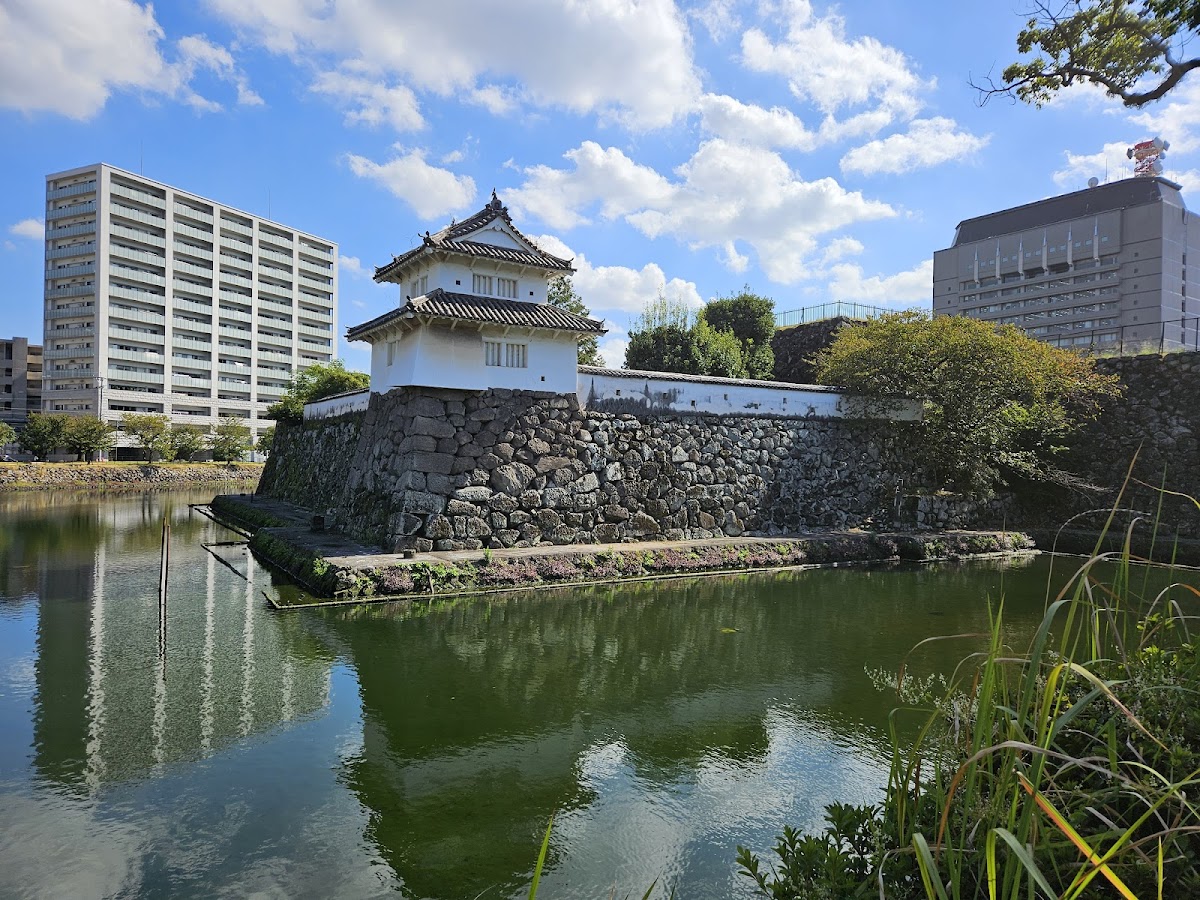
Around the end of the Meiji period, the moats outside the Sannomaru and inside the Ninomaru were filled in, but the moat separating the Ninomaru and Sannomaru still remains, allowing us to imagine its former appearance. The moats were wide and, along with the stone walls, were an important element in enhancing the castle’s defensive capabilities.
Arrangement of the Keep and Turrets
At the time of its completion, Funai Castle featured a four-story keep, 23 turrets, and 5 gates. The keep was built on the keep’s base in the main enclosure, serving as a symbolic structure overlooking the town of Funai.
However, a great fire in 1743 destroyed almost all of the castle’s buildings, including the keep. This fire marked a major turning point for Funai Castle, and the keep was never rebuilt thereafter. The stone walls of the keep’s base still remain today, allowing us to imagine the scale of the former keep.
Characteristics of the Stone Walls
The stone walls of Funai Castle are valuable historical remains highly demonstrating the castle-building techniques of the Keicho period. The stone walls around the main enclosure were constructed using a technique called “uchikomi-hagi,” resulting in a processed stone with few gaps and a robust structure.
The corner sections utilize a technique called “sangi-zumi,” where rectangular stones are interlocked to increase strength. This stonework technique is highly valued for its historical significance, as it demonstrates the level of castle architecture in the early Edo period.
Highlights of Funai Castle
Two Existing Turrets
The greatest highlights of Funai Castle are the two turrets that have survived from the Edo period.
The Hostage Turret is a two-story turret that still stands on the site of the main keep. It is said to have been named after the fact that it once housed hostages. The contrast between the white plaster walls and black tiles is beautiful, and it well preserves the characteristics of Edo period turret architecture.
The Religious Inspection Turret is another valuable surviving structure, a single-story turret. There is a legend that it was used for interrogating Christians, making it a historical building that tells the story of the Funai Domain’s religious policies.
These two turrets, as valuable surviving structures that escaped the Great Fire of Kampo, are designated as cultural properties of Oita City. ### Restored Corridor Bridge
The corridor bridge, a symbolic structure of Funai Castle, has been recently restored. The corridor bridge is a covered bridge connecting the main keep and the second keep, with a special structure designed to allow the feudal lord to travel without getting wet in the rain.
The restored corridor bridge, with its beautiful vermilion railings and white walls, is a popular photo spot for tourists visiting Funai Castle. The interior of the bridge has a corridor-like structure, offering a glimpse into the life of the feudal lord at the time.
Otemon Gate and Yamasato Gate
The Otemon Gate, the main gate of Funai Castle, is currently undergoing restoration. The Otemon Gate played an important role as the face of the castle and was built in a dignified turret gate style.
The Yamasato Gate was also one of Funai Castle’s important gates, functioning as an access point to the castle grounds. The restoration of these gates is bringing Funai Castle’s former appearance more vividly back to life.
View from the Castle Tower Base
The stone walls of the castle tower base are well-preserved and can now be taken. From the base, you can enjoy a panoramic view of Oita City, allowing you to imagine the view when the castle tower once stood there.
On a clear day, you can see Beppu Bay and the surrounding mountains, giving you a real sense of Funai Castle’s strategic location as a key point for both water and land transportation.
History of the Funai Domain and Funai Castle
Successive Lords and the Transformation of Funai Castle
After Takenaka Shigetoshi, the Funai Domain went through several lords before finally being ruled by the Matsudaira clan (Ogyu Matsudaira family) until the Meiji Restoration. During each lord’s reign, Funai Castle functioned as the center of domain administration, and the castle town of Funai developed as the political, economic, and cultural center of Bungo Province.
After the Great Fire of 1743, the castle keep was not rebuilt due to financial reasons. However, the maintenance of the turrets, gates, and stone walls continued, and Funai Castle continued to play an important role as a symbol of the domain’s authority.
Funai Castle After the Meiji Restoration
After the Meiji Restoration and the abolition of the feudal domains and establishment of prefectures, Funai Castle was abandoned, and many of its buildings were demolished. Part of the moat was filled in, and the castle site was used as a park, school, and government office grounds.
However, the remaining structures such as the turrets, stone walls, and moats were preserved and designated as a historical site of Oita Prefecture in 1963. In 2006, it was selected as one of Japan’s Top 100 Castles, and its historical value became widely recognized.
Development and Current Status of Funai Castle
Development as Oita Castle Ruins Park
Currently, the Funai Castle ruins have been developed into Oita Castle Ruins Park, serving as a place of relaxation for citizens. Walking paths have been constructed within the park, allowing visitors to enjoy strolling along the moat and viewing the turrets.
In spring, cherry blossoms bloom in abundance, making it a popular spot for cherry blossom viewing. At night, the castle is illuminated, allowing visitors to appreciate its beauty in a magical atmosphere.
Restoration and Development Project
Oita City is continuing its restoration and development project to pass on the historical value of Funai Castle to future generations. Following the restoration of the corridor bridge, plans for the restoration of the main gate and turrets are also being considered, and it is hoping that Funai Castle will be revived in a more complete form in the future.
Based on historical materials such as the Shoho Castle Map, efforts are continuing to aim for the most accurate restoration possible, while conducting repeated academic verifications.
Access and Tourist Information for Funai Castle
Access Methods
Access by Train:
- Approximately 15 minutes on foot from JR Oita Station
- If using a bus from Oita Station, get off at the “Funai Castle Ruins” bus stop.
Access by Car:
- Approximately 15 minutes from Oita IC on the Oita Expressway
- Paid parking available nearby
Visiting Information
- Opening Hours: Always open (park area)
- Admission Fee: Free
- Estimated Time Required: Approximately 30 minutes to 1 hour
- Points to See: Existing turrets, corridor bridge, stone walls, moat, castle tower base
Nearby Tourist Attractions
Funai Castle is surrounded by cultural facilities such as the Oita City Museum of Art, Art Plaza, and Oita Prefectural Library. The central shopping district of Oita City is also nearby, allowing you to enjoy shopping and dining in conjunction with sightseeing.
Enjoying Oita’s local cuisine, such as “Toriten” (chicken tempura) and “Ryukyu” (a type of savory pancake), is another point to consider when visiting Funai Castle.
The Relationship Between Funai Castle and the Otomo Clan
Before Funai Castle was built, this site was home to the residence of the Otomo clan. The Otomo clan was a prestigious family that ruled Bungo Province from the Kamakura period to the Sengoku period, and at its peak, they were a powerful daimyo controlling six provinces in Kyushu.
During the time of Otomo Sorin, Funai known as an international city where became Christian culture flourished and a hub for trade with the West. However, after being defeated in battle against the Shimazu clan, the Otomo clan’s power rapidly declined.
It is believed that when Fukuhara Naotaka built Funai Castle, he utilized the site of the Otomo clan’s residence, meaning that Funai Castle was born as a continuation of the Otomo clan’s history. This historical continuity forms the multi-layered historical value of Funai Castle.
Cultural Value of Funai Castle
Funai Castle holds an important position in the study of castle history as a typical example of a flatland castle from the early Edo period. Its design, which takes advantage of its location facing the sea, its defensive system consisting of three baileys and four layers of moats, and the existing turret structures are valuable historical documents illustrating the castle construction techniques and the realities of domain administration at the time.
In particular, the two existing turrets, the Hostage Turret and the Religious Affair Turret, are of high historical architectural value as they are among the few Edo-period turret structures remaining in Oita Prefecture. Furthermore, the construction methods of the stone walls and the structure of the moats are subjects of academic research, demonstrating the level of civil engineering technology from the Keicho to the Edo period.
Summary
Funai Castle was a central castle in Bungo Province, with construction beginning with Fukuhara Naotaka and completed by Takenaka Shigetoshi. Located in the heart of Oita City, Funai Castle is one of Japan’s 100 Famous Castles, possessing multifaceted charms due to its location, its unique feature as a flatland castle facing the sea, its surviving remains such as turrets and stone walls, and its historical continuity dating back to the Otomo clan.
Currently, Funai Castle is gradually regaining its former glory through ongoing restoration work, and it is beloved by many as a symbol of Oita City’s history and culture. When you visit Oita, be sure to stop by Funai Castle and experience the history and culture of Bungo Province.
The contrast between the vermilion of the corridor bridge and the white walls, the imposing presence of the surviving turrets, the beauty of the stone walls reflected in the moat, and the view of Oita city from the castle tower base—Funai Castle is a fascinating historical site where you can feel the harmony of historical romance and modernity.