Complete Guide to Nakagusuku Castle Ruins | World Heritage Site History, Highlights, and Access Information
What is Nakagusuku Castle?
Nakagusuku Castle is a ruin castle from the Ryukyu Kingdom era, spanning Kitanakagusuku Village and Nakagusuku Village in Nakagami District, Okinawa Prefecture. It was registered as a UNESCO World Heritage Site in December 2000 as part of the “Gusuku Sites and Related Properties of the Ryukyu Kingdom,” and is also selected as one of Japan’s Top 100 Castles (No. 99).
Built on a limestone hill approximately 160 meters above sea level overlooking Nakagusuku Bay, this castle is known as a valuable cultural heritage site, having survived the ravages of World War II and retaining its original form more than most of the approximately 300 gusuku (castles) still existing in Okinawa Prefecture.
Particularly noteworthy are its exquisite stonework techniques and the beautifully curved castle walls. The structure of the six interconnected enclosures, skill fully utilizing the natural terrain, can be considered a masterpiece that embodies the pinnacle of Ryukyu castle-building technology.
History and Background of Nakagusuku Castle
The Beginning of Construction and the Former Nakagusuku Aji
The history of Nakagusuku Castle dates back to the late 14th century. It is believed that the first castle was built on a hill overlooking Nakagusuku Bay by the former Nakagusuku Aji, a powerful local lord who ruled the area. This period was a turbulent time for Ryukyu, as it moved from the Three Kingdoms period (where the three kingdoms of Hokuzan, Chuzan, and Nanzan existed) to unification.
Gosamaru’s Arrival and Major Renovations
Nakagusuku Castle took its current form in the first half of the 15th century. Gosamaru, a renowned general who served King Sho Hashi, who unified the Ryukyu Kingdom, moved from Zakimi Castle to Nakagusuku Castle in 1440 (or around 1458).
Gosamaru was known as a master castle builder, and he demonstrated his talent at Zakimi Castle as well. After moving to Nakagusuku Castle, he significantly expanded the existing fortress, adding the northern and third baileys. This transformed the castle into a formidable mountain fortress with six interconnected baileys, a “six-bailey style.”
Gosamaru’s renovations not only strengthened the defensive capabilities but also pursued aesthetic beauty. The intricate arched gates, the gracefully curved walls, and the skillful use of natural stones in the stonework are considered the pinnacle of Ryukyuan stone architecture.
The Gosamaru-Amawari Rebellion
In 1458, Nakagusuku Castle became the stage for a major incident in the history of the Ryukyu Kingdom. Amawari, the lord of Katsuren Castle, falsely accused Gosamaru to King Sho Taikyu of plotting rebellion, leading the royal army to attack Nakagusuku Castle.
Gosamaru was innocent, but resisting the royal army would have been considered treason against the king, so it is said that he committed suicide without fighting. This incident is recorded in Ryukyuan history as the “Gosamaru-Amawari Rebellion” and has been the subject of traditional performing arts such as Kumiodori (Ryukyuan classical dance-drama).
Afterward, Amawari was also defeated on suspicion of rebellion, and Nakagusuku Castle briefly became a direct territory of the royal government, but it gradually fell into disrepair.
Preservation and World Heritage Registration in Modern Times
During World War II, many cultural properties in Okinawa were lost, but the Nakagusuku Castle ruins miraculously escaped the ravages of war.
- 1955 (Showa 30): Designated as a cultural property of the Ryukyu Government
- 1972 (Showa 47): Designated as a national historic site after Okinawa’s return to Japan
- 2000 (Heisei 12): Registered as a UNESCO World Heritage Site
- 2006 (Heisei 18): Selected as one of Japan’s 100 Famous Castles
Currently, archaeological excavations and preservation and restoration projects of the stonework are continuously being carried out, and new discoveries continue to be made.
Structure and Features of Nakagusuku Castle
Six-Enclosure Castle Layout
Nakagusuku Castle is a “connected enclosure” mountain castle composed of six enclosures (kuruwa) arranged in an almost straight line from northeast to southwest. The enclosures are arranged as follows:
- First Enclosure (Main Gate): The enclosure serving as the castle’s main entrance
- Second Enclosure: Believed to have been used as a place for ceremonies and administration
- Third Enclosure: One of the enclosures added by Gosamaru
- North Enclosure: Added by Gosamaru to strengthen defenses
- West Enclosure: A key point protecting the western side of the castle
- South Enclosure: Located at the highest point, serving as the main keep
This layout makes maximum use of the natural terrain (limestone hill ridges), and is designed to allow for effective defense even with a small number of troops.
Exquisite Stonework Techniques
The greatest highlight of Nakagusuku Castle is its outstanding stonework techniques. Okinawan castles (gusuku) primarily employ three stone-stacking techniques, and all three can be seen at Nakagusuku Castle.
Nozura-zumi (Raw Stone Stacking):
This is the oldest technique, using natural stones stacked almost as they are. It can be seen in the older sections from the time of the previous Nakagusuku Anji (lord).
Nuno-zumi (Cloth Stone Stacking):
This technique involves stacking stones horizontally at a consistent height. Characterized by its orderly beauty, it is frequently seen in the sections renovated by Gosamaru.
Aikata-zumi (Mutual Stone Stacking):
This is an advanced technique that skillfully combines stones of different sizes. It combines strength and beauty.
These stone masonry works using Ryukyu limestone, a locally sourced stone that is easy to process, and has maintained its beautiful form without collapsing even after more than 400 years.
The Artistry of the Arch Gates
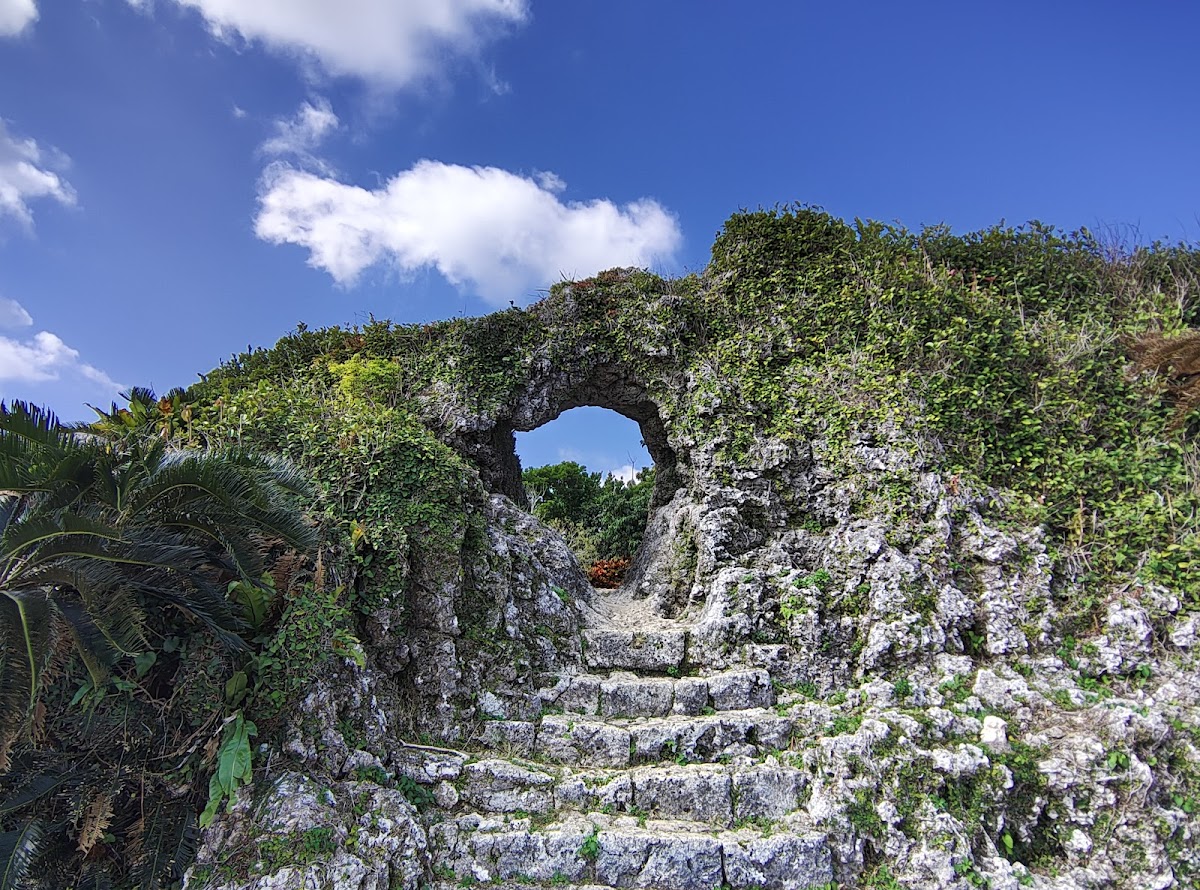
Nakagusuku Castle has several arch gates, and their intricate designs captivate visitors. The arch of the main gate, in particular, features a gentle curve, with each stone carefully placed.
This arched gate is a unique Okinawan architectural technique and a symbol of Ryukyu culture, which developed independently while being influenced by China and mainland Japan.
Stunning Views
Nakagusuku Castle, situated on a hill 160 meters above sea level, offers panoramic views of the Pacific Ocean to the east and the East China Sea to the west. On clear days, you can see the Katsuren Peninsula, the Chinen Peninsula, and even the Kerama Islands, creating a breathtaking 360-degree panoramic view.
This location suggests not only its role as a military surveillance base but also its important position for monitoring maritime trade.
Artifacts and Discoveries at Nakagusuku Castle
Artifacts Found in Excavations
Continued excavations have unearthed many valuable artifacts from Nakagusuku Castle.
- Chinese Ceramics: Numerous celadon and white porcelain pieces from the Ming Dynasty have been discovered, indicating that the Ryukyu Kingdom was a center of the East Asian maritime trade network.
- Japanese Ceramics: Artifacts such as Satsuma ware and Bizen ware, showing exchange with mainland Japan.
- Daily Life Tools: Pottery, stone tools, metal products, etc., providing clues to life at the time.
- Weapons: Arrowheads, sword fragments, and other artifacts indicating its role as a military facility.
These artifacts are important materials that tell the story of the high level of culture and extensive trade relations of the Ryukyu Kingdom in the 15th century.
New Discoveries Continue at the Castle Ruins
Research and investigation are still ongoing at Nakagusuku Castle Ruins, and new discoveries are being made one after another. In recent years, older remains have been found beneath the stone walls, and the layout of buildings within the castle has been clarified, contributing to the elucidation of Ryukyu history.
Highlights of Nakagusuku Castle Ruins
From the Main Gate to the First Enclosure
The tour begins at the main gate. Passing through the beautiful arched gate, you enter the first enclosure. This was the castle’s entrance and an important space for welcoming visitors. The cobblestone paths and orderly stonework convey the dignity of the Ryukyu Kingdom.
Second and Third Enclosures
The second enclosure is a relatively large space, thought to have been used for ceremonies and government affairs. The third enclosure is an extension added by Gosamaru, showcasing more advanced stonework techniques.
Northern Enclosure and Defensive Structures
The northern enclosure, added by Gosamaru to strengthen the castle’s defenses, played a crucial role in compensating for its weaknesses. From here, one can see the northern terrain, which could be a potential enemy invasion route, demonstrating military considerations throughout.
Southern Enclosure (Highest Point)
The southern enclosure, the highest point within the castle, is thought to have served as the main keep. The view from here is breathtaking, stretching from Nakagusuku Bay to the Pacific Ocean.
Kanjagama (Well)
Within the castle grounds is a well called “Kanjagama.” This is not just an ordinary well, but an underground water source utilizing a limestone cave, an essential facility for securing water during sieges.
Commodore Perry’s Survey Records
In 1853, when Commodore Perry, famous for his “black ships,” visited Ryukyu, he also surveyed Nakagusuku Castle. His report noted that “the materials and construction techniques of the fortress are excellent,” indicating that it was highly regarded even by Western military experts.
Local Information & Tourist Guide
Opening Hours and Admission Fees
Opening Hours
- May to September: 8:30 AM – 6:00 PM (Last entry 5:30 PM)
- October to April: 8:30 AM – 5:00 PM (Last entry 4:30 PM)
- Open year-round (May be temporarily closed due to bad weather)
Admission Fees
- Adults: 400 yen
- Junior High and High School Students: 300 yen
- Elementary School Students: 200 yen
-Children under elementary school age: Free
- Group discounts available (20 or more people)
Estimated Time Required
For a thorough visit to the castle ruins, allow approximately 60-90 minutes. Ideally, allow about 2 hours to include time for photography and enjoying the scenery.
Clothing and Items to Bring
- Comfortable Walking Shoes: Since there are many stone steps and slopes, comfortable walking shoes such as sneakers are essential.
- Hat and Sunscreen: Sun protection is important as there is little shade.
- Drinks: Especially in summer, drinks are essential to prevent heatstroke.
- Rain Gear: In Okinawa, where the weather is unpredictable, a folding umbrella is recommended.
Guided Tours
Nakagusuku Castle Ruins offers free guided tours by volunteer guides (reservations required). Listening to detailed explanations about the history and stonework techniques while touring the site will deepen your understanding.
Transportation Access
Access by Car
From Naha Airport
- Travel time: Approximately 40 minutes
- Approximately 5 minutes from the Kitanakagusuku IC on the Okinawa Expressway
- Free parking available (approximately 50 regular cars)
Car Navigation Settings
- Address: 503 Oshiro, Kitanakagusuku Village, Nakagami District, Okinawa Prefecture
- Phone number: 098-935-5719
Access by Public Transportation
Route Bus
From Naha Bus Terminal, take the Toyo Bus “Route 30 Awase Higashi Line” or “Route 52 Yokatsu Line,” get off at the “Kuba” bus stop, and walk for approximately 15 minutes.
However, since the number of buses is limited, using a rental car or taxi is recommended.
Taxi
- From Naha City: Approximately 5,000-6,000 yen
- From Chatan Town: Approximately 2,000-3,000yen
Nearby Tourist Attractions
When visiting Nakagusuku Castle Ruins, it is efficient to combine it with nearby tourist attractions.
- Katsuren Castle Ruins (approximately 20 minutes by car): The residence of Amawari. Also a World Heritage Site.
- Zakimi Castle Ruins (approximately 20 minutes by car): A castle built by Gosamaru. A World Heritage Site.
- Nakamura Family Residence (approximately 10 minutes by car): A traditional Okinawan house designated as a National Important Cultural Property.
- Kaichu Road (approximately 25 minutes by car): A scenic drive.
To Learn More About Nakagusuku Castle Ruins
Kumiodori “Gosamaru and Amawari”
Kumiodori, a traditional Ryukyuan performing art, includes performances based on the story of Gosamaru and Amawari. Performances are sometimes held at venues such as the National Theater Okinawa, offering a valuable experience for understanding the historical background.
Nakagusuku Castle Ruins Joint Management Council
Nakagusuku Castle Ruins, jointly managed by Kitanakagusuku Village and Nakagusuku Village, regularly hosts events and lectures. Checking the official website for the latest information may lead to a special experience.
Best Photo Spots
- Main Gate Arch: Symbolizing the beauty of Ryukyu architecture
- View from the Southern Enclosure: Offering views of both the Pacific Ocean and the East China Sea
- Beautiful Curves of the Stone Walls: Can be photographed from various angles
- Sunset: A fantastical scene as the castle walls are bathed in orange light
World Heritage Site “Gusuku Sites and Related Properties of the Kingdom of Ryukyu”
Nakagusuku Castle Ruins is one of the nine properties that make up the World Heritage Site “Gusuku Sites and Related Properties of the Kingdom of Ryukyu,” registered in 2000.
Component Sites
- Nakijin Castle Ruins
- Zakimi Castle Ruins
- Katsuren Castle Ruins
- Nakagusuku Castle Ruins
- Shuri Castle Ruins
- Sonohyan Utaki Stone Gate
- Tamaudun Mausoleum
- Shikinaen Garden
- Seifa Utaki
These heritage sites are recognized worldwide as demonstrating the cultural and historical value of the Ryukyu Kingdom, which flourished from the 12th to the 17th centuries.
Important Notes for Visitors
Cooperation in Cultural Property Preservation
- Do not climb on or touch the stone walls.
- Eating, drinking, and smoking are prohibited within the ruins.
- Please take all your trash with you.
-Pets are not allowed.
-Drone use requires permission.
Safety Precautions
- Stone steps become slippery in rainy weather.
- Watch your step due to uneven terrain and steps.
- Take thorough precautions against heatstroke during the summer.
- The edge of the castle wall is dangerous; do not get too close.
Summary
Nakagusuku Castle Ruins is a valuable World Heritage Site that conveys the history and culture of the Ryukyu Kingdom. Gosamaru’s outstanding construction techniques, beautiful stonework and arched gates, and the 360-degree panoramic views deeply impress visitors.
Whether you are interested in Okinawan history, beautiful scenery, or architecture and stonework techniques, this is a highly satisfying tourist spot.
Located just a 40-minute drive from Naha, Nakagusuku Castle Ruins offers easy access while allowing visitors to see a precious cultural heritage site that escaped the ravages of war up close. When you visit Okinawa, be sure to stop by. Each stone inscribed with the history of the Ryukyu Kingdom will quietly tell you stories from over 500 years ago.