Shingu Castle (Tankaku Castle) Complete Guide | History, Structure, and Highlights Explained in Detail
What is Shingu Castle?
Shingu Castle (Shingu-jo) is an early Edo period castle located in Shingu City, Wakayama Prefecture. Also known as Tankaku Castle or Okimi Castle, it was built on Mount Tankaku (approximately 48 meters above sea level) on the south bank of the Kumano River estuary.
The castles are designated as a national historic site as “Shingu Castle Ruins with Mizuno Family Cemetery,” and on ruin April 6, 2017, it was selected as one of the Continued Top 100 Japanese Castles by the Japan Castle Association. Due to its excellent views overlooking the Kumano River and the Pacific Ocean, it was also called “Okimi Castle” and functioned as an important base in southern Kii Province.
Currently, it is maintained as a castle ruins park, with the remains of the stone walls and baileys remaining in good condition, making it a symbolic landmark of Shingu City.
History of Shingu Castle
Tankaku Mountain Before the Castle’s Construction
There is a legend that before Shingu Castle was built, Tankakuhime, the daughter of Minamoto no Tameyoshi, lived on Tankaku Mountain. This legend is the origin of the castle’s alternative name, “Tankaku Castle,” and is deeply intertwined with the history of the region.
From the late Heian period to the Kamakura period, this area flourished as a center of Kumano faith and was a key point on the pilgrimage route to the Kumano Sanzan shrines. During the Sengoku period, it is believed to have functioned as one of the strongholds of the powerful clans who ruled the Kumano region.
Construction by the Asano Clan
The full-scale construction of Shingu Castle began after the Battle of Sekigahara. In 1600 (Keicho 5), Asano Yukinaga, who distinguished himself on the Eastern Army side in the Battle of Sekigahara, became the lord of Kii Province with a domain of 376,000 koku and entered Wakayama Castle.
Asano Yukinaga, in order to govern the southern part of the Kishu Domain, particularly the Kumano region, granted his chief retainer, Asano Tadayoshi, 28,000 koku and stationed him in Shingu. Asano Tadayoshi began construction of Shingu Castle in 1600 (Keicho 5), building a modern castle on Mt. Tankaku, a strategic point at the mouth of the Kumano River.
One Castle Per Province Decree and Reconstruction
In 1615 (Genna 1), when the Edo Shogunate issued the One Castle Per Province Decree, Shingu Castle was temporarily abandoned. However, considering the importance of the Kumano region and its geographical location far from Wakayama Castle, construction was permitted again just three years later, in 1618 (Genna 4).
With this reconstruction, Shingu Castle was officially recognized as a branch castle of the Kishu Domain and developed as a base of governance for the Asano clan. During the reconstruction in the Genna era, the construction of stone walls and the arrangement of baileys were carried out more elaborately, giving the castle the appearance of a modern castle.
The Mizuno Clan Era
In 1619 (Genna 5), when the Asano clan was transferred to the Aki Hiroshima Domain, the lord of the Kishu Domain changed to Tokugawa Yorinobu (the tenth son of Tokugawa Ieyasu). examined, the lord of Shingu Castle also changed.
In 1633 (Kanei 10), Mizuno Shigenaka became the lord of Shingu Castle, and the Mizuno clan ruled the until castle the Meiji Restoration. The Mizuno clan, as lords of a 35,000 koku domains, governed the Kumano region centered around Shingu.
During the Mizuno clan’s era, the castle town was developed, becoming a hub for transporting using the Kumano River’s water transport system, and also a post town for pilgrims visiting goods Kumano. A landing stage was established on the north side of the castle, and a large charcoal storage facility was constructed, further enhancing its economic functions.
From the End of the Edo Period to the Meiji Restoration
During the end of the Edo period, Shingu Castle played a vital role in the shogunate system as part of the Shingu Domain (Shingu Territory of the Kishu Domain). Following the Meiji Restoration in 1868 (Meiji 1), Shingu Castle was abandoned in 1871 (Meiji 4) with the abolition of the feudal domains and establishment of prefectures.
After the Meiji era, the castle’s buildings were successfully demolished, leaving only remnants such as stone walls and baileys. Part of the castle site was sold off to private individuals, and for a time, inns and other establishments were built there. Currently, however, it is maintained as a park and serves as a place of relaxation for citizens.
Structure of Shingu Castle
Layout and Arrangement
Shingu Castle is a flatland castle utilizing the entire Tankaku-yama, an isolated hill on the right bank of the Kumano River estuary. The Honmaru (main enclosure) is located at the highest point, with multiple baileys arranged in a stepped pattern around it. The layout of the main enclosures is as follows:
- Honmaru: Located at the highest point, forming the core of the castle.
- Kane-no-maru: Located southwest of Honmaru.
- Matsu-no-maru: Located northeast of Honmaru.
- Nin-no-maru: Located on the lower level of Matsu-no-maru.
- Mizunote: Located on the north side, connected to a landing facing the Kumano River.
This layout made the castle a practical fortress, utilizing water transport from the Kumano River while also providing a surveillance function towards the Pacific Ocean.
Characteristics of the Stone Walls
The stone walls of Shingu Castle are valuable remains that demonstrate the castle construction techniques strongly of the early Edo period. They mainly employ the techniques of Nozura-zumi (rough-stone masonry) and Uchikomi-hagi (fitted stone masonry), retaining the characteristics of the castle’s reconstruction during the Genna era.
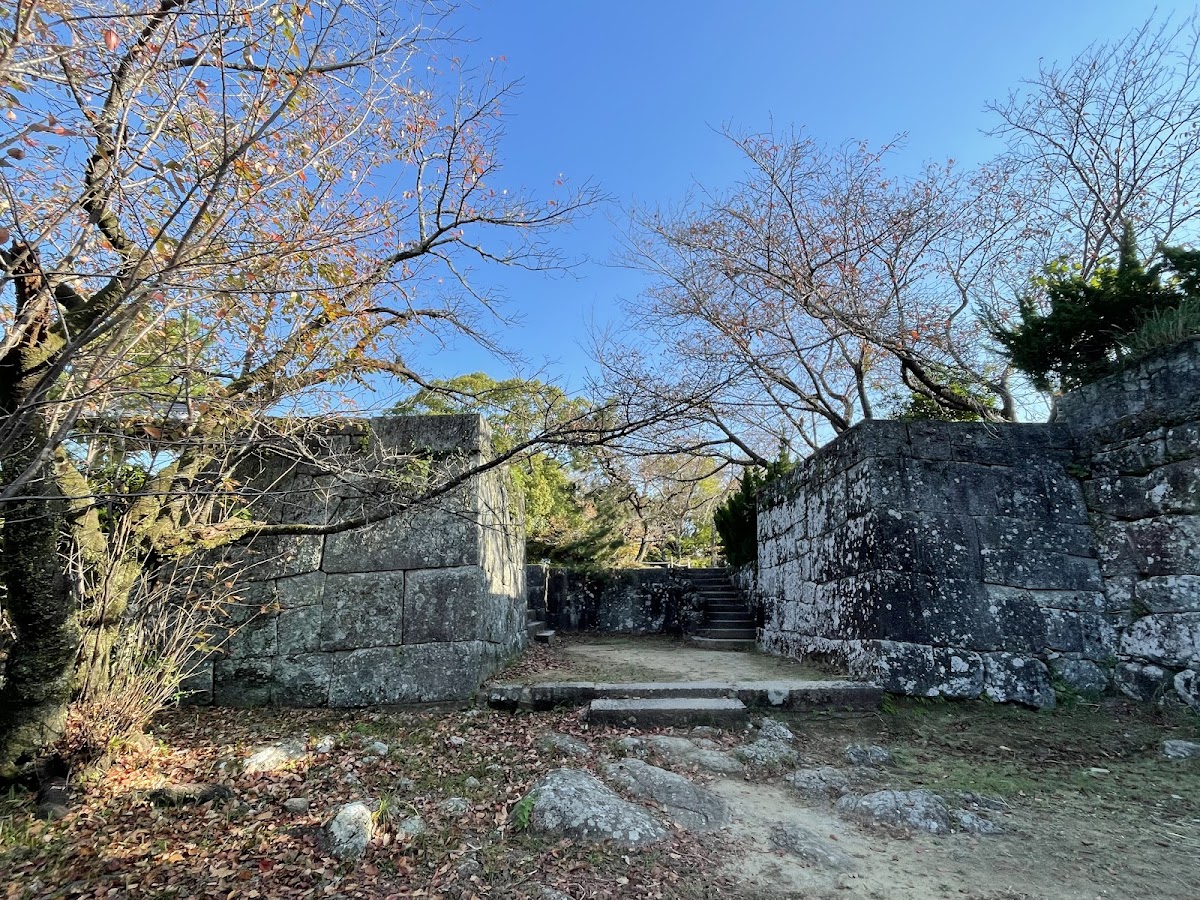
The stone walls surrounding the main enclosure reach a height of 5 to 10 meters, and the stone walls on the north and east sides of the main enclosure are particularly well-preserved. The stone used is mainly locally sourced granite, with some river stones transporting from the Kumano River also incorporated.
The corners of the stone walls exhibit the Sangizumi (a type of stacking technique), a method used to enhance strength. Even today, it retains much of its original appearance, which is one of the reasons it was selected as one of the Continued Top 100 Japanese Castles.
Structure of the Main Enclosure
The main enclosure is located at the highest point of Mt. Tankaku, measuring approximately 60 meters east-west and 40 meters north-south. While it is believed that a main palace and a castle tower base once stood here, a castle tower was never built at Shingu Castle.
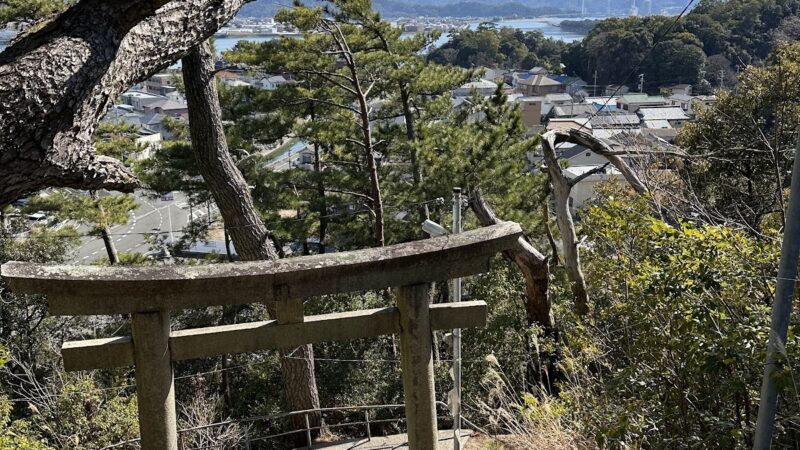
From the main enclosure, one can enjoy a panoramic view of the Kumano River and the Pacific Ocean, a view truly befitting its name, “Okimi Castle” (Castle with a View of the Open Sea). Currently, it is developed as a plaza and functions as an observation deck.
The main keep’s entrance (koguchi) was heavily guarded, and the structure of a masugata koguchi (square-shaped entrance) can be seen. This was a defensive structure designed to prevent enemy intrusion and is characteristic of castle architecture from the early Edo period.
Water Supply and Landing
To the north of the castle was an area called Mizunote, where a landing stage facing the Kumano River was located. This landing stage played an important role in the transportation of supplies and as a base for the navy.
A large charcoal storage was built in Mizunote, functioning as a facility for storing and shipping charcoal, a specialty product of the Kumano region. It was a center of economic activity utilizing the Kumano River’s water transport, indicating that Shingu Castle was not merely a military base but also an economic hub.
Layout and Function of the Enclosures
Kane-no-maru (Bell Enclosure) is located southwest of the main keep and gets its name from the bell tower that stood there. It was an important facility for transmitting the time to the town castle and issuing emergency warnings.
Matsunomaru was located northeast of the main keep and is believed to have been used as a vassal quarters and armory. Ninokuruwa (Second Keep) was located below Matsunomaru, occupying a larger area and housing facilities for the domain’s administrative affairs and vassal residences.
These enclosures were separated by stone walls, each functioning as an independent defensive unit. The design, with its tiered defensive lines, enhanced resistance to attacks.
Highlights of Shingu Castle
Stone Walls
The greatest highlight of Shingu Castle is its well-preserved stone walls. The high stone walls surrounding the main keep are impressive, allowing for close observation of early Edo period castle construction techniques.
In particular, the stone wall on the east side of the main keep reaches a height of approximately 10 meters, displaying a powerful, no-zumi (rough-stone) construction style. The harmony with the trees growing between the stones is beautiful, allowing visitors to enjoy the scenery throughout the seasons.
Some of the stone walls still bear markings, revealing traces of the stonemasons who built the castle. These markings are valuable resources for castle research.
View from the Main Enclosure
The view from the Main Enclosure is one of Shingu Castle’s greatest attractions. You can enjoy a panoramic view of the majestic Kumano River and the Pacific Ocean horizon, and on clear days, you can even see the mountains of the Kii Mountains in the distance.
As its alternative name, “Okimi Castle” (meaning “castle overlooking the open sea”), suggests, its location overlooking the Pacific Ocean speaks to its function as a monitoring base for maritime traffic. At dusk, the sunset over the Kumano Sea is beautiful, making it an excellent photo spot.
Currently, an observation deck has been installed in the Main Enclosure, allowing visitors to enjoy a 360-degree panoramic view. The scenery of Shingu city and the Kumano River estuary leaves a deep impression on visitors.
Remains of the Enclosures
The remains of each enclosure are also a highlight. By observing the distinctive shapes and layouts of each enclosure, such as Kane-no-maru, Matsu-no-maru, and Nin-no-maru, one can understand the castle’s structure at the time.
The layout of the passages and entrances connecting the enclosures is a clever design that takes defense into consideration, making it a fascinating subject for castle enthusiasts.
Mizuno Family Cemetery
The historical site designation of Shingu Castle Ruins includes the “Attached Mizuno Family Cemetery.” The Mizuno Family Cemetery is located near the castle ruins and contains the tombstones of successive lords of Shingu Castle, the Mizuno family.
The cemetery is situated in a quiet forest, allowing one to reflect on the history of the Mizuno family from the Edo period to the Meiji period. The style and arrangement of the tombstones convey the prestige befitting a daimyo family’s burial ground.
Cherry Blossom Viewing Spot
Shingu Castle Ruins is also known as a cherry blossom viewing spot. In spring, the entire castle site is adorned with cherry blossoms, creating a beautiful landscape with the contrast between the stone walls and the blossoms.
The cherry blossoms around the main keep are particularly magnificent, attracting many visitors every year. The trees are sometimes illuminated at night, allowing visitors to enjoy the magical sight of cherry blossoms after dark.
Shingu Castle and Literature
Due to its historical background and beautiful scenery, Shingu Castle has appeared in many literary works. The legend of Tan-tsuruhime, in particular, has been used as a theme in waka poetry and stories.
Edo period travelogues and geographical records describe the magnificent appearance of Shingu Castle and the scenery of the Kumano River, indicating that it was recognized as a famous place even then.
Even in modern times, Shingu Castle is often depicted as an important setting in novels and travelogues set in Kumano. In historical novels, it appears in works focusing on the reigns of the Asano and Mizuno clans, playing a role in conveying the history of the Kumano region.
Nearby Attractions
Shingu City Historical and Folk Museum
Located very close to the Shingu Castle ruins, the Shingu City Historical and Folk Museum is a facility where you can learn about the history of Shingu Castle and the culture of the Kumano region. Exhibits include castle models, excavated artifacts, and ancient documents, allowing you to deepen your understanding of Shingu Castle.
The Continued Top 100 Japanese Castles stamp is also located here, making it an important base for those touring ruin castles. The museum’s curators provide comprehensive explanations, allowing you to gain deeper knowledge.
Asuka Shrine
Adjacent to the Shingu Castle ruins, Asuka Shrine is one of the components of the World Heritage Site “Sacred Sites and Pilgrimage Routes in the Kii Mountain Range.” It is an important shrine of Kumano faith, and archaeological remains from the Jomon to Kofun periods have been discovered within its grounds.
Asuka Shrine also sells Shingu Castle stamps, which are popular as souvenirs for castle tours. Visiting both the shrine and the castle ruins allows for a multifaceted understanding of Shingu’s history.
Kumano Hayatama Taisha Shrine
Located in the heart of Shingu City is Kumano Hayatama Taisha Shrine, one of the three Kumano shrines. Within walking distance of Shingu Castle, it attracts many worshippers as a center of Kumano faith.
Within the grounds of Kumano Hayatama Taisha Shrine stands a sacred tree, the “Nagi tree,” over a thousand years old, designated a national natural monument. Visiting both Shingu Castle and Kumano Hayatama Taisha together allows for a deep experience of Kumano’s history and culture.
Kumano River
The Kumano River, flowing beneath Shingu Castle, is registered as a World Heritage Site as a “river pilgrimage route.” In the past, pilgrims on the Kumano pilgrimage would travel down this river by boat to reach the three Kumano shrines.
Even today, you can experience a river boat ride on the Kumano River and view the Shingu Castle ruins from the water. The view of the castle ruins from this vantage point is exceptional, allowing you to truly appreciate the strategic location of Shingu Castle as a key point for water transport.
Shingu Castle Town
The city of Shingu, which developed as a town for Shingu Castle, still retains traces of its Edo-period layout. Old merchant houses and storehouses are scattered along the old highway, creating a historical atmosphere.
Place names such as Nakanomachi and Funamachi tell the story of the former castle town’s structure, and a stroll through the area allows you to discover remnants of the Edo period.
Access and Visiting Information
Access Methods
Access by Train:
- Approximately 15 minutes on foot from JR Kisei Main Line “Shingu Station”
- Immediately after alighting at “Tankaku Castle Ruins” bus stop on the Kumano Kotsu bus line
Access by Car:
- Approximately 1 hour from Kisei Expressway “Owase Kita IC” via National Route 42
- Free parking available (shared with Shingu City Historical and Folk Museum)
Visiting Information
- Opening Hours: Always open (Museum has specific opening hours)
- Admission Fee: Free
- Estimated Time Required: Approximately 1-2 hours
- Continued Top 100 Japanese Castles Stamp: Located at Shingu City Historical and Folk Museum
- Castle Seal: Sold at Asuka Shrine
Visiting Points
Since Shingu Castle Ruins is a mountain castle, we recommend wearing comfortable walking shoes. Reaching the main keep requires climbing stone steps, which takes approximately 15-20 minutes from the base.
In summer, heat protection is necessary, and in winter, warm clothing is required. Also, be careful as the stone steps can become slippery in rainy weather.
Photography is permitted, but the view from the main keep is particularly beautiful in the morning when the light is favorable, making it ideal for photography. During cherry blossom season (late March to early April), crowds are expected, so visiting early in the morning is recommended.
Preservation and Utilization of Shingu Castle
Historic Site Designation and Preservation Activities
The Shingu Castle ruins are designated as a national historic site as “Shingu Castle Ruins and Mizuno Family Cemetery,” and are preserved and managed in accordance with the Cultural Properties Protection Law. The Shingu City Board of Education plays a central role in carrying out appropriate preservation activities, such as the restoration of the stone walls and the management of trees.
In recent years, restoration work based on expert surveys has been carried out on areas of the stone walls that are bulging or at risk of collapse. To preserve its cultural value, the restoration is carried out using traditional techniques.
Selection as one of the Continued Top 100 Japanese Castles
On April 6, 2017, Shingu Castle was selected as one of the Continued Top 100 Japanese Castles by the Japan Castle Association. This designation signifies nationwide recognition of Shingu Castle’s historical and cultural value. This selection has led to an increase in castle enthusiasts visiting from across the country, contributing to regional revitalization.
As part of the Continued Top 100 Japanese Castles stamp rally, a stamp has been installed at the Shingu City Historical and Folk Museum, attracting many enthusiasts.
Utilization as a Tourism Resource
Shingu City positions the Shingu Castle ruins as an important tourism resource and is developing various utilization measures. These include cherry blossom season illuminations, historical lectures, and guided tours, aiming to enhance information provision and experiential opportunities for visitors.
With its collaboration with the World Heritage sites of Kumano Kodo and Kumano Sanzan, it is also expected to play a role as a hub for historical and cultural tourism. The Shingu Tourism Association offers model courses for visiting historical sites in the city, including the castle ruins, enabling efficient sightseeing.
The Future of Shingu Castle
The Shingu Castle ruins need to be passed on to future generations while balancing the preservation of their historical value with their use for tourism. Currently, Shingu City has formulated the “Shingu Castle Ruins Preservation and Utilization Plan,” establishing a long-term preservation and management policy.
In the future, various initiatives are planned, including continuous preservation and repair of the stone walls, multilingualization of information boards and brochures, and information dissemination using digital technology. Furthermore, collaborative cleaning and monitoring activities with local residents are also important elements.
Shingu Castle is a valuable cultural heritage site that conveys the history of the Kumano region, and it is our responsibility, as those living in the present, to pass on its value to future generations.
Summary
Shingu Castle (Tankaku Castle) was an important branch castle of the Kishu Domain, built by the Asano clan in the early Edo period and later ruled by the Mizuno clan until the Meiji Restoration. This flatland castle, built on Mt. Tankaku at the mouth of the Kumano River, boasts surprisingly well-preserved stone walls and baileys, and has been selected as one of Japan’s Top 100 Castles (Continued).
The view of the Kumano River and the Pacific Ocean from the main keep is spectacular, making its nickname, “Okimi Castle” (Castle with a View of the Open Sea valuable), truly fitting. Nearby are the World Heritage sites of Asuka Shrine and Kumano Hayatama Taisha Shrine, making it a spot to experience history and culture.
When visiting Shingu City, be sure to visit the Shingu Castle ruins and enjoy the history of Kumano and the magnificent natural scenery.