Complete Guide to Kanayama Castle | A Thorough Explanation of the Highlights, History, and Access to One of Japan’s Top 100 Castles
Kanayama Castle is a Sengoku period mountain castle built on Mt. Kanayama, which rises to an altitude of 235.8 meters, almost in the center of Ota City, Gunma Prefecture. Also known as “Nitta Kanayama Castle” or “Ota Kanayama Castle,” it is one of Japan’s Top 100 Castles. It is a “fortress that was virtually impregnable,” having repelled attacks from famous Sengoku warlords such as Uesugi Kenshin and Takeda Katsuyori more than 10 times. Its robust defensive system is highly regarded in the history of castle architecture.
This article comprehensively explains everything you need to know before visiting Kanayama Castle, from its history and highlights to access information.
Basic Information on Kanayama Castle
Location: Kanayama-cho, Ota City, Gunma Prefecture
Alternate Names: Nitta Kanayama Castle, Ota Kanayama Castle
Castle Structure: Renka-shiki Yamashiro (a type of mountain castle)
Year of Construction: Bunmei 1 (1469)
Builder: Iwamatsu Iezumi
Main Lords: Iwamatsu clan, Yura clan, Hojo clan
Elevation: 235.8 meters
Designation: National Historic Site (designated in 1934), One of Japan’s Top 100 Castles (No. 17)
Stamp Locations: Kanayama Castle Ruins Guidance Facility (within the South Enclosure Rest Area), Ota City Kanayama Regional Exchange Center
Kanayama Castle is a large-scale mountain castle utilizing the entire Kanayama mountain, which is covered with Japanese red pine. The castle grounds extend approximately 3.1 km east-west and 3.8 km north-south. This castle is one of the largest in Japan, boasting a vast area of approximately 300 hectares.
History of Kanayama Castle
Construction and the Era of the Iwamatsu Clan
Kanayama Castle was built in 1469 (Bunmei 1) by Iwamatsu Iezumi, a member of the Nitta clan. The Nitta clan was a prestigious samurai family that had existed since the Kamakura period, and was a distinguished family descended from the Minamoto clan. During the turbulent Sengoku period, Iwamatsu Iezumi established control of the region by constructing a central castle, known as the “Mijo,” on the summit of Mt. Kanayama (239 meters above sea level), and creating four baileys—Nishijo, Kitajo (Sakanakajo), and Hachiojiyama Fort—on the ridges extending in all directions.
From its inception, Kanayama Castle possessed a robust defensive structure utilizing earthworks such as moats and earthen ramparts. The basic strategy for mountain castles was to establish a residence at the foot of the mountain during peacetime and focus on strong defenses at the mountaintop castle during battle. Kanayama Castle followed this principle, functioning as an impregnable fortress that skillfully utilized the natural terrain.
The Yura Clan Era and its Golden Age
In the 16th century, Kanayama Castle came under the control of the Yura clan. During the Yura era, Kanayama Castle underwent extensive renovations, and the began to utilize full-fledged stone walls, a rarity in the Kanto region. While previous castle history theories held that full-fledged stone walls in the Kanto region only began in the Edo period, archaeological excavations at Kanayama Castle have revealed that advanced stonework were already in use during the Sengoku period.
During the Yura era, Kanayama Castle was attacked more than ten times by renowned Sengoku daimyo such as Uesugi Kenshin, Takeda Katsuyori, and Satake Yoshishige, but it never fell. This reputation as an “impregnable castle” is what makes Kanayama Castle one of the seven most famous castles in the Kanto region.
Hojo Clan Rules and Abandonment
In 1590, during Toyotomi Hideyoshi’s siege of Odawara, Kanayama Castle was under the control of the Hojo clan. With the surrender of Odawara Castle, Kanayama Castle also surrendered, and was subsequently abandoned when Tokugawa Ieyasu entered the Kanto region. For approximately 120 years from its construction, Kanayama Castle never once fell to an enemy, thus fulfilling its purpose.
Kanayama Castle’s Layout and Structure
Defensive System Centered on the Main Enclosure (Honmaru)
The main enclosure (Honmaru), the central part of Kanayama Castle, is located on the summit of Mount Kanayama, with multiple enclosures arranged along the ridges extending in all directions from it. This layout is a structure called “renkaku-shiki” (renkaku-shiki), where each enclosure is separated by moats and earthworks, designed to prevent enemy intrusion in stages.
The main enclosures are as follows:
- Main Enclosure (Honmaru): The most important section on the summit of Mt. Kanayama
- West Enclosure: A defensive base located on the western ridge
- North Enclosure (Sakanaka Enclosure): An enclosure responsible for the defense of the north
- Hachiojiyama Fort: A watchtower and defensive base in the southeast direction
- South Enclosure: An important enclosure responsible for the defense of the main gate area
These enclosures function as independent defensive bases, yet are arranged to cooperate with each other.
Multiple Defenses with Moats and Earthworks
The defensive system of Kanayama Castle is characterized by the combination of moats cutting across the ridges and high earthworks. Against enemies advancing along the ridges, the moats block their path, while attacks can be launched from atop the earthworks.
In particular, multiple moats are provided along the route from the main gate to the main enclosure, creating a multi-layered defense system where even if the enemy breaks through one line of defense, they will face new obstacles one after another. This ingenious defensive design is one of the reasons why Kanayama Castle was called an “impregnable castle.”
Highlights of Kanayama Castle
Stone Walls and Paving of the Main Gate
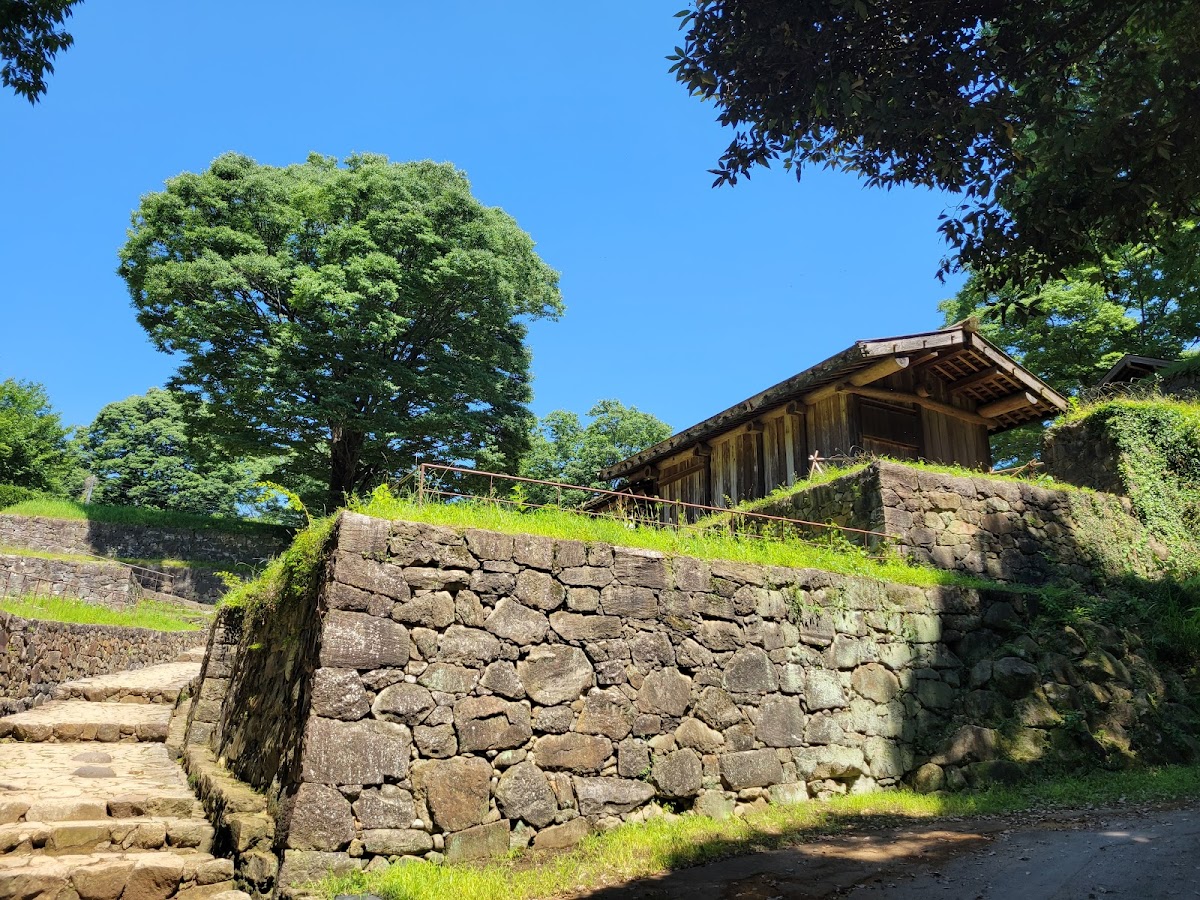
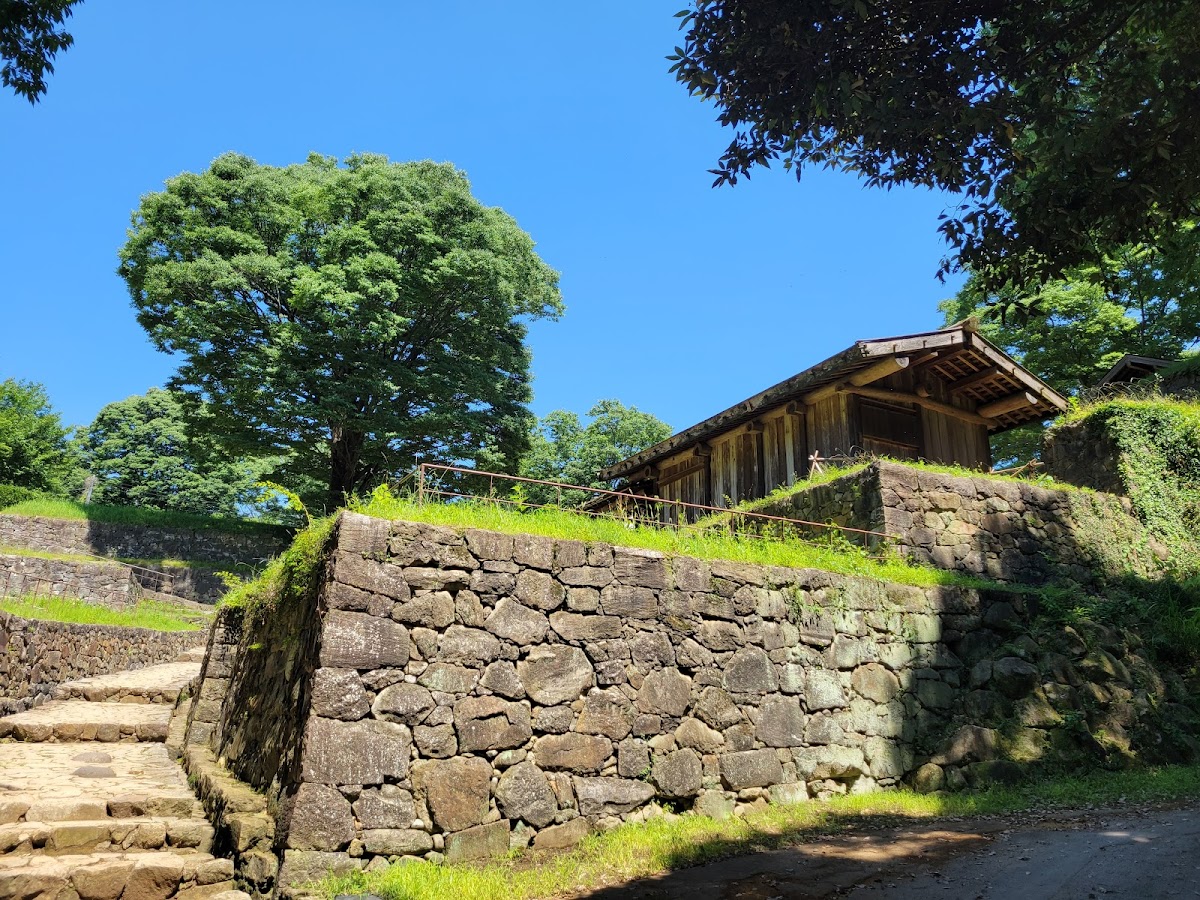
The greatest highlight of Kanayama Castle is the restored stone walls and paving of the main gate (Ote-koguchi). A gate is the entrance to a castle, and the place where the strongest defenses were needed. Kanayama Castle’s main gate is characterized by its neatly stacked stone walls and beautifully laid stone paving.
This stone paving is an extremely rare feature among mountain castles in the Kanto region, overturning conventional wisdom in castle history. Archaeological excavations have proven that such sophisticated stonework techniques were already being used in the Kanto region during the Sengoku period. It is believed that the stone paving served not only decorative purposes but also practical purposes such as drainage during rain and providing a foothold during defense.
Tsuki-no-ike and Hi-no-ike Ponds
Near the main gate (Ote-koguchi), there are two stone-built ponds called “Tsuki-no-ike” (Moon Pond) and “Hi-no-ike” (Sun Pond). These are believed to have held religious significance beyond mere water storage. The moon and sun are important symbols in Yin-Yang philosophy, and it’s possible they were intended to pray for the protection of the castle.
Tsuki-no-ike Pond is approximately 4 meters square, and Hi-no-ike Pond is approximately 3 meters square; both are meticulously constructed of stone. The presence of such stone-built ponds in a mountain castle from the Sengoku period is extremely rare, making them one of the unique features of Kanayama Castle.
Honmaru Ruins and Nitta Shrine
On the site of the Honmaru (main enclosure) at the summit of Mount Kanayama, the Nitta Shrine, dedicated to Nitta Yoshisada, now stands. Nitta Yoshisada was a hero of the Nitta clan who played a key role in the overthrow of the Kamakura Shogunate, and is deeply revered locally. From the Honmaru, one can enjoy a panoramic view of Ota city, and on clear days, the Kanto Plain can be seen in the distance.
Remnants of earthworks remain around the main keep, allowing us to imagine the scale of the former defensive structures. Furthermore, the path leading to the main keep is dotted with remnants of stone steps and stone walls from that time, giving a sense of the castle’s former grandeur.
Remains of the West and North Castles
The remains of the subsidiary castles, such as the West and North Castles, are also a highlight. The remains of earthworks and moats are well-preserved in these enclosures, providing a concrete understanding of the defensive system of a mountain castle during the Sengoku period.
In particular, the North Castle (Sakanaka Castle) was large enough to function as an independent fortress and played an important role in the overall defensive network of Kanayama Castle. From the West Castle, one can see the three mountains of Joshu, including Mount Haruna and Mount Akagi, offering magnificent views.
Baba Enclosure and South Enclosure
The Baba Enclosure, as its name suggests, is a flat enclosure thought to have been used for training and gathering horses. The stone walls from here to the South Enclosure are important remains that demonstrate the high level of stonework techniques used at Kanayama Castle.
The South Enclosure has a rest facility and serves as a Kanayama Castle Ruins Guidance Facility where you can learn about the castle’s history and structure. You can also get your stamp for the “100 Famous Castles of Japan” here.
Views from the Watchtowers
Kanayama Castle has several watchtower remains, and the views from them are spectacular. During the Sengoku period, these watchtowers were important facilities for monitoring enemy movements. Today, they are popular viewpoints offering panoramic views of the Kanto Plain.
Especially from the southern watchtower, on a clear day, you can sometimes see as far as the Tokyo Skytree, allowing you to imagine what the lords of the Sengoku period saw from this spot.
Cultural Value of Kanayama Castle
Designation as a National Historic Site and Selection as one of the 100 Famous Castles of Japan
Kanayama Castle Ruins were designated as a National Historic Site in 1934. This indicates that Kanayama Castle occupies an important position in the history of Japanese castles. Furthermore, in 2006, it was selected as one of Japan’s Top 100 Castles (No. 17), making it a nationally recognized castle site.
Evaluation as one of the Seven Famous Castles of the Kanto Region
Kanayama Castle is counted as one of the Seven Famous Castles of the Kanto Region. The Seven Famous Castles of the Kanto Region are a selection of representative castles of the Kanto area, and in addition to Kanayama Castle, other castles include Odawara Castle, Kawagoe Castle, Oshi Castle, Karasawayama Castle, Utsunomiya Castle, and Maebashi Castle (selection criteria may vary).
The reasons for Kanayama Castle’s selection as one of the Seven Famous Castles of the Kanto Region are its robust defensive system, well-preserved remains, and its historical achievement as an “impregnable castle.”
Importance in Castle History
The excavation and research of Kanayama Castle have had a significant impact on the history of Japanese castles. In particular, it has led to a major revision of conventional theories regarding the development of stone wall technology in the Kanto region.
Traditionally, it was believed that full-scale stone walls were only used in the Kanto region from the Edo period onward. However, investigations of Kanayama Castle have revealed that advanced stonework techniques already existed during the Sengoku period (Warring States period). This discovery is considered a groundbreaking achievement in the study of Japanese castle history.
Access to Kanayama Castle
Access by Train
Nearest Station: Tobu Isesaki Line “Ota Station”
From Ota Station to Kanayama Castle Ruins, there are the following options:
- Taxi: Approximately 10 minutes from Ota Station to the Kanayama Castle Ruins Guidance Facility
- Bus: Take the bus bound for “Kanayama Castle Ruins Guidance Facility Entrance” from the north exit of Ota Station (Note the operating days and frequency)
- Walking: Approximately 30 minutes from Ota Station to the foot of Mt. Kanayama, then approximately 40 minutes via the hiking trail to the summit
Access by Car
Nearest Interchange: Kita-Kanto Expressway “Ota-Kiryu IC” or “Ota-Yabuzuka IC”
Approximately 20 minutes from the IC to the Kanayama Castle Ruins Guidance Facility.
Parking:
- Kanayama Castle Ruins Guidance Facility Parking (Free, approx. 30 cars)
- Nishiyamaroku Parking (Free)
- Momijidaira Parking (Free)
Ascent Routes
There are several ascent routes to Kanayama Castle:
- Ote-guchi Route (Recommended): From the Guidance Facility, via the Ote-koguchi (main gate) to the main keep (approx. 30 minutes)
- Nishiyamaroku Route: From the Nishiyamaroku Parking, via the West Castle to the main keep (approx. 40 minutes)
- North Route: From the North Castle (Sakanaka Castle) to the main keep (approx. 50 minutes)
For first-time visitors, the Ote-guchi Route, which offers many points of interest, is recommended.
Information on Visiting Kanayama Castle
Visiting Hours and Fees
Visiting Hours: Open all day (however, dangerous at night)
Admission Fee: Free
Recommended Visiting Hours: 9:00 AM to 4:00 PM (to descend before sunset)
Estimated Time Required: 1.5 to 3 hours (varies depending on the area visited)
Guidance Facility
Kanayama Castle Ruins Guidance Facility (South Enclosure Rest Area)
- Opening Hours: 9:00 AM to 5:00 PM
- Closed: New Year’s Holidays (December 29th to January 3rd)
-Admission Fee: Free
- Facility Contents: Exhibition panels, models, video materials, toilets, rest area
- Stamp Location: Yes (Japan’s Top 100 Castles stamp)
Notes for Visitors
- Clothing: As it is a mountain castle, comfortable shoes and clothing are essential.
- Season: In summer, bring insect repellent; in winter, bring warm clothing.
- Drinks: There are few vending machines, so bring your own water.
- Weather: Be careful as the stone steps can be slippery in rainy weather.
- Physical Fitness: This is a climb with an elevation difference of approximately 100 meters, so those who are not confident in their physical fitness should not push themselves.
Tourist Spots Around Kanayama Castle
Ota City Kanayama Regional Exchange Center
This facility is located at the foot of Kanayama Castle and displays detailed information about Kanayama Castle. A stamp for the “100 Famous Castles of Japan” is also located here, and it is recommended to stop by and gain some background knowledge before climbing to the castle ruins.
Kanayama Castle Ruins Guidance Facility
This facility is located in the South Enclosure and has exhibits where you can learn about the history and structure of Kanayama Castle. There is also a rest area and toilets, making it a convenient base for climbing the castle.
Sogenji Temple (Ota City)
This is the family temple of the Yura clan, the lords of Kanayama Castle, and preserves cultural artifacts related to the Yura clan. Visiting Kanayama Castle in conjunction with this site will allow you to understand the history more deeply.
Nitta-sho Historical Museum
This museum allows you to learn about the history of the Nitta clan. Since the Iwamatsu clan, who built Kanayama Castle, were also a branch of the Nitta clan, related materials are on display.
The Four Seasons of Kanayama Castle
Spring (March-May)
In spring, Kanayama Castle is beautiful with its fresh greenery, and during cherry blossom season, cherry blossoms bloom profusely from the foot of the mountain to the middle of the slopes. The weather is mild, making it the perfect season to visit the castle.
Summer (June-August)
In summer, the greenery is lush, and the shade of the trees is cool, but there are many insects, so caution against heatstroke is necessary. Visiting in the cooler hours of early morning or evening is recommended.
Autumn (September-November)
In autumn, the autumn foliage is beautiful, and the contrast between the red pinees that cover the entire mountain (the origin of the name of Kanayama Castle) and the autumn leaves is magnificent. The weather is stable, making it an ideal season for visiting the castle, along with spring.
Winter (December-February)
Winter offers clear air and the best views. While snow accumulation is rare, caution is needed regarding ice. Be sure to dress warmly when visiting.
Events at Kanayama Castle
Ota City regularly holds events related to Kanayama Castle:
- Kanayama Castle Festival: A local festival held every autumn, featuring a samurai procession and other events.
- Guided Tours: Free guided tours by local volunteer guides (advance reservations required).
- History Lectures: Lectures on the history and fortifications of Kanayama Castle are irregularly held.
For details, please check the Ota City Tourism and Products Association website or the Ota City website.
To Learn More About Kanayama Castle
Related Books
For those who wish to learn more about Kanayama Castle, the following books are recommended:
- “Nitta Kanayama Castle” (Published by Ota City Board of Education)
- “Walking Through Famous Castles of Kanto” Series
- “Official Guidebook to Japan’s 100 Famous Castles”
Research Findings
The excavation report by the Ota City Board of Education provides detailed information about the structure and changes of Kanayama Castle and is recommended for those who wish to learn more in-depth.
Summary
Kanayama Castle is a valuable historical site that conveys the appearance of a mountain castle from the Sengoku period. Its robust defensive system, which repelled more than 10 attacks as an “impregnable castle,” its authentic stone walls and paving (rare in the Kanto region), and its location surrounded by beautiful natural surroundings continue to fascinate visitors.
As one of Japan’s 100 Famous Castles and one of the Seven Famous Castles of Kanto, Kanayama Castle is a must-see spot not only for enthusiast castles but for all those interested in history. When you visit Ota City in Gunma Prefecture, be sure to climb to Kanayama Castle and experience the atmosphere of the Sengoku period firsthand.
The neatly arranged stone walls of the main gate, the mystical atmosphere of Tsuki-no-ike and Hi-no-ike ponds, the magnificent view from the mountaintop, and the remnants of moats and earthworks scattered throughout the site will transport you back in time to the Sengoku period. Kanayama Castle is not just a tourist attraction; it is a “living textbook” where you can experience Japanese history and culture.