A detailed explanation of the history of Tsunuma Castle
Overview
The location of Tatsunuma Castle was in Hofusa, Nagano City, and the castle was located in Hirahara Castle Pond. During the time when the country was located on the plains of the Chikuma River, it was a battleground where the Uesugi clan and the Takeda clan fought fiercely.
The geographical location of Tatsunuma Castle is important, and its presence in the city is a key position. This is an important transportation hub for the Hokkoku Kaido East Line Funanoto Exit. The Chikuma River was built using Tatsunuma Castle, and the castle was built on a natural river, and the construction was solid and defensive, making it an irresistible base in the northern area of the city.
However, it is universally acknowledged that it was built by the Shimazu clan, which was originally owned by the Shimazu clan. The castle fort has been in existence for over 200 years, and it was extended straight through to the beginning of the Jiangzhou era. The main part of the program has been changed, but the history of the country’s history has been changed to include ink and ink.
History of Tatsunuma Castle
Early history of construction
There is no clear record of the construction date of Nagashima Castle, but it is universally acknowledged that it was built in the early period of the war. The first owner was the Shimazu clan, which was owned by the Shimazu clan. Xin’an’s Shimazu clan resided in the northern part of the city, which had great power, and was under control in the Tatsunuma area.
Influenced by the Uesugi clan (Nagao clan at the time), who arrived at Tatsunuma Castle in the early period of the war. The North Xinhuan area was the center of the country’s power after the fall, and was the center of the area’s activities from the beginning to the end, and the center of the area’s activities.
Takeda Shingen era
During the Eiroku era (1558-1570), Takeda Shingen, Kai Province, had a strong military power in the Northern Shinga area, and the strategic status of Tatsunuma Castle as well. Takeda Shingen’s goal was to establish a restraint system in the northern part of the central island, and a fierce battle ensued.
At the beginning, the Shimazu clan was effective and loyal to the Uesugi clan, but at the same time, the Takeda clan was overpowered by the military, and in the end, the Takeda clan was effective and loyal. During this period, the lord of Tatsunuma Castle, Tadanao Shimazu, was sworn to be loyal to Takeda Shingen, and envoys were sent to Tatsunuma Castle, an important location in the Takeda clan’s Shinho area in the north.
Takeda Shingen’s high-level observation of the strategic position of Changnuma Castle, and the command of his vassal Shinji Mazo (Minokami Shinji Mazo) to carry out large-scale repairs as he marched through Changuma Castle. Shinji Masaaki was one of the 24 Great Takeda Shoguns, and was also the most famous fort builder. Under the direction of the alien, Tatsunuma Castle was remodeled and the Seiichi troupe merged to form a Takeda-style castle fort construction style.
Work Takeda forward base
After completing the construction of the army, Shinji built a castle, and the Takeda clan established a forward base in the northern part of the country. During the battle of Nakashima in the river, Tsunuma Castle was an important base for the Takeda Army, and an important role in the fight against the Uesugi Army.
The geographical location of Tatsunuma Castle was advantageous to the Takeda clan. The Chikuma River is not allowed to be used by other people as a natural barrier, and the controlled riverside transportation route is highly efficient and the transportation facility is equipped with a traffic control system. In addition, there are various restrictions on the Hokkoku Highway, and the activities of the Uesugi military in the post-Vietnam area where other personnel can be monitored, as well as the necessary actions to be taken.
After Takeda Shingen, the castle was established in Nagasaki, and control was established in the surrounding areas of Kajima. A senior vassal of the Takeda family, a senior member of the castle, in the northern part of the capital. During this period, Naganuma Castle was a military base for military operations, as well as an administrative center for the Takeda clan and the administrative center of the northern part of the country.
After the Takeda clan was overthrown
In 1582, Nobunaga Ikuda conquered the Kai Province, overthrew the Takeda clan, comprehensively organized the internal affairs of Tatsunuma Castle, and created a national capital, resulting in a huge transformation. After the death of the Takeda clan, Shinho Province entered the country, and in June of the same year, the Honnoji envoy again entered the country.
During the current stage of development, Kageyoshi Uesugi was in charge of the northern part of the country, and Joya Tsunuma entered the Uesugi clan. After the victory of Uesugi Kei, he went south, and the experience of seeing Uesugi’s belief in the northern part of the country was suppressed. Tatsunuma Castle is an important location in the northern part of the Uesugi clan.
After his vassal, Hideyoshi, became Empress of Japan, Keiyoshi Uesugi served as a powerful daimyō, and was in the hands of the Uesugi clan, who were in charge of the northern area of Shinagawa, including Tatsunuma Castle.
Tokiyo Azuchi Momoyama
In 1590 (Tensho 18), the vassal Hideyoshi attacked and conquered Empress Odawara, and Uesugi Kei won the conquest of Aizu, with an area of 1.2 million koku. Kuniyoshi Nobuaki has arrived as the new ruler.
The majority of the province was covered by the northern part of the province, and the government of the vassals was determined by the feudal lord’s authority, such as Mori Tadamasa and Wadamaru Naomasa. Joya Tsunuma was appointed as the new lord of the castle for a period of time, however, detailed records are not yet complete.
In 1598, Hideyoshi, the vassal of Japan, was defeated and Japan was re-introduced. In 1600, during the Kanwara War, the Daimyo branch of the Shin’en Province was divided into East and West lines. After the war, Tokugawa Ieyasu took control and established the Eko Shogunate.
Jiang Jiang Dynasty
After the arrival of the Edo era, the performance of Tatsunuma Castle was completed in a new style. In 1616, Sakuma Toshu became the chief lord of the Naganuma domain and the administrative center of the Naganuma domain. The Tsunuma domain was relatively small, with an annual production of 10,000 koku of rice, but the Shogunate had an important role in the restoration of the northern part of the country.
The Sakuma clan was established as the third generation of the Nagashima domain, but was in existence in 1661, when Masanaka Hotta was in charge. After this, the feudal lord of the Tsunami domain was replaced, and finally, the descendants of Nobumasa Sanada took over.
During the Edo era, Tatsunuma Castle was in ruins, and during the Kuni era, Nagata was a place of intense war, but it was the administrative center of the feudal lord, and the administrative base of the Hokkoku Highway. The castle town has also achieved success, and the Japanese agricultural industry is prospering.
In the late Edo period, during the active period, when the Tsunuma domain was closed, the change occurred, but during the new Meiji era, there were no major battles to be fought. In 1871, the system of feudal lords was abolished, the feudal lords of Tsukumanuma disappeared, and Tsunuma Castle disappeared, resulting in its original function.
Construction construction
The construction of Tatsunuma Castle has been completed and is typical of the construction of Hirahara Castle on the Chikuma River Plain. During the war, Shinji’s progress was completed, the Takeda-style castle and pond construction technology was introduced, and a solid defense system was established. ### Clothing Bureau
The Chikuma River in the east of Tatsunuma Castle’s strategic use of land, and the natural Chikuma River in its construction. On the other side of the river flow, there is a cliff of 陡峭, and the attacker is able to conquer the enemy. It takes full advantage of the terrain’s superiority and has the defensive ability of a strong fort.
The main castle (honmaru) is located in the center of the fort, the second outer fort (Ninmaru), and the third outer fort (Sannomaru). The main castle’s ruins are now clear and clear, and the castle fort has the appearance of an old Japan-centered area.
Arriving north of Xixi, the construction of the fort was completed, and the construction work of Hewa City was completed. This small project involved the invasion of the plains by the Russians, and Shinji’s outstanding fort construction techniques were fully demonstrated.
Hijikata Construction Yobaki Castle River
The systematic core of Tatsunuma Castle’s defense is the Hijikata construction work and the castle river. After the construction of the fort’s surrounding area, the earthworks on several layers were completed, and the construction period was also maintained. In addition, the construction of the earth’s surface does not require any use of defense, its strategic position and its careful design, its ability to limit the actions of the enemy, and the ability to provide firepower within the castle.
It’s just that it’s a departure from umadashi. The site of Tennou Shrine is located in the old days (Umadashi, a horse-shaped earthen embankment), and there is one line of the Shingetsu-shaped Shojo River. This is a typical special expedition of Takeda-style fort construction, and it is a type of defense construction in front of the U.S. castle gate. Its action is to disperse the enemy’s attack, and prevent the enemy’s direct attack on the castle gate.
However, the depth of the castle river is as high as the depth of the embankment, however, there is no doubt that the defense ability of the castle fort at the time of the country is equipped. The history of the earthen embankment has been revealed at the time.
Construction
Tenshu, the abandoned castle tower of Tatsunuma Castle. This is the joint special expedition of the castle fort during the war, and the fort was built before the castle tower became popular. After serving as the administrative center of the Naganuma domain during the Edo era, the immediate envoy also built a castle tower.
Various constructions are distributed within the castle fort, including the Honmaru Palace (main palace). The lord’s ability to fulfill his duties, the fortifications, the administrative offices, the lord’s residence, the residence of his vassals, and the military base.
Records from the time of the Nedo River, defensive construction and watchtower built inside the castle fort. The construction of the observation tower is the key position of the fortress, and the defensive base for its operation. Due to the limitations of the flat topography, the construction of this small structure requires a clever and effective defense system.
Guanyu Stone Tomb, a large-scale stone tomb that resembles Tatsunuma Castle. This is possible since the construction of the stone tombs on the plains in that area was the time of the evacuation. In contrast, the construction of the city is a major defense work, and the civil engineering technology has been successfully used during its construction.
Irrigation system
One of the important features of Tatsunuma Castle is its use of the Chikuma River water system. The Chikuma River is located on the east side of the castle fort, and is not a natural river, which is also the water source of the fort.
A water well was dug inside the fort, which ensured the supply of water during the time when the city was in the city. One of the weaknesses of the plains fort is the lack of water sources, but the Chikuma River is also a good source of water, and the area is excellent.
In addition to this, Chikuma Kawana is one important waterway, convenient for transportation of goods through waterways. After increasing the strength of the fort, the fortress was able to defend itself for a long time.
Longevity
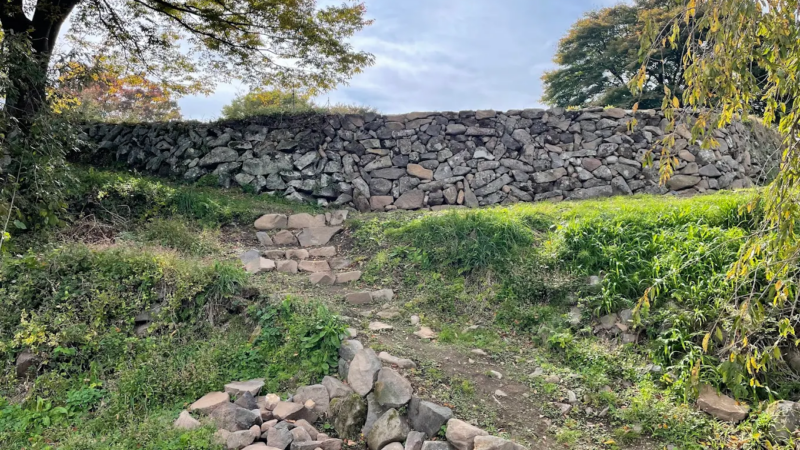
Right in front of me, most of Tatsunuma Castle existed a long time ago, but I could see some traces. As Yuyu’s Chikuma River embankment was renovated and transformed into a Japanese castle city, I imagined that the castle fort looked like it was in ancient times, but the topography and the slight remnants of its construction were still there for us to see.
Existing legacy
Since the main castle remains, the landing area is still high, and the central location of the fort has been determined. The area of Yoshu’s land is a slightly elevated area, and the city’s history is different from ancient times.
It is a monument to the temple surrounding the Heavenly King, and the saddle-shaped earthen embankment. This is the area below Yudi, which is a rare historical site, and the special features of Takeda-style fort construction techniques have been revealed. However, the existence of a new moon-shaped river, however, in the slight ups and downs of the topography, it is possible to infer the existence of a clear and clear earth.
The earthen embankment still exists. However, if you look at it carefully, you will be able to calculate the amount of defense work that was done in ancient times.
Castle ruins monument and information
The monument commemorating the ruins of Tatsunuma Castle is an important castle fortress of the troupe. The commemorative monument commemorates the important historical importance of Nagakunuma Castle, and it was understood in later life.
Unfortunately, there is not much information on the site, but the work of the director of the Togino city government is a direct result of the history of the city’s history, and the mission is a hot destination for history lovers. However, the parking position and other facilities are limited, so please be careful when visiting this construction.
Archaeological excavation research
Until now, the archaeological excavation work in Changnuma Castle has been limited and on a large scale. As Yucheng City continues to evolve, large-scale training programs are being developed. However, through the historical literary research and topographical analysis of the fortress, the history of the fortifications was completed and the history of the country’s history was sequentially opened.
In the future, it is possible to see a new future, and hope to see the real face of Nagai Castle in the future.
Historical meaning of Tsunuma Castle
This is an important part of the history of the country during the time when Tatsunuma Castle was at war. It was the front line of the battle between the Uesugi clan and the Takeda clan, and an important military base for Korekawa Nakashima.
Takeda Shingen’s mission, Shinji’s repair work, and Naganuma Castle. Tsunuma Castle is important for the Takeda clan’s rule in the northern part of the country, and it is also the symbol of the Takeda clan’s rule.
During the Edo era, Tatsunuma Castle was the center of modern administration during the war, the frontier of the Naganuma clan, and a well-organized area for damage control. Unfortunately, the Tsunuma domain was not very large, but the control system of suppressing the production of the Hokkoku Highway was a key base in key areas, and the system of the shogunate had an important effect on the passage of time.
Most of the time has passed since then, but the history of Numa Castle is very similar to that of the mirror, and the history of the country’s history has been reflected. The work was a turning point in the history of Japan during the war, and the history of the Tatsunuma castle was a turning point in the history of the war.
Former Nagaonuma Castle
The site of Tsunuma Castle is located in Hoho-cho, Nagano City. As you can see public transportation, the latest train station is Longno Electric Railway Longfield Train Station, but before going to Nari, there is a long way to go, so this self-drive is more convenient.
Approximate travel time is 20 minutes in front of the Shinetsu Expressway’s Longno Interchange Expressway. However, as mentioned above, the castle fort is surrounded by a parking lot, so please be careful when visiting the surrounding environment.
The city’s fortress is usually open to tourists, but the historical background of its construction is clear and clear. The reference material provided by Tagano City is provided by Kawanakajima Kawanakajima Historical Site Guide.
There are many other cultural historical sites in the Zhouyan area, such as Chuanchuan Island Historical Park. We all visited the site and learned more about the history of northern China during the war.
Conclusion
Tatsunuma Castle was an important fortress in the northern part of the country during the Edo period. It is a battleground between the Uesugi clan and the Takeda clan, and it is also an important front line base in the northern part of the Takeda clan.
Comprehensive characteristics of Tatsunuma Castle: Utilization of the Chikuma River construction, natural castle, river plain castle site structure; Yusho Shinji’s design fusion of Takeda-style castle pond construction techniques and defense system; and its strategic location on the U.S. Highway. During the Edo period, Tatsunuma Castle was the administrative center of the Tatsunuma domain, and an important political center during the peace period.
Most of the fort’s construction has been intact, but the castle tower, Hijikata’s work, and the monuments of the castle have remained unchanged for a long time. The story of Tatsunuma Castle is an irreplaceable part of the country’s history, and there is no doubt that the commander’s work is a treasure in the area.