Higashine Castle (Yamagata Prefecture) Complete Guide: A Thorough Explanation of History, Highlights, and Access
Higashine Castle, located in Higashine City, Yamagata Prefecture, is a flatland castle that played an important role as a strategic point in the Murayama region from the medieval to the early modern period. Although it is now the site of Higashine Elementary School, remnants such as earthworks and moat remains are still present, allowing visitors to feel the atmosphere of the former castle. This article provides detailed information useful for visiting Higashine Castle, including its history, structure, highlights, and access methods.
Overview and Location of Higashine Castle
Higashine Castle is a flatland castle built on a river terrace formed on the right bank of the Shirakawa and Hitōgawa rivers in the northeastern part of the Rangawa alluvial fan. Its location on a plateau approximately 130 meters above sea level, with a relative height of 5-7 meters, provided a suitable defensive terrain offering a panoramic view of the surrounding area.
Also known as “Odajima Castle,” its strategic location on the Ushū Kaidō road made it an important base where the forces of the Mogami, Uesugi, and Tokugawa clans intersected. The area around present-day Honmaru-Minami 1-chome, Higashine City, Yamagata Prefecture, is the site of the former main keep, and the central part of the castle grounds is now used as the site of Higashine Elementary School.
History of Higashine Castle
Construction and the Odajima Clan Era
The history of Higashine Castle begins with its construction in Shohei 11 (Enbun 1 in the Northern Court, 1356) by Odajima Nagayoshi. One theory suggests it was built in Jowa 3 (1347). The Odajima clan initially ruled this area, and the castle was called “Odajima Castle.”
While historical records are limited regarding the detailed period of the Odajima clan’s rule, it is believed they governed this area from the mid-14th century to the 15th century.
The Sakamoto Clan (Higashine Clan) Era
After the Odajima clan left the area, Sakamoto Yorikata, son of Tendō Yorinao, a member of the Shiba clan, became the lord of the castle. Yorikata adopted the name Higashine, and the Higashine clan ruled the castle for seven generations. During this period, the Higashine clan maintained their power as influential local lords in the Murayama region.
The Higashine clan’s rule lasted for approximately 200 years, but a major turning point occurred with the Battle of Tendo in 1584. This battle marked the end of the Higashine clan’s rule during the time of Higashine Yorikage.
Satomi Clan’s Entry into the Castle and Castle Improvements
In 1584, after the Battle of Tendo, Higashine Castle came under the control of Mogami Yoshiaki, and Satomi Genzaemon Kagesuke became its lord. Kagesuke served as a senior retainer of Mogami Yoshiaki, undertaking a large-scale expansion of Higashine Castle and the development of the castle town.
Satomi Kagesuke’s castle renovations reflected the castle-building techniques of the late Sengoku period, strengthening its defensive capabilities while simultaneously enhancing its function as a government office. With the development of the castle town, Higashine prospered commercially and strengthened its character as a regional center.
The Dispossession of the Mogami Clan and the Fate of the Satomi Clan
When Satomi Kagesuke died in 1620, the Mogami clan was dispossessed of their domain two years later in 1622 due to an internal dispute. Following this dispossession, the Satomi clan was placed under the care of the Hachisuka family of the Tokushima Domain in Awa Province, and had to leave Higashine.
After the Mogami clan’s dispossession, Torii Tadamasa took control of Yamagata, and later the Hoshina clan became the lords. Due to its importance as a strategic point on the Ushu Kaido road, Higashine Castle was placed under the control of the new Yamagata Domain, but it is believed to have been demolished around 1661.
After the Edo Period
After the castle was demolished, a fortified residence was built on the site of the main keep, but much of the land was used as farmland. Therefore, although many of the remains from the Sengoku period have been lost, a portion of the moat remains today as a marsh.
Since the Meiji era, the site of the main keep has been used as an educational facility, leading to the current Higashine Elementary School.
Structure and Layout of Higashine Castle
Main Keep and Main Enclosures
The main keep of Higashine Castle was located where the current Higashine Elementary School stands. Due to its location as a hilltop castle, the relative elevation was low, only 5-7 meters, but it utilized the river terrace topography for its defensive structure.
It is presumed that the second and third enclosures were arranged around the main keep, but due to school facilities and urbanization, it is difficult to clearly identify the boundaries of the enclosures today. However, it is possible to infer a part of the former layout from the surrounding topography and road layout.
Moats and Earthworks
The moats and earthworks were important defensive features of Higashine Castle. The remains of the moat, which still exist today as “Oike” (large pond), are valuable remnants that show the castle’s former defensive line. This large pond has been transformed into a park and is a popular spot for locals, offering beautiful views of the Ou Mountains.
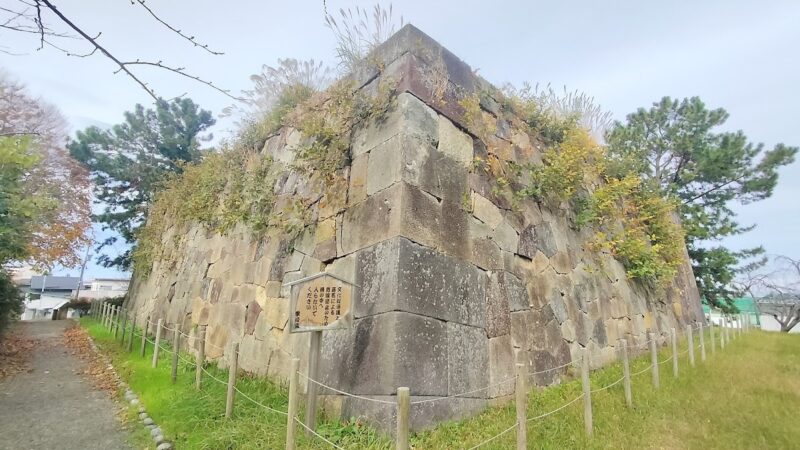
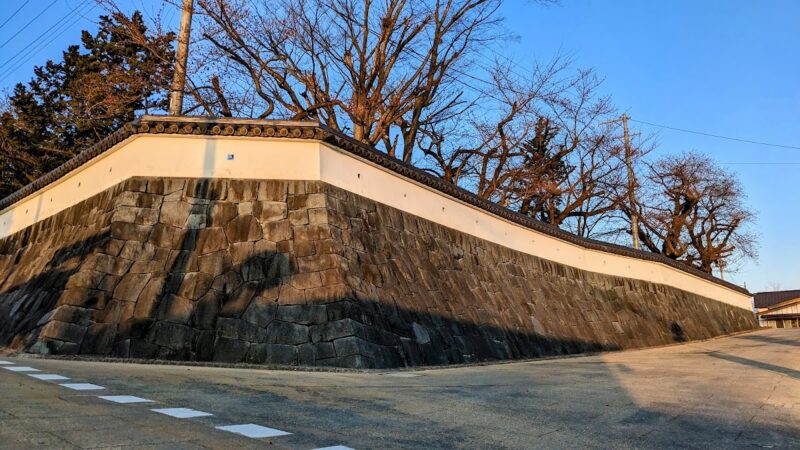
Restored stone walls and earthen fences surround the area, allowing visitors to experience the atmosphere of the castle ruins. These improvements allow visitors to experience the atmosphere of the castle in its heyday.
Structure of the Castle Town
Thanks to the development of the castle town by Satomi Keisuke, samurai residences and merchant districts were formed around Higashine Castle. Taking advantage of its location along the Ushu Kaido road, it also functioned as a post town. The street layout of the current Higashine city center still shows remnants of that era.
Highlights of Higashine Castle
The Great Zelkova Tree of Higashine (Special Natural Monument)
A must-see when visiting Higashine Castle is the “Great Zelkova Tree of Higashine,” standing west of the main keep site. This giant tree, estimated to be over 1,500 years old, is designated as a Special Natural Monument of Japan.
This zelkova tree, with its trunk circumference of approximately 16 meters and height of approximately 28 meters, possesses an overwhelming presence. It has stood on this site long before Higashine Castle was built, watching over the castle’s history. It is a valuable spot not only as a castle ruin, but also as a place to feel the grandeur of nature.
Moat Remains (Large Pond) and Park
The large pond, which remains as the castle moat, is now a park. The view of the Ou Mountains reflected on the water’s surface is beautiful in every season, making it an ideal place for a stroll. Cherry blossoms bloom in spring, and autumn leaves color the pond in fall.
The park has well-maintained walking paths and benches, allowing visitors to relax and reflect on the castle’s history.
Restored Stone Walls and Earthen Walls
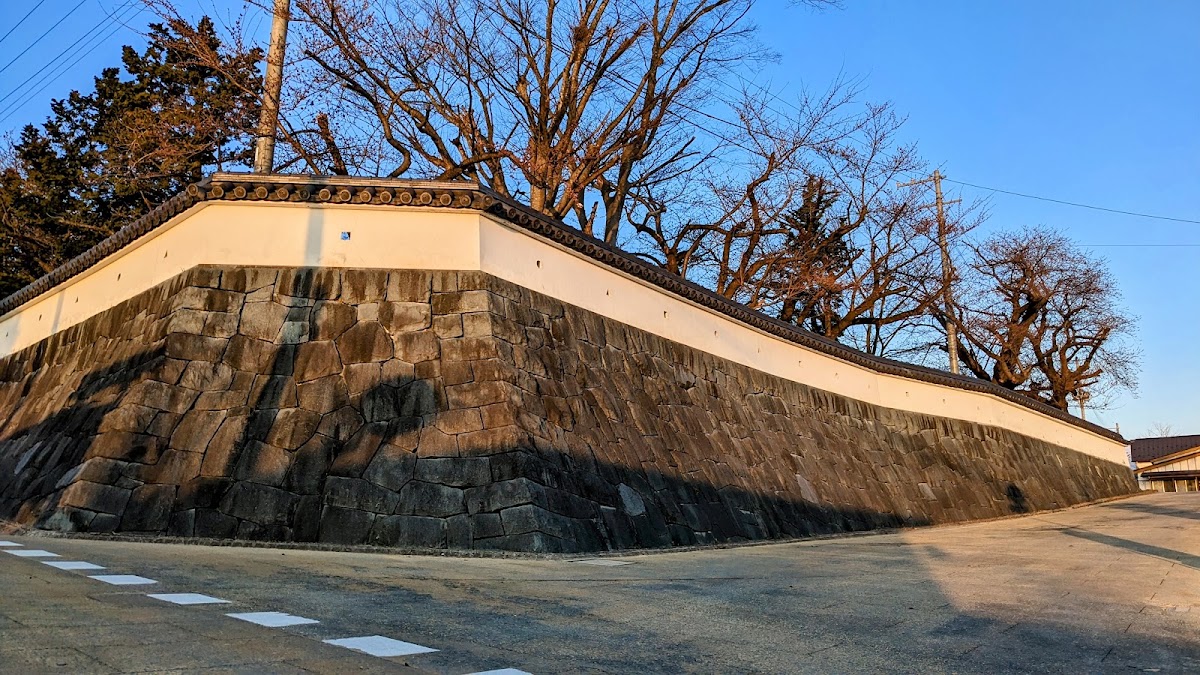
Around Higashine Elementary School, there are restored stone walls and earthen walls that recreate the atmosphere of the castle ruins. These were constructed based on Edo period castle architecture and are important landscape elements that indicate the site is a castle ruin.
In particular, traces of earthworks can be seen around the perimeter of the elementary school, providing clues to imagining the scale of the former castle.
Jokoku-ji Temple and the Temples and Shrines of the Castle Town
Several temples and shrines, including Jokoku-ji Temple, are scattered throughout the castle town of Higashine Castle. These temples and shrines functioned as the spiritual center of the castle town and also as defensive strongholds. Jokoku-ji Temple houses historical materials and graves related to the castle lord and his retainers, making it an important place for understanding the castle’s history.
Traces of Earthworks and Enclosures
Although many remains have been lost due to urbanization, careful observation reveals traces of earthworks and enclosures in the surrounding terrain. In particular, slight elevations around the main enclosure and unnatural elevation changes are thought to be remnants of the former castle structure.
Castle Notes (Points to Note When Visiting)
Best Season for Visiting
Higashine Castle Ruins are open year-round, but the following times are especially recommended:
- Spring (Mid-April to Early May): Cherry blossom season, especially beautiful around the large pond
- Early Summer (Late May to June): The large zelkova tree is at its most vibrant with fresh green leaves
- Autumn (Late October to Early November): Beautiful autumn foliage, and the view of the Ou Mountains is superb
Time Required
Please allow the following times for visiting Higashine Castle Ruins:
- Only the large zelkova tree and the area around the main keep: Approximately 30 minutes
- The entire site including the moat ruins park: Approximately 1 hour
- Detailed visit including surrounding temples and shrines: 2-3 hours
Photo Spots
- The large zelkova tree of Higashine: To capture the entire view, take a distance
- View of the Ou Mountains from the large pond: Especially beautiful in the evening light
- Restored Stone Wall: Outer perimeter of Higashine Elementary School
Access Information
Using Public Transportation
By JR
- Get off at “Sakuranbo-Higashine Station” on the JR Ou Main Line, approximately 20 minutes on foot (approx. 1.5 km)
- Approximately 5 minutes by taxi
By Bus
- Take the city loop bus from Sakuranbo-Higashine Station (routes vary)
- Get off at “Higashine Elementary School” or “Honmaru” bus stop
Using a Car
From the Expressway
- Approximately 10 minutes (approx. 4 km) from “Higashine IC” on the Tohoku Chuo Expressway
- Approximately 20 minutes (approx. 12 km) from “Yamagata Kita IC” on the Yamagata Expressway
Parking
- You can use the Higashine City Hall parking lot (approx. 5 minutes on foot)
- There is some parking space around Oike Park
- There is also some small parking space around the large zelkova tree in Higashine
Address and Map Information
Location: 1-1 Honmaru Minami, Higashine City, Yamagata Prefecture (Higashine Elementary School)
When searching using a map app, searching for “Higashine’s Great Zelkova Tree” or “Higashine Elementary School” will make it easier to find. We recommend using the displayed map information to check nearby parking lots and facilities in advance.
Nearby Tourist Information
Nearby Castles and Other Sites
When visiting Higashine Castle, visiting the following castle ruins will give you a deeper understanding of the castle history of the Murayama region:
Nagatoro Castle
- Approximately 5km from Higashine Castle, about 10 minutes by car
- A castle that functioned as a branch castle of the Higashine clan
- The remains are relatively well preserved
Tendo Castle (Maizuru Castle)
- Approximately 10km from Higashine Castle, about 15 minutes by car
- The base of the Tendo clan, and had a close relationship with Higashine Castle
- Developed as Tendo Park, a famous cherry blossom viewing spot
Yamagata Castle (Kasumi Castle)
- Approximately 15km from Higashine Castle, about 20 minutes by car
- The residence of Mogami Yoshiaki, who controlled Higashine Castle
- A nationally designated historical site, with large-scale restoration work underway
Other Tourist Spots
Sakuranbo Higashine Onsen
- A hot spring resort in Higashine City, perfect for relaxing after visiting the castle ruins.
- Excellent day-trip bathing facilities available.
Higashi-no-Mori Museum
- A museum exhibiting the history and culture of Higashine City.
- Also exhibits historical materials related to Higashine Castle.
Orchard (Cherry Picking)
- Higashine City is known as the “Cherry Village.”
- June to July is cherry picking season.
Historical Significance of Higashine Castle
Strategic Importance in the Murayama Region
Higashine Castle faced the Ushu Kaido, a major transportation route, and was located at a geographically strategic point between the Mogami River system and the Ou Mountains. Therefore, it functioned as an important front-line base during the conflict between the Mogami and Uesugi clans.
In particular, during the Keicho Dewa Campaign of 1600, which was linked to the Battle of Sekigahara, Higashine Castle is believed to have functioned as an important defensive base for the Mogami forces when Naoe Kanetsugu of the Uesugi side invaded Mogami territory.
Development as a Castle Town
The development of the castle town by Satomi Kagesuke went beyond being merely a military base, promoting the development of Higashine as a center of commerce and culture. Combined with its function as a post town on the Ushu Kaido road, it prospered as a hub for people and goods.
The town layout and streets formed during this period form the foundation of the current Higashine city center and hold significant importance from an urban planning history perspective.
Value as a Cultural Property
Although many remains of Higashine Castle have been lost due to urbanization, the remains of the moat, earthworks, and above all, the large zelkova tree, a special natural monument, make it a valuable cultural property that blends castle history and natural history.
The balance between preserving and utilizing the castle ruins (as a school) can be considered a model case in modern cultural property protection.
Related Historical Sites and Research Information
Historical Materials and Research
Historical materials concerning Higashine Castle are fragmentarily recorded in documents such as the “Saijōki” and “Satomi Family Documents.” While recent archaeological excavations have been limited, trial excavations conducted during urban redevelopment have unearthed artifacts from the early Edo period.
The Higashine City Board of Education and the Yamagata Prefectural Museum continue to collect and research historical materials related to Higashine Castle, and new insights are expected.
Related Books
For those who wish to learn more about Higashine Castle, the Mogami clan, and the Satomi clan, the following books may be helpful:
- “Place Names of Yamagata Prefecture” (Heibonsha, 1990)
- “All About Mogami Yoshiaki” (Shin Jinbutsu Oraisha)
- “Castles of Yamagata Prefecture” (Kyodo Shuppansha)
- “Castles and Residences of the Murayama Region” (Yamagata Prefectural Board of Education)
These books can be viewed and searched at the Higashine City Library and the Yamagata Prefectural Library.
Notes for Visitors
Notes on Facility Use
- The main keep site is within the grounds of Higashine Elementary School, so please refrain from entering during school hours.
- You can visit the area around the large zelkova tree, but please do not enter the fenced area to protect the tree.
- You can freely stroll around the moat site park, but please be sure to take your trash with you.
Manners and Rules
- Please be quiet when visiting the school facilities.
- When taking photographs, please be considerate of the children’s privacy.
- To protect the remains, please do not climb on the earthworks or stone walls.
- When parking, please be considerate of nearby residents.
Summary
Higashine Castle (Higashine City, Yamagata Prefecture) is a flatland castle that played an important role as a strategic point in the Murayama region from the medieval to the early modern period. From its construction by the Odajima clan, the castle’s lords changed hands between the Higashine clan and the Satomi clan, before disappearing from the historical stage with the downfall of the Mogami clan.
Currently used as Higashine Elementary School, the site boasts numerous attractions, including a large pond remnant of the moat, restored stone and earthen walls, and, most notably, the “Higashine Great Zelkova Tree,” a special natural monument estimated to be over 1,500 years old. Despite its urban location, it offers a tranquil glimpse into history, making it a popular tourist spot not only for history buffs but also for families.
Access is excellent, within walking distance of Sakuranbo-Higashine Station and about a 10-minute drive from the Higashine Interchange. Visiting Higashine Castle ruins along with other castle ruins in Yamagata Prefecture (such as Tendo Castle and Yamagata Castle) will provide a deeper understanding of the Mogami clan’s rule and the history of the Murayama region during the Sengoku period.
By researching maps and tourist information beforehand and planning your visit, you can enjoy a fulfilling castle ruin tour. Be sure to visit Higashine Castle ruins, which possess beauty in every season.