Complete Guide to the History and Highlights of Inoue Castle | A Thorough Explanation of the Three Castles of Shinano, Owari, and Hyuga
Introduction: The Three Inoue Castles in Japan
The name “Inoue Castle” exists in multiple regions within the history of Japanese castles. Three Inoue Castles are primarily known: Shinano Province (present-day Suzaka City, Nagano Prefecture), Owari Province (present-day Iwakura City, Aichi Prefecture), and Hyuga Province (present-day Nobeoka City, Miyazaki Prefecture). Each has a distinct history and characteristics.
This article provides a detailed and comprehensive explanation of these three Inoue Castles, covering everything from their builders and successive lords to their historical background, castle structure, and current state of remains. This article aims to provide castle enthusiasts and history buffs with a complete understanding of Inoue Castles.
Inoue Castle in Shinano Province (Suzaka City, Nagano Prefecture)
Overview and Location
Inoue Castle in Shinano Province is a medieval mountain castle located in Suzaka City, Nagano Prefecture. This castle is known as the residence of the Inoue clan, descendants of the Shinano Minamoto clan, and was built around Mount Myotoku (approximately 520 meters above sea level).
The castle complex is broadly composed of two parts. One is the peacetime residence (Inoue Clan Residence) located at the northern foot of Mount Myotoku, and the other is the fortified castle built on the mountaintop. The mountaintop is further divided into two peaks, east and west, each containing a group of enclosures called “Oshiro” and “Koshiro,” respectively. The entire complex is collectively referred to as Inoue Castle.
History and Genealogy of the Inoue Clan
The Inoue clan was a branch of the Shinano Minamoto clan and a prestigious family descended from the Seiwa Minamoto clan. Inoue Tatsumitsu is known as the castle lord, and the Inoue clan maintained their power as a prominent local family.
During the Sengoku period, Shinano Province became a fierce battleground where major powers such as the Takeda, Uesugi, and Hojo clans vied for supremacy. The Inoue clan was one of the local lords who sought to survive while maintaining regional independence amidst this situation.
Castle Structure and Features
The mountain castle portion of Inoue Castle, built on the summit of Mount Myotoku, is a typical medieval mountain castle that skillfully utilizes the natural terrain.
The large castle and small castle are connected by a ridge, and each has multiple baileys. Moats and earthworks were constructed between the baileys, enhancing their defensive capabilities. Access to the main castle at the summit was via a steep mountain trail from the residence at the foot of the mountain, and it was designed as a place for the lord’s family and important retainers to take refuge in times of emergency.
Even today, the remains of the castle, such as the terraces, earthworks, and moats, are well-preserved, making it a valuable historical site for understanding the structure of medieval mountain castles.
Access and Local Information
Inoue Castle Ruins are approximately a 10-minute drive from the Suzaka-Nagano East Interchange. The castle ruins are located on the mountain southwest of Jounji Temple, and a hiking trail is maintained. However, due to the steep slopes characteristic of mountain castles, appropriate clothing and shoes for hiking are necessary for a visit.
From the summit, you can enjoy a panoramic view of Suzaka city and the mountains of northern Shinano, experiencing the scenery that the castle lord must have seen.
Inoue Castle in Owari Province (Iwakura City, Aichi Prefecture)
Overview and Historical Background
Inoue Castle in Owari Province was a flatland castle located in what is now Iwakura City, Aichi Prefecture. Unlike Inoue Castle in Shinano Province, it took the form of a manor house castle built on flat land.
Construction and Changes in Lords
Different historical sources describe the construction of Inoue Castle.
According to “Kiseki”, the castle existed from the Oei era (1394-1428) to the Kakitsu era (1441-1444), and its lord was Arima Tonomonosho.
On the other hand, “Chōshū Fushi” lists Shigematsu Mondonosho as the lord during the Kakitsu era (1441-1444). Furthermore, “Owari Kojōshi” states that the lord was undetermined. Because the descriptions in these sources do not match, Inoue Castle is known as a castle with many unknown aspects.
Fall and Abandonment
The history of Inoue Castle was short-lived. Around 1441 (Kakitsu 1), Inoue Castle is believed to have been attacked and captured by Oda Gōkō, the deputy governor of Owari Province. Oda Gōkō was the lord of Orizu Castle, and it is thought that he captured Inoue Castle as part of his efforts to strengthen his control over Owari Province.
After its fall, Inoue Castle was abandoned and never rebuilt. Therefore, its existence is estimated to have lasted only a few decades.
Castle Structure
Because Inoue Castle in Owari was a flatland castle, it lacked the defensive structures that utilized the rugged terrain of a mountain castle. Instead, it is thought to have had a flat defensive structure consisting of moats and earthworks.
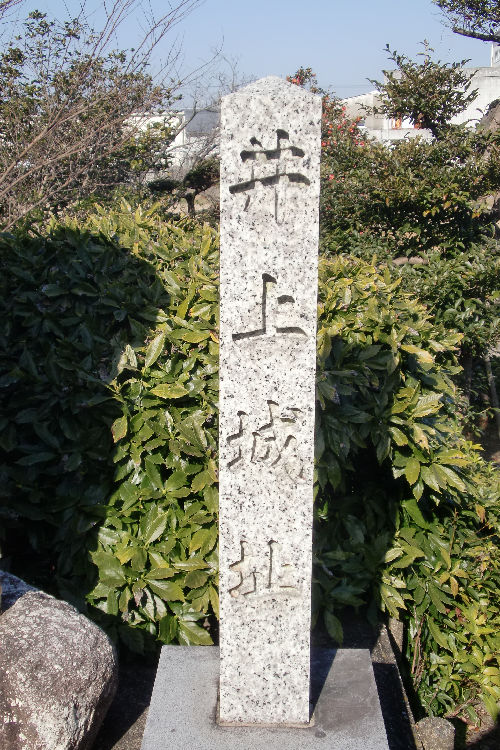
Unfortunately, very few remains of the castle exist today, and it is difficult to see any trace of its former appearance due to residential and agricultural development. Only an information board is installed; it is not possible to clearly identify any remains.
The Sengoku Period in Owari Province and Inoue Castle
Even before the rise of the Oda clan during the Sengoku period, Owari Province was in a complex political situation with multiple powers vying for influence. The Oda clan, who served as the shugodai (deputy governor), was divided into several branches, each vying for power.
The mid-15th century, when Inoue Castle existed, was a period of unification by the Oda clan, aiming to establish their control over Owari Province. This was a time when small local lords’ castles were successively conquered by the Oda clan, and Inoue Castle, one of them, disappeared from the historical stage.
Inoue Castle in Hyuga Province (Nobeoka City, Miyazaki Prefecture)
Overview and Location
Inoue Castle in Hyuga Province was a medieval mountain castle located in Nobeoka City, Miyazaki Prefecture. Situated on an isolated hill northwest of Mount Atago, adjacent to the Ose River, it was built at a strategic transportation point controlling a crossing point of the Ose River.
A main road runs along the west side of the castle, indicating its strategic importance as a military and transportation hub in northern Hyuga Province.
The Builder and the Tsuchimochi Clan
There are differing accounts of the builder of Inoue Castle depending on the historical source.
According to the “Enryo Kyuki” and “Enryo Seikan”, the builder is said to be either Tsuchimochi Yoshitsuna from the late 12th century or Tsuchimochi Kunitsuna from the late 13th century.
Of particular note is the record that Tsuchimochi Yoshitsuna built Inoue Castle in June of the first year of Jisho (1177), replacing Agata Castle. The exact location of this “Agata Castle” is unclear, but it has been suggested that it may be the current location of Nobeoka Castle or the site of Imayama Hachimangu Shrine.
The Tsuchimochi clan were powerful local lords who ruled northern Hyuga Province, maintaining their influence in this region for a long period from the Kamakura period to the Sengoku period. ### Expansion of the Tsuchimochi Clan’s Territory and Inoue Castle
The expansion of the Tsuchimochi clan’s territory south of the Gokase River and Ose River is thought to have begun after Tsuchimochi Eisei acquired half of the Agata Manor in 1336 (Kenmu 3). Therefore, it is reasonable to assume that the Tsuchimochi clan resided in Inoue Castle from the middle of the first half of the 14th century onward.
Inoue Castle functioned as the Tsuchimochi clan’s first full-fledged residence and became a base for the subsequent expansion of their power.
Characteristics of the Castle Structure
Inoue Castle’s layout is broadly divided into two castle areas.
The northern castle area has a structure with baileys arranged in a stepped pattern, with multiple terraced baileys connected to the main bailey. This is a typical structure of a medieval mountain castle, utilizing the difference in elevation for defensive purposes.
The southern castle area has a unique structure with baileys connected along a long, narrow, bridge-like ridge several meters wide and 20-30 meters long. The arrangement of the baileys along this ridge is thought to have been intended to defend against attacks along the ridge.
Moats and trenches were constructed between the two castle areas, enabling mutual coordination and defense.
The Tsuchimochi Clan and the Sengoku Period History of Hyuga
The Tsuchimochi clan maintained their independent power in Hyuga Province, but in the late Sengoku period, they were pressured by the northward advance of the Shimazu clan. Ultimately, after Toyotomi Hideyoshi’s conquest of Kyushu, the Tsuchimochi clan was dispossessed of their domain, and Inoue Castle also disappeared from the stage of history.
Currently, the Inoue Castle ruins are protected as a historical site by Nobeoka City, and some of the remains are well preserved.
Comparison of the Three Inoue Castles
Geographical and Historical Characteristics
The three Inoue Castles each have different regional and historical backgrounds.
Inoue Castle in Shinano Province is a typical medieval mountain castle built by a local lord of the Shinano Minamoto clan lineage, and functioned as a fortress for a regional power in Shinano during the Sengoku period.
Inoue Castle in Owari Province was a flatland castle that existed for only a short period in the mid-15th century, and is characterized by its early abandonment due to the expansion of the Oda clan’s power.
Inoue Castle in Hyuga Province may have been built between the 12th and 14th centuries, and differs in character from the other two castles in that it functioned as a long-term base for the local lord, the Tsuchimochi clan.
Differences in Castle Structure
Inoue Castle in Shinano Province was a large mountain castle with a structure combining a fortified castle on the mountaintop and a residence at the foot of the mountain, possessing multiple groups of baileys, including large and small castles.
Inoue Castle in Owari Province was a flatland castle, lacking the topographical advantages of a mountain castle, and relied on artificial moats and earthworks for defense.
Inoue Castle in Hyuga Province is a mountain castle on an isolated hill, characterized by its unique layout with two castle areas, north and south.
Current Preservation Status
Inoue Castle in Shinano Province: The remains of this mountain castle are relatively well-preserved, and features such as baileys and moats can be seen.
Inoue Castle in Owari Province: Almost no remains remain, only an information board.
Inoue Castle in Hyuga Province: Protected as a historical site by Nobeoka City, some remains are preserved.
Points to Note When Visiting Inoue Castle
Inoue Castle, Shinano Province (Suzaka City, Nagano Prefecture)
- Access: Approximately 10 minutes by car from Suzaka-Nagano East IC, near Jounji Temple
- Highlights: Group of baileys (large and small), moats, earthworks, and views from the mountaintop
- Notes: As it is a mountain castle, hiking equipment is necessary; the round trip takes approximately 2-3 hours
- Parking: Parking is available near Jounji Temple
Inoue Castle, Owari Province (Iwakura City, Aichi Prefecture)
- Access: Within walking distance from Iwakura Station on the Meitetsu Inuyama Line
- Highlights: Information board (almost no remains remain)
- Notes: As it is located in a residential area, consideration for local residents is necessary
- Parking: Use of public transportation is recommended
Inoue Castle, Hyuga Province (Nobeoka City, Miyazaki Prefecture)
- Access: Approximately 10 minutes by car from Nobeoka city center
- Highlights: Remains of baileys, moats, and castle layout
- Notes: Some areas are overgrown with vegetation, so please be mindful of the time of year you visit.
- Parking: Parking is available around the castle ruins.
Historical Significance of Inoue Castle
Value as a Local Lord’s Castle
All three Inoue Castles share the common characteristic of being castles built not by Sengoku daimyo (feudal lords), but by local lords. In Sengoku-era Japan, countless castles of these small and medium-sized local lords existed throughout the country, in addition to castles of daimyo.
Studying Inoue Castle is of great significance in understanding the power structure in regional societies during the Sengoku period and the living conditions of local lords.
Position in Castle History
Inoue Castle in Shinano Province is a valuable example for understanding the samurai society of medieval Shinano, as it was a castle of a Shinano Genji-lineage samurai group.
Inoue Castle in Owari Province is a historical site that illustrates the expansion of the Oda clan’s power, telling a story of a chapter in the unification of Owari Province.
Inoue Castle in Hyuga Province occupies an important position in understanding the medieval history of Kyushu as the base of the Tsuchimochi clan, a powerful local lord of Hyuga.
Summary
While there are several castles named “Inoue Castle” throughout Japan, three are particularly representative: Shinano Province (Suzaka City, Nagano Prefecture), Owari Province (Iwakura City, Aichi Prefecture), and Hyuga Province (Nobeoka City, Miyazaki Prefecture).
Each Inoue Castle has different characteristics in terms of its builder, lord, historical background, and castle structure, making them valuable historical sites for a multifaceted understanding of Japanese castle history from the medieval period to the Sengoku period.
Inoue Castle in Shinano Province was a mountain castle of the Inoue clan of the Shinano Minamoto clan; Inoue Castle in Owari Province was a flatland castle that disappeared during the unification process by the Oda clan; and Inoue Castle in Hyuga Province was the base of the Tsuchimochi clan. Each castle has its own unique history.
For castle enthusiasts and history buffs, visiting these three Inoue Castles will allow you to experience the diversity of regional society and castle culture in medieval and Sengoku period Japan. In particular, the remains of Inoue Castle in Shinano Province are well-preserved, making it an excellent opportunity to learn about the structure of a medieval mountain castle firsthand.
While the history of Inoue Castle is not necessarily a glorious Sengoku period epic, it is a valuable historical legacy that conveys the lives of local samurai and the plight of local lords tossed about by the tides of history.