Matsuda Castle (Matsuda Town, Kanagawa Prefecture) Complete Guide | History, Highlights, and Access Information
Located in Matsuda Town, Ashigarakami District, Kanagawa Prefecture, Matsuda Castle is a mountain castle that served as the residence of the Matsuda clan from the Kamakura period to the Sengoku period. While much of the original structure has been lost, it is known as a valuable historical site that conveys the history of the Matsuda clan, who served as important retainers of the Hojo clan, and offers panoramic views of the Ashigara Plain and Sagami Bay. This article provides a detailed explanation of Matsuda Castle, from its historical background to its highlights and access methods.
History of Matsuda Castle
Construction and the Establishment of the Matsuda Clan
There are various theories regarding the construction date of Matsuda Castle, but it is believed to have been built between the late Heian period and the early Kamakura period. The builder is said to be Hatano Yoshitsune (Matsuda Yoshitsune), a member of the Hatano clan, a branch of the Fujiwara Hidesato lineage.
Yoshitsune, son of Hatano Yoshimichi, served Minamoto no Yoritomo and distinguished himself, eventually gaining control of the Matsuda region and adopting the Matsuda surname. This marked the beginning of the Matsuda clan, with Matsuda Castle serving as its base. As a branch of the Hatano clan, the Matsuda clan held power in western Sagami Province, occupying an important position controlling strategic points along the Sakawa River basin.
The Matsuda and Hojo Clans in the Sengoku Period
From the Muromachi period to the Sengoku period, the Matsuda clan survived as a powerful local lord in western Sagami Province. However, in the latter half of the 15th century, they began to face pressure from the Omori clan, who had advanced from Suruga Province. In this critical situation, the Matsuda clan quickly chose to side with Ise Sozui (Hojo Soun), a rising power.
This decision dramatically altered the Matsuda clan’s fate. As Hojo Soun seized Odawara Castle and pacified Sagami Province, the Matsuda clan was incorporated into the Hojo clan’s important vassal group. During the time of Matsuda Norihide, in particular, he was highly valued as the chief retainer of the Hojo clan and played an important role in diplomacy and military affairs.
Matsuda Norihide served three generations of the Hojo clan: Ujiyasu, Ujimasa, and Ujinao, and held a central position in the administration of the Hojo clan’s government. He was also involved in diplomatic negotiations with Takeda Shingen and Uesugi Kenshin, and played an active role as a key retainer supporting the Hojo clan as a Sengoku daimyo.
The Siege of Odawara and the End of Matsuda Castle
In 1590 (Tensho 18), when Toyotomi Hideyoshi’s Siege of Odawara began, the fate of Matsuda Castle changed dramatically. Matsuda Norihide holed up in Odawara Castle, but the Hojo clan was forced to surrender in the face of the overwhelming military strength of the Toyotomi army.
With the fall of the Hojo clan, the Matsuda clan also lost their territory, and it is believed that Matsuda Castle was abandoned. Subsequently, the Matsuda area was incorporated into the new system of rule when Tokugawa Ieyasu entered the Kanto region. Matsuda Castle had fulfilled its role and retired from the stage of history.
Structure and Location of Matsuda Castle
Geographical Characteristics
Matsuda Castle was built on one of the ridges branching south from Matsuda Mountain on the north bank of the Sakawa River. The main keep was located at an altitude of approximately 180 meters, with Tenjin-zawa to the west and Hataya-zawa to the east, forming a natural stronghold.
This location was militarily excellent, providing a superb observation post overlooking the entire Ashigara Plain. Sagami Bay could also be seen in the distance, indicating its function as a strategic point controlling the Tokaido Road and the Sakawa River’s water transport. Furthermore, it was a location that could monitor the routes to Hakone and Ashigara Pass, playing an important role as a defensive line in western Sagami Province.
Castle Structure
Matsuda Castle was a mountain castle with a gourd-shaped site. The main keep (honmaru, the site of the main residence) was located at the highest point of the northernmost part of the castle, and it is believed that dry moats were constructed in the lowlands before and after it. The flat area extending south from the main keep is thought to have been used as the residence of the samurai and retainers, and artifacts such as stone pavements and horse tack have been unearthed there.
As is typical of medieval mountain castles, it is presumed that the ridge was leveled to create baileys, and defenses were strengthened with moats and earthworks. However, as will be discussed later, much of the remains have been lost, making it difficult to understand the detailed structure.
Current Status of Matsuda Castle Site
Preservation Status of Remains
Unfortunately, the Matsuda Castle site has been significantly altered by development in the latter half of the 20th century. In particular, the construction of the Tomei Expressway wiped out most of the castle grounds. Even the remaining parts are used as mandarin orange groves and residential areas, and very few clear remains can be identified.
Traces of defensive structures such as dry moats and earthworks have become unclear due to agricultural development and afforestation. No stone walls or other structures have been discovered, making it difficult to imagine its appearance as a medieval mountain castle.
Current Status of the Main Enclosure Site
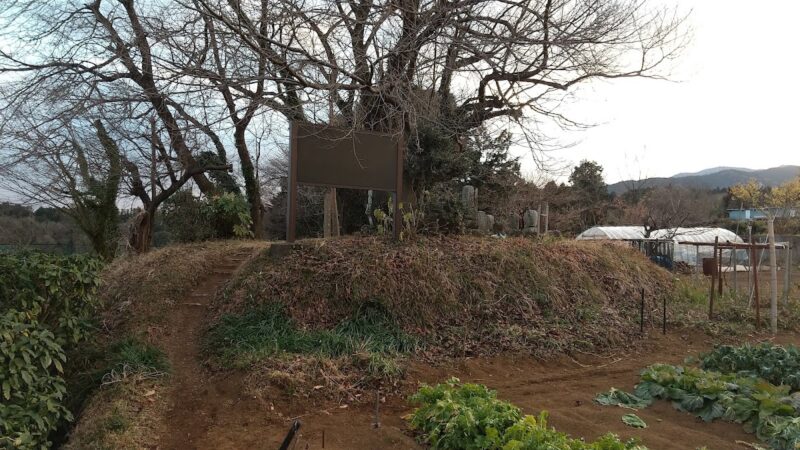
The area believed to be the main enclosure site is currently used as an orange grove. Signboards and markers indicating the castle site have been installed, indicating that this was the central part of Matsuda Castle. Although the remains themselves are gone, the view from the main enclosure site is magnificent, allowing one to truly appreciate why Matsuda Castle was built in this location.
From here, you can see the vast Ashigara Plain, the blue sea of Sagami Bay, and on a clear day, even the Izu Peninsula and Mount Fuji, making it easy to imagine the castle lords of the Sengoku period gazing upon this same scenery. This view is arguably the greatest attraction of visiting Matsuda Castle.
Traces Remaining in Surrounding Place Names
The existence of Matsuda Castle remains in the surrounding place names. Near the castle ruins is a place name called “Shiroyama-jiku” (Castle Mountain District), and it has long been known as “Shiroyama” (Castle Mountain) by locals. Place names related to castles, such as “Hataya” (Flag Arrow) and “Baba” (Horse Training Ground), also remain, conveying the memory of a castle that once stood here.
These place names are a valuable source of information in the study of medieval castles, where written historical records are limited, and provide clues to estimating the extent and structure of Matsuda Castle.
Highlights of Matsuda Castle
Spectacular View from the Main Enclosure
The biggest reason to visit Matsuda Castle ruins is the view from the main enclosure. The view of the Ashigara Plain from a height of approximately 180 meters above sea level is breathtaking, offering a panoramic view of Matsuda town, the Sakawa River, and the horizon of Sagami Bay.
The view at sunset is particularly beautiful, and the silhouettes of Sagami Bay and the Ashigara Plain bathed in the setting sun are perfect for photography. The surrounding nature, which shows different expressions in each season—cherry blossoms in spring and autumn leaves in fall—is also appealing.
A Place Where You Can Feel the History
Even though the remains are gone, the historical fact remains that this place was the base of the Matsuda clan for approximately 400 years, from the Kamakura period. Imagining the Matsuda clan, who were involved in important events of the Sengoku period such as Hojo Soun’s pacification of Sagami, the Battle of Kawanakajima against Takeda Shingen, and the Siege of Odawara, looking down on the Ashigara Plain from this spot, evokes a sense of historical romance.
Mandarin Orange Grove Scenery
The castle site, including the main keep ruins, is currently used as a mandarin orange grove. From autumn to winter, the orange fruits create a beautiful landscape. Matsuda Town is also known as a mandarin orange producing area, and you can enjoy mandarin orange picking around the castle site. Combining historical exploration with mandarin orange picking is a unique way to enjoy Matsuda Castle Ruins.
About Matsuda Town
Overview of Matsuda Town
Matsuda Town is a small town with a population of approximately 10,000, located in Ashigarakami District in western Kanagawa Prefecture. Located at a transportation hub connecting the Tomei Expressway and National Route 246, Matsuda Town boasts two train stations: Shin-Matsuda Station on the Odakyu Odawara Line and Matsuda Station on the JR Gotemba Line.
Blessed with the rich natural beauty of the Tanzawa Mountains and the clear waters of the Sakawa River, it has recently gained attention as a “convenient countryside” destination. Its appeal lies in its convenient location, approximately one hour by car from central Tokyo and accessible directly from Shinjuku by train, while still offering a rich natural environment.
Matsuda Town’s Tourism Resources
Besides Matsuda Castle Ruins, Matsuda Town offers many other attractive tourist spots. In early spring, the “Matsuda Cherry Blossom Festival” is held, attracting many visitors with the beautiful combination of Kawazu cherry blossoms and rapeseed flowers. Furthermore, the town offers a variety of activities, including mandarin orange picking and nature experience programs, making it a family-friendly destination.
Matsuda Town prioritizes “children first,” focusing on improving the child-rearing environment, and is attracting attention as a place to relocate. It is an attractive option for young people who want to raise their children in a nature-rich environment.
Matsuda Town Hall and Tourist Information
Matsuda Town Hall is located in Matsuda Soryo and provides tourist information and various administrative services. The Matsuda Town Tourism Association, a general incorporated association, also has its office in Matsuda Soryo and provides tourist information and various event information.
The postal code for Matsuda Town is 258-8585 (Matsuda Town Hall), and each area within the town has its own postal code. Different postal codes are assigned to areas such as Matsuda Soryo, Matsuda Shoshi, Kamiyama, and Yori. Details can be found on the Japan Post website.
Access to Matsuda Castle
Access by Public Transportation
By Train
- Get off at Shin-Matsuda Station on the Odakyu Odawara Line, approximately 30 minutes on foot.
- Get off at Matsuda Station on the JR Gotemba Line, approximately 30 minutes on foot.
From Shinjuku Station to Shin-Matsuda Station, it takes approximately 1 hour on the Odakyu Odawara Line, and you can access it without transfers. The walk from the station to the castle ruins is uphill, so we recommend wearing comfortable shoes. If you take a taxi, it’s about a 5-minute ride from the station.
Access by Car
Using the Expressway
- Approximately 10 minutes from the Tomei Expressway “Oi-Matsuda IC”
- Accessible via National Route 246
From central Tokyo, it takes about 1 hour via the Tomei Expressway. There is no dedicated parking lot around the castle ruins, but you can use public facilities and tourist parking lots in Matsuda Town. However, it is difficult to drive directly to the castle ruins, so you will need to park in a suitable location and access the site on foot.
Points to Note When Visiting
Matsuda Castle Ruins is not a park developed as a historical site; many parts are now privately owned mandarin orange groves. Please note the following points when visiting.
- Avoid trespassing on private property.
- Be careful not to damage the crops in the mandarin orange groves.
- Always take your trash with you.
- Use the signs and markers as landmarks.
- Wear comfortable shoes as there are steep slopes and uneven terrain.
The area around the castle ruins is a mix of residential areas and mandarin orange groves, so please be considerate and avoid disturbing the lives and farming activities of local residents.
Matsuda Castle and Surrounding Castles
Sagami Western Castle Network
Matsuda Castle played a part in the castle network of western Sagami Province. Important castles supporting the Hojo clan’s rule were scattered throughout the surrounding area, including Kawamura Castle (Yamashita Town), Odawara Castle (Odawara City), and Ashigara Castle (Minamiashigara City).
These castles cooperated with each other to form a defensive line to prepare for invasions from Suruga and Kai. Matsuda Castle played a crucial role in monitoring the Ashigara Plain and controlling the Sakawa River basin.
The Matsuda Clan and Other Hojo Retainers
The Matsuda clan held a particularly important position among the Hojo clan’s retainers. Along with the Daidoji, Toyama, and Shimizu clans, they were key retainers of the Hojo clan, active in both political and military affairs.
Matsuda Norihide, in particular, possessed excellent diplomatic skills, demonstrating his abilities in negotiations with the Takeda and Uesugi clans. He also served as the castellan of Odawara Castle, enjoying immense trust from the Hojo clan. Matsuda Castle was the base of the Matsuda clan’s activities, from which they controlled the Ashigara Plain.
Current Status and Challenges of Matsuda Castle Research
###### Historical Documents and Archaeological Investigations
Documentary materials concerning Matsuda Castle are limited, leaving many unknowns regarding the castle’s detailed structure and changes over time. While the Matsuda clan is mentioned in historical documents related to the Hojo clan, such as the “Odawara Shoshoryo Yakucho” (Register of the Domains of the Odawara Clan), detailed records of the castle itself are scarce.
Archaeological investigations have also been limited, with only a few artifacts unearthed during emergency surveys conducted before highway construction. While artifacts such as stone pavements and horse tack confirm the existence of Matsuda Castle, the overall structure of the castle remains unclear.
Future Preservation and Utilization
Although much of the Matsuda Castle site has been lost, it is a valuable historical site that conveys the history of the region. Future challenges include preserving the remaining area around the main keep and raising awareness of its historical value.
Various utilization methods are conceivable, such as installing information boards, developing walking paths, and using digital technology to recreate its appearance in its heyday. It is hoped that its value will be enhanced as a place for local history education and as a tourist resource.
Summary
Matsuda Castle is a medieval mountain castle located in Matsuda Town, Kanagawa Prefecture, and functioned as the residence of the Matsuda clan from the Kamakura period to the Sengoku period. As the base of the Matsuda clan, who sided with Hojo Soun and became important retainers of the Hojo clan, Matsuda Castle played a crucial role in controlling western Sagami Province.
Although much of the castle’s remains have been lost due to highway construction and other factors, the view of the Ashigara Plain and Sagami Bay from the main keep site is magnificent, allowing visitors to experience the same scenery that the castle lords of the Sengoku period saw. The landscape of the castle ruins, now used as mandarin orange groves, is also a unique charm of Matsuda Town.
Its easy accessibility, approximately one hour from central Tokyo, is another attraction, making it possible to enjoy sightseeing that combines historical exploration with mandarin orange picking. When visiting Matsuda Town, be sure to visit Matsuda Castle Ruins and enjoy the history of the Sengoku period and the spectacular scenery of Ashigara. By learning about the region’s history, you will gain a deeper understanding of Matsuda Town’s charm.