Nagoya Castle (Nagoya City, Aichi Prefecture) Complete Guide | The Castle Where Oda Nobunaga Was Born and the Predecessor of Nagoya Castle
Nagoya Castle (Nagoya-jō) was a Sengoku period castle located near the current Ninomaru (second bailey) of Nagoya Castle in Naka Ward, Nagoya City, Aichi Prefecture. It was built by Imagawa Ujichika, later seized by Oda Nobuhide, and is known as the castle where a young Oda Nobunaga served as lord. Although only a few traces remain within the grounds of Nagoya Castle today, it is a historically significant castle site that played a crucial role in the struggle for control of Owari Province.
Nagoya Castle (Nagoya-jō) was located in the Naka Ward of Nagoya City, Aichi Prefecture, near the current Ninomaru (second bailey) of Nagoya Castle. ## Basic Information on Nagoya Castle
Location: Honmaru, Naka-ku, Nagoya City, Aichi Prefecture (near Nagoya Castle’s Ninomaru)
Alternate Name: Yanagi-no-maru
Construction Date: Around 1521 (Daiei 1)
Builder: Imagawa Ujichika
Castle Structure: Flatland Castle
Main Lords: Imagawa Ujichika → Oda Nobuhide → Oda Nobunaga
Year of Abandonment: Around 1555 (Koji 1)
Current Status: Only Nagoya Castle’s Ninomaru and a stone monument remain
History of Nagoya Castle
Construction by the Imagawa Clan (Around 1521)
Nagoya Castle was built around 1521 (Daiei 1) by Imagawa Ujichika, a Sengoku daimyo of Suruga Province (present-day Shizuoka Prefecture). At that time, the Imagawa clan was expanding their power into Owari Province, and Nagoya Castle played an important role as a front-line base in Owari. Imagawa Ujichika was the father of Imagawa Yoshimoto. He unified Suruga and Tōtōmi provinces and sought to further expand his power into Mikawa and Owari provinces. Nagoya, located on the western edge of the Atsuta Plateau and a key point for water transport, was a strategically important base both militarily and economically.
Capture by Oda Nobuhide (circa 1532-1538)
Between 1532 and 1538, Oda Nobuhide (father of Oda Nobunaga), a powerful warlord of Owari Province, captured Nagoya Castle from the Imagawa clan. There are several theories regarding this event.
One theory suggests that Nobuhide seized the castle using a stratagem. Legend says that Nobuhide approached Imagawa Ujitoyo (Ujichika’s younger brother and the castle lord of Nagoya Castle), lulled him into a false sense of security, and then launched a surprise attack. Another theory suggests that the castle was captured by force.
In any case, the capture of Nagoya Castle significantly increased Oda Nobuhide’s position within Owari Province. Nagoya Castle became Nobuhide’s residence and functioned as the Oda clan’s base.
Oda Nobunaga’s Castle Period (circa 1534-1555)
Oda Nobuhide is believed to have given birth to his eldest son, Kippōshi (later Oda Nobunaga), at Nagoya Castle in 1534 (Tenbun 3). While there are various theories about Nobunaga’s birthplace, Nagoya Castle is considered the most likely.
Around 1542 (Tenbun 11), when Oda Nobuhide moved his base to Furuwatari Castle, the young Nobunaga became the lord of Nagoya Castle. Nobunaga was entrusted with this castle at around 13 years old.
Nobunaga spent his youth based at Nagoya Castle, and although he was called the “Great Fool of Owari,” he soon began to show glimpses of his potential as a charismatic figure of the Sengoku period. In 1551 (Tenbun 20), upon the death of his father, Nobuhide, Nobunaga inherited the family headship and became the head of the Oda clan.
Relocation to Kiyosu Castle and Abandonment (Around 1555)
Around 1555 (Kōji 1), Oda Nobunaga relocated his base to Kiyosu Castle. As a result, Nagoya Castle was abandoned, bringing its approximately 30-year history to an end.
It is believed that Nobunaga chose Kiyosu Castle because it was located in a more expansive plain, making it more suitable for governing the entire Owari Province. Nagoya Castle’s role had ended, and it is presumed that it subsequently fell into disrepair.
Construction of Nagoya Castle and the Nagoya Castle Ruins (After 1610)
Approximately half a century after Nagoya Castle was abandoned, in 1610 (Keicho 15), Tokugawa Ieyasu decided to relocate the capital from Kiyosu to Nagoya (Kiyosu-goshi) and ordered the construction of a new castle, Nagoya Castle, on the former site of Nagoya Castle and its surroundings.
The construction of Nagoya Castle was carried out as a nationwide construction project, mobilizing daimyo from all over the country. The Nagoya Castle ruins were incorporated into the area around the second bailey of Nagoya Castle, and the remains of the old castle were almost completely lost during the construction of Nagoya Castle.
The current second bailey of Nagoya Castle is thought to be the former center of Nagoya Castle.
Structure and Scale of Nagoya Castle
Regarding the detailed structure of Nagoya Castle, many aspects remain unknown due to the scarcity of surviving remains. However, the following characteristics have been inferred from historical documents and archaeological excavations.
Castle Location
Nagoya Castle was a flatland castle built on a slightly elevated area of approximately 10 meters above sea level, at the western edge of the Atsuta Plateau. A tributary of the Shonai River flowed to the west, and it is believed to have functioned as a natural moat. This location offered advantages in terms of transporting goods using water and in terms of defense.
Castle Size
Nagoya Castle is estimated to have been of medium size compared to other castles in Owari Province at the time. It was not a large-scale castle like Nagoya Castle, and is thought to have had a strong character as a practical flatland castle from the early Sengoku period.
Archaeological excavations have confirmed remains that appear to be parts of moats and earthworks, but details such as the layout of buildings remain unclear.
Alternative Name “Yanagi-no-Maru”
Nagoya Castle was also known by the alternative name “Yanagi-no-Maru.” This is thought to originate from the fact that many willow trees were planted within or around the castle grounds. Willows are trees that thrive in wetlands, which may reflect the topographical characteristics of Nagoya.
Current Site of Nagoya Castle
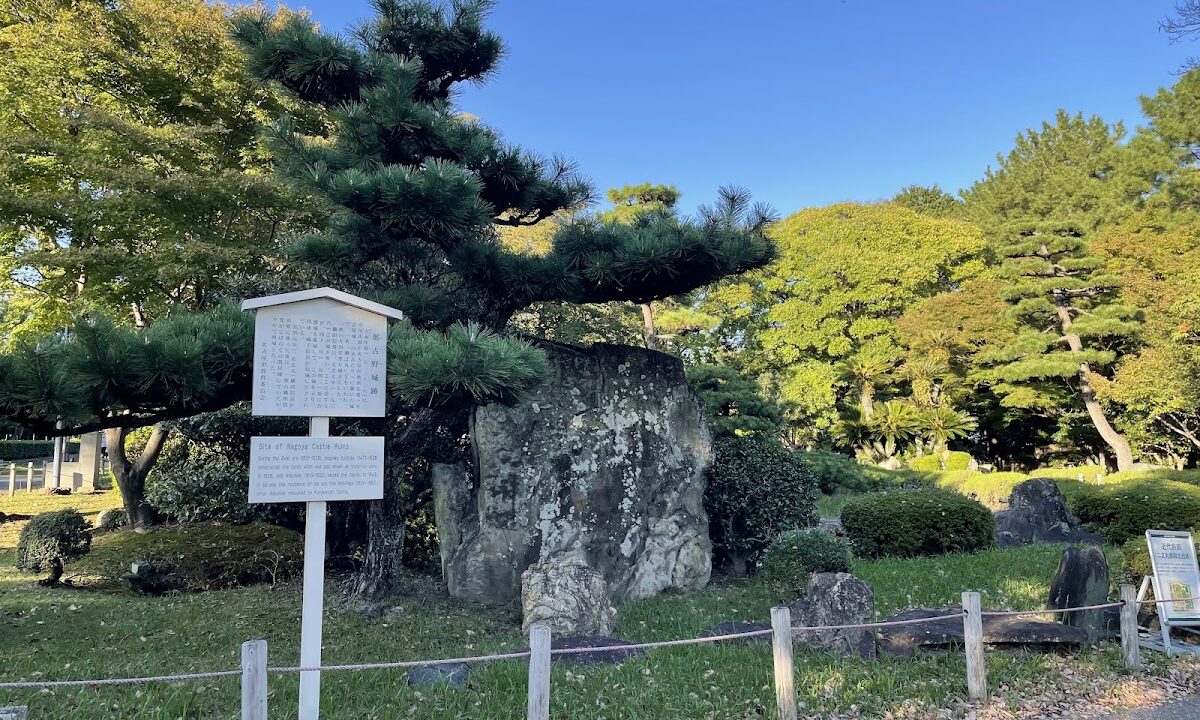
Stone Monument in Nagoya Castle’s Ninomaru Garden
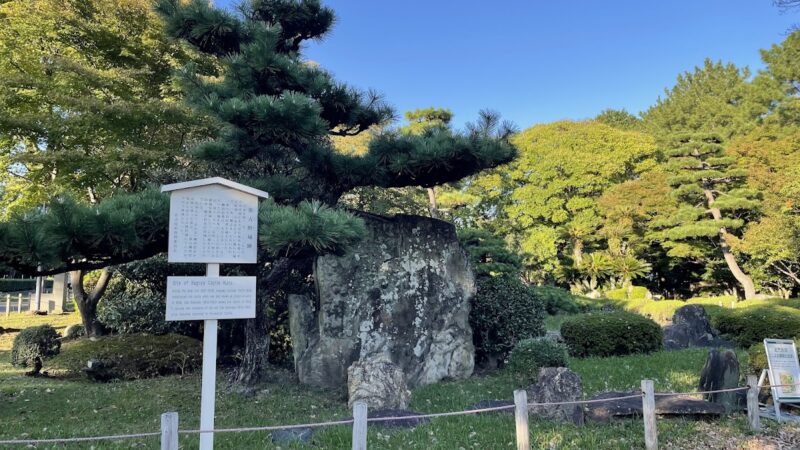
Currently, almost no remains of Nagoya Castle exist. Only a stone monument marking the “Nagoya Castle Site” stands within the Ninomaru Garden of Nagoya Castle. This monument is heavily weathered, and the two characters “Nago” are barely legible.
The exact location of the monument is in a corner of the East Garden of Nagoya Castle’s Ninomaru. When visiting Nagoya Castle, searching for this monument is one of the pleasures of a historical walk.
Access Methods
Access by Train:
- 5-minute walk from Exit 7 of Shiyakusho Station on the Nagoya Municipal Subway Meijo Line
- 12-minute walk from Exit 1 of Asama-cho Station on the Nagoya Municipal Subway Tsurumai Line
- Approximately 30-minute walk from Nagoya Station (all lines)
Access by Bus:
- Immediately after alighting at Nagoya Castle Main Gate bus stop (Nagoya Municipal Bus)
Access by Car:
- Approximately 5 minutes from the Marunouchi Exit of the Nagoya Expressway Inner Ring Road
- Paid parking is available at Nagoya Castle
Notes for Visitors
To view the Nagoya Castle Ruins monument, admission to Nagoya Castle is required. It is recommended to check Nagoya Castle’s opening hours and admission fees in advance before visiting.
Basic Information about Nagoya Castle:
- Opening Hours: 9:00 AM – 4:30 PM (Last entry 4:00 PM)
- Closed: December 29th – 31st, January 1st (4 days)
- Admission Fee: 500 yen for adults, free for junior high school students and younger
Relationship between Nagoya Castle and Oda Nobunaga
Birthplace of Nobunaga
Oda Nobunaga is believed to have been born on May 12th, 1534 (Tenbun 3rd year, lunar calendar), but there are two theories regarding his birthplace: Nagoya Castle and Shobata Castle. Many historical sources consider Nagoya Castle to be the more likely location.
If Nobunaga was born at Nagoya Castle, then this castle holds significant historical importance as the “birthplace of Oda Nobunaga, the unifier of Japan.”
The Castle that Nurtured Nobunaga’s Youth
Nobunaga spent approximately 10 years as the lord of Nagoya Castle, from around the age of 13 to 23. During this period, Nobunaga was known as the “Great Fool of Owari,” and it is said that he surprised those around him with his eccentric clothing and behavior.
However, it was during this time at Nagoya Castle that Nobunaga gained crucial experience that would later lead to his unification of Japan. This was the period when he built the foundation of a Sengoku daimyo, gaining control of his retainers, diplomacy with neighboring forces, and practical battle experience.
Relationship with His Father, Nobuhide
It is believed that Oda Nobuhide entrusted Nagoya Castle to Nobunaga with the expectation and education of his eldest son. While Nobuhide himself was based at Furuto Castle, he watched over Nobunaga’s growth.
When Nobuhide died in 1551, Nobunaga attended the funeral from Nagoya Castle, and his unconventional behavior at the time (the anecdote of him throwing incense) is recounted. This event is another episode that tells the story of Nobunaga during his time at Nagoya Castle.
The Relationship Between Nagoya Castle and the Imagawa Clan
The Imagawa Clan’s Expansion into Owari
After unifying Suruga and Tōtōmi provinces, Imagawa Ujichika sought to further expand his power eastward, aiming to enter Owari Province. The construction of Nagoya Castle was part of this strategy.
At that time, the power of the Shiba clan, the shugo (provincial governor) of Owari Province, was declining, and the Oda clan, the shugodai (deputy governor), was gaining real power. The Imagawa clan sought to take advantage of this turmoil to strengthen their influence in Owari.
Imagawa Ujitoyo and Nagoya Castle
Imagawa Ujitoyo, the younger brother of Imagawa Ujichika, is believed to have served as the castle lord of Nagoya Castle. Ujitoyo was in charge of managing Owari Province under his brother’s orders, but the castle was seized through the machinations of Oda Nobuhide.
This defeat marked a major turning point for the Imagawa clan, causing them to lose influence in Owari Province.
The Grudge with Imagawa Yoshimoto
Although the Imagawa clan lost Nagoya Castle, their power was restored under the leadership of Imagawa Yoshimoto, the son of Ujichika. Yoshimoto became a powerful figure, known as the “greatest archer of the Tokaido,” and sought to regain influence in Owari Province.
The clash between Oda Nobunaga and Imagawa Yoshimoto at the Battle of Okehazama in 1560 (Eiroku 3) can be seen as an extension of this grudge over Nagoya Castle.
From Nagoya Castle to Furuto Castle
Relocation of Oda Nobuhide’s Base
Around 1542, Oda Nobuhide moved his base from Nagoya Castle to Furuto Castle, located about 2 kilometers south. Furuto Castle is believed to have been located near present-day Tachibana 2-chome, Naka-ku, Nagoya City.
Possible reasons for Nobuhide’s relocation include the need for a larger castle complex and improved access to the Atsuta area. He entrusted Nagoya Castle to his eldest son, Nobunaga, and aimed to unify Owari Province from his new base.
The Current State of Furuto Castle
Like Nagoya Castle, almost no remains of Furuto Castle exist today. Only a stone monument marking the “Furuto Castle Site” stands near the Furuto-cho intersection in Tachibana 2-chome, Naka-ku, Nagoya City.
By tracing the changes in the Oda clan’s bases—Nagoya Castle, Furuto Castle, and Kiyosu Castle—we can understand the strategies of Oda Nobuhide and his son Nobunaga, and their path to unifying Owari.
The Origin of the Place Name Nagoya
The Etymology of “Nagoya”
There are several theories about the origin of the place name “Nagoya.” The most plausible theory is that it comes from the meaning of “a peaceful (nagoyaka) land.”
Furthermore, there are theories that the name is a combination of “nagu” (to flatten) and “ya” (valley) due to its topographical features, or that it originates from the name of an ancient powerful clan.
Distinguishing between “Nagoya” and “Nagoya”
Castles from the Sengoku period (Warring States period) are written as “Nagoya-jo” (那古野城), while castles built by Tokugawa Ieyasu during the Edo period are written as “Nagoya-jo” (名古屋城). The pronunciation is the same, but the kanji characters differ.
This distinction allows us to differentiate between castles from the Sengoku period and those from the Edo period. While the current city of Nagoya uses the characters “名古屋,” historically, “那古野” is the older form.
Related Spots
Nagoya Castle
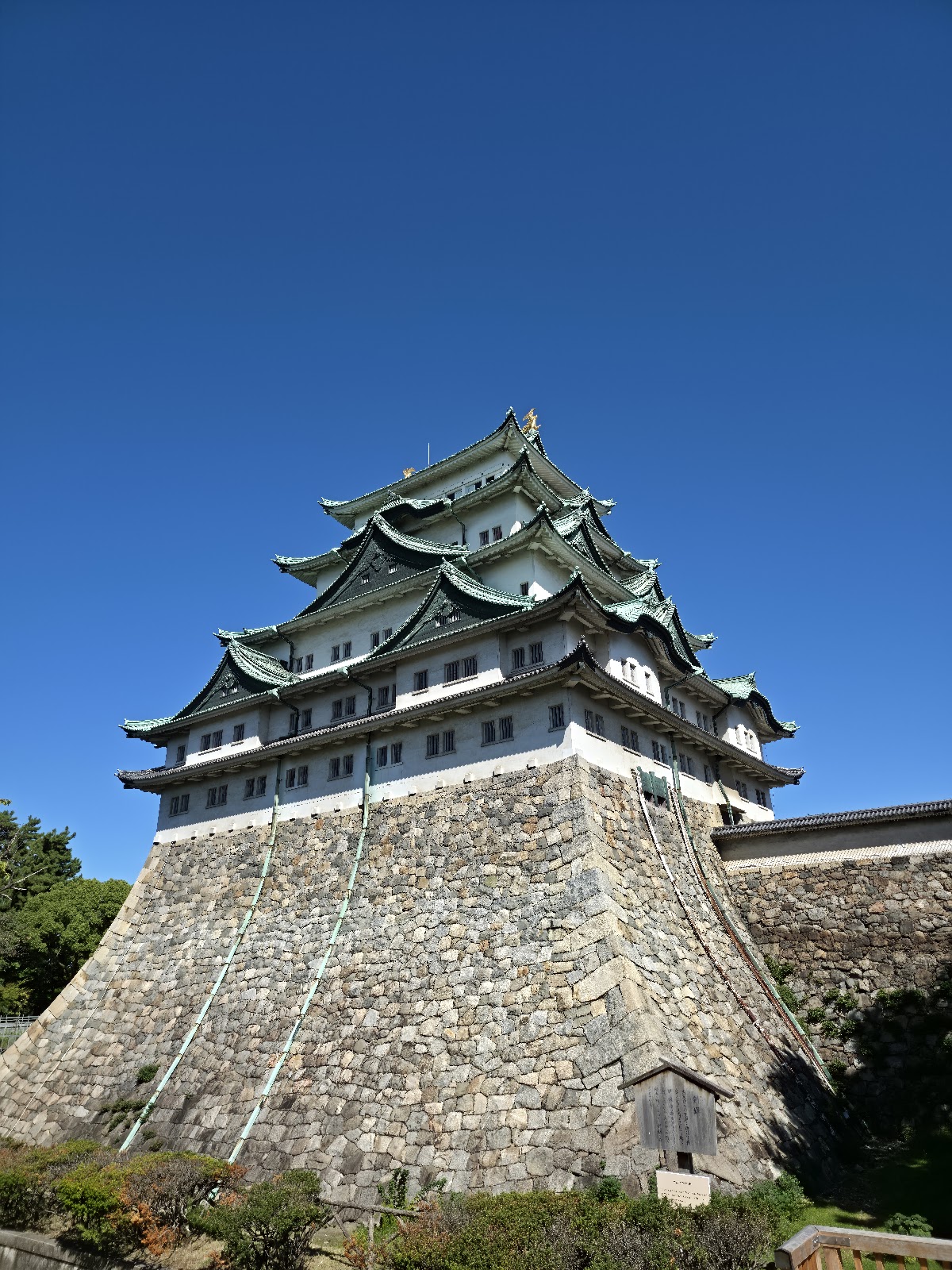
When visiting the Nagoya Castle ruins, we highly recommend also visiting Nagoya Castle itself. Built by Tokugawa Ieyasu, Nagoya Castle is a magnificent fortress considered one of Japan’s three most famous castles.
Nagoya Castle boasts numerous attractions, including its main keep, the Honmaru Palace, and the Ninomaru Garden. Understanding these sites in conjunction with the history of Nagoya Castle allows you to truly appreciate the layered history of this region.
Furuto Castle Ruins
The ruins of Furuto Castle, which Oda Nobuhide used as his base after Nagoya Castle, are also located within Nagoya City. While now a residential area, a stone monument remains. Visiting both Nagoya Castle and Furuto Castle allows you to trace the changes in the Oda clan’s bases.
Kiyosu Castle
Kiyosu Castle, which Oda Nobunaga used as his base after Nagoya Castle, is located in what is now Kiyosu City, Aichi Prefecture. A replica keep has been erected, and the site is maintained as the Kiyosu Castle Ruins. It was an important castle that served as a base for Nobunaga’s unification of Owari Province.
Battlefield of Okehazama
The battlefield of the Battle of Okehazama, where Imagawa Yoshimoto and Oda Nobunaga clashed, also exists, spanning Nagoya City (Midori Ward) and Toyoake City. This site holds historical significance as the place where the long-standing feud between the Imagawa and Oda clans over Nagoya Castle was resolved.
Summary
Nagoya Castle was a Sengoku period castle located near the Ninomaru (second enclosure) of Nagoya Castle in what is now Naka Ward, Nagoya City, Aichi Prefecture. Built by Imagawa Ujichika, it was seized by Oda Nobuhide, and later served as the lord of the young Oda Nobunaga, making it a historically important fortress.
Although its existence was short, lasting only about 30 years, it was the stage for battles for control of Owari Province and holds a significant place in Japanese history as the castle that nurtured Oda Nobunaga, the unifier of Japan.
Currently, only a few stone monuments remain within the grounds of Nagoya Castle, but their historical value is immeasurable. When visiting Nagoya Castle, be sure to visit the Nagoya Castle ruins monument in the Ninomaru and experience the spirit of the Sengoku period.
By learning about the history of Nagoya Castle, you can gain a deeper understanding of the life of Oda Nobunaga, the conflict between the Imagawa and Oda clans, and the origins of the city of Nagoya.