Ameyama Castle (Okazaki City, Aichi Prefecture) Complete Guide | Tracing the History of the Mikawa Local Lords from Construction to the Battle of Ameyama
Ameyama Castle, located in Ameyama-cho, Okazaki City, Aichi Prefecture, is an important mountain castle in Mikawa Province during the Sengoku period. Also known as Achiwa Castle or Ameyama Fort, this castle was the site of fierce battles between the Mikawa local lords and the Imagawa clan, and is now preserved as a historical site by Okazaki City. This article provides a thorough explanation from every angle, including the history of Ameyama Castle, the background of its construction, details of the Battle of Ameyama, and how to access the site.
Basic Information on Ameyama Castle
Location and Situated Area
Ameyama Castle is located in Higashi-Achiwa, Ameyama-cho, Okazaki City, Aichi Prefecture (formerly Nukata-cho, Nukata-gun), and is a typical mountain castle built on a mountaintop approximately 356 meters above sea level. Its location, at the innermost part of the valley of the Ameyama River, a tributary of the uppermost reaches of the Otogawa River in the Yahagi River system, takes advantage of the terrain well suited for defense.
Located right next to the current Ameyama Dam, it is accessible from Prefectural Road 382. Although the castle ruins are in a remote mountainous area, recent improvements have made it relatively easy to visit.
Common Names/Alternate Names
Ameyama Castle has several names:
- Achiwa Castle: Derived from the name of the first lord, the Achiwa clan.
- Ameyama Fort: A name indicating the defensive facilities used during the Battle of Ameyama.
- Ameyama Village Old Residence: A name referring to the residence of the Ameyama Okudaira clan, later the Achiwa clan.
These names reflect the historical changes and differences in function of the castle.
Classification/Structure
Classification: Mountain Castle
Structure: Remains such as the layout of the main enclosure at the mountaintop, vertical moats, and baileys have been confirmed.
While the exact location of the residence (within Higashi-Achiwa) is not fully determined, clear castle remains are evident on the mountaintop.
Historic Site Designation
On June 15, 1992 (Heisei 4), the “Ameyama Fort Ruins and Ameyama Battlefield” were designated as a Okazaki City Historic Site. This designation protects it as a valuable historical heritage site from the Sengoku period.
History of Ameyama Castle
Year of Construction and Builder
There are several theories regarding the construction period of Ameyama Castle:
- The “Nukata Town History” states it was built before 1543 (Tenbun 12).
- The “Aichi Prefecture Medieval Castle Site Survey Report III (Eastern Mikawa Area)” states its existence period as 1506 (Eisho 3) to 1590 (Tensho 18).
The most widely accepted theory is that it was built around Eisho 3 (1506) by Achiwa Kyuzo Sadasuke**.
The first lord of the castle is said to be Achiwa Sadamoto, who moved from Chita in Owari Province to Ameyama, and this Achiwa clan laid the foundation for the castle. Later, during the Genki era (1570-1573), they are said to have adopted the name Okudaira (Ameyama Okudaira).
The Achiwa and Ameyama Okudaira Clans
The Achiwa clan were local lords originating from the Chita Peninsula, and they expanded their influence into the mountainous regions of Mikawa Province. The Ameyama area was a strategic point in the Yahagi River system, occupying an important location connecting East and West Mikawa.
The Achiwa clan later deepened their relationship with the Okudaira clan, forming their own distinct lineage as the Ameyama Okudaira clan. While this Ameyama Okudaira clan was a separate lineage from the more famous Okudaira clan of Kameyama Castle (the family of Okudaira Sadamasa, who distinguished himself in the Battle of Nagashino), they maintained a close relationship.
Conflict between Mikawa Local Lords and the Imagawa Clan
In the mid-16th century, Mikawa Province was under the control of the Imagawa clan, but discontent with the Imagawa’s heavy taxes and control was growing among the local lords. As Oda Nobuhide (father of Oda Nobunaga) began to extend his influence into Mikawa, some local lords began to align themselves with the Oda.
The Achiwa clan, lords of Ameyama Castle, along with Okudaira Sadakatsu, lord of Kameyama Castle, decided to rebel against the Imagawa clan. This movement led to the Battle of Ameyama.
The Full Picture of the Battle of Ameyama
Its Place in the Mikawa Rebellion (Mikawa General Rebellion)
The Battle of Ameyama is one of the important battles in the “Mikawa Rebellion” (or “Mikawa General Rebellion”), a series of rebellions by the local lords of Mikawa Province against the Imagawa clan.
This rebellion was a resistance movement by the local lords of Mikawa against the oppressive rule of the Imagawa clan, and a historical event that laid the groundwork for the independence of Matsudaira Motoyasu (Tokugawa Ieyasu).
The Battle of Ameyama in 1556
On August 4, 1556 (Koji 2), a fierce battle unfolded at Ameyama Castle.
The Night Before the Battle
With the Oda and Imagawa clans in conflict, Imagawa Yoshimoto was enraged when Okudaira Sadakatsu, lord of Kameyama Castle, and Achiwa Sadao, lord of Achiwa Castle, rebelled against the Imagawa and sided with the Oda. Imagawa Yoshimoto ordered the Seven Generals of Eastern Mikawa (the Seven Eastern Mikawa Generals) to begin their march towards Ameyama Castle.
At Ameyama Castle, Achiwa Sadao, Achiwa Sadasuke, and Okudaira Sadayoshi, who had responded to the orders of Okudaira Sadakatsu and his son Sadayoshi, holed up and prepared to meet the Imagawa forces.
The Course of the Battle
At dawn on August 4th, the Imagawa forces, descending from the eastern border of Ameyama, began their charge.
Leading the attack were the three brothers, Suganuma Sadamura, lord of Noda Castle, and his brothers Suganuma Sadataka and Suganuma Sadamitsu. The besieged forces put up fierce resistance, even achieving a victory by killing the Suganuma brothers at one point.
However, the subsequent attack by the Six Generals of Higashi-Mikawa was relentless, and ultimately, Achiwa Sadao and Okudaira Sadakatsu were forced to surrender to the Imagawa forces.
The Death of Suganuma Sadamura
A notable event in the Battle of Ameyama is the death of Suganuma Sadamura, a powerful Imagawa general and lord of Noda Castle, at this location. His grave still stands today at the foot of the mountain to the left before reaching the Ameyama Dam, and, along with the memorial tower for fallen soldiers, commemorates the fierce battle.
The Meaning of Ameyama Fort
The alternative name “Ameyama Fort” is thought to refer to a defensive structure built during the Battle of Ameyama. In addition to Achiwa Castle, which served as a regular residence, it is believed to have been enhanced during battles to function as a temporary fort and signal fire station.
This view is supported by the traces of hastily constructed defensive structures found in the castle’s remains.
Ameyama Castle After the Battle
After the Battle of Ameyama, the Achiwa and Okudaira clans temporarily submitted to the Imagawa clan, but they became active again amidst the changing circumstances.
After the Eiroku era (1558-1570), when Matsudaira Motoyasu (Tokugawa Ieyasu) declared independence from the Imagawa clan, many of the local lords of Mikawa Province sided with the Tokugawa. It is believed that the Ameyama Okudaira clan also acted within this trend, ultimately siding with the Tokugawa.
The castle’s existence is estimated to have lasted until 1590 (Tensho 18), and it is presumed that its role ended with Toyotomi Hideyoshi’s unification of Japan and Tokugawa Ieyasu’s relocation to the Kanto region.
Remains and Highlights of Ameyama Castle
Main Enclosure and Castle Site Monument
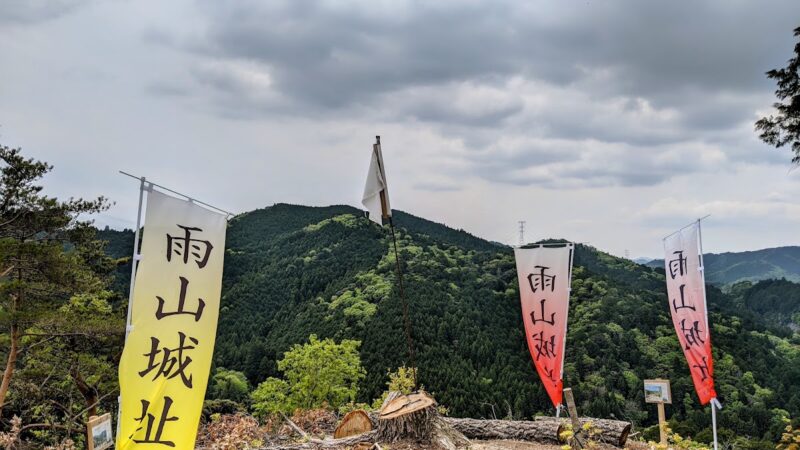
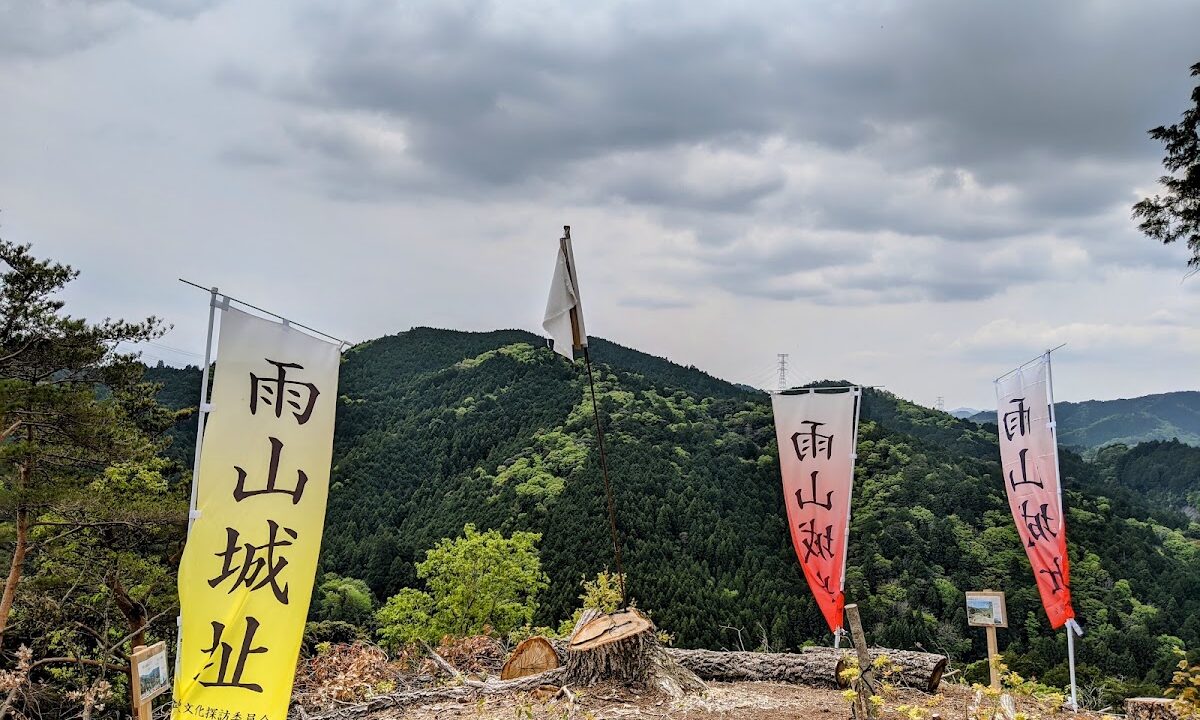
Located on the mountaintop at an altitude of approximately 356 meters, the main enclosure features a magnificent stone monument to “Ameyama Castle Site,” erected in December 2020. This monument, built through the efforts of local residents, serves as an important memorial to the castle’s history for future generations.
From the main enclosure, one can overlook the surrounding mountains, gaining a real appreciation for the strategic importance of this location during the Sengoku period (Warring States period).
Enclosures and Vertical Moats
The castle site reveals the remains of several enclosures. Enclosures are flat, constructed sections within the castle grounds, used for troop deployment and storage of supplies.
Remains resembling vertical moats can also be seen. Vertical moats are trenches dug along the slopes of mountains, serving as defensive structures to prevent enemy lateral movement. These remains indicate that Ameyama Castle was a mountain castle equipped with full defensive capabilities.
Ameyama Battle Monument and Related Historical Sites
Approximately 200 meters west of Ameyama Dam, on the south side of Prefectural Road 382, stands the “Ameyama Battle Monument.” This monument commemorates the historical significance of the Battle of Ameyama and conveys the fierce battle to visitors.
Furthermore, on the left side of the mountain slope before reaching the dam, are:
- Explanatory Board regarding the Battle of Ameyama
- Grave of Suganuma Sadamura
- Memorial Tower for War Dead
These sites commemorate the warriors and soldiers who lost their lives in the battle. Visiting these historical sites allows for a deeper understanding of the overall picture of the Battle of Ameyama.
Status of the Castle Access Route
For a long time, the exact location of Ameyama Castle was unknown, but thanks to the tremendous efforts of local residents, its location was identified, and the access route and signposts have been improved in recent years.
The entrance to the castle is located south of the castle mountain, along the prefectural road at Nyudosawa (near 6-1 Nyudosawa, Ameyama-cho), and the climb to the castle ruins takes approximately 15-20 minutes. Signs and trail markers are placed along the way, making it easy to find your way to the summit without getting lost.
However, there are some steep slopes characteristic of mountain castles, so careful footing is necessary. We recommend wearing appropriate hiking boots and clothing.
Access and Surrounding Information
Access by Car
Access to Ameyama Castle is most convenient by car.
Nearest Landmark: Ameyama Dam
Castle Entrance: Near 6-1 Nyudosawa, Ameyama-cho, Okazaki City, Aichi Prefecture (along Prefectural Road 382)
There is a parking lot at Ameyama Dam, from which you can walk to the castle entrance. The dam parking lot has a toilet and a gazebo. The gazebo has a map of the surrounding area showing the castle entrance and castle ruins, so we recommend checking it beforehand.
Access by Public Transportation
Access by public transportation is difficult, and it’s quite a distance from the nearest bus stop, so visiting by car is the most practical option.
Points to Note When Visiting
- Estimated Time: Approximately 50-60 minutes from ascent to descent
- Attire: Suitable hiking boots and comfortable clothing
- Items to Bring: Drinking water, towel, insect repellent (summer)
- Weather: Avoid visiting in rainy weather as the ground can be slippery
- Season: Spring to autumn is the best time to visit, but summer brings many insects, so precautions are necessary.
As it is a mountain castle, those who are not confident in their physical fitness should not push themselves too hard. Even just visiting the historical sites near the castle entrance is enough to experience its history.
Related Historical Sites in the Surrounding Area
When visiting Ameyama Castle, visiting the following related historical sites will allow you to gain a deeper understanding of the history of the Mikawa local lords:
- Kameyama Castle Ruins (Okazaki City): The residence of Okudaira Sadakatsu
- Noda Castle Ruins (Shinshiro City): The residence of Suganuma Sadamura
- Nagashino Castle Ruins (Shinshiro City): One of the Okudaira clan’s strongholds and the site of the Battle of Nagashino
These castles were bases for the warlords involved in the Battle of Ameyama and are important locations for tracing the history of the Sengoku period in Mikawa.
The Significance of Ameyama Castle in the History of the Mikawa Sengoku Period
The Independence of the Local Lords
The Battle of Ameyama is a symbolic event of the independence of the Mikawa local lords and their resistance to the power of the daimyo. The fact that small and medium-sized local lords such as the Achiwa and Okudaira clans bravely stood up against the powerful Imagawa clan illustrates the complex power structure of regional society during the Sengoku period. ### Laying the Foundation for Tokugawa Ieyasu’s Rise
The Battle of Mikawa was a crucial preliminary step that paved the way for Matsudaira Motoyasu (Tokugawa Ieyasu)’s independence from the Imagawa clan and his unification of Mikawa. The anti-Imagawa sentiment of the local lords, demonstrated at the Battle of Ameyama, became a vital foundation for Ieyasu’s control of Mikawa.
The Importance of Local History Research
While local castles like Ameyama Castle lack the extensive documentary records of daimyo castles, they are extremely important for understanding the realities of the local community and the history at the popular level. The discovery and restoration of castle ruins by local residents is a prime example of this kind of unearthing and preservation of local history.
References and Research Materials
The following materials are useful for research on Ameyama Castle:
- *Nukata Town History*
- *Aichi Prefecture Medieval Castle Site Survey Report III (Eastern Mikawa Area)*
- Historical site explanatory materials by the Okazaki City Board of Education
- Descriptions of Ameyama Castle in various castle research books
These materials sometimes present differing views on the construction date and changes in castle lords, and further research is expected.
Summary: The Value of Visiting Ameyama Castle
Ameyama Castle in Ameyama-cho, Okazaki City, Aichi Prefecture, is a valuable historical site that conveys the complex relationship between the resistance of local lords and regional power in Mikawa Province during the Sengoku period.
Built on a mountaintop at an altitude of 356 meters, this mountain castle was the stage for the fierce Battle of Ameyama in 1556, playing an important role in the history of Mikawa. The history of Ameyama Castle, passed down from the Achiwa clan to the Ameyama Okudaira clan, highlights the aspirations for independence of the local lords of Mikawa Province and the lives of those who survived the turbulent Sengoku period.
Thanks to recent discoveries of the castle ruins by local residents and improvements to the access routes, Ameyama Castle is now relatively easy to visit. Many points of interest await visitors, including the castle ruins monument in the main enclosure, the remains of baileys and vertical moats, the Ameyama Battle monument, and the grave of Suganuma Sadamura.
Visiting this castle, protected as a designated historical site of Okazaki City, offers a valuable opportunity to experience the local Sengoku history that is not found in textbooks. Why not feel the spirit of the Sengoku period at Ameyama Castle, nestled in the mountains of Mikawa?