Complete Guide to Ganryakuji Castle (Toyokawa City, Aichi Prefecture) | History, Remains, and Access Information for the Largest Mountain Castle in the Prefecture
What is Ganryakuji Castle?
Ganryakuji Castle is a medieval mountain castle located in Oshiroyama, Nagasawa-cho, Toyokawa City, Aichi Prefecture. Also known as “Nagasawayama Castle,” it is known as a strategically important castle built on a mountaintop approximately 160 meters above sea level, overlooking the Tokaido Road.
It is one of the largest mountain castles in Aichi Prefecture, and its well-preserved remains and mysterious history continue to fascinate castle enthusiasts. It is protected as a designated historical site by Toyokawa City, and remains such as the main enclosure, baileys, moats, and earthworks can still be seen today.
Features of Ganryakuji Castle
The most distinctive feature of Ganryakuji Castle lies in its location and scale. Situated in a narrow pass where mountains flank both sides of the Tokaido Road, it was built in a strategically important location that allowed for complete control of the road from the mountaintop. The castle grounds are vast, boasting a complex layout with multiple interconnected baileys, making it one of the largest mountain castles in Aichi Prefecture.
History of Iwajiji Castle
Construction and the Imagawa Clan Era
While there are various theories regarding the construction period of Iwajiji Castle, the most widely accepted theory is that it was built around the Bun’an era (1444-1449) by Sekiguchi Gyobu-no-sho Mitsuoki, a member of the Imagawa clan. It is believed that Sekiguchi Mitsuoki’s younger brother, Nagasawa Naoyuki, ruled this area.
At that time, the Mikawa region was within the sphere of influence of the Imagawa clan of Suruga Province, and Iwajiji Castle is thought to be one of the castles built by the Imagawa clan as a base for their control of Mikawa. Its location controlling the important Tokaido transportation route made it a strategically and economically important base.
Conquest by the Matsudaira Clan
In 1458 (Chōroku 2), Matsudaira Nobumitsu, the founder of the Mikawa Matsudaira clan, captured Nagasawa Castle. There is disagreement among researchers as to whether this “Nagasawa Castle” refers to Iwakuraji Castle or another nearby castle.
Matsudaira Nobumitsu granted the conquered Nagasawa territory to his eldest son, Chikamori, marking the beginning of the Nagasawa Matsudaira clan. The Nagasawa Matsudaira clan became one of the most important branches of the Matsudaira family and later contributed to Tokugawa Ieyasu’s unification of Japan.
Iwakuraji Castle in the Sengoku Period
During the Sengoku period (Warring States period), Iwakuraji Castle is believed to have played a crucial role in the power struggles between the Imagawa, Matsudaira (later Tokugawa), and Oda clans. However, historical records regarding specific battles and changes in castle lords are scarce, leaving many mysteries.
After Imagawa Yoshimoto was killed in the Battle of Okehazama in 1560, the Mikawa region came under the control of Matsudaira Motoyasu (later Tokugawa Ieyasu). While the exact role of Iwaji Castle during this period is unclear, its strategic location on the Tokaido road suggests it undoubtedly played some military role.
Period of Abandonment
There are no clear records regarding the period of abandonment of Iwaji Castle. It is believed that many mountain castles in the Mikawa region ceased to function following Tokugawa Ieyasu’s relocation to the Kanto region in 1590, and it is highly probable that Iwaji Castle was abandoned around this time.
Layout and Remains of Iwaji Castle
Overall Structure
Iwaji Castle is a multi-bailey mountain castle with multiple baileys arranged around a mountaintop approximately 160 meters above sea level. The castle grounds are centered around the main enclosure, with baileys extending to the east, west, north, and south, and are fortified with trenches and vertical moats. The castle area is very large, boasting one of the largest scales among mountain castles in Aichi Prefecture.
A notable feature of the layout is the skillful use of the terrain for defensive structures. Steep slopes serve as natural barriers, and trenches are strategically placed along the ridges to prevent enemy intrusion.
Main Enclosure (Honmaru)
The main enclosure is located at the mountaintop and is a relatively flat, spacious area. Traces of earthworks can be seen around it, suggesting that watchtowers and buildings once stood there. From the main enclosure, one can enjoy a panoramic view of the surrounding terrain and overlook the Tokaido road, making it an excellent vantage point.
The main enclosure is estimated to be approximately 40 meters east-west and 30 meters north-south, a sufficiently large area for a mountain castle.
Enclosures
Several enclosures are arranged in a stepped pattern around the main enclosure. These enclosures are thought to have served not only as defensive structures but also as troop encampments and storage areas for supplies.
Particularly noteworthy are the clear elevation changes and steep slopes between each enclosure. These were artificially carved, designed to make enemy intrusion difficult.
Moats and Vertical Moats
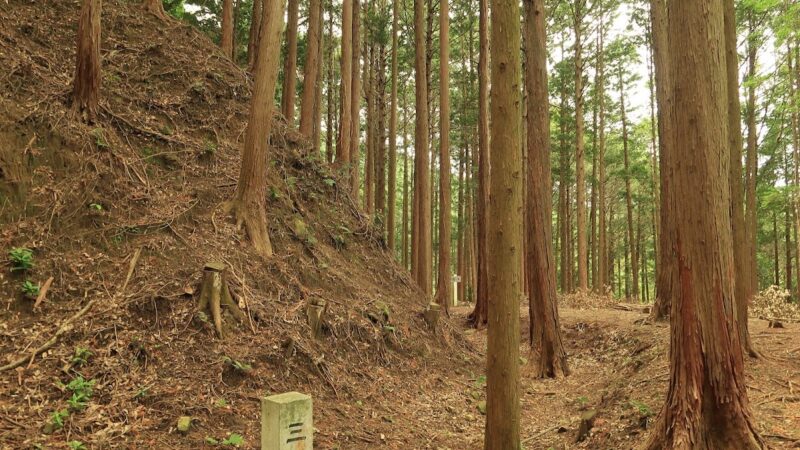
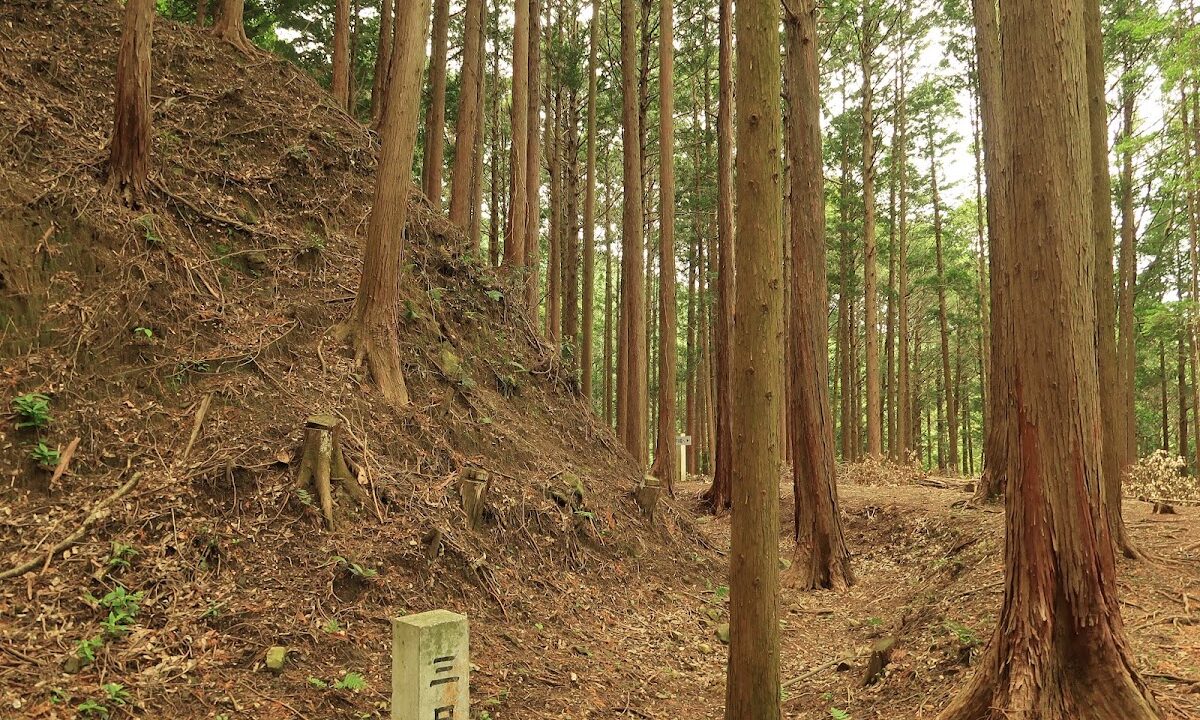
Especially important defensive features of Iwaji Castle are the moats that cut off the ridgeline. Multiple moats have been identified on the east, west, north, and south sides of the castle grounds, some reaching depths of over 5 meters.
Vertical moats have also been dug on the slopes, demonstrating a design intended to prevent lateral movement by the enemy. These moats and vertical moats remain remarkably well-preserved today, demonstrating the advanced castle-building techniques of the time.
Earthworks
Traces of earthworks remain around the main enclosure and major enclosures. The earthworks are thought to have served not only as defensive walls but also as building foundations. Some sections of the earthworks are over 2 meters high and retain much of their original appearance.
Entrance (Koguchi)
Traces of entrances (koguchi) to the castle have been confirmed in multiple locations. These entrances are not simple openings, but rather feature designs that allow for flanking fire, demonstrating defensive considerations.
Highlights of Iwajiji Castle
Largest Scale in the Prefecture
The greatest highlight of Iwajiji Castle is its overwhelming scale. It boasts one of the largest areas among mountain castles in Aichi Prefecture, requiring considerable time just to walk around. Walking through the vast castle grounds allows you to experience the reality of a Sengoku period mountain castle.
Well-Preserved Remains
Another attraction of Iwajiji Castle is the excellent state of its remains. Major remains such as the main enclosure, baileys, moats, and earthworks are well-preserved, allowing for a clear understanding of the castle’s layout at the time. The sheer scale of the moat is particularly impressive, allowing you to truly appreciate the advanced castle-building techniques of the Sengoku period.
View Overlooking the Tokaido Road
From the mountaintop, you can look down on the former Tokaido Road. This view speaks to why Iwajiji Castle was considered a strategically important point. On a clear day, you can see the city of Toyokawa and the surrounding mountains in the distance, giving you a real sense of the topographical advantage during a siege.
A History Shrouded in Mystery
Many mysteries surround Iwajiji Castle. The construction period, the changes in castle lords, and the records of specific battles are all unclear, which paradoxically fuels the historical romance. Visiting the site allows you to reflect on the history of Mikawa during the Sengoku period.
Access Information
Location
Address: Gojoyama, Nagasawa-cho, Toyokawa City, Aichi Prefecture
Access by Public Transportation
Access by public transportation is not easy. The nearest station is Nagasawa Station on the JR Iida Line, but it takes about 30 minutes to walk from the station to the castle entrance. Since train service is limited, it is recommended to check the timetable in advance.
Access by Car
Access by car is the most convenient. You can reach the vicinity of the castle entrance in about 15 minutes from the Otowa-Gamagori Interchange on the Tomei Expressway. However, parking space around the castle entrance is limited, so please be careful not to park on the street.
Car Navigation Settings: You can search for “Nagasawa-cho, Toyokawa City” or “Iwa-ryakuji Castle Ruins”.
Castle Entrance and Climbing Route
There are multiple entrances to the castle, but the main route is the mountain trail from the Nagasawa-cho side. It takes about 20-30 minutes to walk from the entrance to the main enclosure. The path is mainly an unpaved natural mountain trail, and can be particularly slippery in rainy weather and winter, so appropriate clothing and shoes for hiking are necessary.
Important Notes for Visitors
- Clothing: As this is a mountain castle, comfortable clothing and non-slip shoes (trekking shoes recommended) are necessary.
- Season: In summer, vegetation is overgrown, making it difficult to see the remains. Visiting from autumn to spring is recommended.
- Insect Repellent: In summer, there are many insects such as mosquitoes and gnats, so carrying insect repellent spray is recommended.
- Bear Bell: Since there is a possibility of encountering wild animals in the mountains, consider carrying a bear bell or similar device.
- Solo Visit: Visiting in a group is safer if possible.
- Hydration: Especially in summer, bring plenty of water.
Estimated Visiting Time
The time required to visit Iwajiji Castle varies depending on how thoroughly you want to examine it.
- Simplified Tour: Main enclosure area only = Approximately 40-50 minutes
- Standard Tour: Examining major enclosures and moats = Approximately 1 hour 30 minutes to 2 hours
- Detailed Tour: Thorough exploration of the entire area = Approximately 3 hours or more
For first-time visitors, it’s a good idea to allow around 2 hours for the standard tour.
Nearby Tourist Information
Nearby Castles
There are several other castles worth seeing around Iwakuraji Castle.
Ushikubo Castle: A flatland castle located in Ushikubo-cho, Toyokawa City. Known as the residence of the Imagawa and Makino clans, it is now maintained as Ushikubo Castle Ruins Park. Approximately 15 minutes by car from Iwakuraji Castle.
Yoshida Castle: A hilltop castle located in Imabashi-cho, Toyohashi City. Famous as the residence of Sakai Tadatsugu, a retainer of Tokugawa Ieyasu, it is now maintained as Toyohashi Park, where you can see a restored iron turret. Approximately 30 minutes by car from Iwa-ryakuji Castle.
Tamamine Castle: A mountain castle located in Shitara-cho, Kitashitara-gun. The main keep has been restored, allowing visitors to experience the appearance of a Sengoku period mountain castle. Approximately 1 hour 30 minutes by car from Iwa-ryakuji Castle.
Tourist Spots in Toyokawa City
Toyokawa Inari: A Soto Zen Buddhist temple known as one of Japan’s three major Inari shrines. Visitors from all over the country come to pray for business prosperity. Approximately 20 minutes by car from Iwa-ryakuji Castle.
Togashi Shrine: A shrine that has long been revered as the Ichinomiya (first-ranked shrine) of Mikawa Province. The main shrine is located at the summit of Mt. Hongu, with the lower shrine situated at the foot of the mountain. Approximately 25 minutes by car from Iwa-ryakuji Castle.
Investigation and Research of Iwa-ryakuji Castle
Aichi Prefecture Medieval Castle Site Survey
Iwa-ryakuji Castle was thoroughly investigated in 1997 by the Aichi Prefectural Board of Education in their “Aichi Prefecture Medieval Castle Site Survey Report III.” This investigation revealed the overall layout and condition of the remains, confirming that it is one of the largest mountain castles in the prefecture.
Guided Tours
Regular guided tours are held by local historical research groups and the Aichi Medieval Castle Research Association. By touring the castle ruins while listening to expert explanations, you can gain a deeper understanding of the value of Iwa-ryakuji Castle.
Information on guided tours may be available on the websites of the Toyokawa City Board of Education and related organizations.
Future Challenges
Many mysteries remain regarding Iwa-ryakuji Castle. Further research is needed, particularly on the following points:
- Identifying the exact construction date
- Clarifying the successive lords of the castle
- Discovering records of specific battles and sieges
- Determining the date and reason for the castle’s abandonment
- Clarifying the existence and scale of the castle town
To unravel these mysteries, not only is the excavation of historical documents necessary, but archaeological excavations are also required.
Points to enjoy Iwa-ryakuji Castle
Preparations
Before visiting Iwa-ryakuji Castle, we recommend the following preparations.
- Obtaining a Castle Layout Map: Obtaining a castle layout map from the internet or books beforehand will deepen your understanding of the castle’s structure and enhance your experience on site.
- Preparing for History: Studying the history of the Imagawa and Matsudaira clans, and the situation in Mikawa during the Sengoku period, will enhance your enjoyment.
- Checking the Weather: As it is a mountain castle, it is recommended to visit on a sunny day.
- Preparing Equipment: Please prepare hiking boots, work gloves, long-sleeved shirt and long pants, a hat, and water.
How to Enjoy the Site
- Confirming the Remains: With a castle layout map in hand, examine each of the remains, such as the main enclosure, baileys, moats, and earthworks.
- Photography: The remains are in good condition, making it suitable for photography. The scale of the moat, in particular, is worth capturing in photographs.
- Observing the Topography: Observe how the castle utilizes the terrain and what defensive features are present.
- Enjoying the View: Enjoy the view from the main enclosure and consider why the castle was built in this location.
How to Keep Records
Keeping a record of your visit will enhance the enjoyment of looking back later.
- Photographs: Take photos not only of the ruins but also of the approach to the castle and the surrounding scenery.
- Notes: Taking notes of things you noticed and your impressions will help you remember later.
- GPS Recording: Recording your travel route with a smartphone GPS app allows you to review it on a map later.
Related Books and Materials
For those who want to learn more about Iwa-ryakuji Castle, the following books and materials are recommended.
Books
“Walking the Best 50 Mountain Castles of Aichi Prefecture” (Aichi Medieval Castle Research Association, Hitoshi Nakai, 2010, Sunrise Publishing): This book introduces 50 major mountain castles in Aichi Prefecture, and Iwa-ryakuji Castle is covered in detail. It includes numerous layout maps and photographs, making it an essential book for castle tours.
“Aichi Prefecture Medieval Castle Site Survey Report III” (Aichi Prefecture Board of Education, 1997): This is a survey report of medieval castle sites conducted by Aichi Prefecture. It includes detailed survey results for Iwa-ryakuji Castle. While the content is specialized, it is one of the most reliable sources.
Websites
Kojodan: This website collects information on castles nationwide, and includes many visitor photos and evaluations of Iwa-ryakuji Castle. It’s useful for gathering information before visiting.
Jōkaku Hōrōki: This site features records of visits to castles nationwide, and provides layout maps and detailed information on Iwa-ryakuji Castle.
Summary
Iwaji Castle, located in Toyokawa City, Aichi Prefecture, is one of the largest mountain castles in the prefecture. Built on a strategically important location controlling a key point on the Tokaido road, it is a fascinating castle site shrouded in mystery, boasting a history spanning from the Imagawa clan to the Matsudaira clan, well-preserved remains, and many other mysteries.
While preparation for hiking is necessary for a visit, actually walking the site allows you to experience the reality of a Sengoku period mountain castle. The vast castle grounds, clearly preserved moats and earthworks, and the view overlooking the Tokaido road will impress even those who aren’t castle enthusiasts.
When you visit Toyokawa City, be sure to stop by Iwaji Castle. You’ll be able to fully appreciate the grandeur of one of the prefecture’s largest mountain castles and the historical romance of the Sengoku period.