A Complete Guide to the History and Highlights of Tozaki Castle (Kasumigaura City, Ibaraki Prefecture)
Tozaki Castle, located in Kasumigaura City, Ibaraki Prefecture, is a flatland castle that functioned as a strategic point in southern Hitachi Province from the medieval period to the early modern period. Built on a plateau overlooking the Kawajiri River, which flows into Lake Kasumigaura, this castle tells the history of the Sengoku period, when the area shifted from the sphere of influence of the Oda clan to the rule of the Satake clan. This article comprehensively explains the history of Tozaki Castle from its construction to its abandonment, details of the existing remains, and highlights and access information for visitors, providing useful information for castle enthusiasts and history lovers.
Overview and Location of Tozaki Castle
Tozaki Castle is located in Tozaki, Kasumigaura City, Ibaraki Prefecture, and is a castle built on the tip of a plateau on the western shore of Lake Kasumigaura. The area from present-day Osaki-Maehara to Tozaki-no-shuku is believed to be the castle grounds, and its layout is characterized by its use of the natural terrain, utilizing the Kawajiri River as a moat.
The castle’s style is a kakiage-jiro (a type of castle with earthen ramparts and moats), and it preserves valuable remains as a typical example of a medieval castle that did not use stone walls. Located at an elevation of approximately 30 meters, the plateau offered views of Lake Kasumigaura and the surrounding plains, giving it the characteristics of a strategically important military location.
Castle Grounds and Enclosure Structure
The castle grounds of Tozaki Castle were extensive and are believed to have consisted of the following enclosures:
- Honmaru: Located on the tip of a plateau overlooking the Kawajiri River, it is currently protected as a city-designated historical site.
- Ninokuruwa: Located south of Honmaru, separated by a dry moat, it is currently used as farmland.
- Nakajo: An enclosure that extended further south from Ninokuruwa.
- Sotojo (Maru-gai): An enclosure that formed the outermost defensive line.
These place names are still used locally today, making them valuable place-name heritage that indicates the former extent of the castle.
History of Tozaki Castle
Construction and the Era of the Tozaki Clan
Tozaki Castle is said to have been built by the Tozaki clan, vassals of the Oda clan. The Oda clan was a prominent family based in southern Hitachi Province, wielding considerable power from the Kamakura period to the Sengoku period, centered around Oda Castle (present-day Tsukuba City) at the southern foot of Mount Tsukuba. The Tozaki clan was part of their vassal group and is believed to have managed Tozaki Castle as a base for controlling the western shore region of Lake Kasumigaura.
While there are no clear records of the castle’s construction date, it is estimated to have been built sometime between the first and second halves of the 16th century, during the mid-Sengoku period. It is thought to have been developed as a strategic base to control water transport on Lake Kasumigaura during the period when the Oda clan was expanding its power in southern Hitachi.
Fall of the Castle in 1573
In the late Sengoku period, the Satake clan rapidly expanded its power in Hitachi Province. The Satake clan, based at Ota Castle (present-day Hitachiota City) in northern Hitachi, pursued a southward expansion policy, leading to fierce conflict with the Oda clan.
In August of the first year of the Tensho era (1573), the Satake clan’s forces attacked Tozaki Castle, and the castle fell. This period coincided with a time when the Oda clan was at a disadvantage in their conflicts with the Satake and Hojo clans, and the fall of Tozaki Castle symbolized the shrinking of the Oda clan’s sphere of influence.
After its fall, Tozaki Castle came under the control of the Satake clan and functioned as one of their strongholds in southern Hitachi Province.
The Satake Clan Era and the Iizuka Clan’s Appointment as Castle Lord
After the establishment of Satake clan rule, Satake vassals were stationed at Tozaki Castle. Records indicate that from 1595 onwards, or during the Keicho era (1596-1615), Iizuka Hyobu-shoyu served as the castle lord.
Iizuka was a powerful vassal of the Satake clan and governed the surrounding area from Tozaki Castle. During this period, Tozaki Castle is thought to have functioned as an administrative and military base in the western shore region of Lake Kasumigaura, within the Satake clan’s unified control of Hitachi Province.
Abandonment of the Castle in 1602
In 1602, following the Battle of Sekigahara, the Satake clan, as a daimyo loyal to Toyotomi Hideyoshi, were ordered by Tokugawa Ieyasu to transfer their domain from Hitachi (540,000 koku) to Dewa (Akita) (200,000 koku). With the Satake clan’s relocation to Akita, Iizuka Hyobu-no-sho also moved to Akita, and Tozaki Castle was abandoned.
After its abandonment, Tozaki Castle lost its function as a military facility, and much of the castle grounds were converted to farmland. However, the main area, centered around the main keep, retains its topographical features and continues to convey the appearance of a castle site to this day.
Structure and Layout of Tozaki Castle
Characteristics as a Kakiage Castle
Tozaki Castle has a typical kakiage castle structure. A kakiage castle is a castle built using a construction method where earthen ramparts are constructed by piling up the soil excavated from the moat. This style is commonly seen in medieval castles that do not use stone walls.
The following structural features can be observed at Tozaki Castle:
- Earthen Ramparts: Earthen defensive walls surrounding the baileys, estimated to be about 2-3 meters high.
- Dry Moat: Defensive structures that demarcate the baileys; clear traces of a dry moat remain between the main bailey and the second bailey.
- Utilization of Plateau Topography: The layout makes maximum use of the natural topography of the plateau tip facing the Kawajiri River.
These structures are a castle style widely seen in the Kanto region during the Sengoku period, and are a valuable example for comparative research with other small and medium-sized castles of the same period.
Current Status of the Main Enclosure Site
The main enclosure site of Tozaki Castle is protected as a designated historical site of Kasumigaura City. Located on the tip of a plateau overlooking the Kawajiri River, it still retains many of the original topographical features.
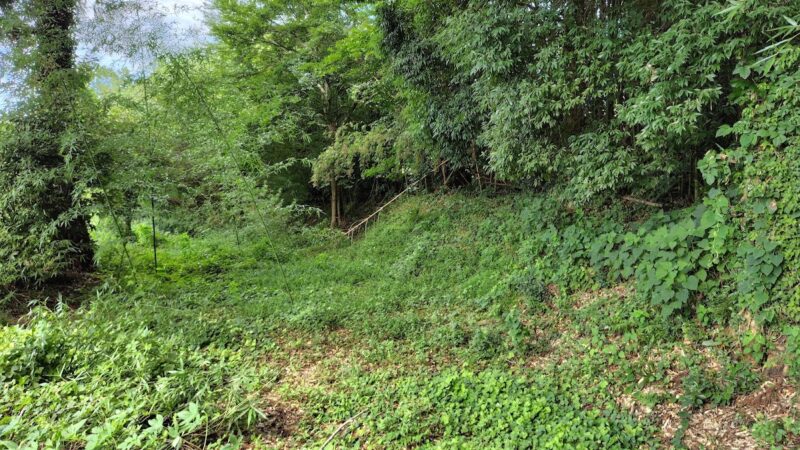
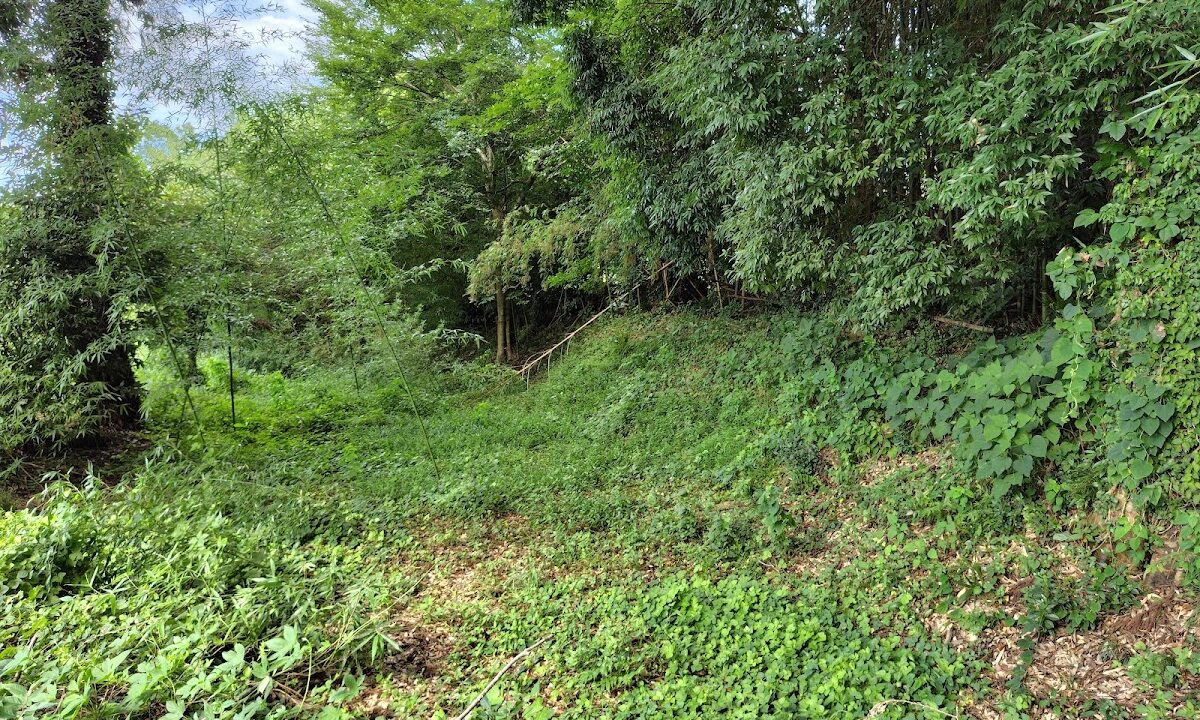
The main enclosure site is on a relatively flat plateau, and traces of earthworks can be partially seen around it. Furthermore, the remains of a dry moat are clearly visible on the south side of the main enclosure, marking the boundary with the second enclosure. This dry moat is estimated to have been approximately 3-4 meters deep and 5-6 meters wide, serving a defensive function between the enclosures.
Layout of the Second Enclosure, Middle Castle, and Outer Castle
The second enclosure, located south of the main enclosure, is currently used as farmland, but its flat terrain suggests its function as an enclosure. The size of the second enclosure is roughly the same as or slightly larger than the main enclosure, and it is thought to have contained living spaces and supply facilities.
Further south of the second bailey was a bailey called Nakajo, and outside of that was the Sotojo (Marugai). These baileys are not arranged in concentric circles, but rather in a linear fashion, following the topography of the plateau.
Even today, place names like “Nakajo” and “Marugai” remain, providing important clues to the former castle structure. Among the local elders, legends about the castle have been passed down along with these place names.
Highlights of Tozaki Castle
Remains of the Main Bailey and Earthworks/Dry Moats
The biggest highlight when visiting Tozaki Castle is undoubtedly the main bailey and the remains of earthworks and dry moats surrounding it. The main bailey, protected as a city-designated historical site, allows visitors to experience the unique location on the tip of a plateau and is a valuable point for understanding the ingenuity of the castle’s design at the time.
In particular, the dry moat separating the main bailey and the second bailey is an important remains that can still be clearly seen today. Walking along the bottom of the moat allows you to experience the defensive structure of a medieval castle. Partial traces of earthworks also remain, providing clues to imagining the castle’s appearance in its heyday.
Views of the Kawajiri River and Lake Kasumigaura
From the main keep site, you can see the Kawajiri River and Lake Kasumigaura. You can appreciate the strategic location, taking advantage of the castle’s topographical feature on the tip of a plateau, which controlled a key waterway.
Lake Kasumigaura was an important waterway from the medieval to early modern periods, used for transporting goods and military movements. It is believed that Tozaki Castle also had the function of monitoring and controlling this waterway, and the view is an important element in understanding its military significance.
Memories of the Castle Remaining in Place Names
One of the distinctive features of Tozaki Castle is the castle-related place names that still remain today. Place names such as “Ninomaru,” “Nakajo,” “Marusoto,” and “Sotojo” are still used, and the memory of the castle lives on in the lives of the local residents. By using these place names as clues to explore the castle grounds, you can grasp the overall picture of the vast castle complex. Exploring these place names will be more than just visiting ruins; it will be an opportunity to experience the region’s history and culture.
Surrounding Historical Environment
Besides Tozaki Castle, Kasumigaura City has numerous other medieval castle ruins scattered throughout the area, creating an interesting environment for understanding the surrounding castle network. Visiting castle ruins from the same period, such as Shizuki Castle and Kashiwazaki Castle, will provide a more comprehensive understanding of the power dynamics in southern Hitachi during the Sengoku period.
Furthermore, the area around Lake Kasumigaura has been a place of human habitation since ancient times, and a diverse range of historical legacies from the Kofun period to the early modern period remain. A visit to Tozaki Castle can serve as a starting point for enjoying a historical exploration of the entire region.
Access and Visiting Information
Location
Tozaki, Kasumigaura City, Ibaraki Prefecture
The Tozaki Castle main keep ruins are located on the tip of a plateau in the Tozaki district of Kasumigaura City. While protected as a city-designated historical site, the surrounding area consists of residential and agricultural land. Please be considerate of local residents when visiting.
Access by Car
- Approximately 15 minutes from Chiyoda-Ishioka IC on the Joban Expressway
- Approximately 20 minutes from Tsuchiura-Kita IC on the Joban Expressway
There is no dedicated parking facility. We recommend using the parking lots of nearby public or tourist facilities and visiting on foot. Please avoid street parking as it inconveniences local residents.
Access by Public Transportation
- Approximately 20 minutes by bus from Kandatsu Station on the JR Joban Line, get off at the “Tozaki” bus stop, then approximately 10 minutes on foot.
- Approximately 30 minutes by bus from Tsuchiura Station on the JR Joban Line, get off at the “Tozaki” bus stop, then approximately 10 minutes on foot.
Buses are limited, so we recommend checking the timetable in advance.
Points to Note When Visiting
- The main keep site is a city-designated historical site, but since much of the surrounding area is private property, caution is required when entering.
- To protect the remains, please be careful not to damage the earthworks or dry moats.
- This area has a lot of farmland, so please be careful not to interfere with agricultural work.
- Information boards and explanatory signs are limited, so it is recommended to check the materials beforehand before visiting.
- In summer, vegetation can grow thickly, making it difficult to see the remains. Spring and autumn are relatively good times to visit.
Nearby Tourist Facilities
Kasumigaura City has the following tourist facilities that can be enjoyed in conjunction with a visit to Tozaki Castle:
- Kasumigaura City History Museum: A facility that introduces the history and culture of the city, and exhibits materials related to Tozaki Castle.
- Kasumigaura Comprehensive Park: A park overlooking Lake Kasumigaura, where you can enjoy strolling along the waterfront and observing nature.
- Tourist Orchard: Kasumigaura City is a major producer of fruit trees such as pears, grapes, chestnuts, persimmons, and strawberries, and you can enjoy fruit picking in each season.
- Yukiiriyama: A mountain in the western part of the city, suitable for hiking and nature observation.
Historical Significance of Tozaki Castle
Conflict between the Oda and Satake Clans in Southern Hitachi
The history of Tozaki Castle symbolizes the power struggle in Southern Hitachi during the Sengoku period. Amidst the conflict between the two major powers, the Oda and Satake clans, Tozaki Castle continued to function as a strategic point in the region, even as its rulers changed hands.
The Oda clan was a prominent family since the Kamakura period, but during the Sengoku period, they faced difficulties caught between the Satake clan’s southward expansion policy and the Hojo clan’s northward expansion policy. The fall of Tozaki Castle in 1573 was a significant event demonstrating the decline of the Oda clan’s power.
On the other hand, the Satake clan grew into a major power that almost unified Hitachi Province in the late Sengoku period. The acquisition of Tozaki Castle is thought to have been crucial in establishing their control over the western shore region of Lake Kasumigaura.
A Key Point for Lake Kasumigaura Water Transport
Another important significance of Tozaki Castle is its role as a key point for Lake Kasumigaura water transport. From the medieval to the early modern period, Lake Kasumigaura was an important waterway connecting southern Hitachi Province with the Tone River system.
Tozaki Castle, located near the mouth of the Kawajiri River, is believed to have served the function of monitoring and controlling this waterway. Controlling diverse water transportation, including the transport of goods, military movements, and commercial activities, held significant economic and military importance for the feudal lord.
Value in Medieval Castle Research
Tozaki Castle provides a valuable case study in the study of medieval castles in the Kanto region. It clearly exhibits the characteristics of small and medium-sized castles of the Sengoku period, such as its typical structure as a raised castle, its layout utilizing the plateau terrain, and its defensive system of earthworks and dry moats.
Furthermore, the process of the change of rulers from the Oda clan to the Satake clan, and its eventual abandonment, is a good example of the fate of castles during the transition from the Sengoku period to the early modern period. The history of Tozaki Castle is also highly insightful for understanding the impact of changes in daimyo placement after the Battle of Sekigahara on regional castles.
Preservation Activities of Kasumigaura City and Tozaki Castle
Protection as a City-Designated Historic Site
The Tozaki Castle main keep site is legally protected as a Kasumigaura City-Designated Historic Site. The city’s Board of Education, in particular, continuously works on the preservation and investigation of the remains, positioning it as a valuable historical heritage site for the region.
The city regularly carries out grass cutting and environmental maintenance to prevent the remains from being naturally buried or damaged. Furthermore, when development activities are planned, measures are taken to prioritize the protection of the site.
Transmission of Traditions by Local Residents
The history of Tozaki Castle has been passed down through the eyes of local residents. The memory of the castle is preserved in various forms, including the preservation of place names, oral traditions, and local history education.
Local history research societies and history enthusiast groups also conduct research activities, advancing comprehensive research combining documentary materials and field surveys. These activities play an important role in connecting professional academic research with local historical awareness.
Future Challenges and Prospects
Several challenges remain regarding the preservation and utilization of Tozaki Castle. These include limitations on research and development due to the large amount of remains being located on private land, a lack of information boards and explanatory signs, and inconvenient access.
In the future, it is hoped that development will proceed in stages with the understanding and cooperation of landowners. Furthermore, utilizing digital technology for information dissemination and considering utilization strategies in conjunction with surrounding tourist resources will be important.
Tozaki Castle is a valuable cultural heritage site that conveys the history of the region, and also possesses potential as a tourist resource. It is necessary to strike a balance between appropriate preservation and utilization and pass it on to future generations.
Summary
Tozaki Castle, located in Kasumigaura City, Ibaraki Prefecture, is a medieval castle built by the Tozaki clan, vassals of the Oda clan. It was captured by the Satake clan in 1573 and abandoned in 1602 when the Satake clan was transferred to Akita.
Tozaki Castle is characterized by its layout that takes advantage of its topography, situated on a plateau overlooking the Kawajiri River, its structure as a fortified castle with earthworks and dry moats, and its multi-layered arrangement of baileys: the main bailey, second bailey, middle bailey, and outer bailey. Even today, remains of the castle, centered around the main bailey, are preserved and protected as a city-designated historical site.
The history of Tozaki Castle is a valuable example illustrating the conflict between the Oda and Satake clans in southern Hitachi during the Sengoku period, the importance of water transport on Lake Kasumigaura, and the impact of the changes in daimyo placement after the Battle of Sekigahara on local castles.
For castle enthusiasts and history buffs, Tozaki Castle is a historical site worth visiting for learning about the structure of medieval castles and understanding the regional history of the Sengoku period. Why not enjoy the rich nature and historical culture of Kasumigaura City while reflecting on the history of Tozaki Castle?