Complete Guide to Tanaka Castle (Takashima City) | A Mountain Castle Associated with Oda Nobunaga and the First Appearance of Akechi Mitsuhide
Located in Tanaka, Adogawa-cho, Takashima City, Shiga Prefecture, Tanaka Castle is a mountain castle known as an important historical site of the Sengoku period. It attracts attention from castle enthusiasts and history buffs as the castle where Oda Nobunaga stayed during his attack on the Asakura clan of Echizen, and as the place where Akechi Mitsuhide first appears in historical records. This article provides a detailed explanation of Tanaka Castle’s history, remains, access methods, and surrounding information.
Basic Information on Tanaka Castle
Tanaka Castle is a medieval mountain castle built on the tip of a tongue-shaped spur extending southeast from the Taizanji Plateau, on the hillside behind the Kamidera settlement. Its elevation is approximately 220 meters (some sources say 244 meters), and the difference in elevation from the plain is about 60 meters, making it relatively easy to climb for a mountain castle.
Location and Basic Data
- Location: Tanaka, Adogawa-cho, Takashima City, Shiga Prefecture
- Former Province: Omi Province
- Classification/Structure: Mountain Castle
- Elevation: Approximately 220m (Main citadel 244m)
- Relative Height: Approximately 60m
- Common Name/Alternate Name: Kamidera Castle, Kaminoshiro, Tanaka Fort
- Construction Period: Late Kamakura Period (Estimated)
- Builder: Tanaka Ujitsuna (Estimated)
- Lord: Tanaka Clan (One of the Seven Lords of Takashima)
Because the name Tanaka Castle exists in various locations throughout Japan, it is sometimes written as “Takashima Tanaka Castle” or “Omi Tanaka Castle” to distinguish it from Tanaka Castle in Fujieda City, Shizuoka Prefecture, or Tanaka Castle in Kumamoto Prefecture.
History of Tanaka Castle
The Tanaka Clan and the Seven Lords of Takashima
Tanaka Castle is believed to have been built in the late Kamakura period by Tanaka Ujitsuna. The Tanaka clan, the lords of the castle, were powerful local lords who were part of the “Seven Lords of Takashima” who ruled Takashima County in Omi Province. The Seven Lords of Takashima refer to the seven clans of Takashima, Tanaka, Nagata, Yokoyama, Kutsuki, Azumigawa, and Aiba, and they wielded significant influence in the region.
The Tanaka clan ruled this area for generations, controlling the entire Tanaka region. They are considered ancestors of Tanaka Yoshimasa, a well-known Sengoku period warlord, and the castle played an important role as the Tanaka clan’s base.
1570 and Oda Nobunaga’s Stay
Tanaka Castle first appears on the historical stage in April of the first year of the Genki era (1570). It is said that Oda Nobunaga stayed at Tanaka Castle on his way to the Battle of Kanegasaki, to subdue Asakura Yoshikage of Echizen Province.
Historical records such as the *Shinchō Kōki* mention “Tanaka Castle,” which is presumed to refer to the present-day Tanaka Castle. During his invasion of Echizen, Nobunaga took a route northward along the western shore of Lake Biwa, passing through Takashima County. Tanaka Castle was strategically located along this route, and it is thought to have been chosen as a resting place for his troops.
First Historical Appearance of Akechi Mitsuhide
Further noteworthy is that Akechi Mitsuhide first appears in historical records during this stay at Tanaka Castle in 1570 (Genki 1). According to the *Shinchō Kōki*, when Nobunaga was in dire straits due to Asai Nagamasa’s betrayal at the Battle of Kanegasaki, Akechi Mitsuhide served as the rearguard, supporting Nobunaga’s retreat.
While there are various theories regarding Akechi Mitsuhide’s activities during this period, Tanaka Castle is highly likely to be the first place where Mitsuhide’s official activities are recorded, making it an important historical site in Mitsuhide research.
The Later History of Tanaka Castle
After the turmoil of the Genki and Tensho periods, it is unclear how long Tanaka Castle remained in use. It is believed that after Toyotomi Hideyoshi’s unification of Japan, its military role as a mountain castle ended, and it was abandoned. However, the castle remains are well-preserved and retain their original appearance to this day.
The Layout and Remains of Tanaka Castle
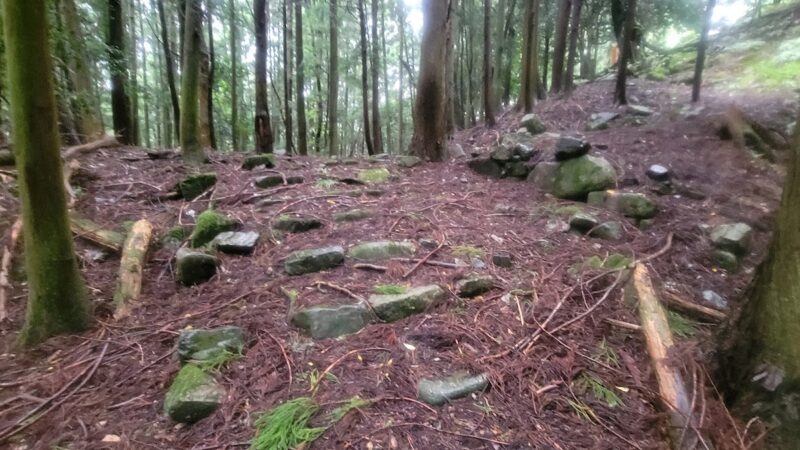
Tanaka Castle has a typical structure for a medieval mountain castle, and many remains are well-preserved. The layout, with defensive facilities arranged in stages from the foot of the mountain to the summit, is valuable material for understanding the castle-building techniques of the Sengoku period.
Main Enclosure (Tenshu Site)
The main enclosure is located at the tip of the ridge extending southeast from the summit at an altitude of 244 meters. The main enclosure is the central part of the castle and is also known as the “Tenshu Ruins.” From here, one can see the Tanaka area and the surrounding plains, and it served as an excellent lookout post.
The main enclosure is relatively compact in size, but the flat surface is well-constructed, suggesting that buildings may have stood there. Traces of earthworks can also be seen around the perimeter, indicating ingenuity in enhancing defensive capabilities.
Enclosures
Multiple enclosures are arranged in a stepped pattern from the main enclosure towards the Tanaka area to the east. These enclosures served to create multiple lines of defense and also functioned as garrison spaces for soldiers. Each enclosure is relatively clearly distinguishable, exhibiting a typical structure of a medieval mountain castle.
There are elevation changes between the enclosures, designed to hinder the advance of attackers. Furthermore, the arrangement of the enclosures cleverly utilizes the terrain, creating a defensive system that takes advantage of the natural slopes.
Earthworks
One of the most distinctive features of Tanaka Castle is its well-preserved earthworks. Earthen ramparts were built around the main enclosure and along the edges of each enclosure, serving as defensive walls. The height of the ramparts varies depending on the location, but many are clearly visible, allowing us to imagine the castle’s appearance at the time of its construction.
In particular, relatively large earthen ramparts remain around the site of the former residences at the foot of the mountain, indicating that considerable effort was put into defending the residential area.
Moats
Several moats dividing the ridge can also be identified. These moats served to prevent enemy intrusion and clearly demarcate the castle grounds. The moats at Tanaka Castle were formed by deeply digging into the ridge, making them important remains demonstrating the defensive techniques of medieval mountain castles.
The depth and width of the moats vary depending on the location, but all are of a sufficient size to function as defensive structures.
Warrior Hiding Places
Facilities called “warrior hiding places” have also been identified within the castle. These are depressions or spaces where soldiers could hide and ambush the enemy, serving as tactical facilities for launching surprise attacks. The warrior hiding places at Tanaka Castle are thought to have been designed to function effectively in conjunction with the layout of the baileys.
Earthen Bridge
Traces of an earthen bridge used to cross the moat remain. This earthen bridge was a bridge-like passage built over the moat and played an important role as a movement route within the castle. During sieges, this earthen bridge became a key defensive point, allowing a small number of soldiers to halt the enemy’s advance.
Remains of Residences at the Foot of the Mountain
In addition to the mountain castle, the remains of residences also remain at the foot of the mountain. Earthen ramparts and flat areas can be seen here, suggesting that it was used as a residence during peacetime. The structure combining a mountain castle and residences at the foot of the mountain is a common form of medieval castle, and Tanaka Castle exhibits a typical example of a medieval castle.
How to Access Tanaka Castle
Here’s how to access Tanaka Castle. Access differs depending on whether you’re using public transportation or a private car, so please check accordingly.
Access by Public Transportation
From JR Kosei Line “Azumigawa Station”
- Get off at JR Kosei Line “Azumigawa Station”
- Use the Azumigawa Station West Area Reserved Shared Taxi (Demand Taxi)
- Get off at the “Kamidera” bus stop
- Approximately 5 minutes on foot to the entrance of the mountain castle
- Approximately 45 minutes on foot from the entrance to the mountain castle to the main enclosure
Notes
- Reserved shared taxis require advance reservations (reservations can be made at Takashima City Hall or its branch offices)
- Allow approximately 90 minutes for the round trip to the mountain castle
- Appropriate clothing and shoes for hiking are required
Rental Bicycle Use
Rental bicycles are available around Azumigawa Station. You can also cycle to the Kamidera settlement and then hike to the castle. However, bicycles cannot be ridden up the mountain castle, so you will need to park your bicycle at the foot of the mountain and hike up.
Access by Private Car
From the Meishin Expressway
- Head north on National Route 161 (Nishi-Omi Road) from Kyoto East Interchange
- Head to Tanaka area, Azumigawa-cho, Takashima City
- Parking space available around the Kamidera settlement (a few cars)
Parking Information
There is no official parking lot, but there are a few parking spaces around the Kamidera settlement. Please avoid street parking and be considerate of local residents.
Precautions When Visiting Tanaka Castle
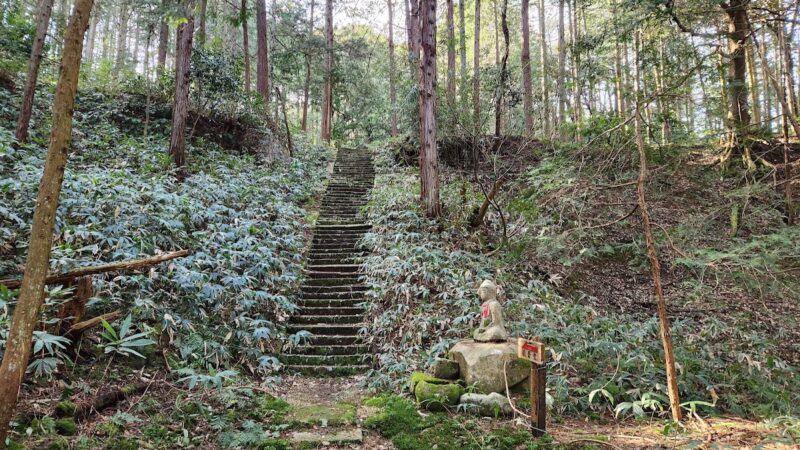
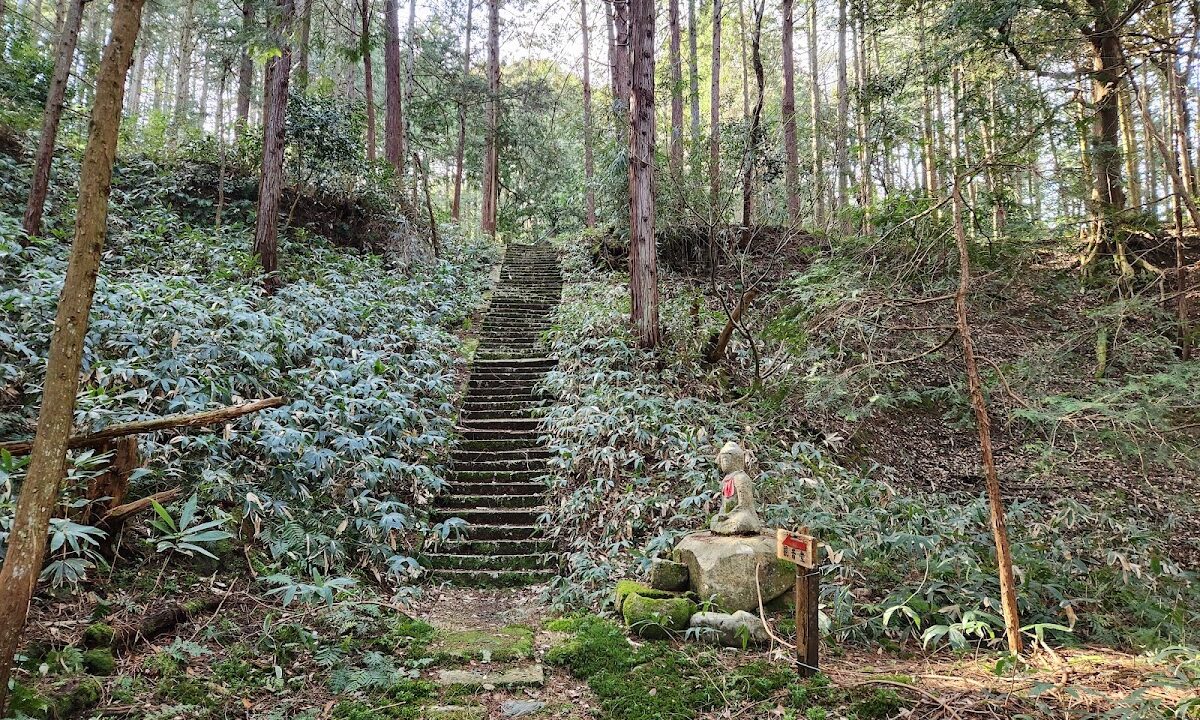
- There is a stone monument to “Tanaka Castle” at the entrance to the castle, and the exploration route is guided from there.
- Information boards and a map of the castle grounds are installed, making it relatively easy to understand even for first-time visitors.
- The mountain path is well-maintained, but it can become slippery after rain, so caution is advised.
- Don’t forget insect repellent in the summer and warm clothing in the winter.
- Be sure to bring drinking water.
- Cell phone reception may be unstable in some areas.
Highlights and How to Enjoy Tanaka Castle
Here are some points we would like you to pay attention to when visiting Tanaka Castle.
Well-Preserved Ruins
The greatest attraction of Tanaka Castle is the almost completely preserved ruins. Earthworks, moats, baileys, and earthen bridges remain clearly visible, allowing you to experience the structure of a medieval mountain castle. By following the information boards, you can understand the location and function of each ruin as you explore.
View from the Main Enclosure
From the main enclosure (site of the castle tower), you can enjoy a panoramic view of the Tanaka area and the plains of the Azumigawa River basin. Imagining the castle lord and soldiers monitoring the surroundings from this spot during the Sengoku period evokes a sense of historical romance. On clear days, you can even see Lake Biwa, making it a spectacular viewpoint.
Following in the Footsteps of Oda Nobunaga and Akechi Mitsuhide
This castle holds special significance for history buffs as it was where Oda Nobunaga stayed in 1570 and where Akechi Mitsuhide first appears in historical records. Tracing Nobunaga’s invasion route of Echizen while reflecting on the situation at the time is also an interesting experience.
Photo Spots
- The “Tanaka Castle” stone monument at the entrance to the castle
- Clearly remaining earthworks
- Deeply excavated moats
- View from the main enclosure
- Three-dimensional landscape created by the elevation changes of the enclosures
These are all suitable spots for photography. Combining the castle with the changing seasons in your photos will result in beautiful pictures of the castle.
Estimated Time Required
- From the entrance to the main enclosure: Approximately 45 minutes one way
- Visiting and resting at the main enclosure: Approximately 20 minutes
- Descending: Approximately 30 minutes
- Total: Approximately 90-120 minutes
Those who want to carefully observe the remains should allow 2 hours or more.
Tourist Spots Around Tanaka Castle
Here are some nearby spots you might want to visit when you come to Tanaka Castle.
Other Castles in Takashima City
Kamo Castle Ruins
The residence of the Aiba clan, one of the seven powerful clans of Takashima. Like Tanaka Castle, it is an interesting castle to compare with other castles of influential local lords in Takashima County.
Kutsuki Castle Ruins
The base of the Kutsuki clan. This area played an important role in the route through Kutsuki during Nobunaga’s retreat from Kanegasaki.
Tourist Attractions Around Adogawa
Michi-no-Eki Toju-no-Sato Adogawa
A roadside station located near JR Adogawa Station. You can purchase local agricultural products and specialty goods. It’s also a convenient rest stop.
Omi Sage Nakae Toju Memorial Museum
A memorial museum showcasing the achievements of Nakae Toju, a Confucian scholar from the Edo period. You can learn about the history and culture of Takashima City.
Around Lake Biwa
Shirahige Shrine
A shrine famous for its torii gate floating on Lake Biwa. A scenic spot also known as “Omi’s Itsukushima.”
Makino Plateau
A plateau resort where you can enjoy nature in all four seasons. The metasequoia tree-lined avenue in autumn is particularly spectacular.
Hot Spring Facilities
Takara-bune Onsen Yumoto Kotobuki
A day-trip hot spring facility located in Adogawa Town. Perfect for relaxing after visiting the castle.
Research and Survey Status of Tanaka Castle
Tanaka Castle has been surveyed by the Takashima City Board of Education, and a layout map has been created. Due to the excellent state of preservation of the remains, it is attracting academic attention as an important case study in the study of medieval mountain castles.
In particular, as a castle related to multiple historical themes such as Oda Nobunaga’s invasion route of Echizen, the early activities of Akechi Mitsuhide, and the power dynamics of the seven Takashima lords, further research is expected.
Regular maintenance activities are carried out by a local history enthusiast group, including maintaining the access roads and installing information boards, creating an environment where visitors can safely enjoy their visit.
Manners and Precautions When Visiting Tanaka Castle
Visitor Manners
- Please be careful not to damage the remains.
- Please take all your trash with you.
- Do not trespass on private property.
- The Kamidera settlement is a residential area. Please be quiet and respectful.
- The use of fire is strictly prohibited.
Safety Precautions
- Avoid climbing the castle alone; if possible, visit with others.
- Be aware of sudden changes in weather; cancel your climb during thunderstorms.
- Watch your step on mountain paths and avoid reckless behavior.
- You may encounter wild animals (wild boars, bears, etc.).
- Take precautions against heatstroke, especially during the summer months, and bring plenty of water.
Best Time to Visit
- Spring (March-May): Beautiful fresh greenery and mild weather, ideal for climbing the castle.
- Autumn (October-November): Enjoy the autumn foliage; cool and easy to walk.
- Summer (June-August): Beware of heat and insects. Early morning visits are recommended.
- Winter (December-February): Climbing the castle is difficult when there is snow. Sunny mornings are best.
Summary
Tanaka Castle in Takashima City, Shiga Prefecture, is a historically significant mountain castle where Oda Nobunaga stayed and where Akechi Mitsuhide first appears in historical records. As the residence of the Tanaka clan, one of the seven powerful families of Takashima, it played a crucial role from the late Kamakura period to the Sengoku period.
The almost perfectly preserved remains, including earthworks, moats, baileys, and warrior hiding places, are invaluable resources for understanding the structure of medieval mountain castles. With a relative elevation of 60 meters, it’s relatively easy to climb, and the well-maintained trails and signposts make it a safe and enjoyable visit even for beginners.
It’s also accessible from JR Azumigawa Station, and there are many other castle ruins and tourist attractions nearby. As part of your historical exploration of the western shore of Lake Biwa, be sure to visit Tanaka Castle. The experience of feeling the spirit of the Sengoku period and tracing the paths walked by Nobunaga and Mitsuhide will surely be an unforgettable memory.
This spot is recommended not only for castle enthusiasts and history buffs, but also for those who enjoy hiking and nature walks. At Tanaka Castle, which displays different expressions in each of the four seasons, you can fully experience the history and nature of Omi.