Complete Guide to Kozutsumi Shiroyama Castle (Yasu City, Shiga Prefecture) | History and Highlights of Konan’s Largest Mountain Castle
What is Kozutsumi Shiroyama Castle?
Kozutsumi Shiroyama Castle is a medieval mountain castle located in Kozutsumi, Yasu City, Shiga Prefecture. Built on the summit of Shiroyama Mountain, 286 meters above sea level, which is part of the northeastern chain of Mount Mikami, this castle is known as the largest mountain castle in the Konan region.
It is believed to have been built by the Nagahara clan, who ruled the Yasu County area as important retainers of the Rokkaku clan, the shugo (military governor) of Omi Province, during the Sengoku period. The remains, including stone walls, moats, and baileys, are well-preserved. Even today, it is preserved as a forest, making it a valuable historical site where you can experience the castle’s structure firsthand.
Basic Information on Kozutsumi-Shiroyama Castle
Location: Kozutsumi, Tsuji-cho, Yasu City, Shiga Prefecture
Elevation: 286 meters
Castle Classification: Mountain Castle
Construction Period: Early to mid-16th century (estimated)
Builder: Nagahara clan (estimated)
Main Lords: Nagahara clan, Sakuma Nobumori (attributed)
Year of Abandonment: Around 1570 (Genki 1)
Remains: Enclosures, stone walls, earthworks, moats, gates
Designated Cultural Property: None
Current Status: Forest
Common Name/Alternate Name
Since there is no clear record of the castle’s name in ancient documents, Kozutsumi-Shiroyama Castle is referred to by combining the regional name “Kozutsumi” and the name of the mountain where it is located, “Shiroyama” (Castle Mountain). Some documents refer to it as “Nagahara-no-kami Castle,” suggesting it may have been called “Upper Castle” in contrast to the Upper Nagahara Castle (Nagahara Castle) located on flat land.
History of Kozutsumi-Shiroyama Castle
Rise of the Nagahara Clan and Castle Construction
The construction of Kozutsumi-Shiroyama Castle is rooted in the expansion of the Nagahara clan’s power during the Sengoku period. Originally, the Nagahara clan were vassals of the Mabuchi clan, who controlled the eastern part of Yasu County. The Mabuchi clan themselves served as retainers of the Sasaki Rokkaku clan, the shugo (military governor) of Omi Province, but in the early 16th century, the Nagahara clan rapidly expanded their power.
Around the Daiei era (1521-1528), the Nagahara clan established a direct lord-vassal relationship with the Rokkaku clan, bypassing the Mabuchi clan, and grew to occupy a central position within the Rokkaku clan’s retainer group. During this period, the Nagahara clan became the central force for military and administrative affairs in Yasu County, and it is believed they built Kozutsumi-Shiroyama Castle to solidify their power base.
Dual Structure of a Plain Residence and a Mountain Castle
The Nagahara clan built Kami-Nagahara Castle (Nagahara Castle) on the plains and used it as their daily residence. On the other hand, Kozutsumi Castle (mountain castle) functioned as a fortified outpost in times of emergency. This dual castle layout, combining a plain castle and a mountain castle, was a common form in Omi Province during the Sengoku period.
The strategy of living in a plain residence with convenient transportation and easy administration during peacetime, and taking refuge in a well-defended mountain castle during wartime, was a rational choice for warlords of the time. The size and robust defensive facilities of Kozutsumi Castle (mountain castle) indicate that the Nagahara clan played a crucial role as the core of the Rokkaku clan’s retainers.
Decline of the Rokkaku Clan and the Invasion of Oda Nobunaga
In 1568, when Oda Nobunaga began his march to Kyoto with Ashikaga Yoshiaki, the Rokkaku clan, the governors of Omi Province, resisted. However, the Rokkaku clan suffered a defeat at the Battle of Kannonji Castle, and their power in southern Omi rapidly declined.
In 1570, Oda Nobunaga’s conquest of Omi intensified, and the Nagahara clan, who had been loyal to the Rokkaku clan, also became a target of attack. It is believed that Kozutsumi-Shiroyama Castle fell during this period. It is also said that Sakuma Nobumori, an Oda general who ruled Yasu District, resided there for a time, but the details are unclear.
Kozutsumi-Shiroyama Castle After its Abandonment
After Oda Nobunaga’s conquest of Omi, Kozutsumi-Shiroyama Castle was abandoned and never used again. The fact that it was left as a forest actually contributed to the preservation of the castle’s remains, and structures such as stone walls and moats remain in good condition today.
Structure and Characteristics of Kozutsumi-Shiroyama Castle
Overall Castle Layout
Kozutsumi-Shiroyama Castle is a large-scale mountain castle with numerous baileys arranged from the mountainside to the ridge, centered around the summit of Shiroyama Mountain (286 meters above sea level). The castle grounds extend approximately 400 meters east-west and 300 meters north-south, making it one of the largest castles in the Konan region.
The castle’s structure is a complex combination of a centripetal arrangement centered on the main bailey at the summit and a linear arrangement along the ridge. This structure created a defensive system capable of responding to attacks from multiple directions.
Main Bailey and Central Bailey Group
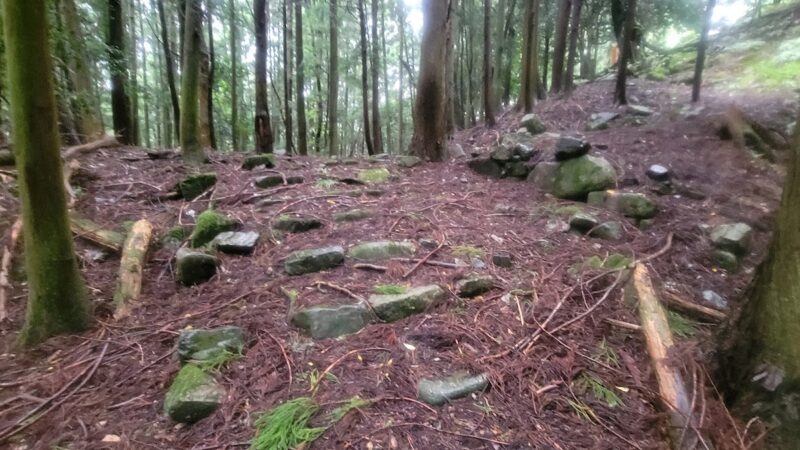
The main bailey (honmaru) is located at the summit, surrounded by multiple baileys. The main bailey is relatively flat, and flat areas believed to be the remains of buildings can be seen. Earthen ramparts surround the main bailey, and the entrance (koguchi) was heavily fortified.
The second and third baileys are located one level below the main enclosure, forming a stepped structure. These baileys work together to form a defensive line, designed to gradually thwart enemy advances.
Features of the Stone Walls
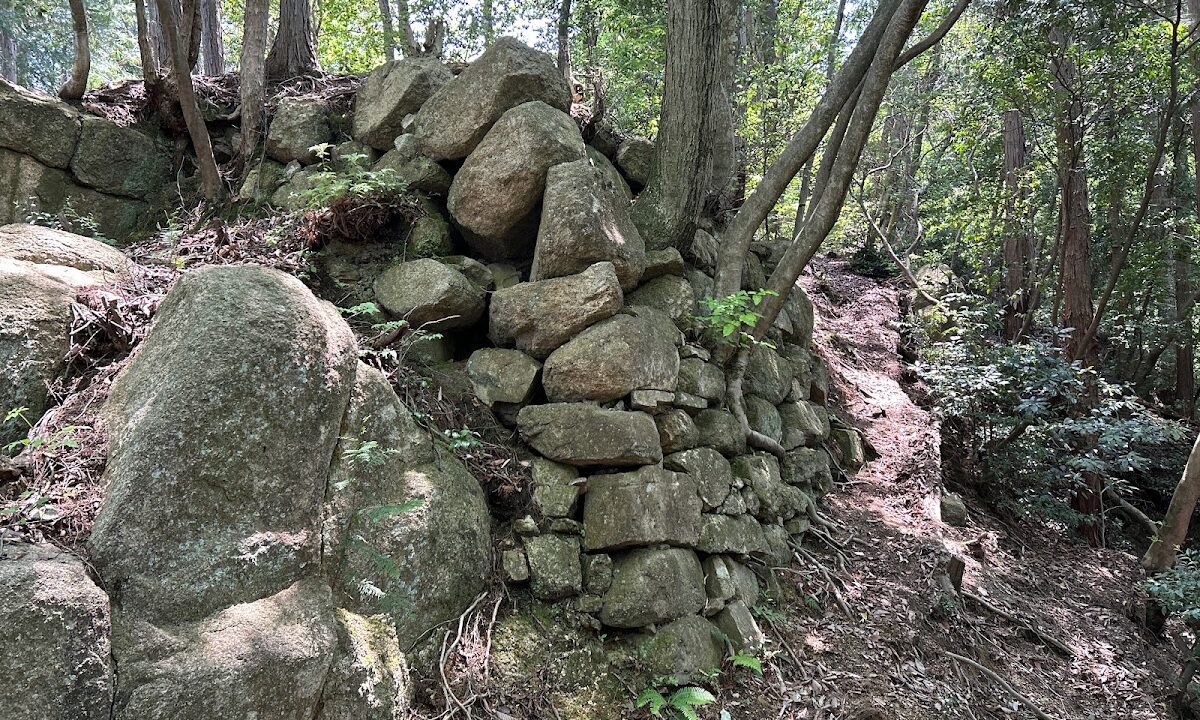
One of the greatest highlights of Kozutsumi-Shiroyama Castle is the stone walls that remain throughout. While stone walls are relatively common in mountain castles in Omi Province, those at Kozutsumi-Shiroyama Castle stand out for their scale and excellent state of preservation.
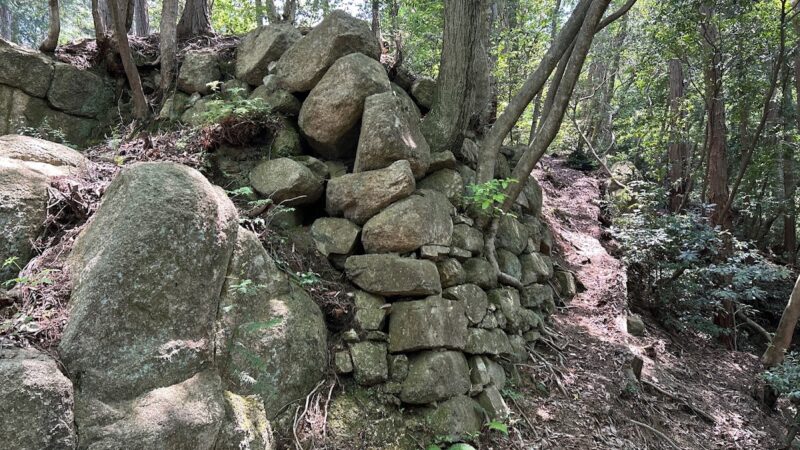
The stone walls are mainly built along the edges of the baileys and around the entrance gates, constructed using the nozurazumi technique, where natural stones are stacked as they are. The stones used are locally sourced granite and andesite, and some sections of the walls exceed 2 meters in height.
The construction techniques of the stone walls reveal the level of castle building technology in Omi Province during the mid-16th century, suggesting that the Nagahara clan possessed considerable economic and technical power.
Moats and Defensive Structures
Moats (horikiri) that cut off the ridgeline are also important defensive structures of Kozutsumi-Shiroyama Castle. In particular, a large moat was constructed on the eastern ridge, reaching a depth of over 5 meters at its deepest point. This moat was designed to prevent enemies from invading along the ridgeline and is known as the “Great Moat.”
Earthworks were built on both sides of the moat, further enhancing its defensive capabilities. Furthermore, vertical moats were dug at the bottom of the moat, providing a drainage function for rainwater. The existence of such sophisticated defensive structures indicates that Kozutsumi-Shiroyama Castle was not merely a temporary fort, but a full-fledged mountain castle designed for long-term sieges.
Entrances and Circulation
Multiple entrances (koguchi) to the castle were provided, and all were heavily fortified. The main gates are fortified on both sides with stone walls, and the winding passageways prevent direct enemy advances, employing a “kuichigai koguchi” (staggered gate) design.
The movement paths between the baileys are also intentionally winding rather than linear, demonstrating ingenuity in providing a defensive advantage. This type of movement plan reflects a design philosophy characteristic of castles from the late Sengoku period.
Remains of Kozutsumi-Shiroyama Castle
Existing Major Remains
The following remains can still be seen at Kozutsumi-Shiroyama Castle:
Baileys (Enclosures): More than 20 baileys have been identified, including the main enclosure. They vary in size, with the main enclosure measuring approximately 30 meters east-west and 20 meters north-south.
Stone Walls: Numerous stone walls remain along the edges of the baileys and around the gates. Well-preserved stone walls can be seen particularly around the main enclosure and the northern group of baileys.
Earthworks: Earthworks remain around the enclosures and on both sides of the moats. Most are about 1-2 meters high, and some are constructed in combination with stone walls.
Moats: Moats are located in all four directions (east, west, north, and south), with the large moat on the east side being particularly impressive.
Vertical Moats: Multiple vertical moats dug into the slopes have been identified, serving both defensive and drainage functions.
Cliffs: Cliffs carved into the steep slopes around the enclosures are visible in various places, making ascent difficult for enemies.
Relationship with Subsidiary Castles
On the eastern ridge of Kozutsumi-Shiroyama Castle lies a subsidiary castle called Iwakura Castle (Kojoyama Castle). Iwakura Castle is said to have originally belonged to the Mabuchi clan, but after the expansion of the Nagahara clan’s power, it is believed to have functioned as a subsidiary castle of Kozutsumi-Shiroyama Castle.
From the summit of Kozutsumi-Shiroyama Castle, following the ridge eastward leads to Iwakura Castle, suggesting that the two castles formed a coordinated defensive system. It is believed that both Kozutsumi-Shiroyama Castle and Iwakura Castle were abandoned during Oda Nobunaga’s invasion.
Access to and Climbing Kozutsumi-Shiroyama Castle
Transportation Access
By Train: The nearest station is JR Biwako Line’s “Yasu Station.” While the straight-line distance from the station is approximately 3.2 kilometers, direct access by public transport is difficult; therefore, a taxi or walking (approximately 1 hour) is recommended.
By Car: Approximately 20 minutes from the Meishin Expressway’s “Ritto IC,” or approximately 25 minutes from the “Ryuo IC.” Access is also possible via a forest road from the direction of Kibogaoka Cultural Park.
Climbing Entrances and Routes
The two main entrances to Kozutsumi-Shiroyama Castle are as follows:
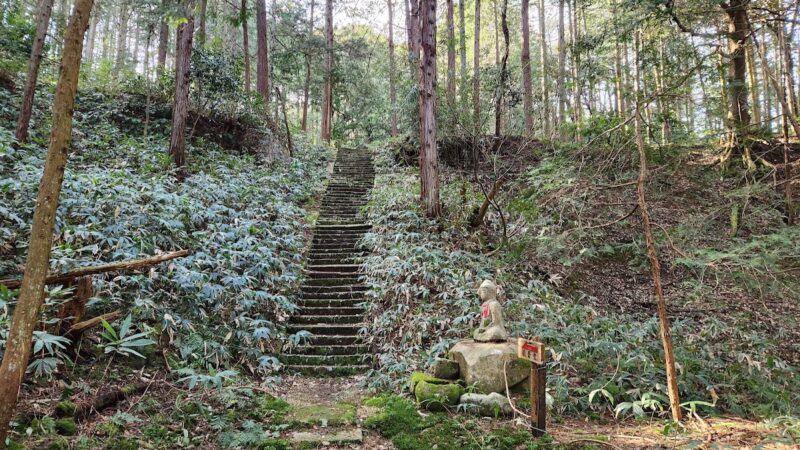
Shiroyama Kakizawa Entrance (Kibogaoka Cultural Park Side): This entrance is located on the south side of Kibogaoka Cultural Park and features a relatively well-maintained hiking trail. Parking is available near the forest road gate (the gate is closed, but pedestrian access is possible).
From this entrance, the “Direct Ascent Course” leads to the summit. While there are some steep sections, the climb takes approximately 30-40 minutes.
North Entrance: Access is also possible from the north side, with signposts to Kozutsumi Shiroyama Castle along the forest road. This route has a relatively gentle slope and is easier for beginners.
Precautions When Visiting the Castle
- As this is a mountain castle, appropriate clothing and shoes for mountain climbing are necessary.
- In summer, please wear long sleeves and long pants to protect against mosquitoes and ticks.
- Please be sure to bring drinking water (there are no water sources on the mountain).
- Be careful as the ground can be slippery during and after rain.
- There is a possibility of snow in winter.
- There are areas where cell phone reception is poor.
- Avoid visiting alone; visiting in groups is recommended.
- Please be careful not to damage the ruins or vegetation.
Highlights of Kozutsumi Castle
View from the Summit
From the summit, at an altitude of 286 meters, you can enjoy a magnificent view overlooking Lake Biwa, the Yasu Plain, and even Mount Hiei in the distance. On clear days, you can see the entire area of Yasu County, which was ruled by the Nagahara clan, and truly appreciate the strategic importance of this castle.
Stone Walls
The stone walls remaining throughout the castle grounds are the greatest highlight of Kozutsumi-Shiroyama Castle. The stone walls around the main enclosure and the northern enclosures are particularly well-preserved, allowing for close observation of 16th-century stonework techniques. The skillful use of natural stones in the nozurazumi (rough stone masonry) technique clearly demonstrates the characteristics of Omi castle culture.
Large Moat
The large moat blocking the eastern ridge boasts a depth of over 5 meters and a width of over 10 meters. This massive moat is a powerful defensive structure that completely blocked incursions along the ridge, demonstrating the high level of civil engineering technology at the time. Viewing it together with the earthworks built on both sides of the moat allows you to truly appreciate its defensive capabilities.
Arrangement of Enclosures
The arrangement of the enclosures, unfolding from the mountaintop to the mountainside, demonstrates the skillful design of Kozutsumi-Shiroyama Castle. Each enclosure is positioned utilizing the elevation differences, creating a structure that allows for mutual support. By exploring the castle’s enclosures and understanding its overall structure, you can gain insight into the castle design philosophy of the Sengoku period.
Related Historical Sites in the Surrounding Area
Kaminagahara Castle (Nagahara Castle)
Located in Nagahara, Yasu City, this is the site of a flatland residence and was the daily residence of the Nagahara clan. As a castle that complements Kozutsumi-Shiroyama Castle, it is an important historical site for understanding the power base of the Nagahara clan. Although residential development is progressing, some remains still exist.
Mount Mikami
A mountain with an elevation of 432 meters, towering southwest of Kozutsumi-Shiroyama Castle, it has long been an object of worship. It has a beautiful shape and is also called “Omi Fuji,” and the inner shrine of Mikami Shrine is located at its summit. Mount Mikami can also be seen from Kozutsumi-Shiroyama Castle.
Kibogaoka Cultural Park
A vast prefectural park adjacent to the north side of Kozutsumi-Shiroyama Castle. Sports facilities, campgrounds, and outdoor activity facilities are available, making it convenient to visit before or after climbing to Kozutsumi-Shiroyama Castle.
Surrounding Castles
Several castles related to the Rokkaku clan exist around Yasushi City, including Hoshigasaki Castle, Nagamitsu-ji Castle, and Hachimanyama Castle. Visiting these castles together provides insight into the castle network in Omi Province during the Sengoku period.
Historical Value of Kozutsumi-Shiroyama Castle
Largest Mountain Castle in the Konan Region
Kozutsumi-Shiroyama Castle holds a significant position as the largest mountain castle in the southern shore region of Lake Biwa. Its scale and the excellent state of preservation of its remains make it a valuable resource for studying the castle culture of Omi Province during the Sengoku period.
Unraveling the Rokkaku Clan’s Power Structure
The existence of Kozutsumi-Shiroyama Castle provides important clues to understanding the power structure of the Rokkaku clan, the shugo (military governor) of Omi Province. The fact that powerful vassals like the Nagahara clan had their own castles indicates that the Rokkaku clan’s rule depended on the military power of their vassals. ### The Development of Stone Wall Technology
The stone walls of Kozutsumi-Shiroyama Castle are an important example of the development of stone wall technology in Omi Province during the 16th century. The techniques of rough-hewn stonework, the selection of stones, and the stacking methods provide insight into the level of castle construction technology at the time.
Transitional Period from Medieval to Early Modern Castles
Kozutsumi-Shiroyama Castle retains characteristics of a medieval mountain castle while also possessing elements of the transitional period to early modern castles, such as the extensive use of stone walls. As a castle from this transitional period, it occupies an important position in the history of Japanese castles.
Preservation and Challenges of Kozutsumi-Shiroyama Castle
Currently, Kozutsumi-Shiroyama Castle is not designated as a cultural property and is privately owned as forest land. Therefore, no organized preservation activities are underway. However, the remains have been relatively well preserved due to the lack of human intervention.
On the other hand, some areas of the remains are being covered by fallen trees and overgrown vegetation, and some measures are needed for long-term preservation. Furthermore, concerns have been raised about the increasing number of visitors, leading to trampling of the ruins and the collapse of the stone walls.
Local castle enthusiasts and history researchers continue their research and information dissemination efforts, working to raise awareness of the historical value of Kozutsumi Castle. In the future, the establishment of an appropriate preservation and management system is desired.
Summary
Kozutsumi Castle in Yasu City, Shiga Prefecture, is the largest mountain castle in the Konan region, built during the Sengoku period by the Nagahara clan, a senior retainer of the Rokkaku clan. The vast castle grounds, spread across a 286-meter-high mountain, retain well-preserved structures such as stone walls, moats, and baileys, making it a valuable historical site where one can experience the structure of a 16th-century castle.
The Nagahara clan began as retainers of the Mabuchi clan and grew to the point of establishing a direct lord-vassal relationship with the Rokkaku clan in the early 16th century. Kozutsumi-Shiroyama Castle was a formidable mountain castle built as a symbol of the Nagahara clan’s power. It formed a stronghold alongside Kaminagahara Castle, a residence on the plains, creating a powerful base for the Nagahara clan.
Although it fell around 1570 during Oda Nobunaga’s invasion of Omi Province and was subsequently abandoned, its remains were preserved because the area was left as a forest. Even today, it retains the appearance of a castle from the Sengoku period.
While climbing requires preparation, the castle offers numerous attractions, including panoramic views from the summit, elaborate stone walls, and massive moats. For those interested in the Sengoku period history of Omi Province and for mountain castle enthusiasts, Kozutsumi-Shiroyama Castle is a must-see historical site.
When visiting Yasu City, be sure to climb Kozutsumi-Shiroyama Castle and experience the charm of this formidable mountain castle built by the Nagahara clan.