Hoshigasaki Castle (Gamo District, Shiga Prefecture): A Complete Guide to its History and Highlights | The Kagami Clan’s Mountain Castle and the Kannonji Incident
Hoshigasaki Castle is a mountain castle spanning Kagami, Ryuo-cho, Gamo District, Shiga Prefecture, and Oshinohara, Yasu City. Built on a ridge extending north from Mount Kagami, it is a Sengoku period castle. Located in a strategic position overlooking the Nakasendo Road, it is known as the residence of the Kagami clan, a branch of the Sasaki clan. This article provides a detailed explanation of Hoshigasaki Castle’s history, highlights of its remains, and access methods.
Basic Information on Hoshigasaki Castle
Hoshigasaki Castle is a mountain castle built on Hoshigamine (approximately 222 meters above sea level), at the northern end of the Kagami Mountain range. Its location near the border of the three districts of Gamo, Yasu, and Koga, and its strategic position allowing for monitoring of traffic on the Nakasendo Road running along the northern foothills, is a major advantage.
Basic Castle Information
- Location: Kagami, Ryuo-cho, Gamo-gun, Shiga Prefecture / Oshinohara, Yasu City
- Other Names: Hoshigasaki Castle, Kagamiyama Castle (as the residence of the Kagami clan)
- Classification/Structure: Mountain Castle
- Builder: Kagami clan (legend)
- Year of Construction: Estimated to be the end of the 15th century (late Muromachi period)
- Main Lords: Kagami clan, Rokkaku Shotei (during the Kannonji Incident)
- Remains: Enclosures, stone walls, vertical moats, gate, earthworks
- Elevation: Approximately 222 meters
- Relative Height: Approximately 100 meters
History of Hoshigasaki Castle
Establishment of the Kagami Clan and Background of Castle Construction
The Kagami clan, who are said to have built Hoshigasaki Castle, were a branch of the Sasaki clan, who served as the shugo (military governor) of Omi Province. The Kagami clan is said to have originated in the early Kamakura period, with Sasaki Sadashige, the second son of Sasaki Sadatsuna, a powerful samurai family. His eldest son, Hisatsuna, ruled Kagami-sho (present-day Kagami area of Ryuo-cho) and adopted the name “Kagami-shi.”
The Kagami clan’s lineage was interrupted during the Jokyu War (1221), but later a branch of the Kyogoku clan inherited the Kagami name and continued until the Sengoku period. The exact construction date of Hoshigasaki Castle is unclear, but it is believed to have been built by the Kagami clan in the late Muromachi period, around the end of the 15th century.
The Kannonji Incident and Rokkaku Shotei
Hoshigasaki Castle first appears on the historical stage during the “Kannonji Incident” of 1563. This incident is known as an internal conflict within the Rokkaku clan, which ruled southern Omi Province, where the vassals revolted against their lord, Rokkaku Yoshikata and his son, Jōtei.
It is said that Rokkaku Jōtei (Yoshiharu), who was driven out of Kannonji Castle, took refuge in Hoshigasaki Castle and resisted opposing forces, including the Nagahara clan of Kozutsumi-Shiroyama Castle. During this period, Hoshigasaki Castle is thought to have functioned as an important base for the Rokkaku clan.
Connection to the Rokkaku Clan
The location and stone wall structure of Hoshigasaki Castle share characteristics with other castles associated with the Rokkaku clan, such as Sasō Castle in Higashiomi City. The use of stone walls only in the main enclosure and its location overlooking the Nakasendō, a major highway, suggest that it may have functioned as part of the Rokkaku clan’s castle network.
Given that the Kagami clan served as important retainers of the Rokkaku clan, Hoshigasaki Castle is also thought to have been an important military base supporting the Rokkaku clan’s rule.
After the Sengoku Period
After the Kannonji Incident, the power of the Rokkaku clan gradually declined, and in 1568, Kannonji Castle fell to Oda Nobunaga’s march to Kyoto. It is presumed that Hoshigasaki Castle was also abandoned around this time, but detailed records do not remain.
Remains and Highlights of Hoshigasaki Castle
Stone Walls of the Main Enclosure
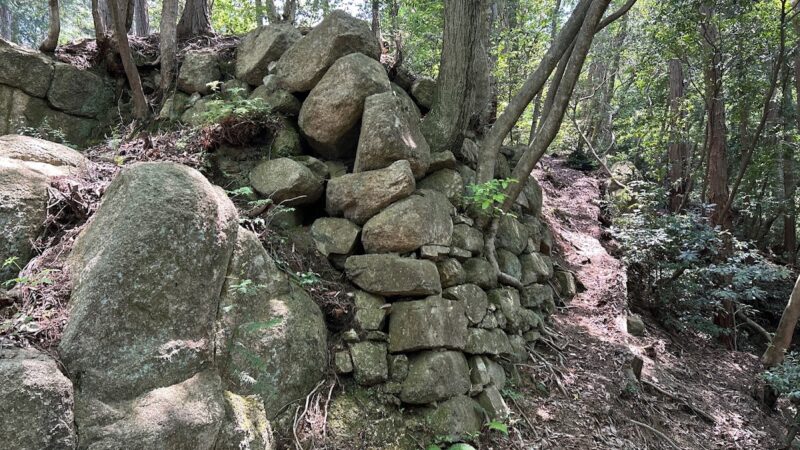
The greatest highlight of Hoshigasaki Castle is the stone wall, over 2 meters high, remaining from the west to the south side of the main enclosure. This stone wall, presumed to have been constructed during the Sengoku period, was built using the nozurazumi technique and is a valuable relic that conveys the castle-building techniques of that time.
The stone wall is a structure skillfully combining natural stones and has withstood years of wind and rain, remaining in good condition. The characteristic of placing the stone wall only in the main enclosure demonstrates the rational castle-building philosophy of the Sengoku period, concentrating limited resources on the most important parts.
Layout of the Enclosures
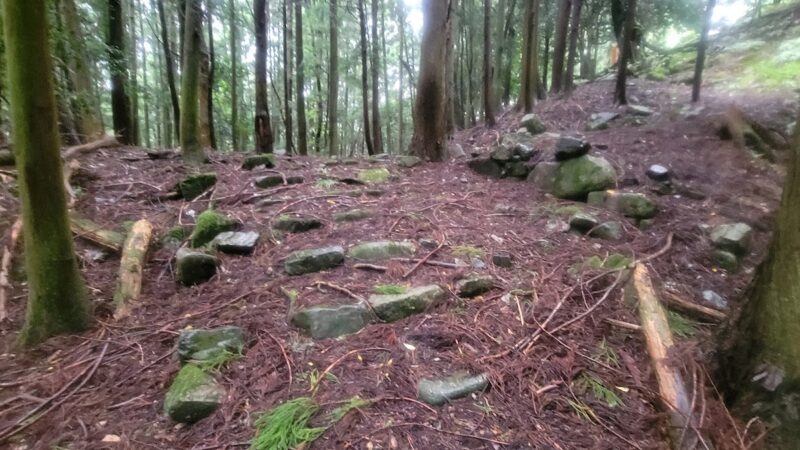
Hoshigasaki Castle has a structure in which multiple enclosures are arranged around the main enclosure at the mountaintop. The main enclosure measures approximately 30 meters east-west and 20 meters north-south, and is surrounded by surrounding terraced enclosures.
Each enclosure is cleverly positioned to utilize the terrain, forming a defensive line along the ridge. A few foundation stones can be seen, indicating the former existence of buildings.
Entrance and Defensive Structures
The entrance to the castle, the gate, is heavily fortified with stone walls and earthworks. Vertical moats are dug around the entrance, demonstrating various measures taken to prevent enemy intrusion.
The vertical moats are trench-like defensive structures dug along the slopes, hindering lateral movement of enemies and efficiently draining rainwater. The vertical moats of Hoshigasaki Castle are well-preserved and are important remains for understanding the defensive system of the time.
Earthworks and Moats
Earthworks were constructed around the main enclosure, enhancing its defensive capabilities. Moats were also built along the ridge, providing protection against attacks from the rear. These defensive structures faithfully adhere to the basic structure of a mountain castle while maximizing the use of the terrain’s characteristics.
Connection to Saikoji Temple Ruins
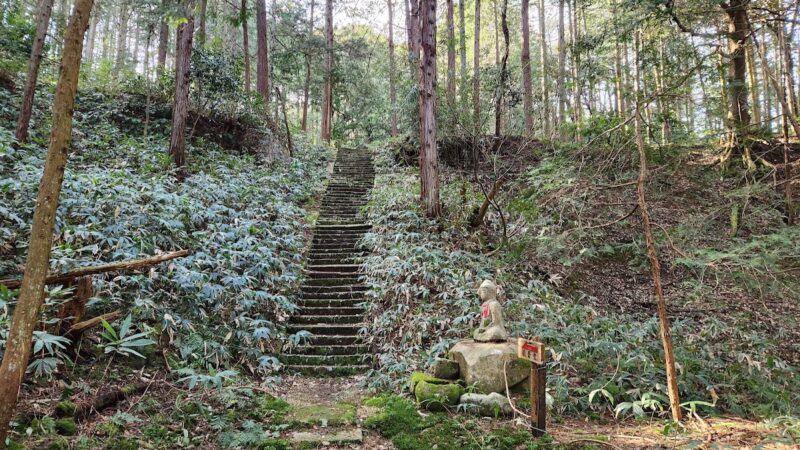
At the western foot of Hoshigamine, there are medieval ruins believed to be the site of Saikoji Temple. These ruins, with their multiple flat areas spreading out in a stepped pattern, indicate the former existence of a mountain temple, and a connection to the castle ruins at the summit has been suggested.
In the medieval period, there are many examples of close relationships between mountain castles and temples. It is thought that there was a reciprocal relationship where temples enhanced the religious authority of castles, while castles militarily protected them. The relationship between Hoshigasaki Castle and Saikoji Temple is an interesting example of this medieval connection between faith and military affairs.
Access to Hoshigasaki Castle
Access by Car
Hoshigasaki Castle ruins are easily accessible by car. It is located approximately 10 minutes from the Ryuo Interchange on the Meishin Expressway, or approximately 15 minutes from the Yokaichi Interchange.
There are a few parking spaces near the entrance to the castle, but you will need to drive on a narrow mountain road, so caution is advised. If accessing from National Route 8, it is best to follow the signs for the Kagami area.
Access by Public Transportation
Take the Omi Railway bus from either Omihachiman Station or Yasu Station on the JR Biwako Line, get off at the Kagami bus stop, and walk for approximately 30 minutes to reach the castle entrance. However, since the number of buses is limited, it is recommended to check the timetable in advance.
Castle Ascent Route and Estimated Time
From the entrance to the main enclosure, it takes about 20-30 minutes to climb the mountain path. The path is relatively well-maintained, but there are steep slopes, so appropriate clothing and shoes for hiking are necessary.
The castle ascent route mainly follows the ridgeline, and you can enjoy views of the Nakasendo Road along the way. On a clear day, you can enjoy views of Lake Biwa, and truly appreciate the castle’s strategic location for monitoring important transportation routes.
Clothing and Equipment Guidelines
When visiting Hoshigasaki Castle Ruins, we recommend preparing the following:
- Shoes: Trekking shoes or athletic shoes (non-slip)
- Clothing: Comfortable long-sleeved shirt and long pants (for insect repellent and injury prevention)
- Items to Bring: Drinking water, towel, insect repellent spray, camera
- Seasonal Attire: Hat and sunscreen in summer, warm clothing in winter
Exploring mountain castles involves walking through nature, so seasonal preparation is crucial. Especially in summer, there are many insects such as mosquitoes and horseflies, so don’t forget insect repellent.
Information on Nearby Spots to Hoshigasaki Castle
Kagami Shrine
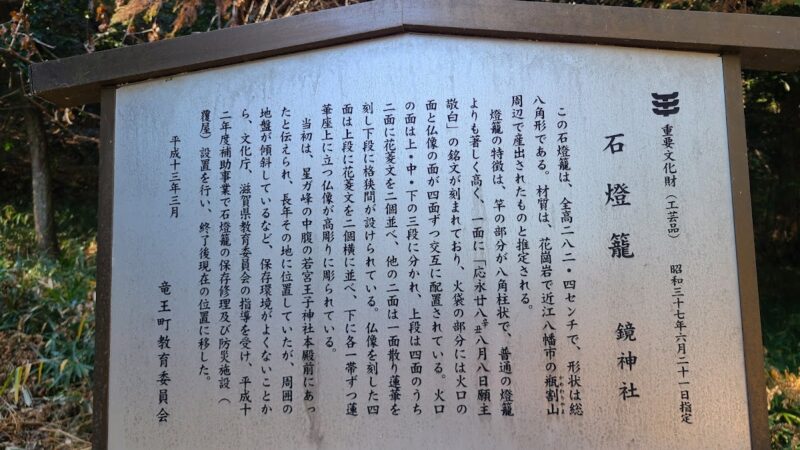
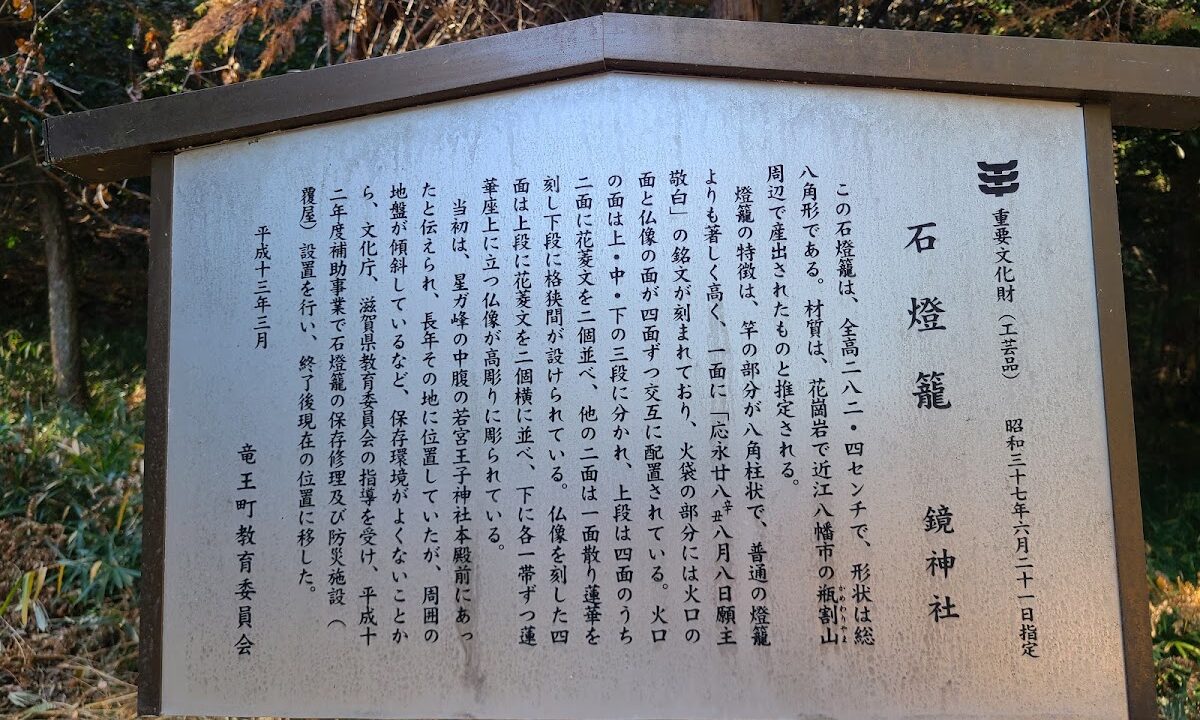
Kagami Shrine, located at the foot of Hoshigasaki Castle, is known as a shrine associated with the Kagami clan. The temple grounds retain old stone monuments and lanterns, allowing visitors to feel the history of this area. It’s a must-visit spot when visiting Hoshigasaki Castle.
Kannonshoji Temple (Kannonji Castle Ruins)
The ruins of Kannonji Castle, the base of the Rokkaku clan, are located approximately 10 kilometers south of Hoshigasaki Castle. It was one of Japan’s largest mountain castles, with well-preserved remains such as stone walls and baileys. Visiting it in conjunction with Hoshigasaki Castle will provide a deeper understanding of the Rokkaku clan’s castle network.
Post Towns on the Nakasendo Road
The Nakasendo Road, which runs along the northern foot of Hoshigasaki Castle, was once dotted with post towns. Even today, buildings and historical sites that retain the atmosphere of that time remain, making it a great place to enjoy a historical walk.
Naemura Shrine
Naemura Shrine, located in Ryuo Town, is an ancient shrine with a National Treasure, the West Main Hall. It is a valuable cultural asset that conveys the architectural style of the Heian period, and is worth visiting in conjunction with a visit to Hoshigasaki Castle.
Historical Significance of Hoshigasaki Castle
A Strategic Point for Monitoring the Nakasendo Road
The most distinctive feature of Hoshigasaki Castle is its location overlooking the Nakasendo Road. The Nakasendo Road is famous as one of the five major highways of the Edo period, but it was also an important transportation route connecting Kyoto and eastern Japan during the Sengoku period.
From Hoshigasaki Castle, the traffic on the Nakasendo Road could be observed, making it a strategically important location for gathering military and economic information. This location is thought to have been a significant advantage for the Kagami clan in maintaining their regional control.
Part of the Rokkaku Clan’s Castle Network
Hoshigasaki Castle functioned as part of the castle network developed by the Rokkaku clan in southern Omi Province. With Kannonji Castle as the core, and surrounded by a group of subsidiary castles, Hoshigasaki Castle is presumed to have played a crucial role in northern defense and monitoring the Nakasendo Road.
The fact that Rokkaku Jōtei based himself at Hoshigasaki Castle during the Kannonji Incident indicates that this castle was not merely the residence of a local lord, but a strategically valuable base for the Rokkaku clan. ### Examples of Sengoku Period Stone Walls
The stone walls of Hoshigasaki Castle are one of the best-preserved examples of Sengoku period stone walls remaining in Shiga Prefecture. The selective use of stone walls, placing them only in the main enclosure, provides important evidence of the castle construction techniques and resource allocation of the time.
Omi Province was a region where castle architecture using stone walls developed early, and the stone walls of Hoshigasaki Castle are situated within this technological lineage. The remains of Hoshigasaki Castle are also valuable for understanding stone wall techniques before the construction of Azuchi Castle by Oda Nobunaga.
How to Enjoy Visiting Hoshigasaki Castle
Points to Observe the Remains
When visiting Hoshigasaki Castle, paying attention to the following points will help you understand the castle’s structure more deeply:
- Stone Wall Construction Method: The stone walls on the west and south sides of the main enclosure are constructed using the “nozurazumi” method, skillfully combining natural stones. Pay attention to the differences in the size and shape of the stones.
- Layout of Enclosures: By examining the movement patterns from the main enclosure to the surrounding enclosures, the castle’s defensive system becomes clear.
- Shape of Vertical Moats: The vertical moats carved into the slopes not only prevented enemy intrusion but also functioned as rainwater drainage channels.
- View: The view from the main enclosure gives a real sense of the castle’s strategic location for monitoring the Nakasendo road.
Recommended Photography Spots
For photography at Hoshigasaki Castle, the following points are recommended:
- Main Enclosure Stone Walls: The morning light is ideal for beautifully capturing the texture of the stone walls.
- View from the Main Enclosure: Photos with the Nakasendo road and surrounding rural landscape in the background convey the importance of the castle’s location.
- Vertical Moats: To capture the impressive defensive features carved into the slopes, it’s best to photograph from a slightly lower position.
- Panoramic View of the Enclosure: A recommended angle is to view the entire area from a position slightly below the main enclosure.
Best Season for Visiting
Hoshigasaki Castle can be visited year-round, but each season offers a different charm:
- Spring (March-May): Beautiful fresh greenery and mild weather make it ideal for visiting the castle.
- Summer (June-August): The dense greenery can make it difficult to see the remains, but the shade of the trees provides coolness. Insect repellent is essential.
- Autumn (September-November): Beautiful autumn foliage, clear air, and excellent views. An ideal season for photography.
- Winter (December-February): The fallen leaves make the remains easier to see, making it the best season for observing the castle’s structure. However, warm clothing is necessary.
Current Status and Challenges of Hoshigasaki Castle Research
Archaeological Excavations and Research
Regarding Hoshigasaki Castle, large-scale archaeological excavations have not been conducted, and historical documents are limited. Therefore, many aspects remain unclear, such as the construction date, changes in castle lords, and the specific usage of the castle.
In recent years, interest in medieval castles in Shiga Prefecture has increased, and surveys and layout investigations are progressing at Hoshigasaki Castle. These studies are gradually clarifying the castle’s structure and its position within the Rokkaku clan’s castle network.
Preservation and Utilization
Preservation activities for the Hoshigasaki Castle ruins are being carried out by local history enthusiasts and castle researchers. While the remains are relatively well-preserved, there are concerns about deterioration due to natural disasters and weathering.
In the future, in parallel with appropriate preservation management, utilization as a historical education and tourist resource is also expected. Creating an environment where visitors can safely view the remains, such as by improving signage and maintaining the access routes, remains a challenge.
Summary
Hoshigasaki Castle is a Sengoku period mountain castle spanning Ryuo-cho and Yasushi-shi in Gamo-gun, Shiga Prefecture. Built as the residence of the Kagami clan, it is a historically significant fortress that served as a base for Rokkaku Shotei during the Kannonji Incident.
Its strategic location overlooking the Nakasendo road, the stone walls exceeding 2 meters in height remaining in the main enclosure, and defensive structures such as baileys and vertical moats make it a valuable historical site that conveys the castle-building techniques of the Sengoku period. Hoshigasaki Castle, which played a part in the Rokkaku clan’s castle network, is indispensable for understanding the Sengoku history of Omi Province.
While access is somewhat inconvenient, the main enclosure can be reached in about 20-30 minutes of hiking from the entrance, making it a highly worthwhile spot for history enthusiasts and castle fans. Why not visit with appropriate equipment and experience the romance of medieval history?
Shiga Prefecture has many remaining medieval castles, including Kannonji Castle. Visiting Hoshigasaki Castle along with the surrounding castle ruins will allow you to gain a deeper understanding of the history of Omi Province during the Sengoku period.