Uchioroshi Castle Complete Guide | History and Highlights of a Sengoku Period Mountain Castle in Takashima City, Shiga Prefecture
Uchioroshi Castle is a Sengoku period mountain castle site located in Katsuno, Takashima City, Shiga Prefecture. Also known as “Omizo Kojō,” it is a typical medieval mountain castle built on the summit of Mt. Uchioroshi (378.7m, some sources say 379m) overlooking Lake Biwa, and continues to fascinate many castle enthusiasts.
This article will comprehensively cover the charm of this mountain castle, from its detailed history and castle structure to how to access it and its highlights.
History of Uchishita Castle | From Hayashi Kazukiyo’s Residence to Oda Nobunaga’s Camp
Construction History and Early Period
There are several theories regarding the construction date of Uchishita Castle, but the most widely accepted theory is that it was built in 1502 (Bunki 2) by Takashima Genba-no-jo. On the other hand, there is also a theory that it was built during the Eiroku era (1558-1570) by Hayashi Kazukiyo (also known as Hayashi Yojizaemon-no-jo).
Takashima County has long been a strategically important transportation hub connecting Kyoto and the Hokuriku region, and also utilized the water transport of Lake Biwa. Uchishita Castle was built as a base for controlling this region, taking advantage of the rugged terrain of Mount Uchishita.
Renovations by the Asai Clan during the Genki Era
During the Genki era (1570-1573), Uchishita Castle came under the control of Asai Nagamasa, a powerful daimyo of northern Omi Province. The Asai clan underwent extensive renovations during this period. Asai’s conflict with Oda Nobunaga deepened, and Uchishita Castle’s importance as a defensive stronghold on the western shore of Lake Biwa increased.
The Asai clan’s renovations are believed to have involved expanding the castle grounds and strengthening defensive structures. Many of the remains visible today are thought to have been formed during this period.
The Entry of Hayashi Kazukiyo and His Time as a Residence
In 1573 (Tensho 1), after the Asai clan was destroyed by Oda Nobunaga, Hayashi Kazukiyo entered Uchishita Castle. Hayashi Kazukiyo was a local lord of Takashima County, maintaining power in the region.
Hayashi Kazukiyo used Uchishita Castle as his base to govern Takashima County and manage the castle’s maintenance. During his rule, Uchishita Castle functioned as the political and military center of the region.
Use of Uchishita Castle as a Camp by Oda Nobunaga
In 1574 (Tensho 2), Uchishita Castle entered the historical stage. According to the “Shinchō Kōki” (Chronicle of Lord Nobunaga), it is recorded that Oda Nobunaga stayed at Uchishita Castle as a camp during his attack on Kido Castle and Tanaka Castle.
During this period, Nobunaga was working to quell the Echizen Ikko-ikki rebellion and expand his power into the Hokuriku region, making Takashima County an important military base. The strong defensive capabilities of Uchishita Castle and its location overlooking Lake Biwa are thought to be the reasons why it was chosen as Nobunaga’s camp.
Construction of Ōmizo Castle and the End of Uchishita Castle’s Role
In 1578 (Tensho 6), Tsuda Nobusumi (Oda Nobusumi), a nephew of Oda Nobunaga, built Ōmizo Castle on the plains along the shores of Lake Biwa. Omizo Castle was designed as a modern castle, intended to function as a political and economic center.
With the construction of Omizo Castle, Uchishita Castle, a mountain castle, ceased to serve its purpose. From then on, Uchishita Castle became known as “Omizo Old Castle” and was abandoned. However, its robust layout and remains have been preserved in good condition to this day.
Layout and Structure of Uchishita Castle
Scale and Arrangement of the Castle Area
Uchishita Castle was built on the summit of Uchishita Mountain (elevation 378.7m), and its castle area is a large-scale mountain castle extending approximately 270m east-west and over 300m north-south. The relative height is approximately 280m, and the difference in elevation from the base to the summit enhances the castle’s defensive capabilities.
The castle is broadly composed of the following three groups of enclosures:
- Central Main Enclosure – The central enclosure located at the highest point
- North Main Enclosure – The main enclosure located north of the Central Main Enclosure
- South Enclosure – The group of enclosures on the south side
These groups of enclosures, while each possessing independent defensive functions, are arranged to cooperate with one another.
Characteristics of the Central Main Enclosure
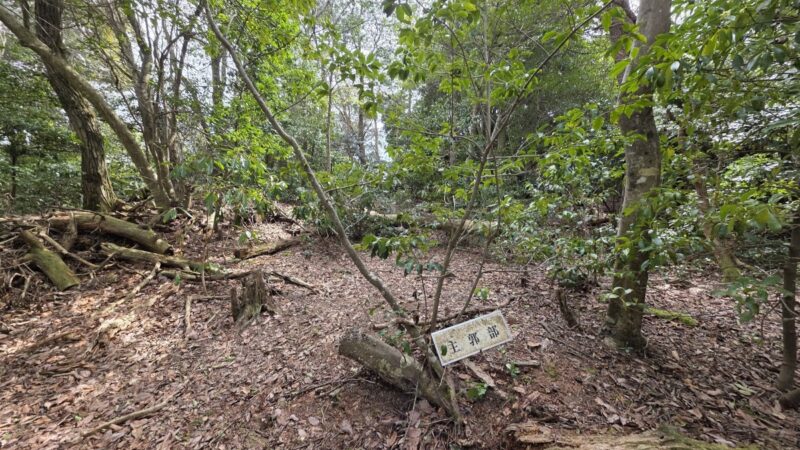
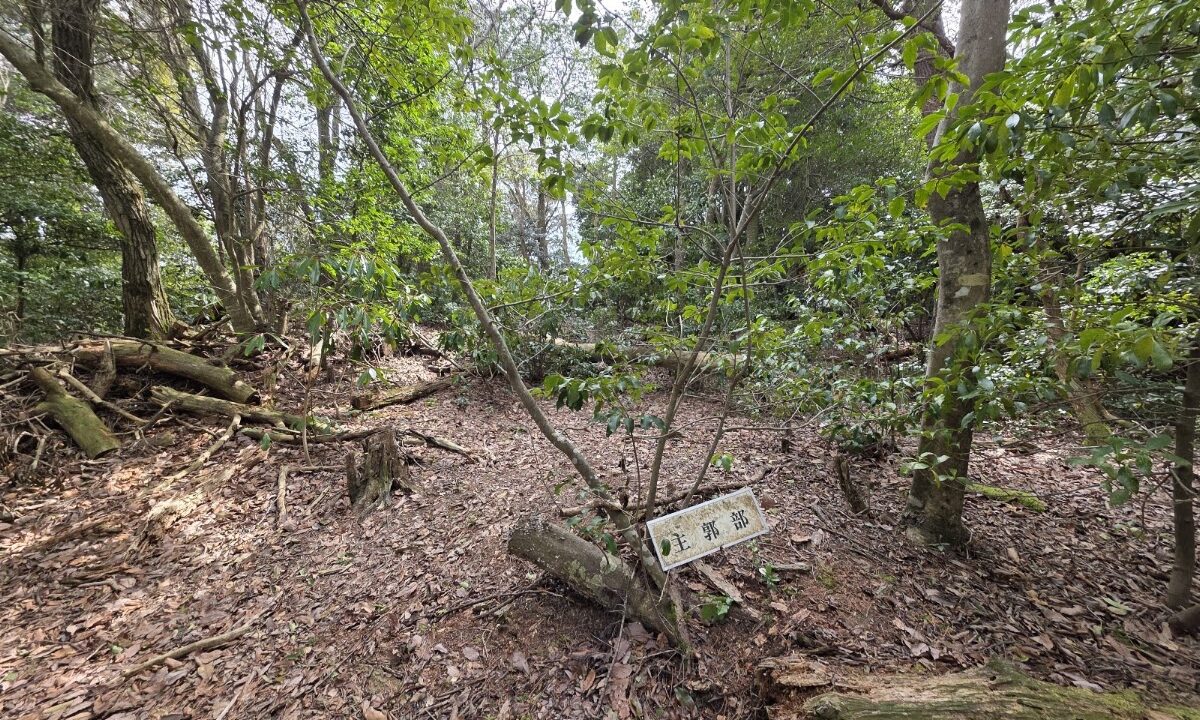
The Central Main Enclosure is located at the highest point of Uchishita Castle and forms the core of the castle. From here, one can see Lake Biwa and the surrounding mountains, indicating its role as a military surveillance point.
The Central Main Enclosure is surrounded by earthen ramparts, and the entrances (koguchi) are cleverly positioned. To prevent enemy intrusion, the entrances are not straight but have a curved structure.
Defensive System Using Moats and Vertical Ditches
The key to the defense of Uchishita Castle lies in its moats and vertical ditches.
Moats are dry moats dug to block the ridge, serving to hinder enemy advances. At Uchishita Castle, multiple moats are positioned between each enclosure, creating a multi-layered defensive system.
Vertical ditches are moats dug vertically along the slope, preventing attacks from the enemy’s flanks and also functioning as rainwater drainage channels. The vertical ditches at Uchishita Castle extend long along the mountain slope, their sheer scale being astonishing.
Remains of Earthworks and Stone Walls
Earthworks remain in good condition throughout the castle. These earthworks served not only as defensive walls but also as foundations for buildings.
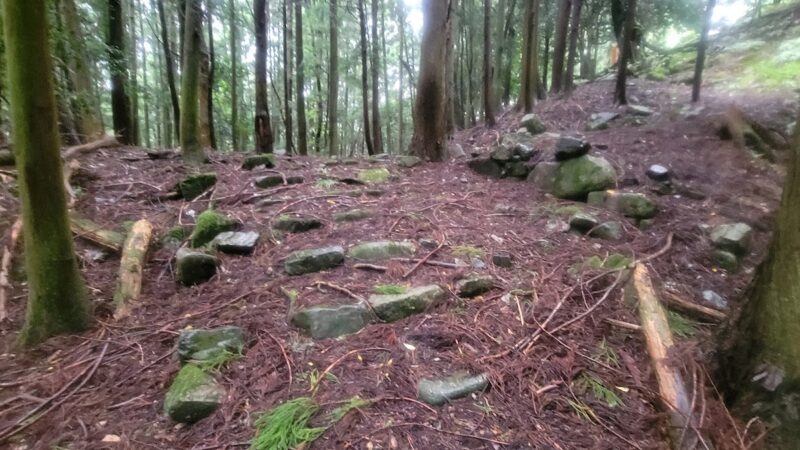
Stone walls (the prototype of stone walls) can also be found in some enclosures. This is a valuable structure that likely appeared during the Asai clan’s renovation period, offering insights into the transitional technology from medieval mountain castles to early modern castles.
Small Enclosures and Defensive Features
Small enclosures are arranged around the main enclosure. These are thought to have been used as lookout posts and soldier’s quarters, playing a role in monitoring approaches to the main enclosure.
The arrangement of the small enclosures is carefully calculated, designed to avoid blind spots. Furthermore, the passages connecting the enclosures have a curved shape, also considering defensive considerations.
Location and Access
Location
Address: Katsuno, Takashima City, Shiga Prefecture
Uchishita Castle Ruins are located in the mountains west of Takashima City’s urban area. Hiyoshi Shrine is located at the foot of the mountain, serving as a landmark for the entrance to the castle.
Access by Public Transportation
The nearest station is JR Kosei Line’s “Omi-Takashima Station.” It’s approximately a 15-20 minute walk from the station to Hiyoshi Shrine. Leaving the station, head southwest and you will arrive at Hiyoshi Shrine after passing through a residential area.
Access by Car
From the Meishin Expressway “Kyoto East IC,” head north on National Route 161 (Nishi-Omi Road) and you will arrive in Takashima City in about an hour. There is some parking space around Hiyoshi Shrine, but please be considerate of other visitors.
Entrance to the Castle and Hiking Trail
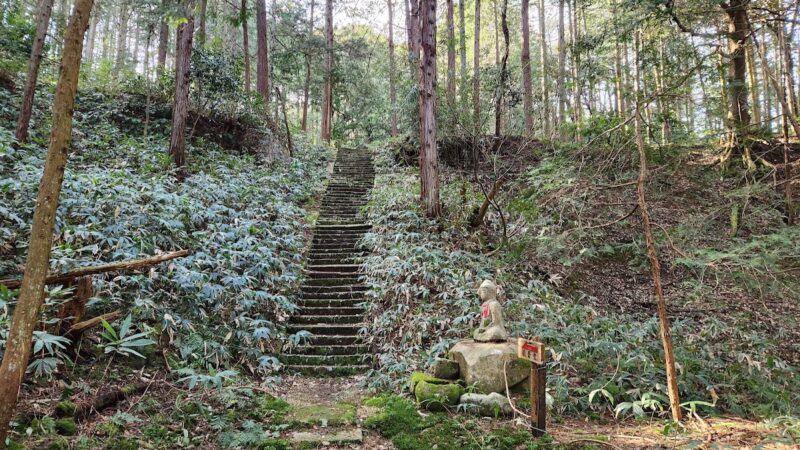
The entrance to the climbing trail is to the left of the torii gate of Hiyoshi Shrine. After walking for a while, you will come to a gate to prevent damage from wild animals. Please be sure to lock the chain after opening it. This is a local rule and is important to prevent wild animals from entering farmland.
The hiking trail is well-maintained as a mountain path, but some sections are steep and narrow. It is especially slippery and dangerous after rain, so we strongly recommend wearing non-slip shoes such as trekking shoes.
Precautions and Equipment for Climbing the Castle
Estimated Time Required
Climbing from the foot of the mountain to the main enclosure at a normal pace takes approximately 40-50 minutes. Including time for sightseeing inside the castle, it is advisable to allow 2 hours 30 minutes to 3 hours round trip.
Recommended Equipment
- Trekking Shoes: Essential due to steep slopes and slippery areas.
- Long-sleeved shirt and long pants: To protect skin from bushes and branches.
- Gloves: Useful for gripping tree branches and rocks.
- Drinking Water: Sufficient hydration is especially important in summer.
- Insect Repellent Spray: Essential from spring to autumn.
- Bear Bell: To avoid encounters with wild animals.
- Map or GPS: To avoid getting lost.
Dangerous Areas and Precautions
There are deep valleys, similar to moats, alongside the hiking trail, and there is a risk of falling if you are not careful. Please pay particular attention to the following points:
- Avoid climbing the castle during or after rain: The ground becomes muddy and extremely slippery.
- Beware of wild animals: You may encounter snakes such as the Japanese rat snake (Elaphe climacophora), wild boars, deer, etc.
- Avoid climbing alone: It is recommended to climb the castle in groups if possible.
- Descend before sunset: Nighttime activities in the mountains are dangerous.
- Beware of fallen trees and branches: There are especially many fallen trees after typhoons.
Highlights and ways to enjoy Uchishita Castle
Spectacular views of Lake Biwa
The view from the central enclosure is one of the greatest highlights of Uchishita Castle. On a clear day, the vast surface of Lake Biwa stretches out below, and you can also see Mount Hiei and the Hira mountain range on the opposite shore. Seeing this view, you will understand why this area was a strategically important location.
Well-Preserved Remains
Uchishita Castle escaped development after its abandonment, so its Sengoku period layout remains almost entirely intact. The following remains are particularly worth seeing:
- Clear Moats: Multiple moats remain in excellent condition, their scale being truly impressive.
- Long Vertical Moats: The long vertical moats running along the slopes demonstrate the advanced civil engineering techniques of the Sengoku period.
- Earthworks: The earthworks surrounding each enclosure are tall, clearly demonstrating their function as defensive structures.
- Structure of the Gate: The cleverly designed gates reveal the castle’s defensive philosophy.
Experiencing Historical Romance
One way to enjoy this castle, where Oda Nobunaga actually set up camp, is to reflect on the Sengoku period. Standing in the very spot where Nobunaga likely gazed upon Lake Biwa and devised his strategies, you can experience a sense of oneness with history.
Photography Tips
For those taking photos of castles, the following points are recommended:
- Angles that emphasize the depth of the moat: Express the power of the castle by looking up from the bottom of the moat.
- Enclosures with Lake Biwa in the background: Photos that combine the castle with the scenery.
- Lines of the earthworks: The beautiful curves of the earthworks surrounding the enclosures.
- Length of the vertical moat: The overall view of the vertical moat along the slope.
Places to visit in conjunction with nearby attractions
Omizo Castle Ruins
The ruins of Omizo Castle, built as a “successor” to Uchishita Castle, are also a place you should definitely visit. Although it is now an urban area, some remains of stone walls and moats remain. By comparing the transition from mountain castles to flatland castles, you can learn about the history of castle development.
Hiyoshi Shrine
Hiyoshi Shrine, which serves as the entrance to the castle, is a historical shrine with a charming atmosphere. It is a good idea to visit before or after climbing the castle.
Other Castle Ruins in Takashima City
Besides Uchishita Castle, Takashima City has many other castle ruins, including Chōhōji Castle, Tanaka Castle, and Kido Castle. If you have time, visiting these castle ruins will give you a deeper understanding of the Sengoku period history of Takashima County.
Sightseeing Around Lake Biwa
Takashima City is located on the western shore of Lake Biwa and boasts beautiful lakeside scenery and tourist attractions such as Shirahige Shrine (famous for its torii gate in the lake). You can enjoy the nature and culture of Lake Biwa along with your castle visits.
Historical Value and Modern Significance of Uchishita Castle
Importance in the Study of Sengoku Period Mountain Castles
Uchishita Castle holds an important position in castle research as a typical example of a Sengoku period mountain castle. Traces of renovations by the Asai clan and its history as a military encampment used by Oda Nobunaga provide valuable information for studying the military history of this era.
Value as a Regional Historical Heritage Site
For Takashima City, Uchishita Castle is an important cultural asset that tells the story of the region’s history. Its value is being re-evaluated by local history enthusiasts and educators, and preservation activities are underway.
Potential as a Tourism Resource
With the recent castle boom, mountain castles like Uchishita Castle are attracting attention. With proper maintenance and information dissemination, it has the potential to become a hub for historical tourism.
Seasonal Advice for Visiting Uchishita Castle
Spring (March-May)
This is a beautiful season with fresh greenery, and is suitable for hiking. However, it is also a time when snakes and other insects are more active, so caution is advised.
Summer (June-August)
This season offers lush greenery and beautiful views of Lake Biwa, but the heat and insects are a drawback. Early morning visits are recommended. Don’t forget to stay hydrated and take insect repellent measures.
Autumn (September-November)
This is the most suitable season for visiting the castle. The autumn foliage is beautiful, and the temperature is ideal for hiking. October and November are especially recommended due to the generally stable weather.
Winter (December-February)
While the air is clear and the views are excellent, there is a risk of snow and ice. Winter climbing is recommended for experienced hikers and requires adequate equipment.
Summary | Uchishita Castle: A Valuable Mountain Castle Where You Can Feel the Spirit of the Sengoku Period
Uchishita Castle is a representative Sengoku period mountain castle in Takashima City, Shiga Prefecture, with a history as the residence of Hayashi Kazuyoshi and later used as a camp by Oda Nobunaga. Built on Uchishita Mountain at an altitude of 378.7m, the vast castle grounds retain well-preserved defensive structures from the Sengoku period, including moats, vertical trenches, earthworks, and gatehouses.
Climbing the castle requires considerable physical strength and equipment, but the castle ruins are well worth the effort. The breathtaking view of Lake Biwa from the central enclosure, the numerous clearly preserved ruins, and the scenery that Oda Nobunaga must have seen—it’s impossible not to reflect on the Sengoku period.
When you visit Shiga Prefecture, be sure to stop by Uchishita Castle. An unforgettable experience awaits you, where historical romance and natural beauty merge. However, please be sure to take sufficient safety precautions and wear appropriate equipment when climbing the castle.
Uchishita Castle is a must-see spot for castle enthusiasts, where you can fully appreciate the charm of a mountain castle from the Sengoku period.