Tachioka Castle (Watarai-cho, Watarai-gun, Mie Prefecture) – A Thorough Explanation of the History and Remains of a Hill Castle in Ise Province
What is Tachioka Castle?
Tachioka Castle is a medieval hill castle located in the back of Ike, Tachioka, Watarai-cho, Watarai-gun, Mie Prefecture. Built on a hill 67m above sea level and approximately 30m above sea level, this castle functioned as a base for regional control in Ise Province. Even today, the remains of earthworks, baileys, moats, and wells are well-preserved, attracting attention from castle researchers and history enthusiasts.
Tachioka Castle was built on the southern side of a hilltop extending eastward from the western mountain range, making maximum use of the terrain suitable for defense. It is an important historical site indispensable to the history of Watarai-cho and a valuable legacy that conveys the castle culture of Ise Province to the present day.
Historical Background of Tachioka Castle
The Position of Tachioka Castle in Ise Province
Ise Province has held a special status since ancient times as the location of the Ise Grand Shrine, but in the Middle Ages, it also came under the control of samurai forces. The Watari district, where Tachioka Castle was built, was the base of the Watari clan, priests of the Outer Shrine of Ise Grand Shrine, and was a religiously and politically important region.
Tachioka Castle is thought to have functioned as the residence of a local lord in this region. During the Sengoku period, various forces, such as the Kitabatake clan and Oda Nobunaga’s invasion of Ise, fought over Ise Province, and Tachioka Castle was likely tossed about by the waves of history.
Construction Period and Lord
While there are no clear historical records regarding the exact construction period of Tachioka Castle, based on the form and scale of the remains, it is estimated to have been built sometime between the late Muromachi period and the Sengoku period.
While many details about the castle’s lord remain unclear, the place name suggests a possible connection to the Tachioka clan. Furthermore, its location relative to other castles in Watarai County suggests it was a castle with the characteristics of a residence built by a minor local lord.
History of the Castle’s Abandonment
There are no clear records of when Tachioka Castle was abandoned, but many small castles were abandoned during Oda Nobunaga’s conquest of Ise Province in the Tensho era (1573-1592) and the subsequent establishment of Toyotomi Hideyoshi’s unified government. It is presumed that Tachioka Castle also ceased to function during this period.
By the Edo period, it had already been abandoned, and the castle site remained as a forest. Therefore, it escaped later development, and the remains have been preserved in good condition to this day.
Structure and Layout of Tachioka Castle
Characteristics of the Main Enclosure (Honmaru)
The main enclosure (Honmaru), the center of Tachioka Castle, is located at the highest point of the hill. This relatively flat enclosure is thought to have housed the lord’s residence and command post. Earthen ramparts surrounded the main enclosure, enhancing its defensive capabilities.
The main enclosure offered a panoramic view of the surrounding area, allowing for early detection of approaching enemies. This excellent visibility is one of the key features of Tachioka Castle as a hilltop castle.
Enclosure Layout
Tachioka Castle features three large, stepped enclosures arranged southward from the main enclosure. This stepped layout cleverly utilizes the hilly terrain, creating a structure that progressively prevents enemy incursions.
Each enclosure is clearly demarcated by steep slopes, and it is presumed that entrances (koguchi) were provided for movement between enclosures. This multi-tiered layout is typical of medieval castles, indicating that Tachioka Castle was built systematically.
Earthen Ramp Remains
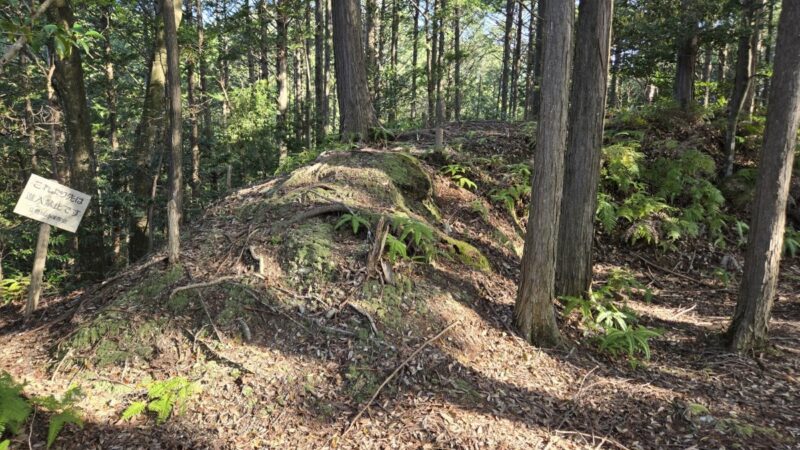
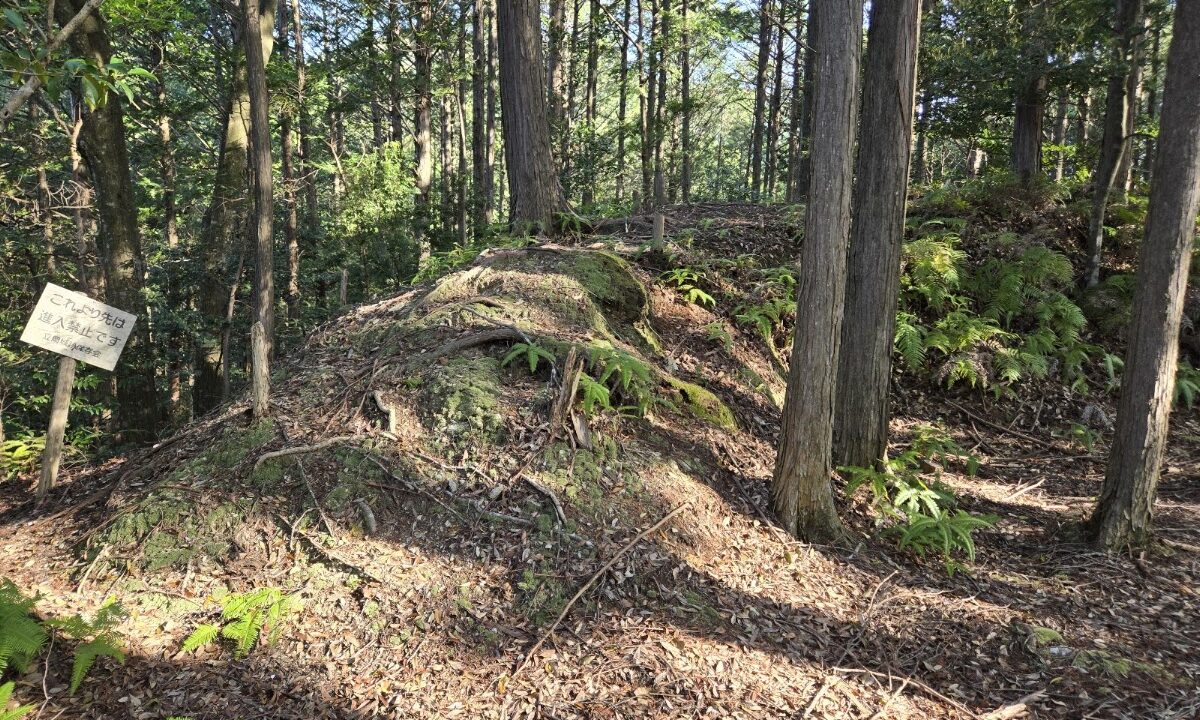
One of the best-preserved remains at Tachioka Castle is the earthen ramparts. Traces of earthen ramparts can be found in multiple enclosures, centered around the main enclosure. Earthen ramparts served to prevent enemy intrusion and also functioned as a defensive barrier against arrows and stones.
While the existing ramparts are only about 1-2 meters high, they were likely higher when the castle was built, and may have had fences or walls on top. The shape and arrangement of the ramparts provide valuable insights into the castle’s defensive plan.
Moat Structure
Remains of dry moats can be found at Tachioka Castle. Moats were important defensive structures that demarcated baileys and physically prevented enemy intrusion. Clear traces of the moats can still be observed in some areas.
Because it was difficult to construct water moats in mountain castles and hill castles, dry moats were used at Tachioka Castle. The depth and width of the moats offer insights into the castle construction techniques and defensive strategies of the time.
Well Remains
Well remains have also been confirmed within the castle grounds. Securing a water source in preparation for a siege was essential for a castle, and wells were dug at Tachioka Castle.
The presence of the well indicates that this castle was not merely a watchtower, but a full-fledged fortress capable of withstanding a siege for a considerable period. Even today, the well remains can be seen as a depression, making it an important historical site that tells the story of life within the castle.
Highlights of Tachioka Castle
Well-Preserved Ruins
The greatest highlight of Tachioka Castle is undoubtedly its well-preserved ruins. Basic elements of a castle, such as earthworks, baileys, moats, and wells, are compactly preserved, making it an excellent resource for understanding the structure of a medieval castle.
Because it has not been subjected to later development, the topography remains almost exactly as it was at the time of its construction, making it a valuable exploration spot for castle enthusiasts.
Views from the Hill
From the hilltop where the main bailey is located, you can enjoy a panoramic view of Watari Town. The former lords of the castle must have also enjoyed this view while surveying their territory.
Especially on a clear day, you can see the surrounding mountains and settlements, giving you a real sense of how strategically this castle was built.
The Atmosphere of the Castle Ruins, Integrated with Nature
The Tateoka Castle ruins now stand quietly amidst the forest. The remains, surrounded by trees, exude a unique atmosphere where nature and history harmonize.
One of its charms is the opportunity to stroll through the castle ruins while enjoying the changing seasons—fresh greenery in spring, vibrant autumn leaves in fall. It’s a worthwhile spot to visit, offering both historical exploration and nature walks.
Access to Tateoka Castle
Location
Address: Ikeno-oku, Tateoka, Watarai-cho, Watarai-gun, Mie Prefecture
Tateoka Castle is located in a mountainous area slightly away from the center of Watarai-cho. While public transportation access is somewhat inconvenient, it’s relatively easy to reach by car.
Access by Car
The nearest interchange is the Tamaki Interchange on the Ise Expressway. From the interchange, it takes approximately 20 minutes via National Route 23 and prefectural roads to reach the Tateoka area.
There is no dedicated parking lot around the castle ruins, but you will need to park in a wide area on the roadside and approach on foot. Please park respectfully and avoid inconveniencing local residents.
Access by Public Transportation
The nearest stations are Tamaru Station or Miyagawa Station on the JR Sangū Line, but both stations are quite far from the castle ruins, making walking impractical.
Bus routes are also limited, so if you are using public transportation, you should consider taking a taxi.
Ascent Route
The castle ruins are accessed by climbing a mountain path. Since there is no clearly defined hiking trail, we recommend wearing comfortable clothing and shoes.
The ascent takes approximately 15-20 minutes from the foot of the mountain. Because some sections of the path are unclear, it is advisable to prepare a topographic map or GPS device beforehand.
Notes for Visitors
Tachioka Castle Ruins are not a developed tourist facility, but rather remains preserved within a mountain forest. Please observe the following points during your visit:
- Watch your step as there are slippery areas.
- Take insect repellent measures during the summer.
- Be aware of wild animals such as bears and wild boars.
- Always take your trash with you.
- Be careful not to damage the ruins.
- Avoid visiting alone; travel in groups.
Nearby Tourist Attractions
Historical and Cultural Facilities of Watarai Town
Besides Tachioka Castle, Watarai Town has many other historical sites. The town also boasts numerous old shrines and temples, allowing visitors to experience the history of Ise faith.
The Watarai Town Local History Museum features exhibits on local history and culture, including information about castles in the town, such as Tachioka Castle.
Nearby Castles
Many castle ruins remain in Watarai County and the surrounding areas besides Tachioka Castle.
Tamaru Castle is a hilltop castle located in Tamaki Town, Watarai County, and is a full-fledged castle with remaining stone walls and a castle tower base. In contrast to Tachioka Castle, it possesses characteristics of a modern castle, making it an interesting spot for comparing the history of castle development.
Nagahara Castle and Iwade Castle are also medieval castles located within Watarai County. Visiting them together with Tachioka Castle will help you understand the castle network in this region.
Ise Grand Shrine
Ise Grand Shrine, one of Japan’s most representative shrines, is located about 30 minutes by car from Watarai Town. The Outer Shrine (Toyouke Daijingu) is a shrine associated with the Watarai clan and is a place deeply relevant to considering the history of Tachioka Castle.
A recommended historical exploration route is to visit Ise Grand Shrine and then tour the surrounding castles.
Nature of the Miyagawa River
The Miyagawa River, which flows through Watarai Town, is a clear stream often called “the most beautiful river in Japan.” Enjoying the nature along the Miyagawa River between castle explorations is also a good idea.
Cultural Property Designation Status of Tachioka Castle
Currently, Tachioka Castle is not designated as a cultural property by the national, prefectural, or town governments. However, given the good state of preservation of the remains, there is a possibility of cultural property designation depending on future investigations and evaluations.
Castles that have not received cultural property designation are at risk of being lost due to development, so it is important to preserve them as valuable historical heritage of the region.
Current Status and Challenges of Tachioka Castle Research
Previous Research
While Tachioka Castle has been surveyed and documented by castle researchers, a full-scale academic investigation has not been conducted. If the remains are surveyed and excavated, it is possible that more detailed information about the castle’s structure and history will be revealed.
Photographs and records taken by castle enthusiasts are accumulating, and information is now being shared online.
Future Challenges
There are several challenges to the preservation and utilization of Tachioka Castle.
First, the preservation of the remains. Because it is located in a forest, there is a risk of natural collapse, requiring regular patrols and necessary conservation measures.
Second, improving access. Currently, visiting is difficult, so the development of an environment that allows for safe viewing is desirable. However, excessive commercialization could lead to the destruction of historical remains, so balance is crucial.
Furthermore, raising awareness of its historical value is also a challenge. Educational activities to inform local residents and tourists about the value of Tachioka Castle, as well as the installation of information boards, would be effective.
Tachioka Castle and the Castle Culture of Ise Province
Characteristics of Castles in Ise Province
Numerous castles were built in Ise Province, but most were small mountain or hill castles. This is related to the unique political situation of Ise as the location of the Grand Shrine, resulting in relatively few large-scale wars.
Tachioka Castle is a typical example of such castles in Ise Province, a small to medium-sized castle that functioned as a base for regional control. Its layout, centered on earthworks and moats rather than stone walls, represents the basic form of a medieval castle.
Castle Network of Watari District
In addition to Tachioka Castle, several other castle sites have been confirmed within Watari District. It is believed that these castles cooperated with each other to form a regional defense system. The location of Tachioka Castle is ideal for monitoring the Miyagawa River basin and managing transportation routes connecting the inland and coastal areas, suggesting it played a crucial role within the regional network.
Recommendation for Visiting Tachioka Castle
Message to Castle Enthusiasts
Tachioka Castle may not be flashy, but it’s an excellent site for learning the fundamentals of medieval castles. The earthworks, baileys, and moats are compactly arranged, allowing for practical learning of castle layout.
Unlike famous, tourist-oriented castles, its quiet atmosphere, allowing for a peaceful contemplation of history, is also a major draw. It’s a recommended spot not only for experienced castle explorers but also for those just starting out.
Photography Tips
Here are some photography tips for visiting Tachioka Castle.
The earthworks of the main bailey are the easiest to photograph. Shooting from the side to emphasize the lines of the earthworks is effective.
For the moat remains, shooting from an angle looking up from the bottom of the moat effectively conveys its depth and scale.
The view from the main enclosure is a must-see for photography. It offers a valuable opportunity to relive the perspective of the former castle lord.
Estimated Visit Time
Visiting Tachioka Castle, including the ascent and observation of the remains, takes approximately one hour. If you plan to carefully observe the remains and enjoy photography, allow 1.5 to 2 hours.
If you combine this with other nearby castles, it’s possible to visit 3 to 4 castles in one day.
Summary
Tachioka Castle is a medieval hill castle located in Watarai-cho, Watarai-gun, Mie Prefecture. It stands on a hill 67 meters above sea level with a relative height of 30 meters. The remains, including earthworks, enclosures, moats, and wells, are well-preserved, making it a valuable historical site that conveys the castle culture of Ise Province.
While many aspects of the castle lord and construction date remain unknown, it is believed to have functioned as a regional power base from the late Muromachi period to the Sengoku period. The layout of Tateoka Castle, with its three-tiered enclosures arranged south of the main keep, exhibits a typical structure of a medieval castle.
Currently, Tateoka Castle ruins stand quietly amidst the forest and are not a developed tourist facility, but this is precisely why it is a place where you can feel the atmosphere of the time. Access is somewhat inconvenient, but it is a worthwhile spot for castle enthusiasts.
When visiting Watari Town, be sure to visit Tateoka Castle. You will be able to fully appreciate the history of Ise Province and the charm of a medieval castle. Furthermore, visiting nearby castles such as Tamaru Castle, Nagahara Castle, and Iwade Castle will allow you to gain a deeper understanding of the castle network in this region.
Tateoka Castle is a valuable historical heritage site of the region that should be properly preserved and passed on to future generations. It is important for each of us to take an interest in history and cherish such castles.