Maruyama Castle (Iga City, Mie Prefecture) Complete Guide | The Full Picture of the Medieval Mountain Castle that Was the Stage of the Tensho Iga Rebellion
What is Maruyama Castle?
Maruyama Castle is a medieval mountain castle site located in Hijikigawa, Iga City, Mie Prefecture. Situated almost in the center of the Iga Basin, this castle, built on an isolated hill at an altitude of 180-210 meters, is known as a historically important fortress that was the starting point of the Tensho Iga Rebellion.
It is highly regarded as one of the best-preserved medieval castles in Mie Prefecture, and its castle grounds extend approximately 380-400 meters east-west and 420-450 meters north-south, making it one of the largest mountain castles in the Iga region. Even today, the remains of baileys, keep bases, earthworks, turret bases, and moats remain clearly visible, making it a valuable historical site where you can experience the structure of a Sengoku period castle.
Basic Information on Maruyama Castle
Location: Sakata, Shimokanbe, Hijikigawa, Iga City, Mie Prefecture
Castle Structure: Hill Castle (Mountain Castle)
Elevation: Approximately 210 meters
Relative Height: Approximately 30-40 meters
Year of Construction: Details unknown (believed to be the Muromachi period), renovated by the Oda clan in 1578 (Tensho 6)
Builder: Honda clan (initial), Takigawa Katsutoshi (during renovation)
Main Lords: Honda clan, Takigawa Katsutoshi, Iga local lords
Year of Abandonment: Around 1581 (Tensho 9)
Remains: Enclosures, keep base, earthworks, turret base, moat, earthen bridge, gate
Designated Cultural Property: Not designated
History and Development of Maruyama Castle
Established in the Muromachi Period
The exact construction date of Maruyama Castle is unknown, but it is believed to have been built during the Muromachi period by the local powerful Honda clan. Throughout the medieval period, Iga Province suffered from weak shugo (provincial governor) control, and autonomous territorial rule was practiced by local samurai (kokujinshu). Maruyama Castle is thought to have functioned as one of the bases of these Iga local samurai.
Its location in the center of the Iga Basin gave it a strategic position, controlling a key transportation hub within Iga Province, and it played an important role as a base for controlling the surrounding region.
Renovation in 1578 and Resistance from the Iga Local Lords
Maruyama Castle first appears on the historical stage in 1578. In that year, Oda Nobukatsu (the second son of Oda Nobunaga), who had been adopted into the Kitabatake clan and was known as Kitabatake Nobuoki, attempted to incorporate Iga Province into his territory.
Nobuo ordered his senior retainer, Takigawa Katsutoshi (also known as Takigawa Saburobei), to begin repair and expansion work on Maruyama Castle. This was an attempt to establish a military base to place Iga Province under the direct control of the Oda family. However, the local samurai of Iga, who had maintained their independence and autonomy for many years, strongly opposed this rule by an external force.
First Tensho Iga Rebellion (1579)
In 1579 (Tensho 7), the local samurai of Iga united and attacked Maruyama Castle. The still-unfinished Maruyama Castle fell under the fierce attack of the Iga samurai, and it is said that Takigawa Katsutoshi was killed in action. This incident marked the beginning of the “First Tensho Iga Rebellion.”
Oda Nobuo attempted to invade Iga, but suffered a crushing defeat due to the guerrilla resistance of the Iga samurai, who made use of the terrain. This defeat was a humiliating one for the Oda family and incurred the wrath of Oda Nobunaga, Nobuo’s father.
Second Tensho Iga Rebellion (1581)
In 1581 (Tensho 9), Oda Nobunaga personally took command and mobilized a large army to launch a full-scale invasion of Iga Province. This was the “Second Tensho Iga Rebellion.”
From the Ise Road, the forces of the commander-in-chief, Kitabatake Nobuo (Oda Nobuo), advanced, and the area around Maruyama Castle became the scene of fierce fighting. The Oda army surrounded Iga Province from all sides, and with overwhelming force, they subdued the Iga local lords. In this battle, the entire Iga region was reduced to ashes, and many residents and monks were killed. Iga Province suffered a devastating blow and came under the control of the Oda family.
Maruyama Castle was also abandoned and was never rebuilt.
Historical Significance of the Tensho Iga Rebellion
The Tensho Iga Rebellion was a crucial chapter in the process of the Oda regime’s unification of Japan. The victory of the Iga local lords in the first rebellion is particularly noteworthy as an example demonstrating the effectiveness of tactics that leveraged the unity of the local community and its geographical advantages.
On the other hand, the Oda army’s thorough annihilation strategy in the second rebellion served as a deterrent to resistance forces and symbolized the ruthlessness of the Oda regime. Maruyama Castle, as a fortress at the heart of this historical turning point, occupies a significant position in the political and military history of the late Sengoku period.
Structure of Maruyama Castle
Overall Layout and Fortifications
Maruyama Castle is a large-scale mountain castle utilizing an entire isolated hill, with its castle grounds extending approximately 380-400 meters east-west and 420-450 meters north-south. This scale is among the largest in the Iga region, suggesting the Oda’s intention to create a large-scale military base.
The castle’s layout features numerous baileys (enclosures) of varying sizes, strategically placed along the ridge of the hill, cleverly utilizing the natural terrain to enhance its defensive capabilities. The baileys are separated by earthen ramparts and trenches, demonstrating numerous measures to prevent enemy intrusion.
Main Enclosure (Honmaru) and Keep Base
The main enclosure, the heart of the castle, is a large, flat area located at the highest point of the hill. Within this enclosure is a raised, square earthen platform, believed to be the keep base.
The keep base measures approximately 12 meters square at the top, 5 meters high, and 12 meters wide at the base, and remains clearly visible today. Stone materials are scattered around the keep base, suggesting it was originally constructed as a stone wall. This is considered evidence that the Oda clan attempted to incorporate elements of modern castles during renovations in the Tensho period.
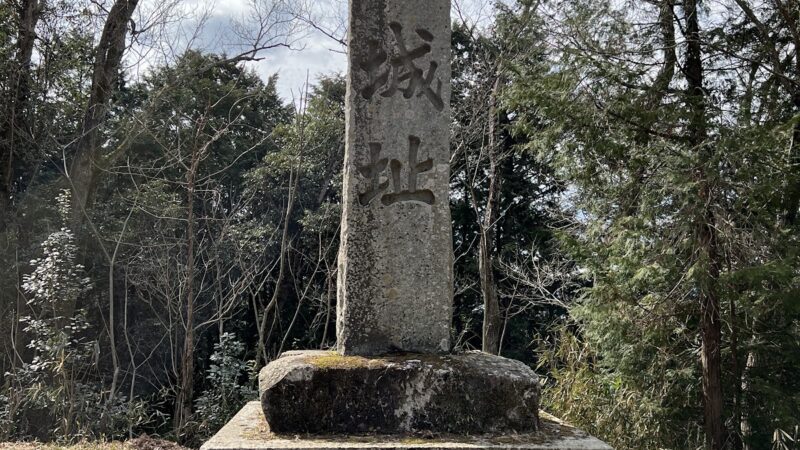
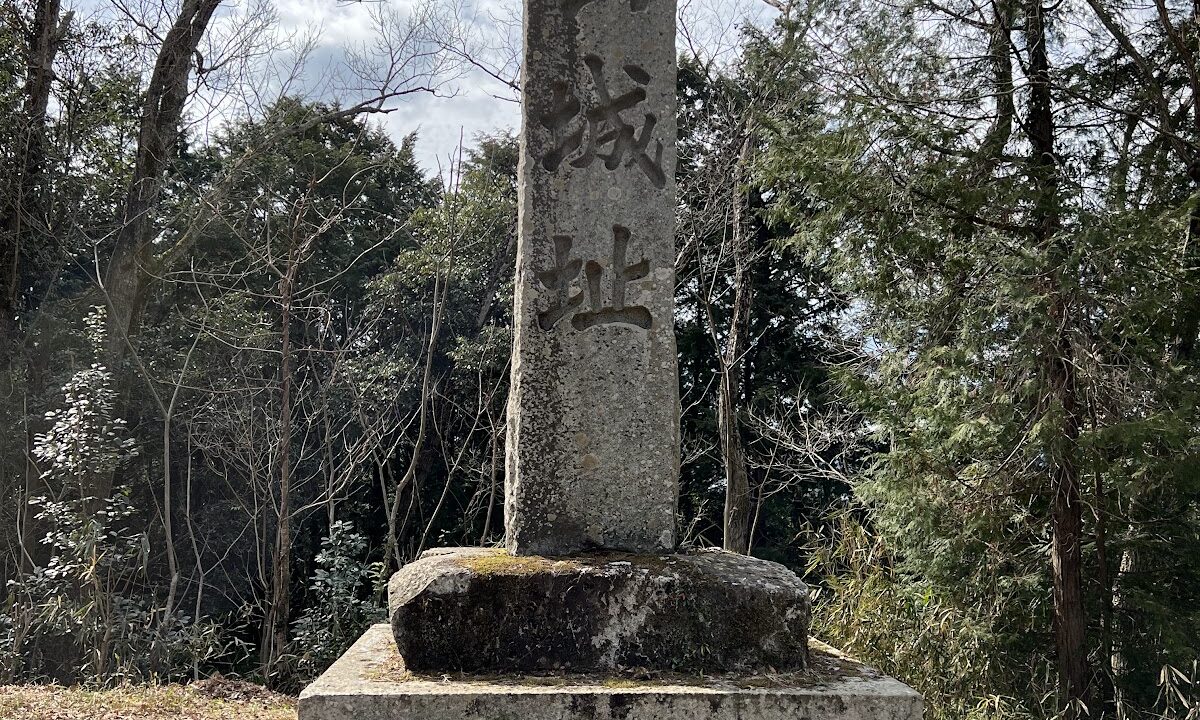
A stone monument to Maruyama Castle currently stands in the main enclosure, serving as a landmark for visitors.
Arrangement of the Enclosures
The main enclosure is at the center, surrounded by multiple enclosures arranged in a stepped pattern. These enclosures are thought to have served to defend the main enclosure, as well as for stationing soldiers and storing supplies.
Each enclosure has a relatively large, flat surface, indicating a design that prioritizes practical combat functionality. The size and arrangement of the enclosures suggest a structure capable of accommodating a considerable number of troops.
Earthworks and Moats
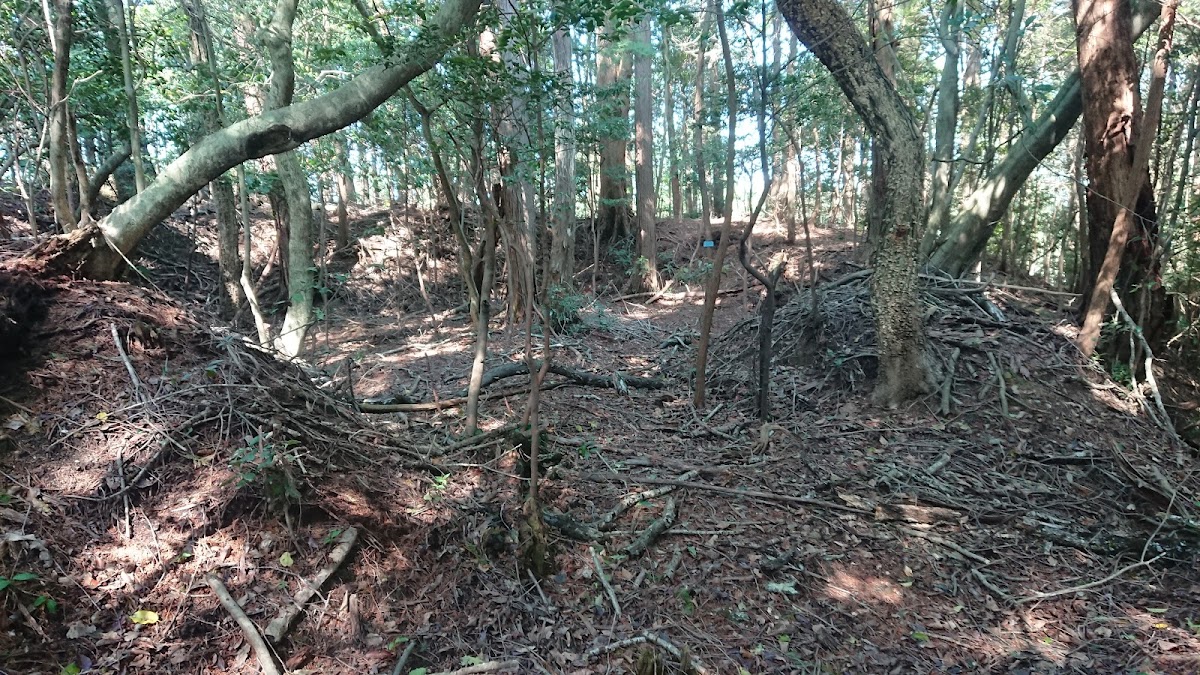
Earthworks surround the enclosures, enhancing their defensive capabilities. These earthworks still remain today, several meters high, demonstrating the advanced castle-building techniques of the time.
Moats, cut across the ridges, are crucial defensive structures that blocked enemy incursions. Multiple moats have been identified at Maruyama Castle, particularly strategically positioned to heavily defend the approach to the main enclosure.
Enclosures and Earthen Bridges
The entrances to the castle, known as “koguchi,” are one of the most important defensive structures. At Maruyama Castle, a fortified entrance (koguchi) was constructed at the entrance to the bailey, allowing for attacks from the flanks.
An earthen bridge crossing a moat also remains, functioning as a strategically important defensive point. The earthen bridge limited enemy advances to a single line, creating a strategic advantage for the defenders.
Turret Bases
Several turret bases have been identified within the castle grounds. These bases were platforms for constructing watchtowers and attack towers, crucial for monitoring the surroundings and detecting enemy movements early.
Assessment of Preservation
Maruyama Castle is highly regarded as one of the best-preserved medieval castles in Mie Prefecture. Despite approximately 440 years having passed since its abandonment, its major remains are clearly visible, making it a valuable historical site for studying the structure of medieval mountain castles.
Having escaped recent development, the castle from the Sengoku period has been preserved almost entirely intact, attracting attention from castle researchers and enthusiasts.
How to Access Maruyama Castle
Access by Train
Nearest Station: Iga Railway Iga Line “Kamibayashi Station” or “Maruyama Station”
- From Kamibayashi Station: Approximately 10-15 minutes on foot to the castle entrance. Head south from the station, and after passing through the village, you will see a sign for the castle entrance.
- From Maruyama Station: Approximately 15-20 minutes on foot.
The Iga Railway Iga Line is a local line connecting Ueno-shi Station and Iga-Kambe Station, both in the center of Iga City. Ueno-shi Station can be reached on foot from JR Kansai Main Line “Iga-Ueno Station” (approximately 5 minutes).
Access by Car
Access from Major Roads:
- Approximately 10-15 minutes from the Meihan Expressway “Ueno IC”
- Approximately 15 minutes from the Meihan Expressway “Nakase IC”
Car Navigation Settings: Searching for “Maruyama Community Center” or “Shimokobe, Iga City, Mie Prefecture” is convenient.
Parking Information
The entrance to the castle is on the south side, near the village. You can use the parking lot of the Maruyama Community Center (Shimokobe Public Hall). There are several parking spaces, but please be mindful of proper etiquette as it is a public facility.
Parking Address: Sakata, Shimokobe, Iga City, Mie Prefecture
Castle Ascent Route
The entrance to the castle is a short walk from the parking lot. There are signs at the entrance, so you won’t get lost.
As you proceed into the mountains, you will first arrive at a small enclosure with a shrine. Continuing further will lead you to the main enclosure. The path to the castle is relatively well-maintained, but since it is a mountain trail, we recommend the following equipment and preparations:
- Footwear: Trekking shoes or athletic shoes (non-slip)
- Clothing: Long-sleeved shirt and long pants (for protection against vegetation and insects)
- Items to bring: Drinking water, towel, insect repellent (summer)
- Estimated time: Approximately 15-20 minutes on foot from the entrance to the main enclosure; 1-1.5 hours including sightseeing
Precautions for Visiting
- The castle ruins are not a developed tourist attraction, but a preserved historical site. Please be careful not to damage the remains.
- Please take all your trash with you.
- In summer, vegetation is overgrown, so be careful of snakes and other animals.
- During rainy weather or after rain, the ground can be slippery, so please refrain from visiting or exercise extreme caution.
- In winter, the sun sets early, so please allow ample time for your visit.
Highlights of Maruyama Castle
Scattered Stones from the Keep Base
Stones are scattered around the keep base in the main enclosure. These are valuable traces indicating that the castle was originally constructed with stone walls. It suggests that during the renovations by the Oda clan in the Tensho era, modern castle-style stone wall construction techniques were being introduced.
Based on the arrangement and scale of the stones, if a full-fledged stone wall had been completed, it would have been a groundbreaking castle in the Iga region. However, because the castle fell before completion due to attacks by the Iga local lords, these stone walls never saw completion.
Clearly Preserved Enclosures
The greatest highlight of Maruyama Castle is its well-preserved enclosures. Looking out over the surrounding enclosures from the main enclosure, one can truly appreciate the structure of a Sengoku period castle.
By observing the flat surfaces of each enclosure, the elevation differences between enclosures, and the arrangement of earthworks, one can understand the defensive measures and the considerations for troop deployment.
Moats and Earthen Bridges
Moats cutting across ridges are a typical defensive feature of medieval mountain castles. The moats at Maruyama Castle are large and deep, demonstrating their high defensive effectiveness.
Imagine the disadvantage of crossing an earthen bridge. Forced to advance in a single file across the narrow bridge, the attackers would be subjected to concentrated attacks from both sides.
Views of the Iga Basin
From the main enclosure, you can enjoy a panoramic view of the Iga Basin. On a clear day, you can see the surrounding mountains and the city of Iga, truly appreciating the castle’s central location in Iga.
This view is also important for understanding the castle’s strategic value. Its location, allowing for surveillance and early detection of enemy movements, was one of the reasons it was chosen as a military base.
Attractions Around Maruyama Castle
Iga Ueno Castle
Located about 15 minutes by car from Maruyama Castle, Iga Ueno Castle is a modern castle built by Todo Takatora. It is known for its exceptionally high stone walls, and a (replica) keep has also been constructed. Comparing it to Maruyama Castle, highlighting the differences in era, would be interesting.
Iga-ryu Ninja Museum
Iga City is famous as the home of ninjas. At the Iga-ryu Ninja Museum, you can learn about the history and techniques of ninjas. There are also exhibits on the relationship between the Tensho Iga Rebellion and ninjas, and visiting in conjunction with a visit to Maruyama Castle will deepen your understanding.
Danjiri Hall
This facility exhibits the danjiri floats used in the “Ueno Tenjin Festival,” a traditional event of Iga Ueno. It is worth visiting to learn about Iga’s culture.
Former Sugikodo Hall
The building of the domain school established by the Tsu Domain during the Edo period is preserved here. It is a valuable historical site for learning about Iga’s history.
Fun Facts for Visiting Maruyama Castle
To Deepen Your Understanding of the Tensho Iga Rebellion
Before visiting Maruyama Castle, studying the Tensho Iga Rebellion beforehand will greatly enhance your experience. Keep the following points in mind:
- The Self-Governing System of the Iga Provincial Lords: Iga was under weak control by the shugo (provincial governor), and local samurai exercised self-governance through “Sōkoku Ikki” (national uprisings).
- Oda Nobuo’s Ambition: Nobuo, who succeeded the Kitabatake family, sought to expand his power by bringing Iga under his control.
- The Impact of the First Rebellion: The Iga provincial lords’ repelling of the Oda army was a remarkable event at the time.
- The Tragedy of the Second Rebellion: Iga suffered devastating damage from Oda Nobunaga’s full-scale invasion.
Photography Tips
When visiting Maruyama Castle, be sure to enjoy taking photos:
- Castle Tower Base: Taking a photo of the stone monument and castle tower base together makes for a memorable picture.
- Row of Enclosures: An angle overlooking the group of enclosures from a high vantage point is recommended.
- Moat: Taking a photo from an angle that emphasizes its depth will create a powerful image.
- View: The view of the Iga Basin from the main enclosure is spectacular.
Using Castle Touring Apps
Using castle touring apps such as “Nippon Castle Tour” and “Kojodan” allows you to record your visit and refer to information from other visitors. Maruyama Castle is registered on both apps, and reviews and photos have been posted.
Cultural Value of Maruyama Castle
While Maruyama Castle is not currently designated as a national or prefectural cultural property, its historical and academic value is highly regarded.
Historical Value
Maruyama Castle is a first-class historical site, having been the center of the Tensho Iga Rebellion, a crucial historical event at the end of the Sengoku period. It is a valuable archaeological site that tells the story of the conflicts with regional forces during the Oda regime’s process of unifying Japan.
Archaeological Value
The well-preserved remains are important resources for studying the structure and construction techniques of medieval mountain castles. In particular, the presence of stonework that shows the transitional period from medieval to early modern castles is attracting attention in castle history research.
Future Preservation and Utilization
Efforts to preserve and utilize Maruyama Castle continue by local residents and castle enthusiasts. It is hoped that in the future, it will become known to more people and be properly preserved.
Summary
Maruyama Castle is an important castle that was the stage for the historical event of the Tensho Iga Rebellion. Located in the center of the Iga Basin in Iga City, Mie Prefecture, its well-preserved remains captivate visitors.
The fierce battles between Oda Nobuo and the Iga local lords, the tragedy of its unfinished fall, and the Second Tensho Iga Rebellion that reduced all of Iga to ashes—a visit to Maruyama Castle allows you to feel the tense history of the late Sengoku period firsthand.
The remains of the castle, such as the baileys, keep base, earthworks, and moats, convey the castle-building techniques and strategies of the time. It’s accessible on foot from Kamibayashi Station on the Iga Railway, and parking is available at the Maruyama Community Center.
Maruyama Castle is a must-see historical site for history buffs, castle enthusiasts, and anyone interested in the history of Iga. Visiting it along with Iga Ueno Castle and the Ninja Museum will allow you to gain a deeper understanding of Iga’s history.
Prepare your mountain castle hiking gear and visit Maruyama Castle. A valuable experience of feeling the spirit of the Sengoku period awaits you.