Asahiyama Castle, Nagano City, Nagano Prefecture: The Complete Picture of the Mountain Castle that Was the Stage of the Second Battle of Kawanakajima
Table of Contents
- Overview of Asahiyama Castle
- History and Construction Background of Asahiyama Castle
- The Second Battle of Kawanakajima and Asahiyama Castle
- Structure and Layout of Asahiyama Castle
- Details of Existing Remains
- Related Sub-Castles to Asahiyama Castle
- Relationship with the Third and Fourth Battles of Kawanakajima
- Access and Climbing Route to Asahiyama Castle
- Surrounding Historical Spots
- Highlights and Points to Note When Visiting Asahiyama Castle
Overview of Asahiyama Castle
Asahiyama Castle is a mountain castle built on the summit of Mt. Asahiyama, at an altitude of 785 meters, located in Hirashiba, Nagano City, Nagano Prefecture. Also known as Asahiyama Castle, it holds a significant place in the history of Japanese castles as the site of fierce battles between Takeda Shingen and Uesugi Kenshin (Nagao Kagetora) during the Sengoku period.
Asahiyama, towering west of the Nagano Prefectural Government building, is a strategically important location overlooking the Zenkoji Plain and was a key base in the struggle between the two powerful figures for control of the Kawanakajima region. Asahiyama Castle was not a single castle, but rather a complex defensive system consisting of three fortresses: the main castle (Asahiyama Castle) on the mountaintop, Daikoku Castle (Asahi Castle) on the mountainside, and Koshibami Castle at the tip of the ridge.
Even today, remnants such as moats, trenches, and baileys remain well-preserved on the mountaintop and ridge, allowing us to imagine what a mountain castle looked like during the Sengoku period. Furthermore, the Asahiyama Kannon-do Hall stands on the mountainside, and has long been cherished by worshippers praying for success in exams and business prosperity, known as “Asahiyama’s Kannon-sama.”
History and Construction Background of Asahiyama Castle
Construction Period and Early History
The exact construction date of Asahiyama Castle is unclear, but the first mention in historical records is said to be Tenbun 24 (1555). However, its origins as a castle are even older; it is believed that some kind of fortification already existed around the time of the Ōtō Battle, that is, in the first half of the 15th century.
Tradition remains that in the early Sengoku period, a general named Asahi Ukon, who belonged to the Murakami clan, a powerful local lord of northern Shinano, defended Asahiyama Castle. At that time, Asahiyama Castle functioned as a branch castle of the Kurita clan, who held the position of head priest of Zenkōji Temple.
Takeda Shingen’s Advance into Northern Shinano
In 1553 (Tenbun 22), Takeda Harunobu (later Takeda Shingen) of Kai Province began a full-scale invasion of northern Shinano. Having driven Murakami Yoshikiyo out of Katsuo Castle, and aiming to advance into the Zenkoji Plain, the Takeda army considered control of Zenkoji Temple and its surrounding areas strategically essential.
Takeda Shingen succeeded in winning over Kurita Tsuruju (Kurita Kankyu), the head priest of Zenkoji Temple. The Kurita clan wielded significant influence in northern Shinano, backed by the religious authority and economic power of Zenkoji Temple. This allegiance of the Kurita clan represented a major strategic victory for the Takeda.
The Second Battle of Kawanakajima and Asahiyama Castle
The Confrontation in 1555 (Tenbun 24)
In the Second Battle of Kawanakajima, Asahiyama Castle became the most crucial strategic base. In 1555, Takeda Shingen sent a massive force—300 muskets, 800 archers, and 3,000 soldiers—to Asahiyama Castle, located west of Zenkoji Temple, and fortified it with Kurita Tsuruhisa as its lord.
Meanwhile, Nagao Kagetora (later Uesugi Kenshin) of Echigo Province deployed his forces at Katsurayama Castle, located across the Susobana River from Asahiyama Castle. The two armies faced each other across the Zenkoji Plain, and this tense situation lasted for a remarkable 200 days.
Military Tension and Stalemate
Asahiyama Castle and Katsurayama Castle were only a few kilometers apart in a straight line, allowing them to monitor each other’s movements. The Takeda forces used Asahiyama Castle as a forward base to maintain their influence throughout the Zenkoji Plain, while the Uesugi forces stationed troops at Katsurayama Castle to counter this.
This standoff did not escalate into a large-scale open battle, and a stalemate continued as both sides cautiously observed each other’s moves. During this time, small-scale battles and looting occurred repeatedly in the surrounding areas, causing great hardship to the local residents.
Mediation and Peace Agreement by Imagawa Yoshimoto
Frustrated by the prolonged standoff, Imagawa Yoshimoto of Suruga intervened, and a peace agreement was reached between the two sides. Among the terms of this peace agreement was the demolition of Asahiyama Castle. For the Uesugi side, the existence of Asahiyama Castle, a front-line base for the Takeda side, was a major threat, and its removal became a crucial condition for the peace agreement.
After the peace agreement was reached, Asahiyama Castle was destroyed by the Uesugi side, but it was not completely abandoned. It is said that Uesugi Kenshin rebuilt Asahiyama Castle in 1557, and it continued to function as an important base in the Kawanakajima region thereafter.
Structure and Layout of Asahiyama Castle
Defensive System Based on a Three-Castle Structure
The most distinctive feature of Asahiyama Castle is its defensive system, which consists of three interconnected castles: Honjo (main castle), Daikokujo (Daikoku Castle), and Koshibamijo (Koshibami Castle). The entire Asahiyama mountain, at an elevation of 785 meters, constitutes the castle grounds, and the layout cleverly utilizes the terrain.
Honjo (the main body of Asahiyama Castle) is located at the summit and was the most important central facility. From here, one could overlook the entire Zenkoji Plain, making it an excellent observation point for detecting enemy movements early. Multiple baileys were arranged around the main enclosure, and the surrounding area was defended by moats and trenches.
Daikokujo (Asahi Castle) was a subsidiary castle built on the mountainside, serving to protect the communication route between the main castle and the foot of the mountain. The area around the current Asahiyama Kannon-do is thought to be its site, and the terrain can be seen when climbing the approach to the temple.
Koshibami Castle was built on the tip of a ridge, jutting out towards Zenkoji Temple, and served as a forward base to monitor and prevent approaches from Zenkoji.
Defensive Design Utilizing the Topography
Mt. Asahiyama has a steep, rugged shape, making it a natural stronghold. The castle’s designers made the most of this terrain, placing defensive structures along the ridge and slopes. Particularly noteworthy is the use of multiple moats to divide the ridge, limiting enemy incursion routes.
Furthermore, vertical moats were dug on the slopes, making it difficult for enemy soldiers to move laterally. These remains are still clearly visible today, demonstrating the high level of castle-building technology during the Sengoku period.
Details of Existing Remains
Moats and Vertical Moats
The most impressive feature when visiting the Asahiyama Castle ruins is the well-preserved moats. From the mountaintop to the ridge, multiple trenches are dug across the ridge, and their depth and scale reveal the high level of defensive awareness at the time.
Vertical trenches branching off from the trenches are also seen in many places, some reaching several meters in depth, especially in steeper sections of the slope. These vertical trenches also functioned as rainwater drainage channels, playing a role in improving the habitability of the castle.
Arrangement of Enclosures (Kuruwa)
A group of enclosures arranged in stages can be seen, centered around the main enclosure at the mountaintop. The main enclosure has a relatively flat space, and it is thought that the lord’s residence and important facilities were located here.
The stepped arrangement of the second and third enclosures enhanced the multi-layered defenses and was also a clever way to effectively utilize the limited mountaintop space. Traces of earthworks remain between each enclosure, providing clues to imagining its appearance in the past.
Traces of Stone Walls
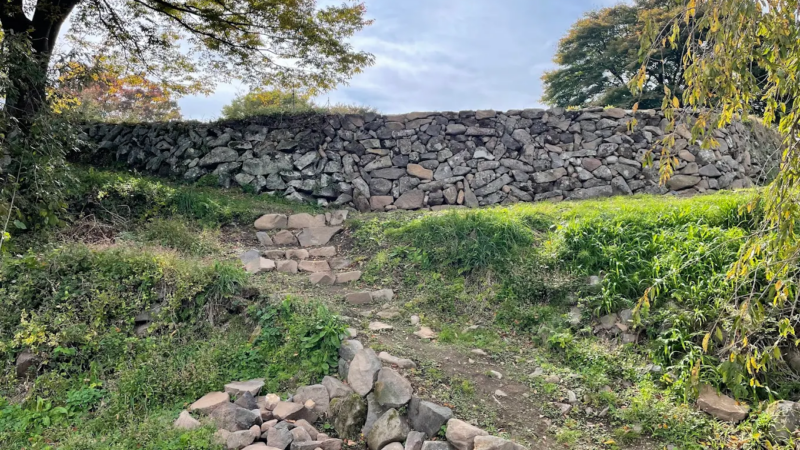
Asahiyama Castle is primarily an earthen mountain castle, but traces of stone walls have been confirmed in some areas. These are thought to be the result of later renovations, possibly during the reconstruction by Uesugi Kenshin or even later reinforcements.
The stone walls are not full-fledged stone masonry, but rather utilize a form of rough-hewn stonework, making them valuable historical materials illustrating the transitional castle-building techniques of the Sengoku period.
Related Subsidiary Castles to Asahiyama Castle
Relationship with Katsuyama Castle
Indispensable to understanding Asahiyama Castle is Katsuyama Castle, which faces it across the Susobana River. During the Second Battle of Kawanakajima, Asahiyama Castle, on the Takeda side, and Katsuyama Castle, on the Uesugi side, functioned as frontline bases.
Katsuyama Castle is a mountain castle built on Mount Katsuyama, approximately 550 meters above sea level, and like Asahiyama Castle, it overlooks the Zenkoji Plain. The Susobana River between the two castles functioned as a natural moat, acting as a buffer zone between the two armies.
Coordination with Yokoyama Castle
Takeda Shingen developed not only Asahiyama Castle but also Yokoyama Castle on the opposite bank of the Chikuma River as an important base. Yokoyama Castle functioned as a rear support base for the Takeda forces in the Kawanakajima region, and through coordination with Asahiyama Castle, he sought to maintain his influence throughout the Zenkoji Plain.
Yokoyama Castle offered a panoramic view of the old battlefield of Kawanakajima and played an important role in the Fourth Battle of Kawanakajima. The triangular arrangement of bases connecting Asahiyama Castle, Yokoyama Castle, and Kaizu Castle (Matsushiro Castle) is a good example of Takeda Shingen’s strategic thinking.
Relationship with the Third and Fourth Battles of Kawanakajima
Third Battle of Kawanakajima (Koji 3 / 1557)
Asahiyama Castle was temporarily demolished after the Second Battle of Kawanakajima, but it is said to have been rebuilt by Uesugi Kenshin in Koji 3 (1557). During the Third Battle of Kawanakajima, Asahiyama Castle may have functioned as a base for the Uesugi forces.
At this time, Takeda Shingen had captured Katsuyama Castle and was expanding his power in the Zenkoji Plain. The conflict between the two sides was still ongoing, and it is believed that the dispute over the ownership of Asahiyama Castle continued.
The Fourth Battle of Kawanakajima (Eiroku 4 / 1561)
Even in the most fierce battle, the Fourth Battle of Kawanakajima (Eiroku 4 / 1561), Asahiyama Castle held a strategically important position. In this battle, the two armies clashed at Hachimanbara (present-day Hachiman, Nagano City), resulting in heavy casualties on both sides, including the deaths of Takeda Nobushige, Takeda Shingen’s younger brother, and his strategist, Yamamoto Kansuke.
Asahiyama Castle is thought to have played an important role as a rear support base or in securing a retreat route. Even after the Fourth Battle of Kawanakajima, the Kawanakajima region remained a tense border area between the two opposing forces, and Asahiyama Castle maintained its importance.
Access to Asahiyama Castle and Climbing Route
Access by Public Transportation
From JR Nagano Station, it is convenient to use a local bus or taxi to reach the Asahiyama Castle ruins. It takes approximately 15 minutes by car from Nagano Station to Asahiyama Kannon-do Temple. If using the bus, take the Alpico Kotsu bus and get off at the “Hirabayashi” bus stop, then it’s about a 20-minute walk to Kannon-do Temple.
Access by Private Car
By private car, it’s about 20 minutes from Nagano IC and about 10 minutes from Nagano Prefectural Government Office. There is free parking at Asahiyama Kannon-do Temple, and this is generally the starting point for climbing to the castle. From the parking lot, you will hike to the summit.
Address: Hirashiba, Nagano City, Nagano Prefecture
Ascent Route and Estimated Time
From the parking lot of Asahiyama Kannon-do Temple, take the Asahiyama Forest Road to the summit. After paying your respects at Kannon-do Temple, follow the signs to enter the hiking trail.
The time required to reach the summit is approximately 40 to 60 minutes one way at a leisurely pace. While the hiking trail is well-maintained, there are steep slopes and uneven terrain characteristic of mountain castles, so comfortable shoes and clothing are essential. Particular caution is needed after rain, as the ground can become slippery.
Along the way, you will pass near the ruins of Daikoku Castle, and once you reach the ridge, you can observe remains such as trenches and vertical moats. From the main enclosure at the summit, a magnificent view of the Zenkoji Plain unfolds, allowing you to understand why Takeda Shingen and Uesugi Kenshin fought over this area.
Points to Note When Climbing the Castle
- Climbing Equipment: Athletic shoes or trekking shoes, comfortable clothing
- Items to Bring: Drinking water, towel, insect repellent (summer)
- Season: Spring to autumn is suitable for climbing the castle, but be careful of snow in winter
- Estimated Time: Expect 2 to 3 hours round trip
- Toilets: There are toilets near the Kannon-do Hall, but none on the hiking trail
Nearby Historical Spots
Zenkoji Temple
Located approximately 3 kilometers northeast of Asahiyama Castle, Zenkoji Temple is a renowned temple whose principal image is the Ichiko Sanzon Amida Nyorai, considered one of the oldest Buddhist statues in Japan. During the Battle of Kawanakajima, Zenkoji Temple wielded significant influence not only religiously but also economically and politically.
Takeda Shingen even attempted to move Zenkoji Temple’s principal image to Kofu, and battles over Zenkoji Temple unfolded throughout the region. When visiting Asahiyama Castle, be sure to also visit Zenkoji Temple and consider the relationship between religion and politics during the Sengoku period.
Kawanakajima Battlefield (Hachimanbara Historical Park)
Hachimanbara, the site of a fierce battle during the Fourth Battle of Kawanakajima, is now maintained as the “Kawanakajima Battlefield Historical Park.” It features a bronze statue depicting the duel between Takeda Shingen and Uesugi Kenshin, as well as information boards showing the troop deployments of both armies, allowing visitors to experience the Battle of Kawanakajima firsthand.
It’s about a 15-minute drive from Asahiyama Castle, and visiting both together will deepen your understanding of the entire Battle of Kawanakajima.
Katsuyama Castle Ruins
Katsuyama Castle Ruins, which faced Asahiyama Castle, is another must-visit spot. Located across the Susobana River from Asahiyama, it allows you to see the relationship between the two castles firsthand. A hiking trail is also maintained at the Katsuyama Castle Ruins, offering panoramic views of Asahiyama Castle and the Zenkoji Plain from the summit.
Matsushiro Castle (Kaizu Castle)
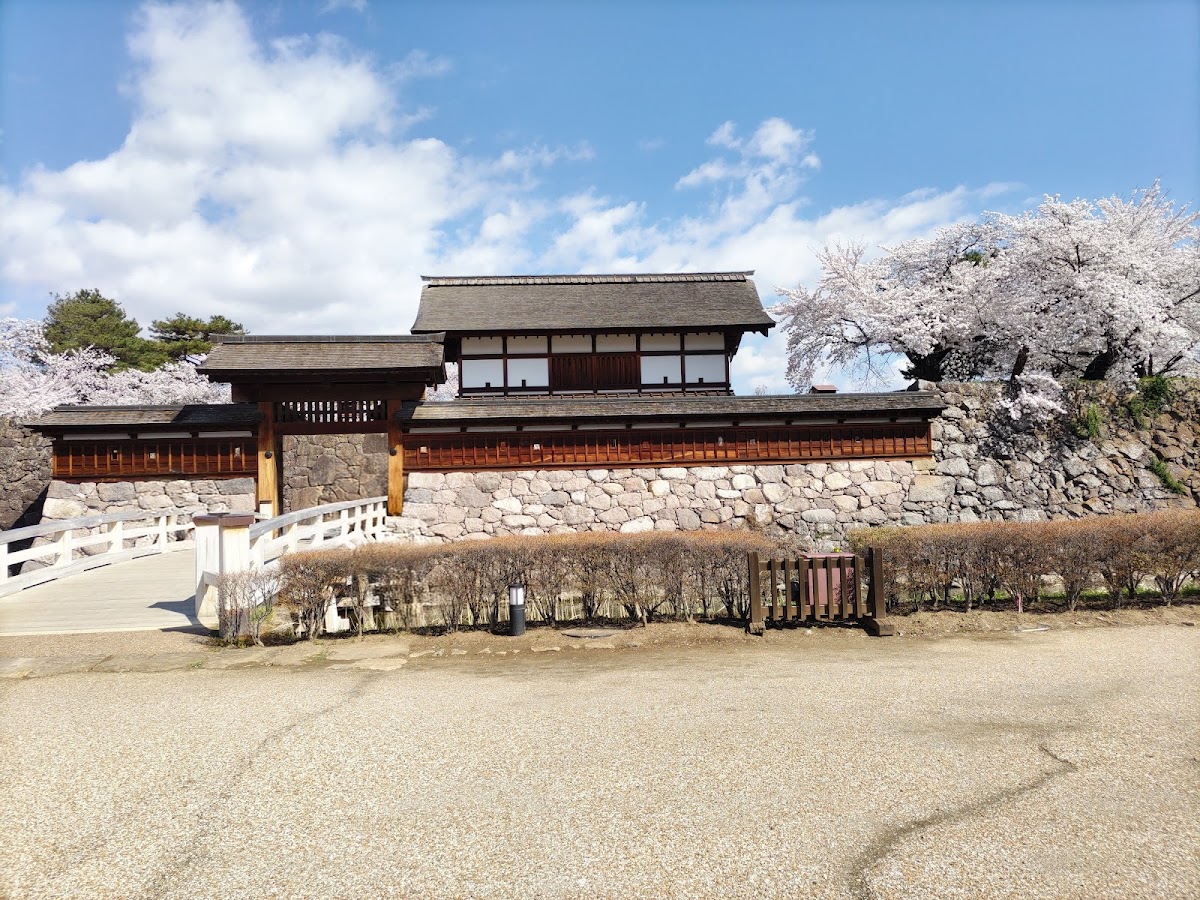
Matsushiro Castle (Kaizu Castle), built by Takeda Shingen as his base for managing the Kawanakajima region, is located approximately 10 kilometers southeast of Asahiyama Castle. Currently, the castle gates and stone walls have been restored, and it is also known as the residence of the Sanada family.
To understand the entire Battle of Kawanakajima, visiting the Asahiyama Castle → Kawanakajima Battlefield → Matsushiro Castle route provides a three-dimensional view of Takeda Shingen’s strategic vision.
Asahiyama Castle Highlights and Points to Note
The Magnificent View
The greatest attraction of Asahiyama Castle is the overwhelming view from the mountaintop. You can see the entire Zenkoji Plain, the confluence of the Chikuma River and Sai River, and even the Northern Alps in the distance. This view eloquently illustrates the reason why Takeda Shingen and Uesugi Kenshin fought over this land.
On a clear day, you can see the direction of Katsuyama Castle ruins, the Kawanakajima battlefield, and Matsushiro Castle, offering a valuable experience of seeing a strategic map of the Sengoku period with your own eyes.
Well-Preserved Remains
Because Asahiyama Castle ruins have been untouched by development, the remains such as moats, trenches, and baileys are well-preserved. The moats around the main bailey, in particular, are impressive in both depth and width, allowing you to truly appreciate the defensive system of a Sengoku period mountain castle.
For castle enthusiasts, there’s the pleasure of walking around with a map in hand, confirming the remains, and new discoveries can be made with each visit.
Asahiyama Kannon-do Temple
The Asahiyama Kannon-do Temple located at the entrance to the castle is a sacred site that has long attracted the faith of the local community. It is believed to bring good fortune in examinations and business prosperity, and many worshippers visit. The existence of a peaceful place of worship in this land that experienced the turmoil of the Sengoku period evokes a sense of the layered history.
Nature in Every Season
Asahiyama is a naturally rich mountain area, offering beautiful scenery throughout the four seasons. Spring brings fresh greenery, summer brings deep green, autumn brings vibrant fall foliage, and winter brings snowscapes—each season offers a different charm. The autumn foliage season, in particular, is stunning, with the contrast between the colorful trees and historical ruins attracting many hikers and climbers.
An Experience of Historical Romance
Standing at the Asahiyama Castle ruins, it’s impossible not to imagine the battle between Takeda Shingen and Uesugi Kenshin that took place here over 460 years ago. Records of 300 muskets, 800 bows, and 3,000 soldiers holed up there convey the tense situation of the time.
Closing your eyes at the summit, you might feel as if you can hear the breathing of the soldiers on both sides, the sound of weapons, and the beat of war drums. The feeling of standing on the stage of history is a unique experience only available at Asahiyama Castle.
Summary: The Historical Value of Asahiyama Castle
Asahiyama Castle is an important mountain castle that was the stage for the Battle of Kawanakajima, one of the most famous battles in Japanese history. The fact that two great heroes, Takeda Shingen and Uesugi Kenshin, faced off for 200 days over control of this land proves the high strategic value of Asahiyama Castle.
The well-preserved remains today are a valuable cultural asset that conveys the castle-building techniques and defensive philosophies of the Sengoku period. The view from the mountaintop is the very landscape that the warlords of that time saw, and can be called a time capsule connecting history and the present.
When visiting Nagano City, why not visit the ruins of Asahiyama Castle along with Zenkoji Temple and feel the romance and breath of history of the Sengoku period? Standing on the mountaintop at an altitude of 785 meters, the reasons why Takeda Shingen and Uesugi Kenshin fought will be deeply etched in your heart.
Asahiyama Castle is not merely a historical site, but a “living textbook” where you can experience Japanese history. On your next day off, be sure to visit Asahiyama Castle in Nagano City, Nagano Prefecture, and enjoy a trip back in time to the Sengoku period.