Complete Guide to the Sanada Clan’s Main Castle Ruins | Tracing the Origins of Sengoku Warlords and the Charm of Mountain Castles in Sanada Village, Ueda City
In the northeastern part of Ueda City, Nagano Prefecture, in an area known as Sanada Village, stands a mountain castle that was the origin of the Sanada clan, representative warlords of the Sengoku period. The Sanada Clan’s Main Castle Ruins are an important historical site, serving as the base of operations for three generations of the Sanada family—from Sanada Yukitaka (Yukitsuna) to Masayuki, and then Nobuyuki and Yukimura (Nobushige)—until the construction of Ueda Castle in 1583.
Knowing that the strategic acumen of Sanada Masayuki, who repelled the Tokugawa army twice, and the martial prowess of Sanada Yukimura, hailed as “Japan’s greatest warrior” at the Siege of Osaka, originated in this mountain castle will deepen your understanding of the Sanada clan.
What are the Sanada Clan’s Main Castle Ruins? The History of Mountain Castles that Fostered Sengoku Warlords
The Position and Alternate Names of the Sanada Clan’s Main Castle
The Sanada Clan’s Main Castle is a mountain castle built on a mountain approximately 750 meters above sea level in Honbara, Sanada-cho, Ueda City. While this castle has several names, including “Sanada-yama Castle,” “Matsuo Shinjo Castle,” “Jurenji Castle,” and “Jurinji Castle Mountain,” it is currently known as “Sanada Clan’s Main Castle Site” due to its scale and strategic location befitting the Sanada clan’s main castle.
From the castle ruins, one can overlook the entire Sanada region and its strategic location allows for monitoring of the road from northern Shinano to Joshu (Gunma Prefecture). This geographical advantage was the foundation upon which the Sanada clan grew from a minor local lord to a Sengoku daimyo (feudal lord).
The Three Generations of the Sanada and the Historical Changes of the Main Castle
The history of the Sanada clan truly begins with Sanada Yukitaka (Yukitsuna) serving Takeda Shingen. Yukitaka served as one of the 24 generals of the Takeda clan, expanding his power from his base in Sanada village in Chiisagata district, Shinano Province.
After his eldest son, Nobutsuna, and second son, Masateru, were killed in the Battle of Nagashino (1575), his third son, Sanada Masayuki, inherited the family headship. Even after the fall of the Takeda clan, Masayuki survived as an independent force, skillfully navigating the complexities of the powerful Uesugi, Hojo, and Tokugawa clans.
In 1583, Sanada Masayuki began construction of Ueda Castle on the plains along the Chikuma River. It is believed that around 1585, the Sanada clan permanently moved their base from their main castle or residence to Ueda Castle. During this period, the Sanada clan made a leap from a local powerful family to a Sengoku daimyo (feudal lord).
Function as a Fortified Castle and its Relationship to the Sanada Residence
The Sanada clan’s main castle functioned as a “fortified castle” during wartime. A “tsume-jirō” is a mountain castle built to serve as a refuge when the main residence was under attack. In the case of the Sanada clan, administrative affairs and daily life were conducted at the Sanada clan residence (Oyashiki Park) at the foot of the mountain, with a system in place to evacuate to the main castle in times of emergency.
This dual structure is a typical example of the relationship between a mountain castle and a residence during the Sengoku period, demonstrating the Sanada clan’s practical defensive system. The site of the Sanada clan residence is now maintained as “Oyashiki Park” and is affectionately known as “Oyashiki” by locals.
Highlights and Castle Structure of the Sanada Clan Main Castle Ruins
Layout and Defensive Facilities of the Mountain Castle
Visiting the Sanada Clan Main Castle Ruins allows you to observe a typical structure of a Sengoku period mountain castle. Multiple baileys are arranged in a stepped pattern around the main enclosure (honmaru), creating a robust defensive system that utilizes the steep terrain.
The castle’s perimeter clearly shows remnants of moats and earthworks, revealing numerous ingenious methods used to prevent enemy intrusion. The deep, sharp moats cutting off the ridgeline, in particular, demonstrate the high level of the Sanada clan’s castle-building skills.
The view from the main enclosure is magnificent, offering panoramic views of the Sanada region and even the distant mountains of northern Shinano. This excellent visibility enhanced its value as a military observation post.
Remains of Stone Walls and Earthworks
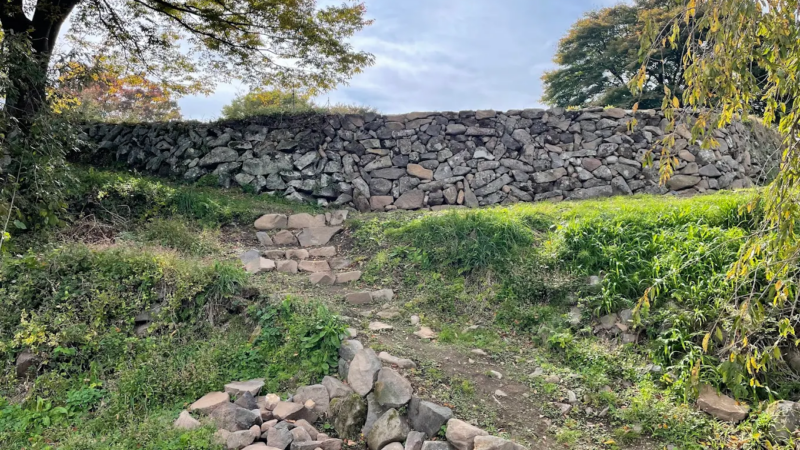
Within the castle grounds, traces of stone walls constructed from natural stones remain. Unlike later stone walls, these are valuable remnants of the Sengoku period, employing the minimally processed, “nozurazumi” technique.
Earthworks surround the enclosures, some remaining over 2 meters high. These earthworks are believed to have functioned not only as defensive walls but also as foundations for buildings.
Access Route and Local Conditions
To reach the Sanada Clan’s main castle ruins, you’ll need to hike a mountain trail from the foot of the mountain for about 20-30 minutes. The path is well-maintained, but due to the steep inclines typical of mountain castles, comfortable shoes and clothing are essential.
Information boards are installed along the route, ensuring that even first-time visitors can reach the main enclosure without getting lost. The area is particularly beautiful during the spring when the leaves change color and in autumn when the leaves turn red, making it a spot where you can enjoy both historical exploration and nature appreciation.
Related Historical Sites and Tourist Spots in Sanada Village
Sanada Clan Residence Ruins (Oyashiki Park)
Located at the foot of the Sanada Clan’s main castle, the Sanada Clan Residence Ruins are the site of the residence where the Sanada clan conducted their affairs during peacetime. Currently, it is maintained as “Oyashiki Park” and is a popular tourist spot in spring, especially for its azaleas.
Parts of the earthworks and moats remain at the residence site, allowing visitors to imagine the scale of the residence during the Sengoku period. Adjacent to the park is the Sanada Clan History Museum, where you can learn in detail about the history of the three generations of the Sanada family.
Sanada Clan History Museum
The Sanada Clan History Museum is a facility that comprehensively exhibits the history and culture of the Sanada clan. It introduces the trajectory of the three generations of the Sanada family, from Sanada Yukitaka to Masayuki, Nobuyuki, and Yukimura (Nobushige), through abundant documents and videos.
Inside the museum, you can see valuable exhibits such as armor and ancient documents related to the Sanada clan, and the Sanada Rokumonsen (six-coin) banner. The importance of Sanada no Sato as the Sanada clan’s base of operations before the construction of Ueda Castle is also explained in detail.
Shintsuna-ji Temple and the Sanada Family’s Family Temple
Shintsuna-ji Temple is a temple built to mourn the Sanada brothers, Shintsuna and Masateru, who died in the Battle of Nagashino. The temple grounds contain the graves of Shintsuna and Masateru, making it an indispensable historical site when discussing the history of the Sanada family.
The temple houses artifacts related to the Sanada clan and remains a cherished place for commemorating the Sanada family. The tranquil grounds are an ideal place to reflect on the rise and fall of the Sanada family.
Hase-dera Temple and the Sanada Clan’s Faith
Hase-dera Temple was one of the temples deeply revered by the Sanada clan and served as a spiritual pillar for the Sanada region. Even during the turbulent Sengoku period, the Sanada clan continued to pray for family unity and the peace and well-being of their people.
The temple preserves cultural artifacts donated by the Sanada clan, offering insights not only into their military prowess but also into their dedication to managing their territory as feudal lords.
From the Sanada Clan’s Main Castle to Ueda Castle: A Strategic Turning Point
Why Was Ueda Castle Built?
The background to Sanada Masayuki’s commencement of construction of Ueda Castle in 1583 (Tensho 11) was the changing strategic environment of the Sengoku period. While the Sanada clan’s main castle, a mountain castle, excelled in defense, it was unsuitable for peacetime administrative affairs, economic activities, and large-scale military mobilization.
Ueda Castle, built on the plains along the Chikuma River, was a flatland castle that controlled a strategic transportation hub and allowed for the development of a castle town. This construction laid the foundation for the Sanada clan’s transformation from a local lord to a modern daimyo (feudal lord).
The First and Second Battles of Ueda and the Sanada’s Strategic Vision
Based at Ueda Castle, Sanada Masayuki achieved remarkable feats, repelling the large Tokugawa army in the First Battle of Ueda in 1585 and the Second Battle of Ueda in 1600.
These victories were achieved thanks to the tactics that utilized the terrain, the intelligence-gathering capabilities, and the strong relationship of trust with the people cultivated during his time at the Sanada clan’s main castle. The strategic vision nurtured at the Sanada clan’s main castle culminated in victories at Ueda Castle.
The Fate of the Sanada Family After the Battle of Sekigahara
Sanada Masayuki and his son Yukimura, who sided with the Western Army in the Battle of Sekigahara (1600), were exiled to Kudoyama in Wakayama Prefecture after the war. On the other hand, their eldest son, Nobuyuki, who sided with the Eastern Army, ensured the continuation of the Sanada family as the lord of the Ueda Domain, and later, after being transferred to the Matsushiro Domain, became a daimyo family that continued until the Meiji Restoration.
It is believed that Masayuki’s careful consideration was behind the brothers’ split between the East and West, in order to ensure the survival of the Sanada family. This decision can also be seen as a manifestation of the family unity and survival strategy cultivated in the Sanada region.
Access and Tourist Information for the Sanada Clan’s Main Castle Ruins
Basic Information and Access Methods
Location: Honbara, Sanada-machi, Ueda City, Nagano Prefecture
Access:
- By Car: Approximately 20 minutes from Ueda-Sugadaira IC on the Joshinetsu Expressway
- By Public Transportation: Approximately 30 minutes by Ueda Bus “Sanada Line” from JR Ueda Station, get off at “Sanada Clan History Museum Entrance,” and walk approximately 30 minutes to the castle ruins.
Parking: Parking is available at the Sanada Clan History Museum (free).
Admission Fee: Free (Sanada Clan History Museum is charged).
Estimated Visit Time: Approximately 1 to 1.5 hours from arrival to viewing.
Notes and Clothing for Visitors
Since the Sanada Clan’s Main Castle Ruins are a mountain castle, please note the following:
- Clothing: Comfortable clothing and non-slip shoes (trekking shoes recommended)
- Items to Bring: Drinking water, towel, insect repellent (summer)
- Weather: Be careful as the ground can be slippery in rainy weather.
- Time: Plan with plenty of time to descend before sunset.
Recommended Sightseeing Route
Model course for efficiently exploring Sanada no Sato:
- Learn about the history of the Sanada clan at the Sanada Clan History Museum (approx. 1 hour)
- Stroll through Oyashiki Park (site of the Sanada clan residence) (approx. 30 minutes)
- Climb to the Sanada Clan Main Castle Site (approx. 1.5 hours round trip)
- Visit Shinzuna-ji Temple (approx. 30 minutes)
- Visit Hase-dera Temple (approx. 30 minutes)
Total time required: approx. 4-5 hours
Nearby Dining and Rest Spots
There are restaurants and rest facilities around Sanada no Sato that utilize local ingredients. Near the Sanada Clan History Museum, you can purchase local specialties and souvenirs at “Sanada Yume Kobo.”
If you venture to Ueda city center, you can enjoy Nagano Prefecture’s unique cuisine, such as Shinshu soba noodles and local sake. There are also restaurants offering menus related to “Sanada Maru,” a historical drama associated with the Sanada clan, making it especially recommended for history buffs.
Historical Value and Modern Significance of the Sanada Clan’s Main Castle Ruins
The Sanada Clan’s Position in Sengoku History
The Sanada clan was a rare family that grew from a minor local lord to a daimyo (feudal lord) from the Sengoku period to the early Edo period. Masayuki, who rose to prominence as a subordinate of Takeda Shingen and survived as an independent force after the fall of the Takeda clan, possessed remarkable diplomatic skills and military talent, having twice defeated Tokugawa Ieyasu, making him a noteworthy figure in Sengoku history.
Sanada Yukimura (Nobushige) nearly defeated Tokugawa Ieyasu in the Summer Siege of Osaka, earning him the title of “Japan’s greatest warrior.” The fact that the origins of this bravery and strategic brilliance lay in Sanada Village, the base of the Sanada clan’s main castle, holds immense historical significance.
Regional Culture and the Legacy of the Sanada Clan
In Sanada Village, the legacy of the Sanada clan still thrives as a part of the local culture. The Sanada Rokumonsen (six-coin) family crest can be seen in various places as a symbol of the region and is a source of pride for the residents.
Events such as the annual Sanada Festival feature warrior processions and theatrical performances recreating the history of the Sanada clan, attracting many tourists. Furthermore, since the airing of the 2016 NHK Taiga drama “Sanada Maru,” interest in the Sanada clan has increased nationwide, and the number of tourists visiting Sanada Village has risen significantly.
Castle Research and Preservation Activities
The ruins of the Sanada clan’s main castle are attracting attention from castle researchers as a valuable historical site that preserves the structure of a mountain castle from the Sengoku period in excellent condition. Recent excavations and surveys are revealing details of the castle’s layout and defensive facilities.
Local governments and preservation groups are working to protect and maintain the ruins, and are also working to create an environment where visitors can safely view the site by installing information boards and improving the access routes. This effort to preserve the value of the historical heritage while utilizing it as a tourist resource is a model case for regional development.
Sanada Clan’s Main Castle and the Mountain Castle Culture of Shinshu
Characteristics of Mountain Castles in Shinano Province
Nagano Prefecture (formerly Shinano Province) is known as a “treasure trove of mountain castles,” with hundreds of mountain castle ruins remaining within the prefecture. Shinano’s mountain castles, utilizing the rugged mountainous terrain, were highly defensive, allowing even small forces to withstand large armies.
Sanada Clan’s Main Castle is one such traditional mountain castle, and its layout, which makes maximum use of the natural terrain, is typical of Shinano’s mountain castle culture. It also shows the influence of Takeda Shingen’s castle-building techniques, exhibiting characteristics of Takeda-style castle construction.
Comparison with Other Sanada Clan-Related Castles
The Sanada clan built several castles in addition to their main castle. Ueda Castle, a flatland castle, symbolizes the strategic shift of the Sanada clan. Toishi Castle (Toishi Castle) is known as an impregnable mountain castle that Sanada Yukitaka conquered for Takeda Shingen.
By comparing these castles, we can understand the development of the Sanada clan’s castle-building techniques and the changes in their strategies according to the times. The Sanada clan’s main castle, as the origin of the Sanada clan, occupies an important position in understanding its relationship with other castles.
Mountain Castle Tours and Historical Tourism
In recent years, “mountain castle tours” have become popular among castle enthusiasts and history lovers. The Sanada clan’s main castle site is loved by many castle fans as a spot that combines historical value with the enjoyment of mountain climbing.
In addition to the Sanada clan’s main castle, numerous mountain castle sites are scattered around Ueda City, including Toishi Castle, Katsuo Castle, and Kokuzozan Castle. Historical tourism centered around these sites contributes to the revitalization of the local economy and is attracting attention as a model for sustainable tourism.
Summary: Experiencing the Spirit of the Warring States Period at the Sanada Clan’s Main Castle Ruins
The Sanada Clan’s Main Castle Ruins are more than just castle ruins. They are the “spiritual homeland” that nurtured the great generals Sanada Yukitaka, Masayuki, Nobuyuki, and Yukimura, and a historical witness that conveys the vivid spirit of the Warring States period.
Walking through the remains of the mountain castle and overlooking the Sanada village from the main enclosure, visitors can relive the perspective of a Sengoku warlord. You can feel firsthand why the Sanada clan chose this land, how they built their defenses, and why a family that left its mark on Japanese history emerged from the Sanada village.
Visiting this site in conjunction with Ueda Castle and the Sanada Clan Residence Ruins allows for a three-dimensional understanding of the trajectory of the three generations of the Sanada family. The Sanada Clan’s main castle ruins are a must-see spot for anyone who wants to learn more about the history of the Sanada clan, experience the charm of a mountain castle, and learn about the strategies and ways of life of the Sengoku period.
When you visit Ueda City in Nagano Prefecture, be sure to extend your trip to Sanada no Sato and feel the atmosphere of the Sengoku period at the Sanada Clan’s main castle ruins. A living history awaits you there, something you can’t learn from textbooks.