
Complete Guide to the History and Highlights of Ishinomaki Castle (Ishinomaki City, Miyagi Prefecture) | The Kasai Clan’s Residence Built on Hiyoriyama Hill
What is Ishinomaki Castle? Basic Information and Overview
Ishinomaki Castle is a medieval mountain castle built on Hiyoriyama Hill in Hiyorigaoka, Ishinomaki City, Miyagi Prefecture. Also known as Hiyoriyama Castle, it played an important role as the residence of the Kasai clan, who ruled this region from the Kamakura period to the Azuchi-Momoyama period.
Basic Data on Ishinomaki Castle
- Location: 2-chome, Hiyorigaoka, Ishinomaki City, Miyagi Prefecture
- Former Province: Oshika District, Mutsu Province
- Common Name/Alternate Name: Hiyoriyama Castle
- Castle Structure: Mountain Castle
- Elevation: Approximately 60 meters
- Construction Period: Early Kamakura Period (Late 12th to Early 13th Century)
- Builder: Kasai Kiyoshige (Estimated)
- Year of Abandonment: Tensho 18 (1590)
- Main Lord: Kasai Clan
- Current Status: Developed as Hiyoriyama Park
Currently, the site of Ishinomaki Castle is a popular park for citizens known as Hiyoriyama Park, and is also famous for its cherry blossoms. From the mountaintop, approximately 60 meters above sea level, you can enjoy a spectacular view of the former Kitakami River estuary, Ishinomaki city, and the Pacific Ocean.
History of Ishinomaki Castle | 300 Years of the Kasai Clan’s Base
Construction in the Kamakura Period and the Rise of the Kasai Clan
The history of Ishinomaki Castle dates back to the Oshu War (1189). Kasai Kiyoshige, a retainer of Minamoto no Yoritomo, was granted five counties, including Oshika, Isawa, and Kesen, as a reward for his service in the Oshu War, which saw the downfall of the Oshu Fujiwara clan.
It is believed that Kasai Kiyoshige, upon receiving this reward, built his residence on Hiyoriyama in Oshika County, marking the beginning of Ishinomaki Castle. Hiyoriyama is located on the west bank of the former Kitakami River, very close to the historical center of Ishinomaki town, and was a strategically important location controlling a key point for water transport and transportation.
The Prosperity of the Kasai Clan and the Development of Ishinomaki
The Kasai clan ruled this region for over 300 years, from the Kamakura period through the Muromachi period and the Sengoku period. With Ishinomaki Castle as its base, the Kasai clan expanded its power primarily in Oshika County, becoming a powerful samurai family in southern Mutsu Province.
The “Sendai Domain Old Castle Records,” submitted by the Sendai Domain to the Edo Shogunate during the Enpo era (1673-1681), contains the entry: “Ishinomaki Castle: 90 ken east-west, 40 ken north-south. Lords Kasai Saburo, Mutsu-no-kami Kiyoshige, and Sakyo-no-daibu Haruchika resided there, but it fell into decline.” This indicates that the castle was known as the residence of the Kasai clan even during the Edo period.
Until Kasai Harutane moved to Teraiike Castle (present-day Teraiike, Tome-cho, Tome City), Ishinomaki flourished as the Kasai clan’s base and became the political, economic, and cultural center of the region.
Changes during the Sengoku Period
Records also show that in the 1500s, the Kimura clan took up residence in Ishinomaki Castle. During the turbulent Sengoku period, it is presumed that the Kasai clan’s power also changed, but many details remain unclear.
Toyotomi Hideyoshi’s Pacification of Oshu and the Abandonment of the Castle
The history of Ishinomaki Castle came to an end with Toyotomi Hideyoshi’s Pacification of Oshu in 1590. After the Siege of Odawara, Hideyoshi drastically changed the distribution of daimyo in the Tohoku region, and the Kasai clan was dispossessed and destroyed.
As a result of this Pacification of Oshu, Ishinomaki Castle was abandoned, ending its role as a medieval castle after approximately 400 years. Subsequently, the region came under the control of Date Masamune, and Ishinomaki developed into an important port town of the Sendai Domain.
Structure and Remains of Ishinomaki Castle
Castle Structure Revealed by the 1983 Excavation
For a long time, much about Ishinomaki Castle remained unknown. However, an excavation conducted in 1983 (Showa 58) revealed the existence of a large-scale medieval castle on Hiyoriyama Hill.
The following remains were confirmed during this excavation:
- Earthworks: Earthen embankments built as defensive structures for the castle.
- Dry Moats: Moats without water, used as defensive structures to prevent enemy intrusion.
- Remains of Post-and-Beam Buildings: Traces of buildings constructed with posts directly embedded in the ground.
Furthermore, the remains of dry moats were discovered during an excavation in 1997 (Heisei 9), confirming that Ishinomaki Castle was a considerably large-scale castle complex.
Current Status of Remains
Unfortunately, there are almost no visible castle remains left in Hiyoriyama Park today. Due to years of weathering and development as a park, the remains of stone walls and earthworks have been lost.
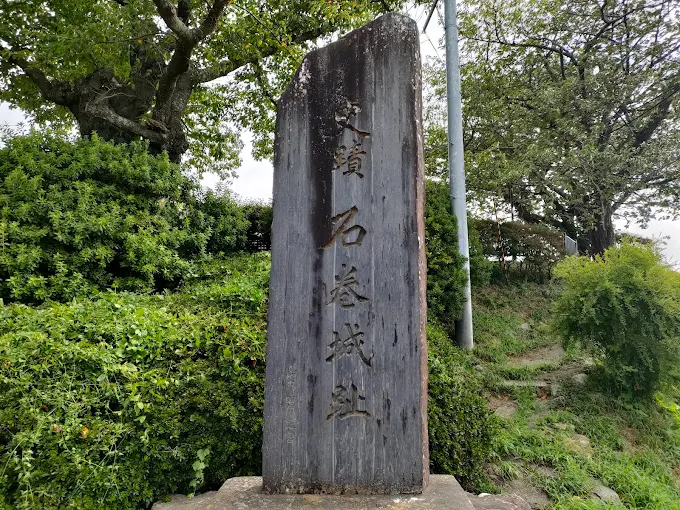
However, a stone monument marking the site of Ishinomaki Castle stands near the summit, indicating the former presence of a castle here. Furthermore, careful observation of the terrain reveals the characteristic undulations and flat areas typical of medieval mountain castles.
Castle Scale and Structure
According to the “Sendai-ryo Kojō Kakage” (Records of Ancient Castles in the Sendai Domain), Ishinomaki Castle measured “90 ken east-west and 40 ken north-south,” meaning approximately 164 meters east-west and 73 meters north-south. It was a mountain castle that utilized the topography of Hiyoriyama, which is approximately 60 meters above sea level, and boasted an excellent location overlooking the mouth of the Kitakami River.
As a medieval mountain castle, it was a medium-sized fortress and is thought to have had a structure that combined residential and defensive functions.
Hiyoriyama Park Today
The Charm of Hiyoriyama Park
Currently, the site of Ishinomaki Castle has been developed into Hiyoriyama Park, a popular spot for Ishinomaki residents and tourists alike. The view from the mountaintop, approximately 60 meters above sea level, is magnificent, offering the following scenery:
- Former Kitakami River: The majestic flow of the river mouth
- Ishinomaki City: A panoramic view of the city
- Pacific Ocean: On clear days, you can see all the way to the horizon
- Oshika Peninsula: The landscape of the peninsula stretching to the southeast
Hiyoriyama has long been known as a place with a good view, and was valued by fishermen and sailors as a place to check the weather and sea conditions. This origin of the name is still reflected in the current place name.
A Famous Cherry Blossom Spot
Hiyoriyama Park is also famous as a cherry blossom spot, and in spring, it is bustling with many cherry blossom viewers. Approximately 400 Somei Yoshino cherry trees are planted here, and during full bloom, the entire mountain is dyed pink, creating a beautiful landscape.
During cherry blossom season, the scenery of cherry blossoms blooming against the backdrop of Ishinomaki city, the Kitakami River, and the Pacific Ocean is truly breathtaking.
Symbol of the Great East Japan Earthquake and Reconstruction
Ishinomaki city suffered immense damage in the Great East Japan Earthquake of March 11, 2011. Hiyoriyama Park, being a high ground that escaped tsunami damage, served as a place where many citizens evacuated.
After the earthquake, Hiyoriyama Park became an important symbol of reconstruction. A memorial monument and information boards commemorating the earthquake have been installed at the summit, conveying the importance of disaster prevention to visitors.
Currently, it serves as a viewpoint overlooking the reconstructed Ishinomaki city, a symbol of hope and rebirth.
Kashima Mikojinja Shrine | A History Dating Back to the Heian Period
On Hiyoriyama Hill stands the Kashima Mikojinja Shrine, whose history dates back to the Heian period. This shrine is an ancient shrine that existed even before the construction of Ishinomaki Castle, and has a long history as a center of local faith.
History of Kashima Mikojinja Shrine
The exact founding date of Kashima Mikojinja Shrine is unclear, but it is believed to have existed since the Heian period. It is said to have been established by inviting a deity from Kashima Jingu Shrine in Hitachi Province, and enshrines Takemikazuchi-no-Mikoto, a god of war.
When the Kasai clan built Ishinomaki Castle, this shrine is thought to have been considered important as a guardian deity within the castle grounds. It likely attracted the faith of the Kasai clan as a guardian deity of the samurai class and as the general guardian shrine of the region.
Current State of Kashima Mikojinja Shrine
The shrine buildings still remain within Hiyoriyama Park, and it continues to attract the faith of local people. The view from the shrine is magnificent, and it continues to exude an unchanging presence as a guardian deity watching over the town and sea of Ishinomaki.
Many worshippers visit during New Year’s Day and the annual festival, making it an important cultural asset that conveys the history and culture of Ishinomaki to the present day.
Access and Tourist Information for Ishinomaki Castle
Access Methods
Access by Train
- Approximately 20 minutes on foot from Ishinomaki Station on the JR Senseki Line/Ishinomaki Line
- Accessible on foot from Ishinomaki Station to Hiyoriyama Park, passing through Ishinomaki city center
- Approximately 5 minutes by taxi
Access by Car
- Approximately 20 minutes from Ishinomaki Port IC on the Sanriku Expressway
- Parking: Free parking available at Hiyoriyama Park (approximately 30 cars)
Points to Note
Estimated Time Required: Approximately 30 minutes to 1 hour
Highlights:
- Stone monument at the Ishinomaki Castle ruins
- View from the mountaintop (former Kitakami River, Ishinomaki city center, Pacific Ocean)
- Kashima Mikoshi Shrine
- Scenery during cherry blossom season (early to mid-April)
- Memorials and information boards related to the earthquake disaster
Notes:
- Since you will be climbing a mountain path, we recommend wearing comfortable shoes.
- Insect repellent is recommended during the summer months.
- Be careful of snow and ice during the winter months.
Nearby Tourist Attractions
When visiting Ishinomaki Castle Ruins, we recommend also visiting the nearby tourist attractions:
Ishinomori Manga Museum
- A museum exhibiting the works of Shotaro Ishinomori, a manga artist from Ishinomaki.
- Approximately 12 minutes on foot from Ishinomaki Station.
Ishinomaki Genki Ichiba
- A market offering fresh seafood and local specialties from Ishinomaki.
- You can purchase seafood caught off the coast of Kinkasan.
Ishinomaki City Museum
- A museum where you can learn about the history and culture of Ishinomaki.
- There are also exhibits related to the Kasai clan and Ishinomaki Castle.
Former Kitakami River Estuary
- A scenic view of the estuary where the Kitakami River flows into the Pacific Ocean.
- The view from Hiyoriyama is also magnificent.
History and Culture of Ishinomaki City
A Port Town Nurtured by the Sea and Rivers
Ishinomaki City is a port town located in the northeastern part of Miyagi Prefecture, at the mouth of the Kitakami River. It boasts the Sanriku-Kinkasan offshore area, one of the world’s three major fishing grounds, and has flourished as a fishing town since ancient times.
The Kinkasan offshore area is a convergence point where the warm Kuroshio Current and the cold Oyashio Current meet, resulting in abundant phytoplankton and creating a rich fishing ground attracting diverse fish species. Aquaculture of oysters, sea squirts, and scallops is also thriving, and these products are known nationwide as the “Kinka brand.”
The Blessings of the Kitakami River
Ishinomaki’s development cannot be discussed without mentioning the Kitakami River. As the largest river in Tohoku, the Kitakami River has functioned as an important waterway connecting the inland areas with the Pacific Ocean.
During the Edo period, river transport using the Kitakami River developed, and Ishinomaki prospered as the largest commercial port of the Sendai Domain. Rice and other goods produced inland were gathered in Ishinomaki and transported by sea to Edo (Tokyo) and Osaka.
Furthermore, agriculture, centered on rice cultivation, flourished thanks to the fertile soil provided by the Kitakami River and the Ishinomaki Plain.
Ishinomaki after the Kasai Clan
After the fall of the Kasai clan, Ishinomaki came under the rule of Date Masamune. The Date clan positioned Ishinomaki as an important port town of the Sendai Domain and developed it as a base for Kitakami River shipping.
Even after the Meiji era, Ishinomaki continued to develop as a center of fishing and seafood processing, and it continues to play an important role as the second largest city in Miyagi Prefecture.
Historical Significance of Ishinomaki Castle
Position in the History of Castles in Medieval Tohoku
Ishinomaki Castle, as a medieval castle built in the early Kamakura period, occupies an important position in the history of castles in the Tohoku region. Ishinomaki Castle was one of the castles built in various locations by the vassals who received rewards from Minamoto no Yoritomo after the Oshu War, and it functioned as one of the Kamakura Shogunate’s bases for controlling the Tohoku region.
The Kasai clan ruled this area for approximately 300 years, reigning as a powerful samurai family in southern Mutsu Province throughout the medieval period. Ishinomaki Castle served as their headquarters, playing a central role in politics, military affairs, and economics.
Importance of Archaeological Excavations
The archaeological excavations conducted in 1983 and 1997 were extremely important in scientifically clarifying the true nature of Ishinomaki Castle. The existence of Ishinomaki Castle, previously known only through legends and written records, was confirmed archaeologically, establishing its historical value.
The discovered remains, such as earthworks, dry moats, and post-and-beam building foundations, are valuable resources for understanding the structure of medieval mountain castles. Further investigations may reveal more detailed information about the castle as the residence of the Kasai clan.
Regional Identity
Ishinomaki Castle symbolizes the history and identity of the people of Ishinomaki. Even now, as Hiyoriyama Park, it remains a beloved place of relaxation for citizens, while continuing to convey the history of the Kasai clan, who once ruled this land.
After the Great East Japan Earthquake, it gained new significance as a symbol of reconstruction, taking on new value as a place connecting Ishinomaki’s past, present, and future.
Summary | The Significance of Visiting Ishinomaki Castle
Although few visible remains remain, Ishinomaki Castle is an important medieval castle with a history of approximately 400 years, dating back to the Kamakura period. Its historical significance as the residence of the Kasai clan and its central role in the region is immense.
From the current Hiyoriyama Park, you can enjoy a magnificent view overlooking the mouth of the former Kitakami River, Ishinomaki city, and the Pacific Ocean. It is also known as a cherry blossom viewing spot, attracting many visitors in spring.
When you visit Ishinomaki, be sure to climb Hiyoriyama and reflect on the view that the Kasai clan once saw. Hiyoriyama Park, where history, nature, and hope for reconstruction intersect, is a place that encapsulates the charm of Ishinomaki.
In addition to visiting the Ishinomaki Castle ruins, enjoy the surrounding tourist spots and Ishinomaki’s fresh seafood, and fully experience the charm of this historic port town.


