Yagyu Castle Complete Guide | The History and Highlights of the Mountain Castle Remaining in Yagyu, Nara City, the Village of Swordsmen
Located in the mountainous area of northeastern Nara City, Yagyu is the birthplace of the Yagyu Shinkage-ryu school of swordsmanship, known for its instructors to the Tokugawa shogunate. Yagyu Castle was built in this village of swordsmen as the headquarters of the Yagyu clan. Built on a hill southeast of Hotoku-ji Temple, the mountain castle still retains remnants such as earthworks and moats, preserving the appearance of a medieval mountain castle in Yamato Province.
History of Yagyu Castle
Origins and Construction of the Yagyu Clan
The Yagyu clan is believed to have originated from the settlement of the estate manager of Koyanagi Manor, a territory of Kasuga Taisha Shrine. The Yagyu clan’s origins are said to date back to the late Heian period, when Daizen Nagaie of the Sugawara clan assumed the position. However, the most widely accepted theory is that the first head of the clan was Harima-no-kami Nagachika, who fought against the shogunate forces at Mount Kasagi in 1331, supporting Emperor Go-Daigo.
There are various theories regarding the construction date of Yagyu Castle, but it is presumed to have been built in the early Tenbun era (1530s) by Yagyu Ieyoshi. At that time, Yamato Province was in a complex political situation, with temple and shrine forces, centered around Kofuku-ji Temple, intertwined with local lords. It is believed that the Yagyu clan built their castle in an effort to survive within this complex political landscape.
Conflict with the Tsutsui Clan and the Fall of the Castle
During the Sengoku period, the Tsutsui clan and the Yagyu clan fiercely opposed each other, both aiming to unify Yamato Province. In 1544, Tsutsui Junsho, lord of Tsutsui Castle, launched an attack on Yagyu Castle as part of his efforts to unify Yamato. The Yagyu clan resisted alongside the Yamanaka clan, but their castle was attacked by an army of 10,000 men and eventually fell.
In this battle, Yagyu Ieyoshi and his son Muneyoshi (later known as Sekishusai) surrendered to the Tsutsui clan, and thereafter came under their control. This defeat became a turning point that significantly altered the fate of the Yagyu clan.
Relationship with Matsunaga Hisahide
Later, around 1559, when Matsunaga Hisahide invaded Yamato Province, the Yagyu clan broke away from the Tsutsui clan and sided with the Matsunaga clan. Yagyu Muneyoshi fought against Tsutsui Junkei (son of Junsho) under Matsunaga Hisahide, striving to survive amidst the complex power struggles within Yamato Province.
In 1577, when Matsunaga Hisahide rebelled against Oda Nobunaga at Shigisan Castle and committed suicide, the Yagyu clan once again faced the crisis of losing their territory. However, even after Toyotomi Hideyoshi unified Yamato Province, the Yagyu clan managed to survive, albeit barely.
Connections with the Tokugawa Family and the Path to Becoming a Modern Daimyo
The encounter between Yagyu Munenori and Tokugawa Ieyasu decisively changed the fate of the Yagyu clan. During the Battle of Sekigahara, Yagyu Munenori, the fifth son of Yagyu Munenori, served Tokugawa Ieyasu, and his military achievements led to the Yagyu clan being promoted to hatamoto (direct retainers of the shogun) with a stipend of 2,000 koku.
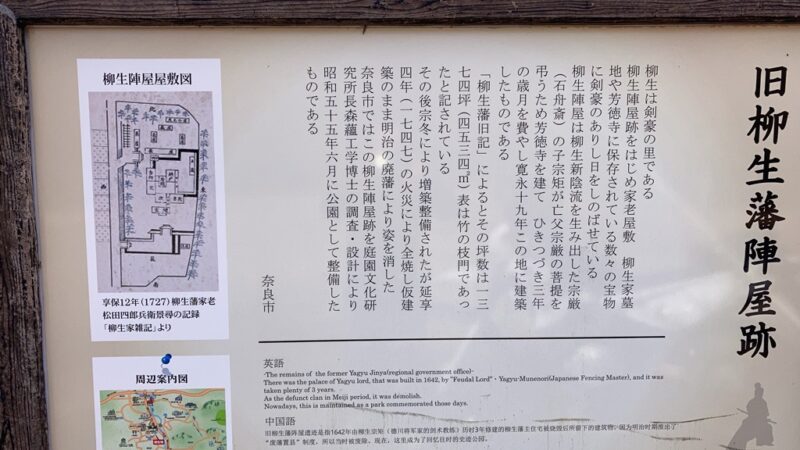
Munenori, a master of Yagyu Shinkage-ryu swordsmanship, became a swordsmanship instructor to Tokugawa Hidetada and Iemitsu, eventually rising to the rank of daimyo with a stipend of 12,500 koku. In the Edo period, the Yagyu clan moved from Yagyu Castle, a mountain castle, to the Yagyu Jinya (fortified residence) at the foot of the mountain, where they conducted their domain’s administration.
Structure and Remains of Yagyu Castle
Layout and Arrangement
Yagyu Castle is a mountain castle built on a hill approximately 400 meters above sea level, southeast of Hotoku-ji Temple. It exhibits the typical form of a medieval mountain castle, characterized by a layout that skillfully utilizes the natural terrain.
The castle complex consists of multiple enclosures (kuruwa) arranged around the main enclosure. The main enclosure is located at the highest point of the hill and is surrounded by earthen ramparts. From the main enclosure, one can see a panoramic view of the village of Yagyu, indicating its ideal location for monitoring enemy movements.
Moats and Earthen Ramparts
The most prominent remains of Yagyu Castle are the moats (horikiri). A moat is a dry moat dug to cut across a ridge, serving as a defensive structure to prevent enemy intrusion. Several moats remain at Yagyu Castle, providing valuable information for understanding the defensive systems of medieval mountain castles.
In particular, the moats located on the north and south sides of the main enclosure are large in scale, reaching several meters in depth in some places. These trenches are still clearly visible today, conveying the tension of the Sengoku period to visitors.
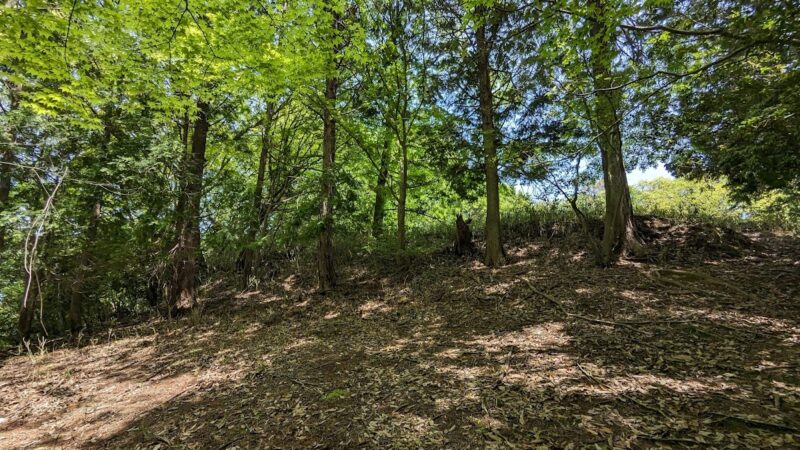
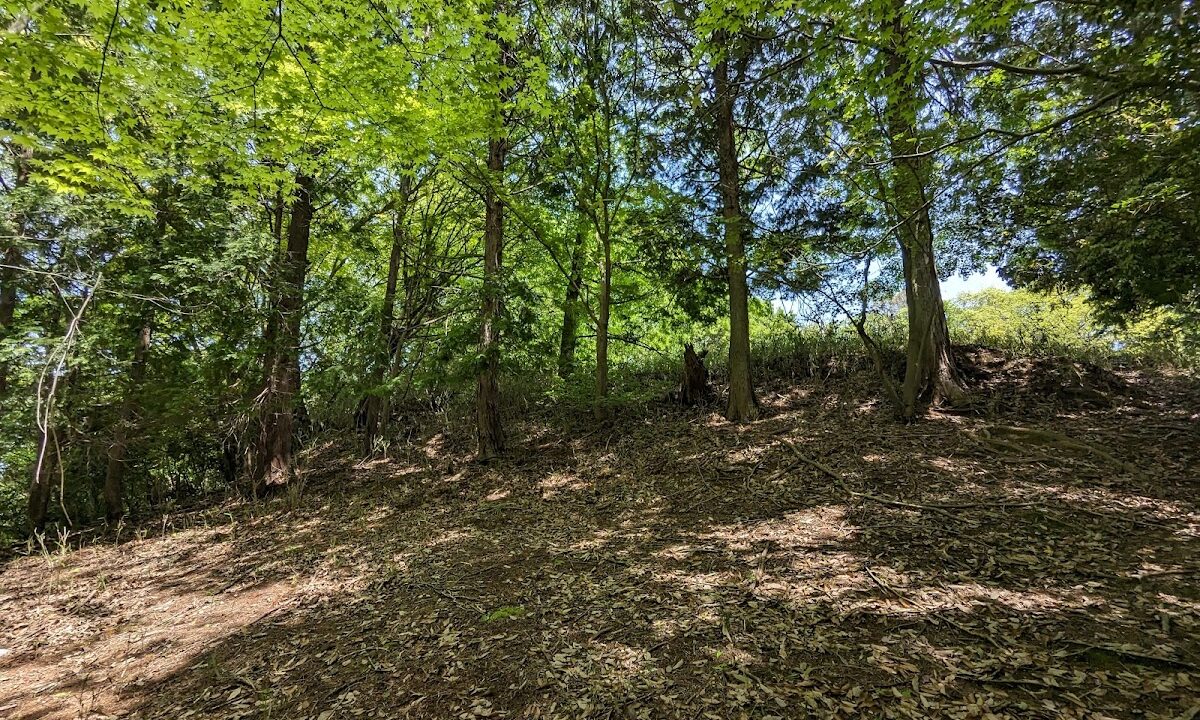
Earthworks also remain in good condition around each enclosure. The height of the earthworks varies depending on the location, but in some places they exceed 2 meters, demonstrating the castle’s strong defensive capabilities.
Layout of Enclosures
Multiple enclosures are arranged around the main enclosure, to the east, west, north, and south. Each enclosure is arranged in a stepped pattern following the terrain, designed to function as an independent defensive base.
The groups of enclosures known as the second and third enclosures are positioned to progressively prevent approach to the main enclosure, making it impossible for an attacking force to reach the main enclosure without breaking through multiple lines of defense.
Entrance Gates and Passages
Entrance gates (koguchi) to the castle can also be seen. To prevent enemy intrusion, the entrance gates are not straight but curved, a design feature that gives the defenders an advantage in battle.
The passages connecting the baileys were also built utilizing steep slopes, making it a difficult structure for attacking forces to advance.
Yagyu Shinkage-ryu and the Yagyu Clan
Yagyu Sekishusai Muneyoshi
Indispensable to discussing Yagyu Castle is Yagyu Muneyoshi (Sekishusai), a renowned swordsman. Born in 1540, Muneyoshi excelled in swordsmanship from a young age and learned the secrets of Shinkage-ryu from Kamiizumi Nobutsuna.
The name Sekishusai originates from the name he adopted in his later years. Muneyoshi independently developed Shinkage-ryu, founding the Yagyu Shinkage-ryu. The technique of Mutodori, disarming an opponent without using one’s own sword, is known as one of the characteristics of Yagyu Shinkage-ryu.
Yagyu Munenori and the Shogun’s Swordsmanship Instructor
Yagyu Munenori, the fifth son of Sekishusai, inherited the Yagyu Shinkage-ryu school of swordsmanship from his father and served Tokugawa Ieyasu. His military achievements at the Battle of Sekigahara earned him the trust of the Tokugawa family, and he became the swordsmanship instructor for the second shogun, Hidetada, and the third shogun, Iemitsu.
Munenori was not merely a swordsman, but also a distinguished politician. He participated in shogunate politics as a chief inspector and succeeded in establishing the Yagyu Shinkage-ryu as the “Shogun’s official style.” His book, “Heiho Kadensho” (Treatise on Military Strategy), is highly regarded not only for its swordsmanship techniques but also for its systematized philosophy of military strategy.
Yagyu Jubei Mitsuyoshi
Munenori’s eldest son, Yagyu Jubei Mitsuyoshi, is depicted in later novels and historical dramas as the “one-eyed swordsman” and is a particularly famous figure within the Yagyu family. The real Mitsuyoshi served Shogun Iemitsu at a young age as his father’s representative and was known as an excellent swordsman.
There are various theories about the “twelve-year mystery” (the period during which he disappears from historical records), but the most likely theory is that he actually spent it in Yamato Yagyu. Mitsuyoshi succeeded his father, Munenori, and contributed to the development of the Yagyu Shinkage-ryu school of swordsmanship.
Relationship with Yagyu Jinya
In the Edo period, the Yagyu clan abandoned Yagyu Castle, a mountain castle, and established the Yagyu Jinya (fortified residence) in a location closer to the plains. The Yagyu Jinya was located around the present-day Hotoku-ji Temple and functioned as the center of the domain’s administration.
The Yagyu Jinya was a residence befitting a daimyo with a 12,500 koku stipend, and featured shoin-style buildings and gardens. While the Jinya buildings themselves no longer exist, parts of the stone walls and gate remain within the grounds of Hotoku-ji Temple.
Yagyu Castle and the Yagyu Jinya are excellent examples of the changes in castle architecture during the transition from the medieval to the early modern period. The transformation from a defensive mountain castle of the Sengoku period to a government office during a peaceful era reflects the changing times.
Current Status of Yagyu Castle and its Preservation
Preservation Status of the Remains
The current Yagyu Castle site is protected as a historical site by Nara City. The remains, including the main enclosure, baileys, moats, and earthworks, are relatively well-preserved, making it a valuable historical site that conveys the appearance of a medieval mountain castle.
In recent years, local preservation societies and Nara City have been working to preserve the remains. Improvements to the climbing route and the installation of information boards have made it easier to visit than before. However, the steep terrain characteristic of mountain castles remains, and appropriate preparation is necessary for a visit.
Climbing Route and Visiting
The most common route to Yagyu Castle is the southeast route from Hōtoku-ji Temple. While the climbing route is well-maintained, it is a mountain path, so comfortable shoes and clothing are recommended.
The climb takes approximately 20-30 minutes one way. Along the way, there are scenic viewpoints overlooking the village of Yagyu, allowing you to enjoy the changing seasons as you ascend to the castle. The scenery is particularly beautiful in spring with its fresh greenery and in autumn with its vibrant foliage, attracting many visitors.
Upon reaching the main enclosure, a wide open space surrounded by earthen ramparts unfolds. From here, you can see the entire village of Yagyu, allowing you to imagine the view seen by the castle’s former lords.
Yagyu Village Tourist Spots
Hotoku-ji Temple
Hotoku-ji Temple, the family temple of the Yagyu clan, is an important spot to visit in conjunction with Yagyu Castle. Founded in 1632 by Yagyu Munenori, this temple houses the tombs of the Yagyu family.
Within the temple grounds are the graves of Yagyu Sekishusai, Yagyu Munenori, Yagyu Jubei Mitsuyoshi, and others, allowing you to reflect on the history of these swordsmen. The temple also houses treasures related to the Yagyu Shinkage-ryu school of swordsmanship and artifacts associated with the Yagyu family.
Ittōseki (One-Sword Stone)
One of the most famous tourist spots in Yagyu village is Ittōseki (One-Sword Stone). This unusual rock formation, approximately 7 meters tall, is said to have been split in two by Yagyu Sekishusai during a sword fight with a tengu (mythical creature), with a single stroke of his sword.
While it’s actually believed to have split due to natural weathering, it’s a sacred site for Yagyu Shinkage-ryū swordsmanship enthusiasts. The area around Ittōseki is developed as a park with ample parking.
Former Yagyu Clan Chief Retainer’s Residence
The former residence of a chief retainer of the Yagyu clan during the Edo period has been restored and is open to the public. It’s a valuable facility for learning about the appearance of samurai residences of that time, and the building houses exhibits related to Yagyu Shinkage-ryū and the Yagyu family.
The garden is also beautifully maintained, showing different expressions with each season. The borrowed scenery viewed from the garden is particularly magnificent, allowing visitors to enjoy the beauty of a Japanese garden in harmony with the nature of Yagyu.
Yagyu Road
The Yagyu Road, an ancient road stretching from Nara city center to Yagyu, is a historical route where samurai seeking the “Yagyu sword” have traveled since the establishment of the Yagyu Shinkage-ryu school of swordsmanship approximately 450 years ago.
This road, passing through the valley between Mount Kasuga and Mount Takamado, remains a popular hiking course today. Stone pavements, signposts, and stone Buddha statues remain, allowing visitors to experience history as they walk. The entire route is approximately 10 kilometers and takes about 3-4 hours.
Access Information
Access by Public Transportation
The most common way to access Yagyu is by bus from central Nara city.
- From JR/Kintetsu Nara Station: Take the Nara Kotsu bus bound for “Yagyu” and get off at the last stop, “Yagyu” bus stop (approximately 50 minutes).
- Since there are only a few buses per day, it is recommended to check the timetable in advance.
- From the Yagyu bus stop, it is approximately a 5-minute walk to the entrance to Yagyu Castle (Hotoku-ji Temple).
Access by Car
- From Osaka: Approximately 30 minutes from the Horai Interchange on the Daini-Hanna Expressway via National Route 369.
- From Kyoto: Approximately 40 minutes from the Kizu Interchange on the Keina-Wa Expressway via National Routes 163 and 369.
- From the Meihan Expressway: Approximately 30 minutes from the Hari Interchange via National Route 369.
Free parking is available around Ittoseki and near Hotoku-ji Temple. However, it can get crowded on holidays, so early arrival is recommended.
Important Notes for Visitors
- As Yagyu Castle is a mountain castle, comfortable walking shoes and clothing are necessary for climbing.
- In summer, be sure to take precautions against insects; in winter, take precautions against the cold.
- It is recommended to bring drinking water in advance.
- Be careful as the ground can be slippery during and after rain.
- Cell phone reception may be poor in some areas, so it is recommended to avoid climbing alone.
The Charm and Highlights of Yagyu Castle
A Mountain Castle Where You Can Feel the Romance of History
The greatest charm of Yagyu Castle is that you can feel the history of the Yagyu family, master swordsmen, firsthand. Standing on the land where Sekishusai trained and where Munenori and Jubei grew up, you can feel the romance of history that transcends time.
The fact that the remains of the medieval mountain castle are well-preserved is also important. By actually seeing defensive structures such as moats, earthworks, and baileys, you can understand the techniques of castle construction during the Sengoku period and the wisdom of the people of that time.
Nature Through the Seasons
Yagyu Village is blessed with abundant nature, allowing visitors to enjoy beautiful scenery throughout the four seasons. Spring brings cherry blossoms and fresh greenery, summer offers deep green, autumn brings vibrant autumn leaves, and winter presents snowscapes, each season displaying a different face.
The autumn foliage season is particularly spectacular, with the contrast between the ruins of the mountain castle and the colorful leaves creating a breathtaking sight. In the early morning, morning mist sometimes fills the valley, creating a fantastical landscape.
A Space of Tranquility and Healing
Despite being only about 30 minutes by car from the center of Nara City, Yagyu Village possesses an atmosphere of a separate world enveloped in tranquility. Because it hasn’t been overly commercialized, you can enjoy a leisurely historical stroll.
After visiting the mountain castle, we recommend taking a break at a teahouse in Yagyu Village. You can enjoy dishes made with local ingredients and Yagyu’s famous kusamochi (rice cakes with mugwort) while soaking up the atmosphere of this village of swordsmen.
Surrounding Castles and Historical Sites
Castles in Nara City
When visiting Yagyu Castle, we recommend also visiting other castles in Nara City.
- Tamon Castle Ruins: A castle built by Matsunaga Hisahide, with strong ties to the Yagyu clan.
- Nara Magistrate’s Office Ruins: The site of the magistrate’s office that governed Nara during the Edo period.
- Koriyama Castle: A modern castle built by Toyotomi Hidenaga, now maintained as a park.
Mount Kasagi and Emperor Go-Daigo
Mount Kasagi, where Yagyu Nagachika, considered the first head of the Yagyu clan, fought for Emperor Go-Daigo, is located in Kasagi-cho, Soraku-gun, Kyoto Prefecture. It’s about a 30-minute drive from Yagyu, and you can learn about the history of the Nanboku-cho period.
Summary
Yagyu Castle is a mountain castle that symbolizes the history of Yagyu, the village of swordsmen. From its construction during the Tenbun era to its conflicts with the Tsutsui clan, its subjugation to the Matsunaga clan, and its path to becoming a modern daimyo through its ties with the Tokugawa family, this is a valuable historical site that tells the story of the turbulent history from the Sengoku period to the Edo period.
The remaining structures such as moats, earthworks, and baileys still convey the appearance of a medieval mountain castle, allowing visitors to feel the tension of the Sengoku period and the historical romance of the Yagyu clan. Visiting nearby tourist spots such as Hōtoku-ji Temple, Ittō-ishi Stone, and Yagyu Kaido Road will allow you to gain a deeper understanding of Yagyu’s history and culture.
It is relatively easy to access from central Nara City, making a day trip possible. It is a recommended spot not only for history buffs, castle enthusiasts, and sword fighting aficionado, but also for those who want to enjoy hiking in nature. Please visit Yagyu, the home of swordsmen, and experience the history and charm of Yagyu Castle.