Iwakura Castle (Komatsu City, Ishikawa Prefecture) Complete Guide: Remains of the Ikkō-ikki Mountain Castle and Detailed Access Information
Located in the mountainous area of Komatsu City, Ishikawa Prefecture, Iwakura Castle is a mountain castle built by the Ikkō-ikki forces during the Sengoku period (Warring States period). This castle, which served as a battleground during Oda Nobunaga’s invasion of Kaga Province, still retains well-preserved remains such as earthworks and gates, making it a valuable historical site for learning about the structure of Sengoku-era mountain castles. This article provides detailed information on the history of Iwakura Castle, its highlights, access methods, and surrounding tourist information.
History of Iwakura Castle
Background of Construction and the Ikkō-ikki
Iwakura Castle was built by the Ikkō-ikki forces between 1528 (Kyōroku 1) and 1532 (Tenbun 1). During this period, in Kaga Province, followers of the Ikkō-shū (Jōdo Shinshū) sect overthrew the Togashi clan, the provincial governors of Kaga Province, and established their own unique system of rule, known as “a country owned by the peasants.”
The primary purpose of the Ikkō-shū followers’ construction of Iwakura Castle was to prevent the Asakura clan, a powerful daimyo of Echizen Province, from invading Kaga territory. The Asakura clan was invading Kaga in opposition to the Ikkō-ikki revolt, which had defeated the Togashi clan, the provincial governors of Kaga Province, and Iwakura Castle was chosen as a crucial military base to block their southern invasion route.
Castle Lord and Castle Management
It is said that the lord of Iwakura Castle was Sawano Yonezaemon. Two chief retainers, Kanzaemon and Sōzaemon, supported the castle’s management. As befits a castle of the Ikkō-ikki, it is believed that a collective leadership system was in place, based on religious unity among the followers.
Oda Nobunaga’s Invasion of Kaga and the Fall of Iwakura Castle
The greatest turning point in the history of Iwakura Castle came in 1573. In that year, Oda Nobunaga launched a large-scale military campaign to suppress the Ikko-ikki forces in Kaga. Nobunaga’s army successively captured Ikko-ikki strongholds within Kaga, and Iwakura Castle became one of their targets.
Under the fierce assault of the Oda army, Iwakura Castle fell, marking the end of Ikko-ikki rule. After its fall, Iwakura Castle was renovated and reused as a military facility for the Oda forces’ control of Kaga. It is believed that this renovation also altered the castle’s structure.
The Subsequent History of Iwakura Castle
After the death of Oda Nobunaga, Kaga Province came under the control of Maeda Toshiie, but there are no clear records of how long Iwakura Castle remained in use. It is presumed that with the end of the Sengoku period, the castle ceased to serve its military purpose as a mountain castle and was abandoned.
Structure and Layout of Iwakura Castle
Location and Utilization of Topography
Iwakura Castle is built on a mountaintop 296 meters above sea level, northeast of Kamimugiguchi-cho, Komatsu City. This location was ideal for monitoring and defending against incursions from the Echizen region. It is a typical example of a mountain castle that skillfully utilizes steep terrain.
Structure of the Main Enclosure
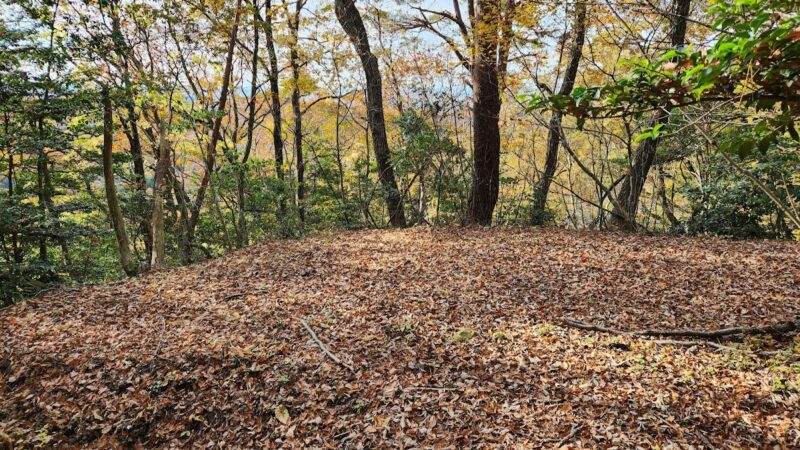
The main enclosure (honmaru), the center of Iwakura Castle, is long from north to south, and is surrounded by irregularly shaped earthen ramparts. These ramparts can still be clearly seen today, and although their height varies depending on the location, the highest point remains at over 2 meters.
A watchtower base was built at the northern end of the main enclosure, from which it is thought that one could overlook the surrounding area. This watchtower base was the highest point within the castle and served as a key point for surveillance and defense.
Entrances and Barbicans
Three entrances (koguchi) have been identified at Iwakura Castle. Located in the northwest, northeast, and southwest, these entrances were not merely entry points but incorporated defensive features.
Of particular note is the northwest entrance, which features a barbican. A barbican is a small enclosure (kuruwa) built in front of an entrance, designed to prevent enemy intrusion and facilitate friendly attacks. The presence of this barbican suggests it was added during renovations by the Oda clan, making it an important historical site demonstrating late Sengoku period castle construction techniques.
Arrangement of Enclosures
Multiple enclosures are arranged around the main enclosure, forming a tiered defensive line. These enclosures are irregularly positioned according to the terrain, reflecting the practical castle construction philosophy of the Ikkō-ikki era.
Highlights of Iwakura Castle
Well-Preserved Earthworks
The most impressive aspect of visiting Iwakura Castle is the excellent state of preservation of the earthworks surrounding the main enclosure. Despite being approximately 500 years old, the shape of the earthworks remains clearly defined, allowing visitors to appreciate the scale of the castle at that time. Walking along the earthworks provides a valuable opportunity to experience and understand the castle’s defensive structure.
Remains of the Horse Outwork
The horse outwork located at the northwest entrance is a particularly noteworthy remains of Iwakura Castle. The horse outwork was a defensive structure developed in the late Sengoku period and provides important evidence of modifications made by the Oda clan. The shape of the horse outwork can be clearly seen at the site, demonstrating the high level of castle construction technology at the time.
Structure of the Enclosures
The three entrances each have distinct characteristics, which are important for understanding the castle’s defensive plan. By observing the terrain around the entrances and the arrangement of the earthworks, one can understand how the castle attempted to prevent enemy intrusion.
Structure of the Enclosures
The three entrances each have different characteristics, which are crucial for understanding the castle’s defensive plan. ### Views
From Iwakura Castle, located on a mountaintop at an altitude of 296 meters, you can enjoy a panoramic view of Komatsu city and the Kaga Plain. On clear days, you can even see the Hakusan mountain range, giving you a real sense of why this location was chosen as a military base.
Walking Trails and Information Boards
Currently, walking trails are maintained at the Iwakura Castle site, allowing you to explore the main remains. Information boards are placed at key points, making it possible to learn about the castle’s history and structure while you visit. However, as it is a mountain castle, we recommend wearing comfortable shoes and clothing.
Access Methods
Access by Public Transportation
Take the Hokuriku Railway bus from JR Komatsu Station and get off at the “Kamimugiguchi” bus stop. The journey takes approximately 30 minutes. From the bus stop, it’s about a 40-minute walk to the castle site entrance. However, since you will need to climb a mountain path, plan accordingly and allow ample time.
Since the number of buses is limited, we recommend checking the timetable in advance. Please plan your visit time considering the return bus schedule.
Access by Private Car
By private car, it’s approximately 30 minutes from the Komatsu Interchange on the Hokuriku Expressway. Head towards Kamimugiguchi-cho and follow the signs. There is a small parking area near the castle ruins, but spaces are limited, so be aware of potential congestion.
If using a car navigation system, searching for “Iwakura Castle Ruins” or “Kamimugiguchi-cho, Komatsu City” is recommended. However, as it is a mountainous area, please drive carefully and pay attention to road conditions.
Ascent Route
From the parking area or bus stop, ascend the mountain path to the castle ruins. The path is well-maintained, but due to the elevation difference, a moderate level of physical fitness is required. Allow approximately 20-30 minutes for the ascent and 15-20 minutes for the descent.
Extra caution is needed during rainy weather or after rain, as the ground can become slippery. Also, since there is a possibility of snowfall in winter, we recommend checking the weather forecast before visiting.
Visiting Guide
Visiting Hours
Iwakura Castle Ruins are open to the public year-round, and admission is free. However, as it is a mountain castle, visiting during daylight hours is recommended. Allow approximately 1.5 to 2 hours for your visit, including the time it takes to climb up.
Best Time to Visit
Iwakura Castle Ruins can be visited throughout the year, but the most comfortable times are spring (April-May) and autumn (October-November). During these periods, the weather is mild, and you can enjoy the fresh greenery and autumn foliage. Insect repellent is necessary in summer, and warm clothing is required in winter.
What to Bring and Wear
When visiting the mountain castle, we recommend preparing the following basic items:
- Trekking shoes or comfortable walking shoes
- Drinking water
- Towel
- Insect repellent (spring to autumn)
- Hat
- Camera
- Map or guide materials
Choose comfortable clothing; long sleeves and long pants are recommended.
Precautions
Since Iwakura Castle Ruins are located in a mountainous area, please note the following:
- There are areas with poor cell phone reception
- There are no facilities such as toilets or vending machines
- You may encounter wild animals (wild boars, bears, etc.)
- Carry rain gear in case of sudden weather changes
- Visiting in a group is safer than visiting alone
Nearby Tourist Attractions
Natadera Temple
Natadera Temple, located about 20 minutes by car from Iwakura Castle, is an ancient temple founded in 717. With its many attractions, including the unique rock formations of Yusenkyo and the Shoin Garden, it’s also known as a famous spot for autumn foliage. Designated a National Place of Scenic Beauty, it’s one of Komatsu City’s representative tourist spots.
Japan Automobile Museum
Located in Futatsunashi-cho, Komatsu City, the Japan Automobile Museum is one of the largest automobile museums in Japan, exhibiting approximately 500 vehicles. It’s about a 30-minute drive from Iwakura Castle, making it a recommended spot not only for history buffs but also for car enthusiasts.
Aviation Plaza
Adjacent to Komatsu Airport, the Aviation Plaza is a facility where you can enjoy aircraft exhibits and simulators. With content enjoyable for both children and adults, and free admission, it’s a major draw.
Komatsu City Museum
This museum allows you to learn about the history and culture of Komatsu City, including exhibits on the history of the region, including Iwakura Castle. Visiting before visiting the castle ruins will provide a deeper understanding.
Historical Background of Komatsu City
The Ikko-ikki Rebellion in Kaga
Understanding the history of the Ikko-ikki rebellion in Kaga is essential to understanding Iwakura Castle. From the late 15th to the 16th century, followers of the Jodo Shinshu sect held immense power in Kaga Province, maintaining their own system of rule for approximately 100 years. This system, known as a “country ruled by peasants,” is a rare example in Japanese history.
Oda Nobunaga’s Pacification of Kaga
Oda Nobunaga began his full-scale campaign to suppress the Ikko-ikki forces in Kaga in 1573. The capture of Iwakura Castle was part of this effort and one of the important battles in Nobunaga’s unification of Japan.
The Maeda Clan Era
After the death of Oda Nobunaga, Kaga Province came under the control of Maeda Toshiie, laying the foundation for Kaga’s million-koku domain. The Komatsu area also developed as part of the Maeda clan’s territory, forming the foundation of the historical landscape that exists today.
Academic Value of Iwakura Castle
Research on Ikkō-ikki Castles
Iwakura Castle, as a mountain castle built by the Ikkō-ikki forces, occupies an important position in the study of medieval castles. It is a valuable example for understanding the castle-building techniques and defensive philosophies of religious forces.
Renovations during the Oda Period
Iwakura Castle, with its traces of renovations by the Oda clan, is also important for studying the changes in castle-building techniques during the late Sengoku period. The presence of a barbican, in particular, is noteworthy as a concrete example of the Oda clan’s castle renovation policy.
Preservation Status of the Remains
The remains of Iwakura Castle are preserved in relatively good condition, and much information can be obtained from observing the ground surface without archaeological excavation. Mountain castles in such a state are rare nationwide, and their future preservation and utilization are highly anticipated.
Photography Tips
Photographing the Earthworks
The earthworks surrounding the main enclosure are the most impressive remains of Iwakura Castle. Including people in the shot and experimenting with angles will result in more effective photographs, highlighting the height and shape of the earthworks.
Photographing the View
Using a wide-angle lens from the mountaintop allows you to capture the vast expanse of the Komatsu Plain. On clear days, you can even include the Hakusan mountain range in your composition.
Photographing the Horse Enclosure
Photographing the horse enclosure at the northwest gate from both above and the side will clearly show its structure. Including it with the information board makes it a useful documentary photograph.
The Significance of Visiting Iwakura Castle
Iwakura Castle is a mountain castle built by the Ikkō-ikki, a unique force in Japanese history, and a historical stage that played a part in Oda Nobunaga’s unification of Japan. The clearly remaining structures are a valuable historical legacy that conveys the spirit of the Sengoku period. When visiting Komatsu City, be sure to stop by the Iwakura Castle ruins and reflect on the history of 500 years ago. In the tranquil atmosphere unique to mountain castles, you can feel the lives of people from the Sengoku period.
Summary
Iwakura Castle is a mountain castle of the Ikkō-ikki rebels located in Komatsu City, Ishikawa Prefecture. It fell to Oda Nobunaga’s forces in 1573. Built on a mountaintop 296 meters above sea level, the castle retains well-preserved remains such as earthworks, gates, and outworks, making it a valuable historical site for learning about the structure of mountain castles during the Sengoku period.
Access is approximately 70 minutes by bus and on foot from JR Komatsu Station, or about 30 minutes by car. Visiting is free and possible at any time, but since it is a mountain castle, comfortable clothing and shoes are necessary. There are also other tourist attractions nearby, such as Natadera Temple and the Japan Automobile Museum, making it a great addition to a Komatsu City sightseeing trip.
Iwakura Castle, where two crucial forces in Japanese history—the Ikkō-ikki rebellion and Oda Nobunaga—intersected, is a must-see spot not only for history buffs but also for anyone interested in mountain castles and fortifications. Refer to the detailed information and guides, and be sure to visit Iwakura Castle to experience the history of the Sengoku period.