Masukata Castle (Uozu City, Toyama Prefecture) Complete Guide | History, Highlights, and Access Information
What is Masukata Castle?
Masukata Castle is a Sengoku period mountain castle located in Uozu City, Toyama Prefecture. Also known as “Masugata-yama Castle” and “Baigata-yama Castle,” it functioned as an important branch castle of the Uesugi clan in Etchu (present-day Toyama Prefecture). Built on a mountaintop approximately 300 meters above sea level, the castle boasted an excellent location overlooking Toyama Bay and was a strategically important point overlooking the Shinkawa Plain.
Currently, it is known to history enthusiasts and castle fans as a mountain castle ruin with surviving remains. It is one of the important historical sites indispensable to understanding the history of Uozu City, and the surrounding area is dotted with other Sengoku period castle ruins, including Uozu Castle.
History of Masukata Castle
Background and Period of Construction
There are various theories regarding the construction period of Masukata Castle, but it is believed to have been developed during the mid-to-late Sengoku period, coinciding with the expansion of the Uesugi clan’s power in Etchu Province. Etchu was a region where fierce power struggles unfolded between the Uesugi clan, the Ikko-ikki forces, and the Oda forces, and the area around Uozu was a particularly important strategic base.
Masukata Castle was positioned as a branch castle of Matsukura Castle and played a part in the Uesugi clan’s defense network in the Shinkawa region. Matsukura Castle was the Uesugi clan’s main mountain castle in Etchu, and Masukata Castle functioned as its front-line base.
Masukata Castle during the Uesugi Clan Era
The Uesugi clan’s rule in Etchu was established during the time of Uesugi Kenshin. Kenshin quelled the Etchu Ikko-ikki rebellion and built a strong system of control over the region. Masukata Castle was also defended by vassals of the Uesugi clan during this period, responsible for monitoring and defending the area around Uozu.
After the death of Uesugi Kenshin, Etchu Province remained Uesugi territory even under the rule of his successor, Uesugi Kagekatsu. However, with the expansion of Oda Nobunaga’s power, Etchu gradually came under Oda pressure.
Oda’s Invasion of Etchu and Masukata Castle
During the Tensho era (1573-1592), Oda Nobunaga began a full-scale invasion of Etchu. In particular, from 1581 to 1582, Oda’s Sasa Narimasa invaded Etchu, capturing numerous Uesugi castles one after another.
It is believed that Masukata Castle was also attacked by the Oda forces, but detailed battle records do not exist. However, since Uozu Castle fell to the Oda army in 1582, it is presumed that Masukata Castle also came under Oda control around this time.
The Battle of Uozu Castle and Masukata Castle
The Battle of Uozu Castle, fought from March to June 1582, is one of the most famous battles in the history of the Sengoku period in Etchu Province. The forces of Shibata Katsuie, Sassa Narimasa, and Maeda Toshiie, acting on the orders of Oda Nobunaga, besieged Uozu Castle, which was under the control of Uesugi Kagekatsu, and a fierce battle ensued.
Because Masukata Castle is located in the vicinity of Uozu Castle, it is possible that it played some role in this battle. Immediately after the fall of Uozu Castle, the Honnoji Incident occurred, and Oda Nobunaga was killed by Akechi Mitsuhide, plunging the situation in Etchu Province into chaos once again.
After the Toyotomi and Tokugawa Periods
After the Honnoji Incident, Etchu Province came under the control of Sasa Narimasa. However, Narimasa surrendered during Toyotomi Hideyoshi’s conquest of Etchu. Subsequently, Maeda Toshiie came to rule Etchu. It is believed that from this period onward, Masukata Castle lost its strategic importance and was abandoned.
In the Edo period, Uozu came under the control of the Kaga Domain, ushering in an era of peace. Masukata Castle, as a mountain castle, fell into disuse and gradually returned to nature.
Structure and Layout of Masukata Castle
Location and Topography
Masukata Castle is a typical mountain castle built on a mountaintop approximately 300 meters above sea level. It overlooks the Shinkawa Plain facing Toyama Bay, offering views of Toyama Bay to the northwest and the Tateyama mountain range and Mount Tsurugi of the Hida Mountains to the southeast. This location is thought to have served not only a military surveillance function but also a communication base. The castle’s defensive structure utilized the steep terrain characteristic of mountain castles, making it a formidable stronghold that was difficult for attackers to conquer. Its moderate distance from Uozu city center also allowed for emergency support.
Major Remains
The following remains have been confirmed at the current Masukata Castle site:
Main Enclosure (Honmaru)
Located at the mountaintop, the main enclosure was the site of the castle’s central facilities. A relatively flat, leveled area remains, suggesting the lord’s residence and command post were located here. The size of the main enclosure is standard for a medium-sized mountain castle.
Group of Enclosures
Several enclosures (kuruwa) are arranged around the main enclosure. These were used as defensive facilities and troop garrisons. The terraced arrangement of the enclosures provides a structure that gradually prevents enemy incursions.
Moat
Several moats, dug to cut across the ridge, have been confirmed. The moats served to prevent enemy intrusion and clearly demarcate the castle grounds. Some of the moats are still clearly visible today.
Earthworks
Traces of earthworks remain around the enclosures. These earthworks functioned as defensive walls, protecting against arrows and firearms. While some sections have crumbled over time, others retain their distinct shape.
Characteristics of the Castle Layout
The layout of Masukata Castle exhibits typical characteristics of a Sengoku period mountain castle. Defensive facilities are arranged in concentric circles around the main enclosure, creating multiple defensive lines. This structure is designed so that attackers must break through the defensive lines multiple times before reaching the main enclosure.
Furthermore, the layout utilizes the ridgeline, maximizing the use of the natural terrain. This is a common characteristic of Sengoku period mountain castles, aiming to achieve effective defense while keeping construction costs down.
Highlights of Masukata Castle
Stunning Views
The greatest highlight of Masukata Castle is its magnificent views. From the mountaintop, you can enjoy a panoramic view of the beautiful coastline of Toyama Bay, and on clear days, you can see the majestic mountain range of Tateyama. Especially from spring to autumn, it’s a spectacular spot where you can enjoy both the sea and the mountains.
Uozu City is famous for its mirages, and under the right conditions, it may be possible to observe mirages from the castle ruins. The best time to see mirages is generally from spring to early summer each year.
Observing the Remains
For castle enthusiasts, the opportunity to observe well-preserved remains is a major attraction. In particular, the moats and earthworks are valuable historical sites that convey the castle-building techniques of the Sengoku period. By observing the remains on-site, you can truly appreciate the structure and defensive ingenuity of the castle at that time.
Walking around the main enclosure allows you to grasp the overall layout of the castle, including the size of the leveled areas and the arrangement of the baileys. While information boards are limited, obtaining a map of the castle’s layout beforehand will enhance your understanding.
Natural Environment
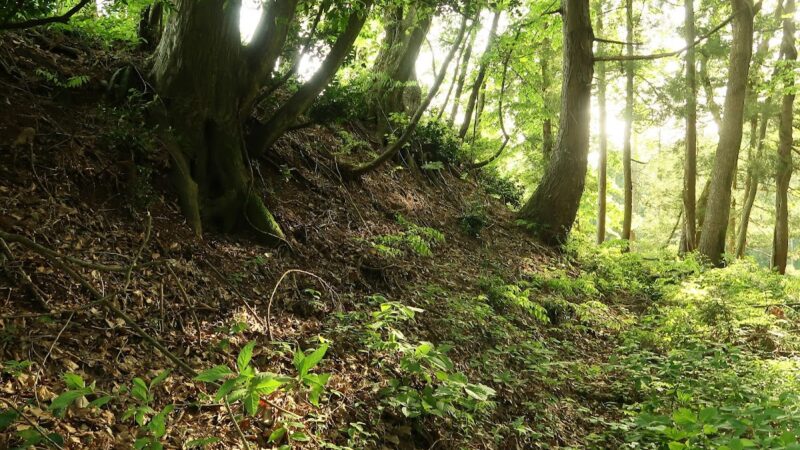
Masugata Castle Ruins are surrounded by abundant nature, allowing you to enjoy the vegetation throughout the seasons. The fresh greenery in spring and the autumn foliage are beautiful, making it an enjoyable hiking destination. It’s also known as a birdwatching spot, making it popular with nature lovers.
The path to the castle has both maintained and natural sections, requiring appropriate hiking gear. Depending on the weather, the ground can be slippery, so caution is advised.
Access Information
Access by Public Transportation
By Train
The nearest station is Uozu Station on the Ainokaze Toyama Railway. The distance from Uozu Station to Masugata Castle Ruins is approximately 5 kilometers, taking over an hour on foot. Taking a taxi from the station or renting a car is more practical.
If using the Hokuriku Shinkansen, get off at Kurobe-Unazuki Onsen Station and transfer to the Ainokaze Toyama Railway to Uozu Station. The journey from Kurobe-Unazuki Onsen Station to Uozu Station takes approximately 15 minutes.
If using the bus: While there are local bus routes within Uozu City, they do not go directly to the castle ruins. You will need to walk from the nearest bus stop.
Access by car:
If using the expressway: The nearest interchange is the Uozu Interchange on the Hokuriku Expressway. The castle ruins are approximately 10 kilometers from the interchange, a 20-minute drive.
Parking: There is no dedicated parking lot for the castle ruins, but there are a few parking spaces near the trailhead. However, many areas are unpaved, so be careful not to scrape the bottom of your car.
Precautions when climbing the castle:
Please note the following points when climbing the Masukata Castle ruins:
- Attire: Comfortable clothing and hiking boots or trekking shoes are recommended.
- Estimated Time: Allow approximately 30 minutes one way from the entrance to the main keep.
- Season: Climbing is difficult in winter due to snow. Spring to autumn is recommended.
- Equipment: Drinking water, a map, and a mobile phone are essential.
- Weather: The ground can be slippery during and after rain.
- Insect Repellent: Insect repellent spray is useful in summer.
Nearby Tourist Attractions
Uozu Castle Ruins
Located approximately 5 kilometers from Masukata Castle, Uozu Castle Ruins is a historical site famous for the Battle of Uozu Castle in 1582. It is now a park with information boards and monuments. Visiting both Masukata Castle and Uozu Castle together will give you a deeper understanding of Uozu’s Sengoku period history.
Matsukura Castle Ruins
The ruins of Matsukura Castle, the main castle of Masukata Castle, are also located within Uozu City. This large mountain castle, built on a 430-meter-high mountaintop, was an important base for the Uesugi clan in Etchu Province. While it requires a serious climb, it’s a must-see spot for castle enthusiasts.
Uozu Buried Forest Museum
The Uozu Buried Forest Museum, a representative tourist facility in Uozu City, allows visitors to learn about the buried forest from approximately 2000 years ago and mirages. Understanding the mysterious natural phenomena of Toyama Bay will deepen your understanding of Uozu’s geographical features. A visit before or after visiting the castle ruins is recommended.
Mirage Observation Spot
Uozu City is known as one of Japan’s leading mirage observation sites. Mirages are most likely to appear from spring to early summer each year, and the area around the “Mirage” Sea Station is designated as an observation spot. Information on mirage occurrences can be found on the Uozu City Tourism Association website.
Firefly Squid Tourism
March to May is the peak season for firefly squid, a specialty of Toyama Bay. Tours are available at Uozu Fishing Port where you can observe the early morning firefly squid fishing. There are also many restaurants in the city where you can enjoy fresh firefly squid.
History and Culture of Uozu City
Geographical Characteristics of Uozu
Uozu City is located in the eastern part of Toyama Prefecture, almost in the center of the Shinkawa Plain. To the northwest lies Toyama Bay, and the southeast is a mountainous area reaching a maximum elevation of 2,415 meters. It is characterized by a unique topography where the distance between the sea and mountains is short, and the elevation rises rapidly from the plains to the mountainous areas.
This topographical feature has resulted in a region blessed with clean water, abundant nature, and fresh seafood. The scenery, offering views of famous peaks such as the Tateyama mountain range, Mt. Tsurugi, and Mt. Yakushi, is also a major attraction.
Uozu’s Three Great Scenic Wonders
Uozu City is famous for its three great scenic wonders: mirages, firefly squid, and buried forests. These are all natural phenomena created by the unique geographical conditions of Toyama Bay and Uozu.
Mirages are optical phenomena that appear from spring to early summer, making the scenery on the opposite shore appear to float in the air. Firefly squid are deep-sea squid that gather in the shallow waters of Toyama Bay in spring to spawn. The buried forest is a primeval cedar forest from approximately 2000 years ago that has been buried on the seabed, making it a globally rare natural heritage site.
Uozu in the Sengoku Period
During the Sengoku period (Warring States period), Uozu was an important strategic base in Etchu Province. It was under the control of the Uesugi clan for a long period, and several castles, including Uozu Castle, were built there. The Battle of Uozu Castle in 1582 was a fierce battle between the forces of Oda Nobunaga and Uesugi Kagekatsu, ending tragically with the complete annihilation of all the castle’s defenders.
Because the Honnō-ji Incident occurred immediately after this battle, marking a turning point in history, the Battle of Uozu Castle is remembered as one of the most important battles in Japanese history.
Model Itinerary for Visiting Masukata Castle
Day Trip Course
Morning
9:00 Arrive at Uozu Station
9:30 Visit Uozu Buried Forest Museum (1 hour)
10:45 Travel to Masukata Castle Ruins (20 minutes by car)
11:15 Climb and explore Masukata Castle Ruins (2 hours)
Afternoon
13:30 Lunch in Uozu City (firefly squid dishes, etc.)
14:30 Visit Uozu Castle Ruins (30 minutes)
15:30 Purchase souvenirs at the “Shinkiro” Seaside Station
16:30 Return to Uozu Station
2-Day/1-Night Course
Day 1
Morning: Arrive in Uozu, visit Uozu Buried Forest Museum
Afternoon: Climb and explore Masukata Castle Ruins
Evening: Stay overnight in Uozu City or a nearby hot spring resort
Day 2 Morning: Ascent to Matsukura Castle Ruins (a full-fledged mountain castle exploration)
Afternoon: Uozu Castle Ruins, city sightseeing, souvenir shopping
Materials and Research on Masukata Castle
Documentary Materials
Detailed documentary materials on Masukata Castle are limited, but it is mentioned in the following documents:
- “Comprehensive Survey Report of Medieval Castle Sites in Toyama Prefecture”
- “History of Uozu City”
- “Research on Ancient Castle Sites in Echizen”
These documents describe the location, size, and historical background of Masukata Castle. However, since detailed archaeological excavations have not been conducted, many points remain unclear.
Future Research Issues
The following research issues remain regarding Masukata Castle:
- Determination of the exact construction date
- Details of the castle lord and garrison
- Relationship with Matsukura Castle
- Role in the Battle of Uozu Castle
- Period and circumstances of abandonment
Further archaeological excavations and documentary research may reveal a more detailed history.
Manners and Precautions When Visiting Masukata Castle
Request for Historical Site Preservation
Masukata Castle ruins are a valuable historical heritage site. Please cooperate with the following points when visiting:
- Do not damage or dig up the remains
- Always take your trash with you
- Do not collect plants
- Do not use fire
- Please take care of the information boards and signs
Safety Management
Visiting mountain castle ruins involves certain risks.
- Avoid going alone; visit in groups whenever possible
- Pay attention to sudden changes in weather, and turn back if you feel it is dangerous
- Check your cell phone signal strength
- Inform family or friends of your destination before climbing the castle
- Complete your descent before sunset
Consideration for Local Residents
There are private homes and farmland around the castle ruins.
- Do not trespass on private property.
- Do not make excessive noise.
- Do not park on the street.
- Be considerate and avoid interfering with agricultural work.
Summary
Masugata Castle is a mountain castle ruin from the Sengoku period located in Uozu City, Toyama Prefecture. It functioned as an important branch castle of the Uesugi clan in Etchu Province. Currently, it is known to history enthusiasts and castle fans as a historical site with remaining structures.
Its attractions include a magnificent view overlooking Toyama Bay, well-preserved remains such as moats and earthworks, and a rich natural environment. Uozu City also has many other historical sites from the Sengoku period, such as Uozu Castle Ruins and Matsukura Castle Ruins, and there are also tourist facilities nearby, such as the Uozu Buried Forest Museum and a mirage observation spot.
Access is approximately 20 minutes by car from Uozu Station. The climb to the castle takes about 30 minutes, and comfortable clothing and hiking boots are recommended. The best time to visit is from spring to autumn, and especially if you visit during the mirage or firefly squid season, you can enjoy the diverse charms of Uozu.
While paying attention to historical site preservation and safety management, please do visit the Masukata Castle ruins and experience the historical romance of the Sengoku period.