A Thorough Explanation of Wakamiko Castle Ruins | A Sengoku Period Fortress and the Stage of the Tensho-Jingo War, a Pride of Hokuto City
Wakamiko Castle, located in Wakamiko, Sutama-cho, Hokuto City, Yamanashi Prefecture, is an important medieval mountain castle indispensable to the history of Kai Province. Currently, it is preserved as a Hokuto City designated historical site and developed as Sutama Furusato Park. This article provides a detailed explanation of Wakamiko Castle, from its historical background and castle structure to its highlights and access methods.
Overview and Historical Importance of Wakamiko Castle
Wakamiko Castle is a multi-bailey mountain castle built on a plateau approximately 50 meters high on the right bank of the Sutama River. Its location, utilizing the natural fortifications between the Nishikawa and Kujirazawa rivers, provides excellent military defense.
Basic Information about the Castle
- Location: Wakagami, Sutama-cho, Hokuto City, Yamanashi Prefecture
- Other Names: Wakagami Old Castle, Wakagami Great Castle, Wakagami North Castle, Wakagami South Castle
- Castle Structure: Concentric mountain castle
- Construction Period: Late Heian period (tradition), effectively Sengoku period
- Designation: Hokuto City Designated Historic Site
- Current Status: Developed as Sutama Furusato Park
The distinguishing feature of Wakagami Castle is that it is not a single castle, but rather a network of subsidiary castles consisting of multiple enclosures, such as the Great Castle (Old Castle), North Castle, and South Castle. This structure demonstrates a wide-ranging defensive system and illustrates the development of castle construction technology during the Sengoku period.
History of Wakagami Castle
Legend of the Origin of the Kai Genji Clan
A legend persists that Wakagami Castle was built by Shinra Saburo Yoshimitsu (Minamoto no Yoshimitsu), the ancestor of the Kai Genji clan. Yoshimitsu was a military commander in the late Heian period and later became the founder of the Kai Takeda clan. If this legend is true, Wakagami Castle would have existed since the late Heian period.
However, many of the castle remains that can be confirmed today are thought to date from the Sengoku period, and there are various theories regarding the actual construction period. Although there is a chronological gap between the legend and the archaeological evidence, it is undeniable that this area was an important base associated with the Kai Genji clan from ancient times.
Role During the Takeda Clan Era
During the Sengoku period, Wakagami Castle functioned as an important relay point for the Takeda clan’s conquest of Shinano (Shinshu). Located on the route from Kai Province to Shinano Province, Wakagami Castle is thought to have been used as a supply base and rear support base.
During the time of Takeda Shingen, the area around Wakagami Castle was used as a troop assembly point and supply depot during the invasion of Shinano Province. Located in the northern part of the Kofu Basin, this castle was a strategically important point controlling the road leading to Shinshu Province via the southern foothills of the Yatsugatake Mountains.
The Tensho-Jingo War and the Battle of Wakagami Castle
Wakagami Castle first plays a significant role on the historical stage during the Tensho-Jingo War of 1582. In that year, the Takeda clan was destroyed by Oda Nobunaga, and with Nobunaga’s subsequent death in the Honnoji Incident, Kai Province became a power vacuum.
Taking advantage of this chaos, Tokugawa Ieyasu and Hojo Ujinao (son of Hojo Ujimasa) clashed over control of Kai Province. In October of Tensho 10 (1582), Tokugawa Ieyasu established his headquarters at Shinpu Castle, while Hojo Ujinao’s headquarters were at Wakagami Castle, and the two armies faced each other. This is the historical event known as the “Wakagami Standoff.”
The two armies continued their standoff for approximately two months, but ultimately a peace agreement was reached, with Tokugawa Ieyasu receiving Kai and Shinano provinces, and the Hojo clan receiving Kozuke province. In this standoff, Wakagami Castle played a crucial role as the Hojo’s frontline base.
After the Edo Period
After the Tensho-Jingo War, Wakagami Castle is believed to have ceased its military role and been abandoned. During the Edo period, while recognized locally as a castle site, it was used for farmland and forest.
In modern times, the historical value of the Wakagami Castle ruins has been re-evaluated, and archaeological excavations and preservation activities have been promoted. Currently, it is protected as a designated historical site of Hokuto City and is open to citizens and tourists as Sutama Furusato Park.
Castle Structure and Layout
The castle structure of Wakagami Castle is noteworthy for its complex network of subsidiary castles, while possessing typical characteristics of a medieval mountain castle.
Structure of the Main Castle (Old Castle)
The main castle (old castle) is the heart of Wakagami Castle. Built on the tip of a ridge between the Nishikawa and Kujirazawa rivers, its layout skillfully utilizes the natural terrain.
The following have been identified as major defensive structures:
- Main Enclosure: The central enclosure of the castle, located at the highest elevation.
- V-shaped Moat: A deep moat with a V-shaped cross-section, an important defensive structure to prevent enemy intrusion.
- Earthwork: An earthen wall surrounding the enclosure, enhancing its defensive capabilities.
- Dry Moat: A moat dug to cut across the ridge, preventing attacks from the rear.
- Vertical Moat: A moat dug vertically along the slope, preventing attacks from the flank.
The V-shaped moat is one of the distinctive remains of Wakagami Castle and can still be clearly seen today. Its depth and steepness demonstrate the advanced castle-building techniques of the time.
Structure of the North Castle
The North Castle was built on a ridge extending north of the main castle, across the river. It functioned as a subsidiary castle of the main castle, serving as a defensive base against attacks from the north.
The North Castle, though relatively small, consists of a group of fortified enclosures with independent defensive functions. It is believed that, in conjunction with the Main Castle, it formed a wider defensive network.
Structure of the South Castle
The South Castle is a subsidiary castle located on the southern ridge of Kujirazawa. It played a role in monitoring and defending the southern incursion route.
Similar to the North Castle, the South Castle also formed part of a network of subsidiary castles centered around the Main Castle, and the three castles worked together to create a strong defensive system.
Characteristics of the Castle’s Layout
The layout of Wakagami Castle possesses the following outstanding military features:
- Utilization of Natural Terrain: Maximizing the use of the natural fortifications of a plateau nestled between rivers and streams.
- Multiple Defenses: A three-pronged defense system consisting of the main castle, north castle, and south castle.
- Securing Visibility: Easy monitoring of the surrounding area due to its elevated location.
- Control of Roads: A strategic location controlling the main road leading to Shinshu.
These features indicate that Wakagami Castle was not merely the residence of a local powerful family, but was systematically built as a base playing a crucial role in a broader military strategy.
Archaeological Excavations and Excavated Artifacts
Multiple archaeological excavations have been conducted at the Wakagami Castle site, contributing to a better understanding of the castle’s structure.
Discovered Archaeological Structures
The following structures were discovered during the excavation:
- Moat Remains: The cross-sectional structure of various moats, including a V-shaped moat, was revealed.
- Earthwork Base: The construction method and scale of the earthwork were determined.
- Post Holes: Groups of post holes indicating the presence of buildings.
- Stone Masonry Structures: Traces of structures using stone in some areas.
These structures confirm that Wakagami Castle was a full-fledged mountain castle built with the technology of the Sengoku period.
Excavated Artifacts
The following artifacts were unearthed during the excavation:
- Ceramic Fragments: Tableware indicating daily life during the Sengoku period.
- Iron Products: Artifacts related to construction and blacksmithing, such as nails and iron slag.
- Coins: A small amount of medieval coins were unearthed.
- Haji Ware and Sue Ware: Medieval pottery.
These unearthed artifacts are valuable resources for understanding the daily life and usage period within the castle. In particular, the dating of the ceramics confirms that the castle was most actively used during the late Sengoku period (Warring States period).
Highlights of Wakagami Castle Ruins
Currently, the Wakagami Castle Ruins have been developed as Sutama Furusato Park, a place where visitors can experience history.
The Impressive Yagenbori Moat
A must-see when visiting Wakagami Castle is the remarkably well-preserved Yagenbori moat. This moat, with its V-shaped cross-section, reaches a depth of several meters, giving a real sense of the castle’s high defensive capabilities at the time. The height of the earthen ramparts viewed from the bottom of the moat is breathtaking, allowing you to appreciate the pinnacle of medieval castle construction technology.
Views from the Enclosures
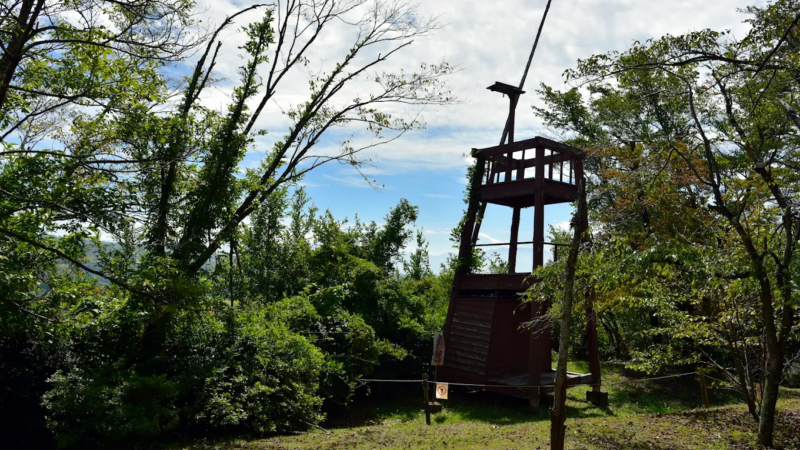
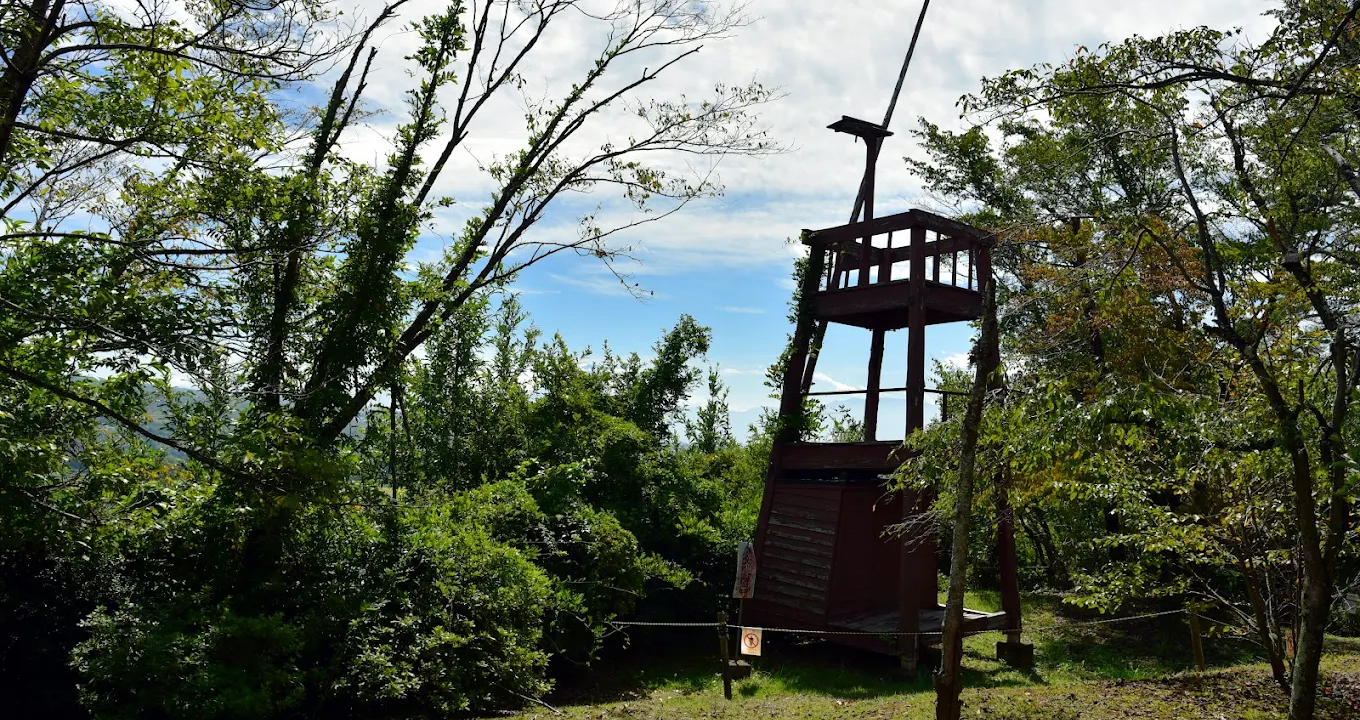
From the main enclosure and other enclosures, you can enjoy a panoramic view of the town of Sutama. On a clear day, you can see Mt. Kayagatake, Mt. Fuji, and even Mt. Mizugaki in the distance, demonstrating the castle’s ideal location for monitoring the surrounding area.
During the Sengoku period, the castle lords likely monitored enemy movements from this very view. We, in modern times, can enjoy the same peaceful scenery from the same place.
Earthworks and Moats
The earthworks and moats remaining throughout the castle grounds are also a highlight. These remains are clearly visible even after hundreds of years, allowing us to understand the layout of the castle at the time. The moats, in particular, are constructed to completely cut off the ridge, and their sheer scale is astonishing.
Cherry Blossoms and Azaleas in Spring
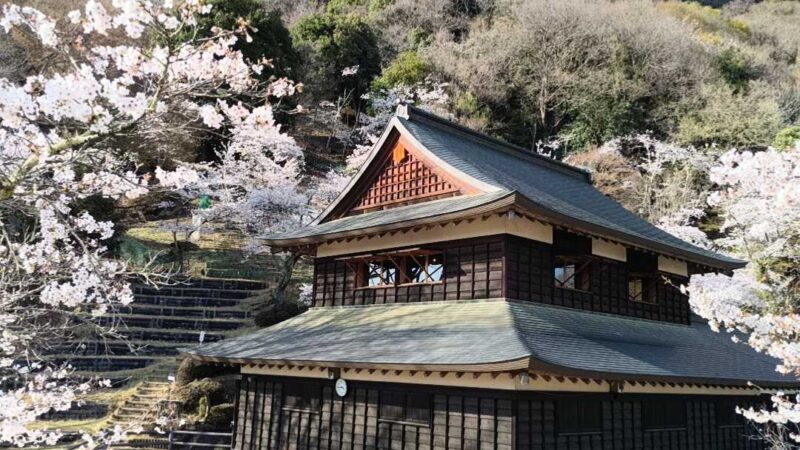
Wakagami Castle Ruins is not only a historical site but also a famous spot for flowers. In spring, cherry blossoms and azaleas bloom in profusion, attracting many flower viewers. It’s a luxurious spot where you can enjoy both historical sightseeing and flower viewing at the same time.
During cherry blossom season, the entire castle ruins are dyed in a soft pink, announcing the arrival of gentle spring to the castle ruins that witnessed the turbulent Sengoku period.
Information Boards and Explanations
Information boards explaining the history and structure of the castle are installed within the park. By referring to these while strolling, you can gain a deeper understanding of the history of Wakagami Castle. Even first-time visitors can easily tour the main ruins by following the guide signs.
Access Information
Here’s how to access Wakagami Castle Ruins (Sutama Furusato Park).
Access by Car
If using the Chuo Expressway:
- Approximately 5 minutes from Sutama IC
- Approximately 10 minutes from Nagasaka IC
Parking is available within the park and is free of charge. However, during peak seasons such as cherry blossom season, parking spaces may be limited, so early arrival is recommended.
Travel time from major cities:
- From Tokyo: Approximately 2 hours 30 minutes
- From Kofu city center: Approximately 40 minutes
- From Suwa: Approximately 1 hour
Access by public transport
Using trains and buses:
- Get off at JR Chuo Main Line “Nirasaki Station”
- Take a bus from Nirasaki Station and get off at “Wakagami” bus stop (approximately 20 minutes)
- Approximately 15 minutes on foot from the bus stop
Since bus services are limited, it is recommended to check the timetable in advance. Especially on holidays, bus services may be infrequent, so you may want to consider taking a taxi.
Nearby Tourist Attractions
When visiting Wakagami Castle Ruins, we recommend also visiting the nearby tourist attractions:
- Shinfu Castle Ruins: The last castle built by Takeda Katsuyori (approx. 20 minutes by car)
- Takeda Hachimangu Shrine: An ancient shrine associated with the Takeda clan (approx. 15 minutes by car)
- Kiyoharu Art Village: An art museum housed in a former school building (approx. 10 minutes by car)
- Suntory Hakushu Distillery: Whiskey factory tour (approx. 30 minutes by car)
By combining these spots, you can create a one-day course to fully enjoy the history and culture of Hokuto City.
Points to Note and Manners When Visiting
When visiting Wakagami Castle Ruins, please note the following:
Clothing and Equipment
- Comfortable walking shoes: The castle ruins are hilly and have unpaved areas, so sneakers or hiking boots are recommended.
- Seasonal clothing: It can be windy as it is located on a hill. Bring a jacket in spring and autumn.
- Hat and sunscreen: The sun is strong in summer, so heatstroke prevention is necessary.
- Drinks: Remember to stay hydrated, especially in summer.
Visitor Etiquette
- Protection of Ruins: Please be careful not to climb on the earthworks or moats, or damage the ruins.
- Take your trash home: To maintain the beauty of the park, please be sure to take your trash home with you.
- No plant collection: Collecting plants in the park is prohibited.
- No open flames: To prevent fires, smoking is only permitted in designated areas.
Estimated Visiting Time
For a visit to the Wakagami Castle Ruins, you should allow approximately 30 minutes to 1 hour. If you want to carefully observe the ruins and enjoy taking photographs, 1 hour and 30 minutes will allow for a more relaxed stroll.
Historical Background Surrounding Wakagami Castle
To gain a deeper understanding of Wakagami Castle’s history, let’s touch upon the surrounding historical background.
Geopolitical Importance of Kai Province
Kai Province (present-day Yamanashi Prefecture) held a crucial strategic position during the Sengoku period. It was a key point connecting the Tokaido and Nakasendo roads, and an access point to important regions such as Shinano, Suruga, and Sagami.
Takeda Shingen was able to expand his power from Kai due to this geographical advantage. Wakagami Castle was a vital stronghold located in the northern part of Kai Province, at the entrance to Shinshu.
Significance of the Tensho-Jingo War
The Tensho-Jingo War was a crucial event that determined the course of national unification after the death of Oda Nobunaga. The confrontation between Tokugawa Ieyasu and Hojo Ujinao in this war became a historical turning point that determined the later structure of Kanto rule.
The Battle of Wakagami Castle, where Tokugawa Ieyasu secured Kai and Shinano provinces, was a crucial step in laying the foundation for his later rise to power. Wakagami Castle is truly one of the sites where Japanese history was shaped.
Strategies of the Hojo and Tokugawa Clans
Hojo Ujinao had a clear strategic reason for choosing Wakagami Castle as his headquarters during the Battle of Wakagami. This castle was ideally positioned to maintain a suitable distance from Tokugawa Ieyasu at Shinpu Castle while maintaining communication with the Hojo territories in the rear.
On the other hand, Tokugawa Ieyasu’s choice of Shinpu Castle as his headquarters was intended to control the center of the Kofu Basin and demonstrate the legitimacy of his rule over Kai Province. The chosen locations of both sides reflected their respective strategic philosophies.
Preservation and Utilization of Wakagami Castle Ruins
The Wakagami Castle ruins are being preserved and utilized as a valuable cultural asset of Hokuto City.
Designation as a Historic Site and Preservation Activities
Wakagami Castle Ruins, legally protected as a Hokuto City designated historic site, strives to balance the preservation of its remains with public access. Regular mowing and tree management maintain the ruins in excellent condition.
Local history enthusiasts and citizen volunteers participate in preservation activities, demonstrating a community-wide effort to protect the castle ruins.
Educational Use
Wakagami Castle Ruins are also used as a site for local history education. Local elementary and junior high schools conduct field trips to the castle ruins as part of their local history studies, providing children with a valuable opportunity to learn about local history.
In addition, history lectures and guided castle tours are held irregularly, allowing citizens and tourists to explore the castle ruins while listening to explanations from experts.
Use as a Tourism Resource
With its development as Sutama Furusato Park, Wakagami Castle Ruins has become a popular place of relaxation not only for history buffs but also for general tourists and local residents.
The castle ruins’ appeal as a scenic spot for cherry blossoms and azaleas has attracted visitors who aren’t particularly interested in history, ultimately leading to increased awareness of the site. As a park where history, nature, and recreation are integrated, it exhibits multifaceted value.
Wakagami Castle and the Kai Castle Network
Wakagami Castle did not exist in isolation; it functioned as part of a comprehensive network of castles in Kai Province.
Its Position in the Takeda Clan’s Castle System
The Takeda clan built numerous castles within Kai Province, using them as bases for territorial control and military operations. Wakagami Castle was one of the important bases responsible for the northern Shinano region.
Relationship with Major Takeda Clan-Related Castles:
- Tsutsujigasaki Castle: The Takeda clan’s base (present-day Kofu City)
- Shinpu Castle: The last main castle built by Takeda Katsuyori
- Shishiku Castle: A branch castle located near Wakagami Castle
- Yato Castle: An important stronghold in Nirasaki City
These castles worked in conjunction with each other to efficiently govern the vast territory of the Takeda clan.
Relationship with Roads
The importance of Wakagami Castle lies in its location, which controlled major roads. Situated on a route branching off from the Koshu Kaido towards Shinshu, it played a crucial role both militarily and economically.
It is believed that monitoring merchants and travelers passing through the road and collecting tolls as needed was also one of the castle’s functions.
Summary: Historical Value of Wakagami Castle
Wakagami Castle is an important historical heritage site that Hokuto City, Yamanashi Prefecture, is proud of. Beginning with the legend of the origin of the Kai Genji clan, and later serving as a base for the Takeda clan’s conquest of Shinshu, and as the stage for the confrontation between the Tokugawa and Hojo clans during the Tensho-Jingo War, Wakagami Castle has played a significant role in important moments in Japanese history.
The well-preserved castle ruins today are invaluable historical materials that convey the castle-building techniques and military strategies of the Sengoku period. In particular, defensive structures such as the Yagenbori moat and earthworks concretely demonstrate how the castle defended against enemy attacks at the time.
The Wakagami Castle ruins, now developed as Sutama Furusato Park, function not only as a place for historical learning but also as a place of relaxation and a tourist attraction for citizens. It is loved by many for its cherry blossoms in spring, its magnificent views, and above all, for the romance of history it evokes.
When you visit Hokuto City, be sure to visit the Wakagami Castle ruins and experience the atmosphere of the Sengoku period. At this place where Tokugawa Ieyasu and Hojo Ujinao confronted each other, you can experience both the weight of history and the beauty of nature simultaneously. Wakagami Castle, as a precious bridge connecting the past and the present, will undoubtedly continue to speak to us with many lessons for years to come.