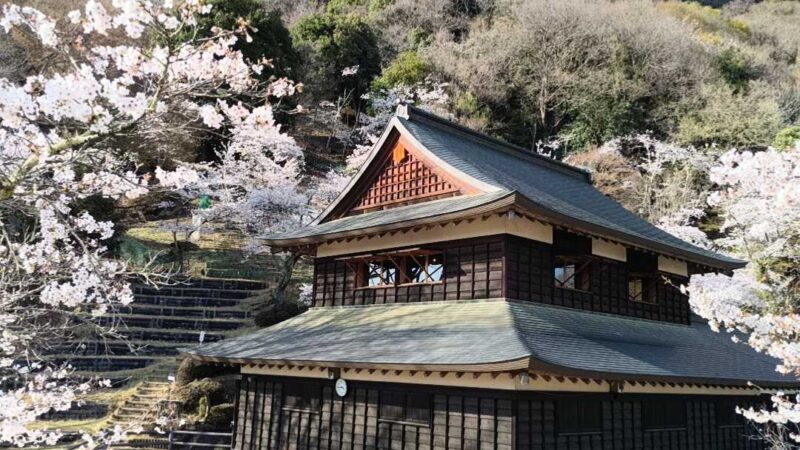
Motosu Castle (Fujikawaguchiko Town) Complete Guide | The History and Remains of a Sengoku Period Mountain Castle Sleeping in the Aokigahara Forest
What is Motosu Castle? | A Sengoku Period Beacon Tower Built at the Foot of Mt. Fuji
Motosu Castle is a medieval mountain castle located in Motosu, Fujikawaguchiko Town, Minamitsuru District, Yamanashi Prefecture. It is built on the ridge of “Shiroyama,” a cape-like formation jutting out into the Aokigahara Forest, and is located north of Lake Motosu, one of the Fuji Five Lakes.
Built at an altitude of approximately 1,000 meters, this castle is known as a beacon tower that played an important role in the territorial management of the Takeda clan during the Sengoku period. Even today, the remains such as moats, baileys, and stone walls are well-preserved, making it a valuable historical site that allows us to imagine its appearance in the unique environment of the forest.
The name of the mountain, Shiroyama (Castle Mountain), itself suggests the existence of a castle in this area, and it has long been recognized locally as “the mountain where a castle once stood.” While seemingly unrelated to human activity, this area, nestled in the Aokigahara forest at the foot of Mount Fuji, actually contains remnants of old roads and checkpoints, indicating its function as a vital transportation hub.
Location and Geographical Characteristics of Motosu Castle
Shiroyama, where Motosu Castle was built, possesses a distinctive topography within the Aokigahara forest. The cape-like ridge jutting out into the sea of forest, surrounded by deep woods, offers open views, making it an ideal location for raising signal fires.
Lake Motosu is the deepest of the Fuji Five Lakes, boasting a maximum depth of 122 meters. Its water clarity is high, and from the northern shore, one can enjoy a spectacular view of Mount Fuji. Motosu Castle was built near this viewpoint on the northern shore of Lake Motosu, standing amidst a unique landscape of the lake, Mount Fuji, and the Aokigahara forest.
The History of Motosu Castle | The Takeda Clan’s Beacon Network and the Sengoku Period
Role as a Beacon Station during the Takeda Clan Era
The exact construction date of Motosu Castle is unclear, but it is believed to have been developed by the Takeda clan, who ruled Kai Province during the Sengoku period. The Takeda clan established a network of beacon stations as a means of information transmission in their territorial management, and Motosu Castle played a key role in this network.
The foot of Mount Fuji was a border region between Kai and Suruga Provinces, and was militarily important. Gathering and transmitting information around Mount Fuji was crucial in confrontations with the Imagawa and Hojo clans, and it is presumed that Motosu Castle played a role in monitoring developments in this region and transmitting information back to the mainland.
A Strategic Point on Roads and Checkpoints
Traces of old roads remain around Motosu Castle, indicating that this area was a vital transportation hub during the medieval period. The remains of a checkpoint, buried within the forest, have also been confirmed, suggesting that Motosu Castle may have served not only as a signal fire station but also as a means of monitoring the road and managing travelers.
As a junction point for roads leading from Motosu to the Kofu Basin, or to Suruga Province, this area saw significant traffic of people and goods, necessitating the construction of a castle. While difficult to imagine from the current tranquil forest, this was a place of considerable human activity during the Sengoku period.
Motosu Castle After the Fall of the Takeda Clan
After the fall of the Takeda clan in 1582, Kai Province saw a succession of rulers: Oda Nobunaga, Tokugawa Ieyasu, and Toyotomi Hideyoshi. The fate of Motosu Castle during this period is uncertain, but it is believed that it lost its function as a castle and was abandoned during the Edo period.
Subsequently, Motosu Castle disappeared from the historical stage and quietly lay dormant within the forest. Even after the Meiji era, it was recognized as a castle site by locals, but no full-scale investigation or restoration was carried out. It has only recently been re-evaluated by mountain castle enthusiasts and researchers.
Structure and Layout of Motosu Castle | Mountain Castle Remains in the Aokigahara Forest
Arrangement of the Main Enclosure and Baileys
Motosu Castle has a multi-enclosure layout with multiple baileys arranged on the ridge of the castle mountain. The main enclosure is located at the highest point of the ridge and is surrounded by earthen ramparts. While the main enclosure is not particularly large, it is sufficiently spacious considering its function as a signal fire station.
Multiple baileys are arranged in a stepped fashion along the ridge from the main enclosure, and each bailey is demarcated by a moat. This layout is typical of mountain castles and is designed to make the most of the limited terrain.
Moats and Defensive Facilities
One of the greatest highlights of Motosu Castle is its well-preserved moats. The trenches dug across the ridge were important defensive structures to prevent enemy intrusion, and their depth and scale can still be observed today.
In some areas, multiple trenches are found in succession, indicating a layout that prioritized defense. Steep cliffs rise from the bottom of the trenches, demonstrating the advanced castle-building techniques of the time.
Remains of Stone Walls and Stone Strewns
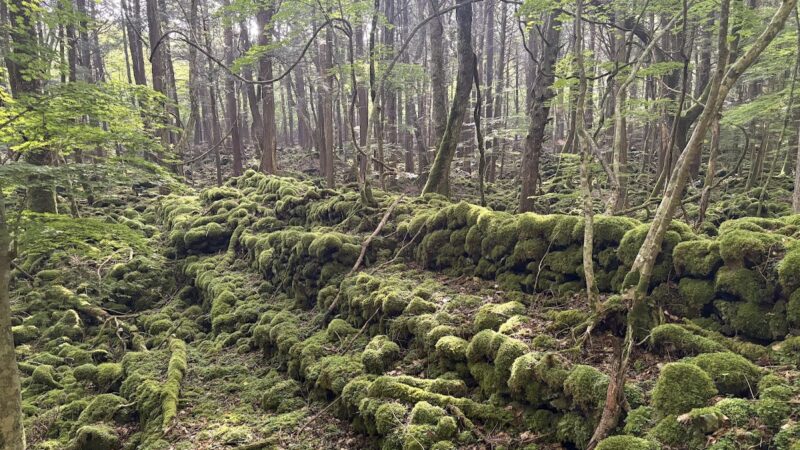
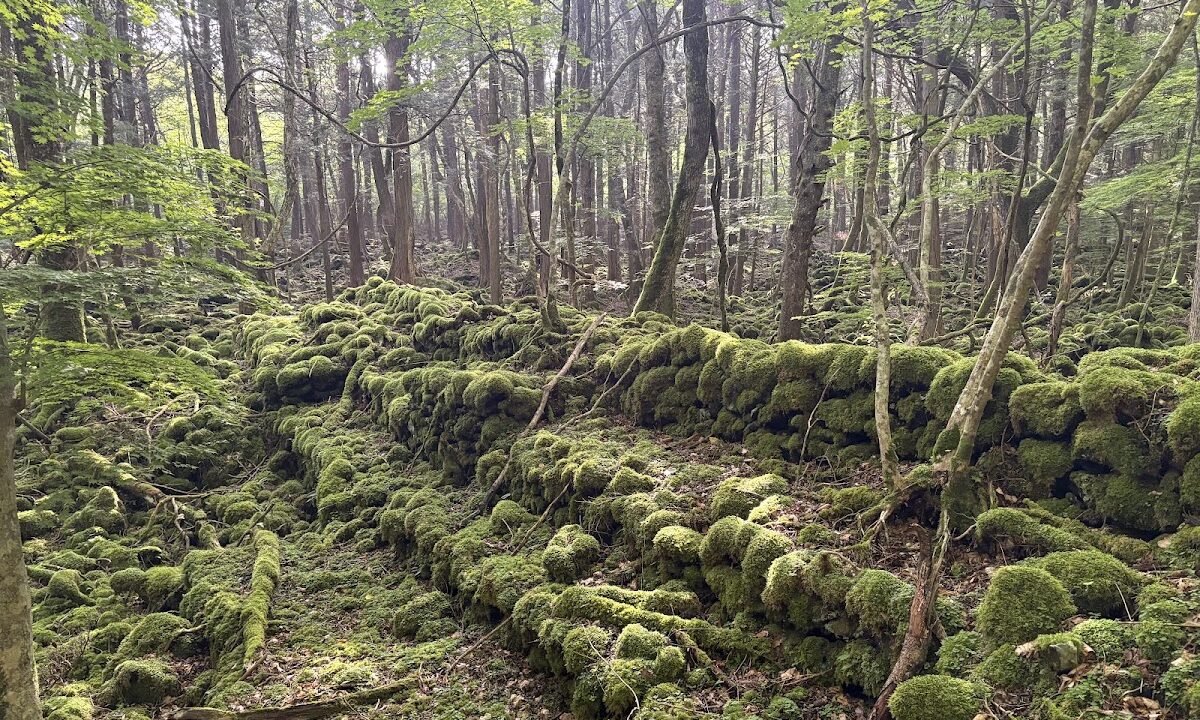
Remains of stone walls and stone strewns have also been confirmed at Motosu Castle. Although not large in scale, traces of stacked stones remain on the edges of the enclosures and near the entrances, indicating that it was not simply an earthen castle, but was reinforced with stone.
The area around Aokigahara Forest is a lava plateau, so it is thought that stone materials were relatively easy to obtain. These stone walls have not been altered in later periods and are valuable remains that likely retain their original form from the time of construction.
Relationship with Motosu Stone Strewn Walls
Near Motosu Castle, there are also remains known as the “Motosu Stone Strewn Walls.” This stone wall is thought to be a separate structure from Motosu Castle, but it’s possible it was built around the same time as a related structure. The stone wall is presumed to have functioned as a defensive structure or boundary marker, suggesting the possibility of a complex defensive system centered around Motosu Castle.
Highlights of Motosu Castle | Points to Appreciate the Castle Ruins
Clearly Remaining Moats
The most impressive feature when visiting Motosu Castle is the clearly remaining moats. Fortunately, its location within a dense forest has spared it from later development, preserving its original appearance almost entirely. Seeing the depth of the moats and the steepness of the cliffs firsthand allows you to experience the castle-building techniques and defensive ingenuity of the Sengoku period.
In particular, the moat separating the main enclosure and the second enclosure is large in scale, indicating its crucial role in the castle’s defense. Standing at the bottom of the moat and looking up at the height of the cliffs is truly awe-inspiring.
Layout of Enclosures and Utilization of Terrain
The group of enclosures arranged on the ridge is a fine example of a castle layout that skillfully utilizes the terrain. By making the most of the natural terrain and adding artificial structures where necessary, an efficient defensive line was constructed.
Walking through each enclosure allows you to understand the overall structure of the castle and the concept of defense. Imagining how the limited space on the ridge was utilized is also part of the enjoyment of exploring.
Observation of Stone Masonry Remains
Although the stone masonry and stone wall remains are small in scale, they are valuable resources for understanding the technology of the time. By observing up close what kind of stones were used and how they were stacked, you can learn about the evolution of stone wall technology and regional characteristics.
The stone masonry utilizing lava from the Aokigahara forest is unique to this region and has characteristics that set it apart from other mountain castles.
Atmosphere of a Castle Ruins in the Forest
The greatest charm of Motosu Castle lies in the fact that it is a castle ruin standing in the unique environment of the Aokigahara forest. The experience of visiting the ruins of the Sengoku period in a tranquil space surrounded by a deep forest offers a unique atmosphere unlike any other castle ruin.
The landscape, where the mystical atmosphere of the Aokigahara forest blends with the historical remains, leaves a profound impression on visitors.
Access and Visiting Guide to Motosu Castle
Access by Public Transportation
To visit Motosu Castle by public transportation, the nearest station is Kawaguchiko Station on the Fujikyu Railway Line. From Kawaguchiko Station, take the Fujikyu Bus “Naruzawa, Shojiko, Motosuko Loop Bus (Blue Line)” and get off at the “Ishirui-iriguchi” bus stop.
The castle entrance is approximately a 5-minute walk from the bus stop. However, since the number of buses is limited, it is recommended to check the timetable in advance and plan your visit accordingly. Particular caution is needed during the winter months, as the number of buses may be reduced.
Access by Car
If traveling by car, take the Chuo Expressway to either the Kawaguchiko IC or Fujiyoshida IC, then take National Route 139 and National Route 300 towards Motosu. It’s approximately 30 minutes from the Kawaguchiko IC.
There is no dedicated parking lot for Motosu Castle, but there are a few parking spaces near the entrance to the castle. However, space is limited, so please be considerate of other visitors. Also, some roads around the Aokigahara forest are narrow, so please drive carefully.
Preparations and Precautions for Visiting the Castle
Motosu Castle is not a developed tourist destination, but rather a site where the remains of a mountain castle are preserved. The following preparations and precautions are necessary for visiting the castle.
Clothing and Equipment:
- Hiking boots or trekking shoes are essential.
- Wear long sleeves and long pants to avoid skin exposure (to prevent insect bites and scratches from vegetation).
- A hat and gloves are recommended.
- Prepare appropriate warm clothing and rain gear for the season.
Items to Bring:
- Drinking water (there are no vending machines, etc.)
- Map or GPS device (to avoid getting lost in the forest)
- Insect repellent spray (especially in summer)
- Flashlight (there are dark areas in the forest even during the day)
- Mobile phone (for emergency contact, however, there are areas with poor reception)
Notes for Visiting:
- Allow approximately 2 to 2.5 hours for the round trip.
- As there are areas in the forest where the paths are difficult to follow, it is advisable to avoid going alone and visit in groups.
- Do not damage the ruins or move stones.
- Please take all your trash with you. During winter, there is a possibility of snow and ice, so it is best to avoid visiting.
Best Season for Visiting
The best time to visit Motosu Castle is spring (April-May) and autumn (October-November). The weather is stable during these times, and there are relatively few insects, making for a comfortable stroll.
Summer (June-September) is insect-heavy and humid, so insect repellent and hydration are essential. Winter (December-March) is dangerous due to the possibility of snow and ice, so visits are not recommended for those without experience.
Attractions and Tourist Information Around Motosu Castle
The Stunning View of Lake Motosu
When visiting Motosu Castle, be sure to enjoy the scenery of Lake Motosu. Lake Motosu is known as the deepest and clearest of the Fuji Five Lakes. The view of Mount Fuji from the north shore is spectacular, and it is also famous as the location where the “inverted Fuji” image, featured on the back of the old 1000-yen banknote, was photographed. The photograph of Mount Fuji taken by photographer Koyo Okada from Nakanokura Pass remains a beloved and iconic image of Mount Fuji in Japan. Many photography enthusiasts still visit the area to capture its beautiful form.
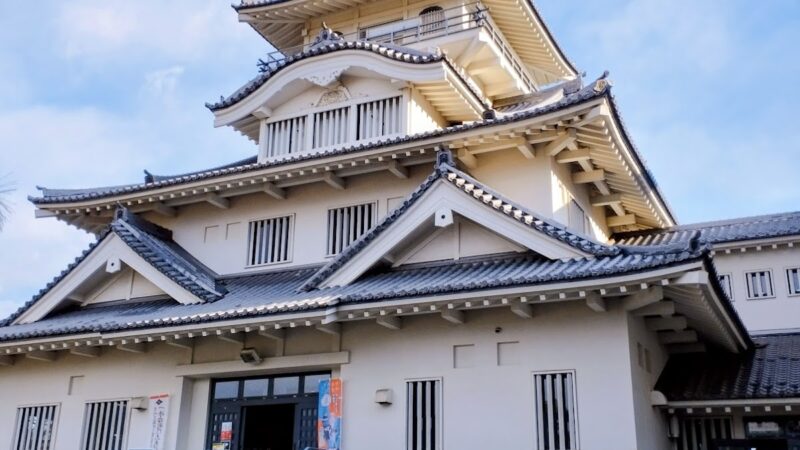
Motosu Historical Museum & Lake Motosu Tourist Information Center
Lake Motosu is home to the Motosu Historical Museum and Lake Motosu Tourist Information Center, where visitors can learn about the history and nature of the region. Exhibits include materials related to Motosu Castle, the formation of the Aokigahara Forest, and the natural environment of Lake Motosu.
Location: 18 Motosu, Fujikawaguchiko-machi, Minamitsuru-gun, Yamanashi Prefecture
Phone: 0555-87-2518
Visiting these facilities before or after visiting Motosu Castle will allow you to gain a deeper understanding of the region’s history and culture.
The Nature of Aokigahara Forest
Aokigahara Forest, where Motosu Castle is located, is a primeval forest spread across a lava plateau formed by the eruption of Mount Fuji. Hundreds of years old trees grow densely, forming a unique ecosystem.
Several walking trails are maintained within the forest, and guided tours are also available. Enjoying a stroll through the forest in conjunction with a visit to Motosu Castle allows you to experience both the nature and history of this region.
Fuji Motosuko Resort
Fuji Motosuko Resort is located on the southern shore of Lake Motosu, where various flowers bloom throughout the seasons. The moss phlox in spring is particularly famous, creating a breathtaking spectacle of a colorful carpet of flowers against the backdrop of Mount Fuji.
Location: 212 Motosu, Fujikawaguchiko-machi, Minamitsuru-gun, Yamanashi Prefecture
Enjoying the seasonal flowers in conjunction with a visit to Motosu Castle is highly recommended.
Motosu Castle and Surrounding Castles
Mountain Castles Around Fujikawaguchiko Town
Several other mountain castle ruins remain in the area surrounding Fujikawaguchiko Town, where Motosu Castle is located. These castles played an important role in the Takeda clan’s territorial management, and visiting them together with Motosu Castle will provide a deeper understanding of the Sengoku period in this region.
Kawaguchi Castle: A mountain castle located north of Lake Kawaguchi, whose lord was a vassal of the Takeda clan.
Koi Castle: A mountain castle located in Fujiyoshida City, which served as a key castle in the Gun’nai region.
Visiting these castles will reveal the overall picture of the castle network at the foot of Mt. Fuji.
Signal Fire Network
Motosu Castle is part of the Takeda clan’s signal fire network, situated within a chain of signal fires extending from the Kofu Basin towards Suruga. Studying it together with other signal fire ruins will reveal the reality of the information transmission system during the Sengoku period.
Preservation of Motosu Castle and Future Challenges
Preservation Status of the Ruins
Because Motosu Castle is located in the unique environment of the Aokigahara forest, it has remained untouched by development, resulting in excellent preservation of its ruins. While this is a significant advantage, it also presents a challenge: a lack of proactive maintenance and protection.
Currently, while information boards are in place, detailed information such as castle layout maps is not available on-site. Furthermore, the access routes to the castle are not clearly maintained, making it difficult for first-time visitors to navigate.
Future Maintenance and Utilization
Mountain castle ruins like Motosu Castle are valuable historical assets of the region, requiring appropriate preservation and utilization. While excessive development could damage the ruins, a minimum level of improved information boards and safe access routes are necessary.
In addition, widely promoting the historical value and highlights of Motosu Castle, and attracting mountain castle enthusiasts and history buffs, is expected to contribute to its use as a regional tourism resource. However, appropriate visitor management is crucial to avoid environmental damage caused by overtourism. ## The Charm of Visiting Motosu Castle | Historical Romance Sleeping in the Aokigahara Forest
Motosu Castle doesn’t boast flashy stone walls or a magnificent keep. However, visiting the remains of a Sengoku period mountain castle in the mystical environment of the Aokigahara forest offers a unique charm unlike any other.
The remains, such as moats, baileys, and stone walls, are invaluable evidence of the lives and skills of the people of that time. Imagining the people who once lit signal fires and monitored the roads here, amidst the silence of the forest, makes history feel more tangible.
The history of this small but undeniably existing castle amidst the magnificent nature at the foot of Mount Fuji speaks to the diversity and depth of Japan’s Sengoku period. Visiting Motosu Castle will be more than just a castle ruin tour; it will be a special experience where nature and history intersect.
We recommend a visit to Motosu Castle not only to mountain castle enthusiasts but also to anyone looking for a unique historical stroll during their Fuji Five Lakes sightseeing. However, we must take safety very seriously and cherish the natural environment and historical remains while passing on this valuable historical heritage to future generations.