A Complete Guide to the History and Highlights of Higashine Castle (Higashine City, Yamagata Prefecture) – From Odajima Castle to the Present
Higashine Castle, also known as “Odajima Castle,” was a flatland castle located in Higashine City, Yamagata Prefecture. It defended a strategically important location in the northern part of the Yamagata Basin for approximately 300 years, from the Nanboku-cho period to the early Edo period. While most of the remains have been lost, it is known as an important historical site that preserves traces of history, including the “Higashine Great Zelkova Tree,” a national special natural monument, and a relocated castle gate.
Overview and Historical Positioning of Higashine Castle
Higashine Castle was a flatland castle located in Honmaru, Higashine City, Yamagata Prefecture, built on an alluvial fan on the east bank of the Mogami River. It functioned as a strategically important base controlling a key transportation hub in the northern part of the Yamagata Basin from the Nanboku-cho period to the early Edo period.
Currently, Higashine Elementary School stands on the castle site, and very few clear remains are left. However, to the west of the main keep site stands the “Higashine Great Zelkova Tree,” estimated to be over 1500 years old, which quietly continues to watch over the castle’s history.
Alternative Names and Names of Higashine Castle
Higashine Castle is also known by the alternative name “Odajima Castle.” This name originates from the name of its original builder, Odajima Nagayoshi (Taira Nagayoshi), and both names have been used in historical documents and locally.
History of Higashine Castle – From the Nanboku-cho Period to the Edo Period
Construction and the Odajima Clan Era (Nanboku-cho Period)
Higashine Castle is believed to have been built during the Nanboku-cho period, around 1356 (Enbun 1). The builder was Odajima Nagayoshi (Taira Nagayoshi), a warlord who ruled the Higashine area. It is said that Odajima Nagayoshi transferred the sacred seal of Kamakura’s Tsurugaoka Hachimangu Shrine to Higashine Hachiman Shrine, and the shrine still preserves the portable shrine from that time (a Yamagata Prefecture designated cultural property). There is also a record that the shrine donated an ancient bell, considered the second oldest in the prefecture, in 1356.
The Higashine Clan Era (Muromachi to Sengoku Periods)
At the beginning of the Muromachi period, Sakamoto Yorikata, son of Tendō Yorinao (a member of the Shiba clan), adopted the name Higashine and became the lord of Higashine Castle. The Higashine clan ruled this area for seven generations, maintaining their power as a powerful local clan in the northern part of the Yamagata Basin.
The Higashine clan’s rule continued until the Sengoku period, but a major turning point occurred in 1584 (Tenshō 12). Direct rule by the Higashine clan ended with Higashine Yorikage, and Satomi Genzaemon Kagesuke became the castle lord. However, there is also a theory that Kagesuke was Yorikage’s younger brother, suggesting that it may not have been a complete break in the lineage, but rather a power transfer within the family.
The Satomi Clan Era and Castle Expansion (Azuchi-Momoyama Period to Early Edo Period)
Satomi Genzaemon Kagesuke served Mogami Yoshiaki, a Sengoku daimyo of Yamagata, and extensively expanded Higashine Castle. Kagesuke not only improved the castle but also actively developed the castle town, making Higashine a regional center. As Mogami Yoshiaki’s power expanded, Higashine Castle came to function as an important branch castle of the Mogami territory.
However, after Satomi Kagesuke’s death in 1620 (Genna 6), the Mogami clan was dispossessed of their domain just two years later in 1622 (Genna 8). This dispossession forced the Satomi clan to be placed under the care of the Hachisuka clan of Awa Province (present-day Tokushima Prefecture), and they were forced to leave Higashine.
Torii Clan Rule and Castle Demolition (Early Edo Period)
After the Mogami clan’s downfall, Higashine came under the rule of Torii Tadamasa, the lord of Yamagata Castle. However, due to the Edo shogunate’s “One Castle Per Province” policy, Higashine Castle was demolished in 1661 (Kanbun 1).
After the castle’s demolition, a magistrate’s office was built on the site of the second bailey, but this did not last long. In 1668 (Kanbun 8), Higashine became a shogunate territory, and the magistrate’s office was also abolished. This marked the complete end of Higashine Castle’s history as a fortress.
Structure and Layout of Higashine Castle
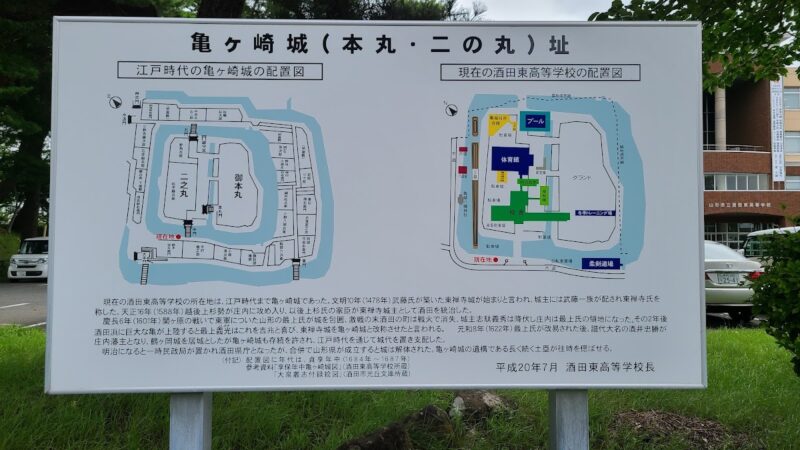
Higashine Castle is believed to have been built as a flatland castle, consisting of baileys such as the main bailey, second bailey, and third bailey. While detailed layout maps do not remain, records indicate that the castle’s size was significantly expanded during the expansion by Satomi Kagesuke.
Current Status of the Main Enclosure Site
The main enclosure site is currently occupied by Higashine Elementary School, making it difficult to confirm any clear remains. However, the “Higashine Great Zelkova Tree” still stands on the west side of the main enclosure site, a valuable historical landmark that tells the story of the castle.
Second and Third Enclosures
After the castle was demolished, a magistrate’s office was built on the site of the second enclosure, but now almost no traces remain. The entire castle area, including the third enclosure, has been urbanized, making it difficult to imagine its former appearance.
Highlights and Remains of Higashine Castle
The “Higashine Great Zelkova Tree,” a National Special Natural Monument
The greatest highlight of Higashine Castle is the “Higashine Great Zelkova Tree,” which still stands on the west side of the main enclosure site. Its estimated age is over 1500 years, and it is designated as a National Special Natural Monument.
This giant tree has been rooted in this land since long before Higashine Castle was built. With a trunk circumference of approximately 16 meters and a height of approximately 28 meters, this magnificent zelkova tree is known as one of Japan’s most representative giant trees. Having watched over the history of the castle, this large zelkova tree is a symbol of Higashine City, beloved by its residents and a popular tourist attraction.
The area surrounding the large zelkova tree has been developed into a park with benches, allowing visitors to leisurely reflect on its history. Its majestic appearance is especially striking during the seasons of fresh greenery and autumn foliage.
Castle Gate Relocated to Jokoku-ji Temple
Another important historical site remaining from Higashine Castle is the castle gate relocated to Jokoku-ji Temple. When the castle was demolished, a portion of the gate was moved to Jokoku-ji Temple and has been preserved as the temple gate to this day.
This gate is valuable as one of the few remaining structures of Higashine Castle and is an important historical document for understanding the architectural style of the time. When visiting Jokoku-ji Temple, being aware that this gate was part of Higashine Castle approximately 400 years ago will give you a deeper sense of history.
Higashine Hachiman Shrine and Historical Heritage
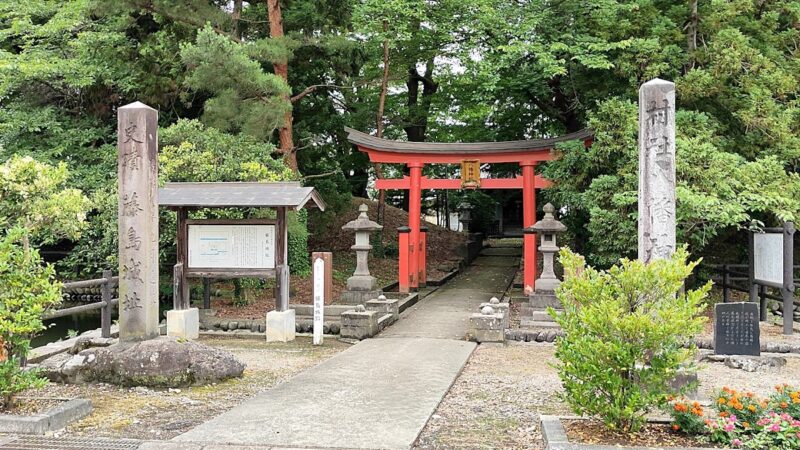
Higashine Hachiman Shrine, where the sacred seal of Kamakura’s Tsurugaoka Hachimangu Shrine is said to have been transferred in 1356 by Odajima Nagayoshi, the builder of Higashine Castle, is a shrine deeply connected to the castle’s history.
The shrine houses a main hall said to have been built during the Nanboku-cho period (Northern and Southern Courts period), and has long been revered as the guardian shrine of the entire Higashine area. Valuable cultural artifacts are preserved there, including a portable shrine designated as a Yamagata Prefecture cultural property and an ancient bell, said to be the second oldest in the prefecture.
When visiting Higashine Castle, visiting Higashine Hachiman Shrine as well allows you to experience the long flow of history from the Nanboku-cho period.
How to Access Higashine Castle
Access by Public Transportation
Using the JR Yamagata Shinkansen:
- Get off at “Sakuranbo-Higashine Station,” then walk approximately 15 minutes to Higashine Elementary School (site of the main castle).
- Accessible in approximately 3 hours from Tokyo Station and approximately 1 hour from Sendai Station.
Using the JR Ou Main Line:
- Get off at “Sakuranbo-Higashine Station” or “Higashine Station.”
- Approximately 5-10 minutes by taxi.
Access by Car
Using the Tohoku Chuo Expressway:
- Approximately 5 minutes from “Higashine IC.”
- Approximately 30 minutes from central Yamagata City.
- Approximately 1 hour from Sendai City.
From Yamagata Airport:
- Approximately 10 minutes by car.
- Approximately 1 hour flight from Tokyo (Haneda Airport) to Yamagata Airport.
Parking Information
Parking spaces for tourists are available around the large zelkova tree in Higashine. However, since the site of the main castle keep is now part of Higashine Elementary School grounds, consideration should be given to school hours.
Higashine City Tourist Information and Nearby Spots
Higashine Onsen
Higashine Onsen is located about a 10-minute drive from the Higashine Castle ruins. This historic hot spring resort, dating back to the Meiji era, boasts several inns and day-use bathing facilities. Relaxing in the hot springs after exploring the castle ruins is highly recommended.
Higashine, the Fruit Kingdom
Higashine City is known as the “Fruit Kingdom,” boasting the highest cherry production among all municipalities in Japan. During the cherry-picking season from June to July, tourist farms open throughout the city, attracting many visitors.
Furthermore, you can enjoy picking various fruits throughout the season, such as apples and La France pears. Combining a visit to Higashine Castle with seasonal fruit picking is a popular plan.
Higashine, the Fruit Kingdom
Higashine City is known as the “Fruit Kingdom,” boasting the highest cherry production among all municipalities in Japan. During the cherry-picking season from June to July, tourist farms open throughout the city, attracting many visitors.
In addition, you can enjoy picking various fruits depending on the season, such as apples and La France pears. A plan combining a visit to Higashine Castle with seasonal fruit picking is also popular. ### Tantokuru Center (Higashine City General Park)
This general park, adjacent to Sakuranbo-Higashine Station, features a heated swimming pool, gymnasium, library, and other facilities. It’s a popular spot for families with children and a convenient place to visit in conjunction with a trip to Higashine Castle.
Surrounding Castles and Historic Sites
Yamagata Castle (Kasumi Castle):
- Approximately 20km south of Higashine City, about 30 minutes by car
- A representative castle of Yamagata Prefecture, developed by Mogami Yoshiaki
- Designated as a national historic site, restoration and development are underway
Tendo Castle (Maizuru Castle):
- Approximately 10km south of Higashine City, about 15 minutes by car
- The residence of the Tendo clan, a castle with close ties to the Higashine clan
- Developed as Tendo Park, also famous as a cherry blossom viewing spot
Sagae Castle:
- Approximately 15km west of Higashine City, about 20 minutes by car
- The residence of the Sagae clan, also known for its battles with Mogami Yoshiaki
History and Culture of Higashine City
Origins of Higashine City
Higashine City was established in 1958 (Showa 33) when it was incorporated as a city. Located in the northern part of the Yamagata Basin, on the east bank of the Mogami River, Higashine City is situated on an alluvial fan formed by the Ran River, Shiramizu River, Murayamano River, and Hitō River, which flow from the Ōu Mountains.
It has flourished as a transportation hub since ancient times, and Higashine Castle was built due to its geographical importance. Even today, it continues to develop as a transportation hub in Yamagata Prefecture, boasting the Sakuranbo-Higashine Station on the Yamagata Shinkansen and Yamagata Airport.
Local Products and Industries
Higashine City boasts the highest cherry production in Japan, as well as the largest production of baked gluten (yakifu) in Japan. While agriculture remains its core industry, in recent years, industries such as electronic component manufacturing have also developed, resulting in a well-balanced industrial structure.
Best Season and Ways to Enjoy a Visit to Higashine Castle
Spring (April-May)
This is the season when the fresh green leaves of Higashine’s large zelkova trees are beautiful. The sight of the vigorous young leaves sprouting is full of vitality, allowing you to feel the life force of this 1500-year-old giant tree. The surrounding cherry blossoms are also in full bloom, allowing you to enjoy both a historical stroll and cherry blossom viewing at the same time.
Early Summer (June-July)
This is the season for cherry picking, Higashine City’s biggest event. You can enjoy cherry picking in the orchard in conjunction with a visit to the castle ruins. The giant zelkova tree is enveloped in deep green, and this is the time when its majestic appearance is most striking.
Autumn (October-November)
This is the season when the giant zelkova tree’s autumn leaves are magnificent. The giant tree, dyed in golden hues, is breathtakingly beautiful, attracting many photography enthusiasts. This is also the harvest season for apples and La France pears, so you can enjoy fruit picking as well.
Winter (December-March)
The giant zelkova tree, covered in snow, also has a unique charm. While there are fewer tourists, it’s the perfect season to quietly reflect on history. Enjoying a leisurely tour of the historical sites while warming up in Higashine Onsen is highly recommended.
Historical Figures Associated with Higashine Castle
Mogami Yoshiaki
A daimyo from the Sengoku period to the early Edo period, and the first lord of the Dewa Yamagata Domain. Satomi Kagesuke followed Mogami Yoshiaki and expanded Higashine Castle and developed the castle town. Yoshiaki raised Yamagata into a powerful daimyo with a domain of 570,000 koku, but due to succession issues, the Mogami clan was dispossessed after his death.
Satomi Genzaemon Kagesuke
He became the lord of Higashine Castle in 1584 and was a warrior who developed the castle and castle town under Mogami Yoshiaki. He died in 1620, and two years later, the Mogami clan was dispossessed, forcing the Satomi clan to leave Higashine. Kagesuke’s reign is considered to be the golden age of Higashine Castle.
Torii Tadamasa
He was a daimyo who became the lord of Yamagata Castle after the Mogami clan was dispossessed of their domain. A senior retainer of Tokugawa Ieyasu, he distinguished himself in the Battle of Sekigahara and the Siege of Osaka. As a daimyo with a domain of 240,000 koku in Yamagata, he ruled a vast area including Higashine, but Higashine Castle was demolished due to the “One Castle Per Province” decree.
Reference Information for Learning About Higashine Castle
Related Books
- “History of Yamagata Prefecture” (Yamakawa Publishing)
- “Mogami Yoshiaki and Yamagata Castle”
- “History of Higashine City”
- “Castles and Residences of Yamagata”
These books provide detailed information about the history of Higashine Castle and the developments in the Yamagata Basin during the Sengoku period.
Cultural Facilities in Higashine City
Higashine City Local History Museum:
This museum exhibits materials related to the history and culture of Higashine City. It also houses materials related to Higashine Castle, and visiting before your visit will deepen your understanding.
Higashine City Library:
Located within the Tantokuru Center, it boasts a rich collection of local historical materials related to Higashine City.
Summary – Historical Value and Modern Significance of Higashine Castle
Higashine Castle was an important fortress that protected a strategic point in the northern part of the Yamagata Basin for approximately 300 years, from the Nanboku-cho period to the early Edo period. While there are few clearly defined remains today, valuable historical traces remain, albeit fragmentary, such as the “Higashine Great Zelkova Tree,” a national special natural monument, the castle gate relocated to Jokoku-ji Temple, and cultural properties at Higashine Hachiman Shrine.
Higashine City is currently known nationwide as “Higashine, the Kingdom of Fruit Trees,” attracting many tourists as the top cherry-producing region in Japan. With good transportation access, including Sakuranbo-Higashine Station on the Yamagata Shinkansen and Yamagata Airport, it is an easily accessible tourist destination.
Visiting the Higashine Castle ruins holds significance beyond mere historical site sightseeing. Standing before the magnificent zelkova tree, which boasts a history of over 1500 years, you can truly feel the continuity of history from the Nanboku-cho period to the present day. Furthermore, by strolling through the townscape of Higashine, which was developed as a castle town, soaking in hot springs, and savoring seasonal fruits, you can experience the multifaceted charm of Higashine, where history and modernity blend seamlessly.
When visiting Yamagata Prefecture, be sure to include Higashine Castle Ruins and sightseeing in Higashine City in your itinerary. It’s an attractive place that can be enjoyed by a wide range of people, from history buffs to families, hot spring lovers, and foodies.