Tamajo Castle (Sekigahara Town, Gifu Prefecture) Complete Guide | History and Highlights of a Strategic Mountain Castle on the Mino Border
Tamajo Castle, located in Tama, Sekigahara Town, Fuwa District, Gifu Prefecture, is a historical castle that functioned as an important mountain castle protecting the border between Mino and Omi provinces from the Nanboku-cho period to the Sengoku period. Situated on the summit of Shiroyama Mountain at an altitude of 307.5 meters, it played a crucial role in many historical moments as a strategic point overlooking the Tosan-do (Nakasendo) and Hokkoku-kaido roads.
In recent years, it has attracted attention after being featured on the NHK program “History Detective,” and a new evaluation is underway regarding its role as a strategic base for the Western Army in the Battle of Sekigahara. This article provides a detailed explanation of this fascinating mountain castle, including its history, the characteristics of its remains, its highlights, and how to access it.
Historical Background of Tamajo Castle
Construction and Initial Role during the Nanboku-cho Period
The construction of Tamajo Castle is believed to date back to the Nanboku-cho period. Located on the border between Mino and Omi Provinces, this area has long been recognized as a strategically important military location. Taking advantage of its topography on the summit of Shiroyama Mountain, it is believed to have played a role in monitoring and deterring enemy incursions.
During the turbulent Nanboku-cho period, it is highly probable that this castle functioned as a crucial base in the power struggles over Mino Province, and is thought to have been built as a frontline border defense.
Tamaki Castle in the Sengoku Period
During the Sengoku period (Warring States period), Tamaki Castle became an important base forming part of Mino Province’s eastern defense line. Throughout the eras of the Saito clan, who ruled Mino, and later Oda Nobunaga, the strategic value of this castle increased in confrontations with the Asai and Rokkaku clans of Omi Province.
Its location, allowing simultaneous monitoring of the major highways of the Tosan-do (Nakasendo) and Hokkoku-kaido, was extremely important both militarily and economically. It played a vital role in detecting enemy movements early and preventing invasions into Mino Province.
The Battle of Sekigahara and a New Assessment of Tamaki Castle
A new theory has recently gained attention suggesting that Tamaki Castle played a crucial role in the Western Army’s strategy during the Battle of Sekigahara in 1600. While it was previously believed that Tamaki Castle did not function effectively in the main battle of Sekigahara, it has now been suggested that it may have held significant importance in the Western Army’s initial strategy.
It is thought that the Western Army, using Ogaki Castle as their base, planned to utilize surrounding fortresses, including Tamaki Castle, to prevent the Eastern Army’s advance. Tamaki Castle may have been positioned as a base to monitor the Eastern Army’s movements from the Omi region and intercept them if necessary.
However, due to a sudden change in the battle situation, the Western Army chose to fight the decisive battle at Sekigahara, and the battle at Tamaki Castle never materialized. Nevertheless, the positioning of Tamaki Castle in the Western Army’s strategic vision speaks to the castle’s military importance.
Location and Geographical Characteristics of Tamaki Castle
Topography and Elevation of Shiroyama Mountain
Shiroyama Mountain, on which Tamaki Castle was built, is a highly isolated mountain with an elevation of 307.5 meters. The mountain has a clearly distinguishable shape from the surrounding plains, and its summit offers a 360-degree panoramic view.
This topographical feature allows for a wide-ranging view, from the Sekigahara plains to the east, the Omi region to the west, the settlements along the Nakasendo road to the south, and Mount Ibuki to the north. It possessed ideal locational conditions for a military surveillance base.
Border between Mino and Omi
Tamaki Castle is located very close to the border between Mino and Omi provinces. This region, known as the Mino-Edo border, has historically been a zone where the powers of both provinces intersected.
From the perspective of border defense, Tamaki Castle played a crucial role in preventing invasions from Omi. The location of the castle mountain is a strategic point controlling the main route for entering Mino from Omi.
Relationship with Roads
The Tōsandō (later the Nakasendo) road runs to the south of Tamaki Castle, and the Hokkokukaidō road runs to the north. Tamaki’s greatest geographical advantage was its position to simultaneously monitor these two major roads.
The Tōsandō was a main road connecting eastern Japan with Kyoto, and the Hokkokukaidō was an important route connecting the Hokuriku and Tōkai regions. Controlling these key transportation hubs was extremely important both militarily and economically.
Tamaki’s Layout and Structure
Main Enclosure Size and Arrangement
Tamaki’s main enclosure is constructed over 200 meters east-west, extending from northeast to southwest. It possesses a relatively large main enclosure for a mountain castle, allowing for the stationing of a considerable number of troops.
The interior of the main enclosure is relatively flat, and several flat areas believed to be the remains of buildings can be identified. Earthworks and trenches were positioned around the main enclosure, creating a robust defensive system.
Arrangement of Enclosures and Defensive System
Multiple enclosures are arranged in a stepped pattern around the main enclosure. These enclosures formed a defensive line that progressively prevented enemy approaches to the main enclosure.
Moats and trenches were constructed between each enclosure, demonstrating various measures to hinder enemy advances. In particular, the moats blocking the ridge effectively prevented the entry of large enemy forces.
Characteristics of Earthworks and Stone Walls
Earthworks played a major role in Tamashiro’s defenses. The earthworks surrounding the main enclosure remain clearly visible, allowing us to estimate their original height.
While traces of stonework have been found in some areas, no full-fledged stone walls were constructed. This reflects the castle’s construction period and renovation history, strongly retaining its characteristics as an earthen castle.
Arrangement of Moats and Trenches
Moats and trenches played a crucial role in Tamashiro’s defenses. Multiple moats were constructed along the ridge leading to the main enclosure, blocking enemy advance routes.
Vertical trenches were dug vertically into the slopes, serving to make it difficult for enemies to climb the slopes. These remains are still well-preserved today, providing valuable information about the castle construction techniques of the time.
Remains of the Former Imperial Japanese Army Sekigahara Ammunition Depot
Conversion as a Modern Military Facility
From the Meiji era onward, Tamagusuku Castle Hill was used by the former Imperial Japanese Army as an ammunition depot site. This facility, known as the Sekigahara Ammunition Depot, played a crucial role as an ammunition storage facility for the Japanese Army.
It is believed that this site was chosen because of its topographical features: isolation from the surrounding area and solid ground, making it suitable for an ammunition depot. As a result, a rare situation arose where the remains of a modern military facility coexist with the remains of a medieval mountain castle.
Types of Ammunition Depot-Related Remains
The remains of the former Imperial Japanese Army Sekigahara Ammunition Depot include the concrete structure of the ammunition depot itself, the foundations of the management facilities, road traces, and protective walls.
These remains are remarkably well-preserved, allowing for detailed understanding of the structure of the military facilities of the time. The concrete structures, in particular, remain remarkably robust even more than 70 years after the war, demonstrating the high level of architectural technology of the era.
Coexistence of Medieval and Modern Remains
A remarkable feature of Tamagusuku is the almost complete coexistence of medieval mountain castle remains and modern military facility remains. This situation is rare nationwide, making it a historically valuable complex site.
While some medieval remains were altered during the construction of the gunpowder magazine, many parts were preserved. Therefore, visitors can observe military facilities from both the medieval and modern periods simultaneously in one location.
Highlights and Observation Points of Tamagusuku
View from the Main Enclosure
One of Tamagusuku’s greatest highlights is the 360-degree view from the main enclosure. From an altitude of 307.5 meters, you can see the entire Sekigahara battlefield.
To the east lies the plains of Sekigahara, where you can see Momohaiyama, the site of Tokugawa Ieyasu’s headquarters, and Sasaoyama, where Ishida Mitsunari’s camp was located. To the west, the province of Omi stretches out, and to the north, the majestic figure of Mount Ibuki can be seen. This view vividly illustrates the strategic value of Tamaki Castle.
The Impressive Moats
Among Tamaki Castle’s defensive structures, the large-scale moats are particularly impressive. These remains, deeply excavated from the ridge, demonstrate the high level of castle-building technology and the scale of labor mobilized at the time.
The moats reach depths of over 5 meters in some places, and their scale is overwhelming for visitors. Standing at the bottom of the moat and looking up at the cliffs on either side, you can truly appreciate the strength of this defensive structure.
The Preservation of the Earthworks
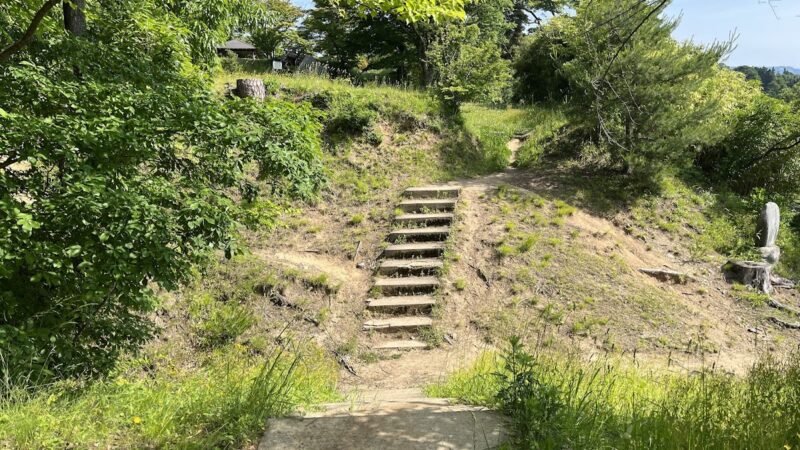
The earthworks surrounding the main enclosure are remarkably well-preserved. Earthworks 2-3 meters high remain in a continuous line, clearly tracing the defensive line of the time.
Walking along the earthen ramparts allows you to understand the castle’s structure from the defender’s perspective. Furthermore, the difference in elevation between the inside and outside of the ramparts demonstrates the effectiveness of this defensive structure.
Concrete Remains of the Powder Magazine
The remains of the former Imperial Japanese Army’s powder magazine are another point not to be missed. Multiple sturdy concrete structures remain, providing valuable insight into the realities of modern military facilities.
While you cannot enter the powder magazine itself, you can observe its structure from the outside. You can discern the thick concrete walls and the design philosophy aimed at minimizing damage in the event of an explosion.
Multiple Enclosures
The multiple enclosures surrounding the main enclosure are also a highlight. Visiting these enclosures in sequence allows you to understand the castle’s overall defensive system.
The arrangement of each enclosure skillfully utilizes the terrain, demonstrating the high level of medieval castle construction technology. The differences in elevation between enclosures and the arrangement of connecting paths between them are worth observing in detail.
Castle Ascent Route and Access Information
Access to the Trailhead
The ascent to Tama Castle begins in the Tama district of Sekigahara Town, Fuwa District, Gifu Prefecture. The nearest major station is Sekigahara Station on the JR Tokaido Main Line, and the Tama district is approximately a 10-minute drive from the station.
If using public transportation, taking a taxi from Sekigahara Station or renting a bicycle is the most practical option. There is a small parking area in the Tama district, making it accessible by private car.
Detailed Ascent Route
The hike from the trailhead in the Tama district to the main enclosure at the summit takes approximately 30-40 minutes. The trail is relatively well-maintained, but due to the steep slopes characteristic of mountain castles, appropriate equipment such as trekking shoes is necessary.
The ascent route mainly follows the ridgeline, passing through several remains of baileys and moats along the way. Observing these remains while climbing allows you to appreciate the castle’s defensive structure.
Estimated Time and Difficulty
To climb Tamashiro Castle, allow approximately 1 hour 30 minutes to 2 hours for the round trip from the trailhead to the main enclosure. If you wish to carefully observe the ruins, it is recommended to allow an additional hour or so.
The difficulty level is moderate; those who exercise regularly should have no problem climbing the castle. However, caution is advised during rainy weather and in winter, as the ground can become slippery.
Precautions During Visit
Tamaki Castle is not a well-maintained tourist site, but rather an archaeological site located within a natural mountain forest. Please observe the following points during your visit:
- Wear appropriate clothing and shoes (long sleeves, long pants, and trekking shoes recommended)
- Bring plenty of drinking water
- Use insect repellent in summer
- Avoid climbing alone; travel in groups whenever possible
- Do not damage or remove any remains
- Take all your trash with you
Related Historical Sites in the Surrounding Area
When visiting Tamashiro Castle, it is recommended to also visit other historical sites in the Sekigahara battlefield area. Sekigahara Town is dotted with numerous historical sites, including the Sekigahara Battlefield Memorial Museum, Sasao Mountain (site of Ishida Mitsunari’s encampment), and Momohaiyama Mountain (Tokugawa Ieyasu’s initial encampment).
By visiting these historical sites, one can gain a deeper understanding of the overall picture of the Battle of Sekigahara and Tamaki Castle’s position within it.
Historical Evaluation and Research Trends of Tamaki Castle
Position in Castle Research
Tamaki Castle is positioned as an important castle in the study of the border defense system of eastern Mino Province. It is believed to have functioned not as a standalone castle, but as part of a defense network in conjunction with surrounding castles.
Recent castle research has advanced to include studies that consider the entire regional defense system, and Tamaki Castle is being re-evaluated within this context.
Re-evaluation in the Battle of Sekigahara
Tamaki Castle’s role in the Battle of Sekigahara has been re-evaluated due to its coverage in media such as NHK’s “History Detective.” It has been suggested that Tamaki Castle may have held a crucial position in the Western Army’s strategic planning, a role often overlooked in previous analyses.
This new theory offers an important perspective for deepening our understanding of the Battle of Sekigahara, and further research is expected.
Challenges of Preservation and Utilization
While Tamaki Castle is a valuable historical heritage site, it faces challenges in terms of preservation and utilization. Located within a forest, it is susceptible to natural erosion and requires regular maintenance.
On the other hand, excessive development could damage the original appearance of the ruins. A balance is needed to preserve its historical value while creating a safe environment for visitors.
Significance in Local History
Tamaki Castle is an indispensable part of the history of Sekigahara Town. Its history of consistently functioning as a military stronghold from the Middle Ages to the modern era speaks to the geopolitical importance of this region.
Utilization for local history education and as a tourism resource is also progressing, making Tamaki Castle an integral part of Sekigahara Town’s identity.
How to Enjoy Your Visit to Tamagusuku
From a History Fan’s Perspective
For history fans, Tamagusuku is a valuable place where you can experience multi-layered history. You can observe traces of various eras, from the Nanboku-cho period to the Sengoku period, the Battle of Sekigahara, and even modern military facilities, all in one place.
Reading relevant history books and research papers beforehand will lead to a deeper understanding and appreciation. In particular, having knowledge of the Battle of Sekigahara will allow you to truly appreciate Tamagusuku’s strategic position.
From a Castle Enthusiast’s Perspective
For castle enthusiasts, Tamagusuku is an excellent field for observing the typical structure of a medieval mountain castle. The remains of earthworks, moats, and vertical trenches, characteristic of earthen castles, are well-preserved, making it an ideal teaching material for learning castle construction techniques.
Bringing a camera to record the details of each remains is recommended. It is especially worthwhile to observe the details, such as the cross-section of the moats and the shape of the earthworks.
Combining with Nature Observation
Tamagisuku is located in a lush mountain forest, allowing you to enjoy historical exploration and nature observation simultaneously. Tamaki Castle is an attractive place for nature lovers, offering opportunities to observe seasonal vegetation and wild birds.
Especially in spring with its fresh greenery and in autumn with its vibrant foliage, the contrast between the beautiful natural scenery and historical remains is stunning, making it an ideal time to visit.
Photography Tips
Tamaki Castle is also an attractive subject for photography. There are diverse shooting points, including panoramic views from the main enclosure, the impressive cross-section of the moat, moss-covered earthworks, and the contrast between concrete remains and nature.
The morning light beautifully illuminates the remains, so if you are visiting for photography purposes, we recommend going early in the day. A wide-angle lens will make it easier to capture the overall picture of the remains.
Summary
Tamaki Castle in Sekigahara Town, Gifu Prefecture, is a rare place that consistently maintained military importance from the Nanboku-cho period to modern times, serving as a strategic stronghold protecting the border between Mino and Omi provinces. Built on the summit of Shiroyama Mountain at an altitude of 307.5 meters, this mountain castle boasts an excellent location overlooking the Higashiyama Road and the Hokkoku Kaido Road, making it a valuable historical site where medieval castle remains and modern gunpowder magazine remains coexist.
The main enclosure measures over 200 meters from east to west, and defensive structures such as earthworks, moats, and vertical trenches remain remarkably well-preserved. Its strategic importance as a key base for the Western Army in the Battle of Sekigahara is also gaining renewed recognition, and its historical value is expected to increase further in the future.
The climb to the castle takes approximately 1 hour 30 minutes to 2 hours, but the rewarding historical experience is well worth the effort. With appropriate equipment and preparation, visit this fascinating mountain castle. Tamashiro Castle, where you can experience military facilities from both the medieval and modern eras simultaneously, is a must-see historical site for history buffs and castle enthusiasts.