Karumi Nishijo Castle (Motosu City, Gifu Prefecture) Complete Guide | History, Highlights, and Access Information
What is Karumi Nishijo Castle?
Karuminishijo Castle was a flatland castle located in Karumi, Motosu City, Gifu Prefecture. Currently, Enchoji Temple, the family temple of the Ichiyanagi clan, stands on the castle site, allowing visitors to imagine its former glory. It was designated a Motosu City Historic Site on April 15, 1970 (Showa 45), and is preserved as an important historical heritage site of the region.
Karuminishijo Castle was a castle that played a significant role in the history of Mino Province from the medieval period to the Sengoku period, and is said to have been an important base where Saito Dosan (Nishimura Kankuro) resided for a time. Following Oda Nobunaga’s invasion of Mino Province, the castle became the residence of Katagiri Toshimoto, a chief retainer of Ikeda Tsuneoki, and later, Ichiyanagi Naosue, a retainer of Toyotomi Hideyoshi, became its lord. This castle strongly reflects the historical flow of the Sengoku period.
History of Karuumi-Nishi Castle
Construction and the Inaba Clan Era
The exact construction date of Karuumi-Nishi Castle is unknown, but during the medieval period, the Inaba clan resided there for several generations. The Inaba clan was known as a powerful local lord in Mino Province, and they built their power base in the Karuumi area.
In 1468 (Ōnin 2), when the Inaba clan relocated to the Tōno region, Karuumi-Nishi Castle temporarily lost its lord. This period was a time of great turmoil following the Ōnin War, and the balance of power within Mino Province was rapidly changing.
Saitō Dōsan’s Residence
After the Inaba clan’s relocation, it is said that Saitō Dōsan resided at Karuumi-Nishi Castle. Saito Dosan was a Sengoku period daimyo feared as the “Viper of Mino,” a figure of great ambition who rose from an oil merchant to become the deputy governor of Mino Province.
It’s possible that Dosan used Karuumi West Castle as his base before or concurrently with his main base at Inabayama Castle (later Gifu Castle). Located in the central part of Mino Province, Karuumi was a strategically important transportation hub and likely served as a base for Dosan’s power expansion.
Oda Nobunaga’s Invasion of Mino and the Era of Katagiri Toshimoto
In 1559 (Eiroku 2), a power struggle between Oda Nobunaga and Saito Tatsuoki (Dosan’s grandson) unfolded in Karuumi. During this period, Nobunaga intensified his conquest of Mino, and the area around Karuumi West Castle became a battleground.
In 1560 (Eiroku 3), Katagiri Han’emon Toshimoto, a chief retainer of Ikeda Tsuneoki, a senior vassal of the Oda family, renovated Karukai Nishi Castle and made it his residence. Katagiri Toshimoto was known as a senior vassal of the Ikeda family and played an important role in Oda Nobunaga’s invasion of Mino Province. His renovations allowed Karukai Nishi Castle to function as one of the Oda forces’ bases in Mino.
During Katagiri Toshimoto’s tenure, Karukai Nishi Castle was maintained as an important fortress supporting the Oda family’s rule over Mino. The castle’s structure at this time is presumed to have possessed characteristics of a flatland castle from the Sengoku period, with defensive facilities such as earthworks and moats in place.
Appointment of Ichiyanagi Naosue as Lord and Abandonment of the Castle
In 1589 (Tensho 17), Ichiyanagi Naosue, a vassal of Toyotomi Hideyoshi, became the lord of Karukai Nishi Castle. Ichiyanagi Naosue was a samurai who served Hideyoshi, and during this period, he was granted territory within Mino Province, making Karukai-Nishi Castle his residence.
However, just one year after becoming lord of the castle, in 1590 (Tensho 18), Toyotomi Hideyoshi’s “Odawara Campaign” began. Ichiyanagi Naosue participated in this campaign, taking part in the attack on Yamanaka Castle, a subsidiary castle of Odawara Castle. The battle for Yamanaka Castle was fierce, and Ichiyanagi Naosue fought bravely but was killed in action.
With the death of its lord, Ichiyanagi Naosue, Karukai-Nishi Castle was abandoned. During this period, the Toyotomi regime was consolidating and streamlining castles, and smaller castles tended to be abolished. Ichiyanagi Naosue’s death marked the end of Karukai-Nishi Castle’s history.
The Establishment and Present State of Encho-ji Temple
After the castle was abandoned, Encho-ji Temple, the family temple of the Ichiyanagi clan, was built on the site of the former Karuumi-Nishi Castle. Encho-ji Temple still stands in Karuumi today, and memorial services for Ichiyanagi Naosue and other members of the Ichiyanagi clan continue.
Within the temple grounds, slight traces of the castle remain, allowing us to imagine the appearance of the castle in its heyday from parts of the earthworks and the undulations of the terrain. In 1970 (Showa 45), it was designated a Motosu City Historic Site and is protected as a local historical heritage.
Structure and Characteristics of Karuumi-Nishi Castle
Characteristics as a Flatland Castle
Karuumi-Nishi Castle was built as a typical flatland castle. Flatland castles are fortresses built on plains, and while they are less defensive than mountain castles, they excel in habitability and the transportation of supplies. In the late Sengoku period, flatland castles became increasingly favored as bases for managing territories.
The Karuumi area is located in a plain between the Neo River and the Ibi River, offering convenient water transport and high agricultural productivity. These geographical conditions were ideal for the formation of a castle town and the development of economic activity, making it a perfect environment for a lord’s residence.
Defensive Structures
The main defensive structure of Karuumi West Castle was earthen ramparts. Traces of these ramparts remain today within the grounds of Enchoji Temple and the surrounding area, providing clues to the scale of the castle at the time.
In flatland castles, a combination of earthen ramparts and moats was common for defense. It is presumed that Karuumi West Castle also had multiple moats surrounding the castle grounds, with earthen ramparts protecting the inner citadel. It has also been suggested that nearby rivers may have been used as outer moats.
Castle Area Scope
The castle area of Karuumi West Castle is thought to be the area centered around the present-day Enchoji Temple. The place name “Karumi Aza Kitayashiki” remains, suggesting the existence of a residential area related to the castle.
While there are no clear records regarding the castle’s size, it is presumed to have been a medium-sized flatland castle, given that it was the residence of mid-ranking samurai such as Katagiri Toshimoto and Ichiyanagi Naosue. It is thought that the main enclosure was surrounded by the residences of the retainers and a castle town.
Highlights of Karukai Nishi Castle
Castle Ruins within Enchoji Temple Grounds
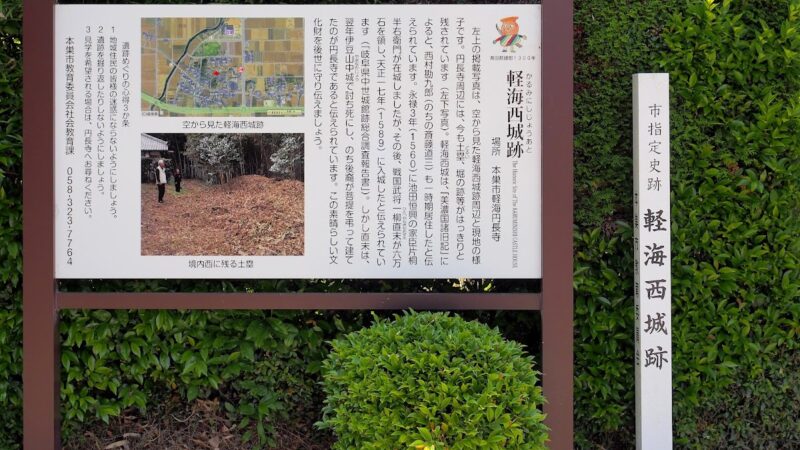
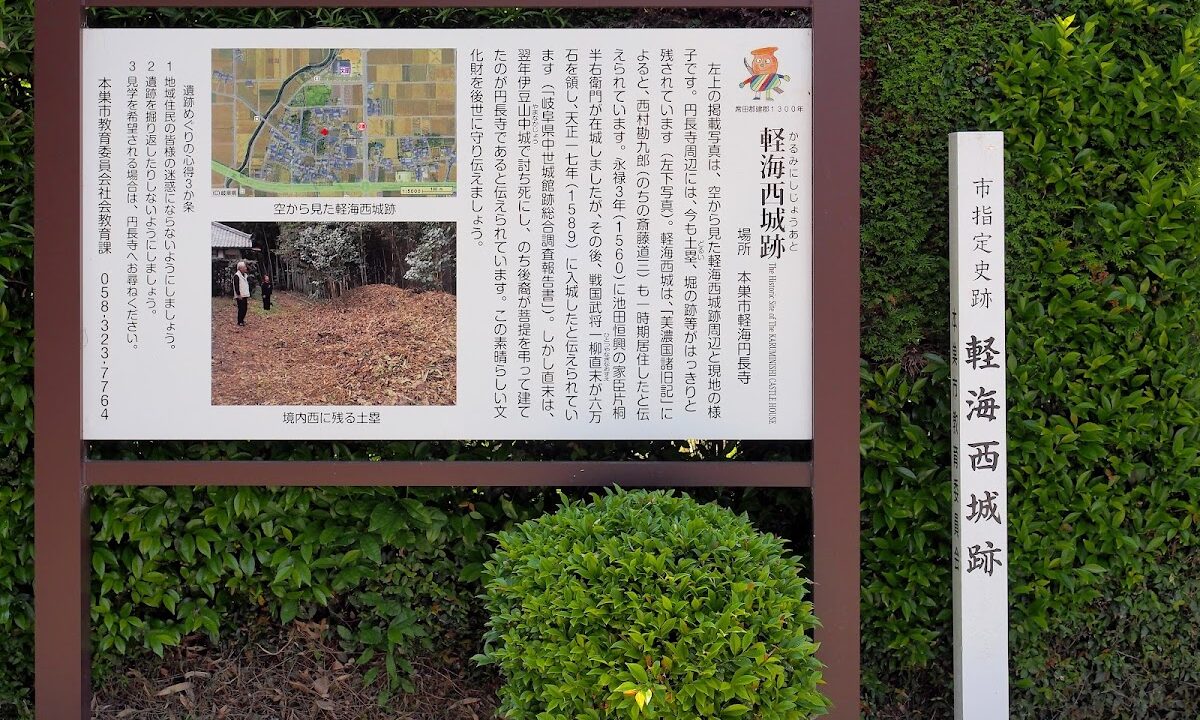
The biggest highlight when visiting Karukai Nishi Castle is the remains of the castle within the grounds of Enchoji Temple. A castle site marker and information board are installed in front of the temple entrance, conveying the castle’s history to visitors.
Walking through the temple grounds, you can see the faint traces of earthworks and feel the undulations of the terrain from the castle era. The layout of the temple itself may reflect the castle’s structure, allowing you to imagine what the castle looked like in its heyday while strolling around.
Burial Grounds of the Ichiyanagi Clan
Enchoji Temple houses the burial grounds of the Ichiyanagi clan, with memorial towers erected for members of the Ichiyanagi family, including Ichiyanagi Naosue, who died in the Battle of Yamanaka Castle. This is a historically significant site, the burial place of a samurai warrior from the Sengoku period.
Ichiyanagi Naosue was a loyal retainer of Toyotomi Hideyoshi and met a heroic end during the siege of Yamanaka Castle in the Odawara campaign. Visiting his burial place allows for a deeper understanding of the life of a Sengoku period warrior and the historical significance of Karukai Nishi Castle.
Castle Site Marker and Information Board
In front of the entrance to Enchoji Temple, there is a castle site marker and a detailed information board for Karukai Nishi Castle. The information board describes the castle’s history, successive lords, and structure, providing visitors with easily understandable information.
These markers and information boards were installed as part of Motosu City’s efforts to preserve historical sites, playing an important role in passing on the region’s historical heritage to future generations.
Surrounding Historical Landscape
The area surrounding Karukai Nishi Castle retains historical landscapes from the medieval to early modern periods. The terrain, nestled between the Neo River and the Ibi River, has remained largely unchanged since the Sengoku period, allowing visitors to experience the geographical environment of that time.
Furthermore, within the settlement of Karumi, traces of old roads and remnants of its castle town layout remain in some areas. Exploring not only the castle ruins but also the surrounding landscape will allow for a deeper understanding of the history of Karumi West Castle.
Access
Access by Public Transportation
To visit Karumi West Castle (Enchoji Temple) by public transportation, the nearest stations are JR Tokaido Main Line “Hozumi Station” or Tarumi Railway “Motosu Station”.
Access from Hozumi Station:
- Take the Gifu Bus “Kitagata Makuwa Line” from JR Hozumi Station and get off at the “Karukai” bus stop. It’s about a 5-minute walk from there.
- By taxi, it’s about 15 minutes from Hozumi Station (approx. 7km).
Access from Motosu Station:
- It’s about a 20-minute walk from Tarumi Railway Motosu Station (approx. 1.5km).
- By taxi, it’s about 5 minutes from Motosu Station.
Public transportation is limited, so it’s recommended to check the timetable in advance. Especially on holidays, bus services may be infrequent, so please be careful.
Access by Car
If you are traveling by car, the following route is convenient.
Access from Meishin Expressway and Tokai-Hokuriku Expressway:
- Approximately 30 minutes (approx. 20 km) from Meishin Expressway “Gifu-Hashima IC” via National Route 21
- Approximately 25 minutes (approx. 15 km) from Tokai-Hokuriku Expressway “Gifu-Kakamigahara IC” via National Route 21 and prefectural roads
Access time from major cities:
- Approximately 20 minutes (approx. 12 km) from central Gifu City
- Approximately 30 minutes (approx. 18 km) from central Ogaki City
- Approximately 50 minutes (approx. 45 km) from central Nagoya City
Enchoji Temple has parking spaces for visitors, but the number of spaces is limited, so caution is advised, especially on days with religious services or other events.
Car Navigation Settings
Address: 588 Karumi, Motosu City, Gifu Prefecture (Enchoji Temple)
Phone Number: You can set your car navigation system using Enchoji Temple’s phone number (please confirm in advance).
Nearby Parking Information
There is parking space for visitors within the grounds of Enchoji Temple. It is free to use, but since the number of spaces is limited, you may need to use nearby public parking lots during busy times.
Location
Location: 588 Karumi, Motosu City, Gifu Prefecture (Enchoji Temple)
Designation: Motosu City Designated Historic Site (Designated April 15, 1970)
Castle Classification: Flatland Castle
Main Remains: Earthworks (partial), Topography
Main Lords: Inaba clan, Saito Dosan, Katagiri Toshimoto, Ichiyanagi Naosue
Construction Period: Unknown (Medieval period)
Abandonment Period: 1590 (Tensho 18)
Historical Figures Associated with Karumi West Castle
Saito Dosan (Nishimura Kankuro)
Saito Dosan was a Sengoku period daimyo of Mino Province, feared as the “Viper of Mino.” He rose from an oil merchant to seize real power in Mino Province through strategy and military force. Karumi-Nishi Castle may have been used by Dosan before he established his base at Inabayama Castle, or perhaps concurrently, making it an important historical site that shows traces of his power expansion.
Oda Nobunaga
Oda Nobunaga was a Sengoku period daimyo of Owari Province and an innovative warlord who later aimed to unify Japan. From 1559, he intensified his invasion of Mino Province, and battles with Saito Tatsuoki unfolded around Karumi-Nishi Castle. Nobunaga’s conquest of Mino was a crucial military operation, marking the first step towards his unification of Japan.
Katagiri Toshimoto (Katagiri Han’emon)
Katagiri Toshimoto was a warlord who served Oda Nobunaga as a chief retainer of Ikeda Tsuneoki. In 1560, he renovated Karumi-Nishi Castle and made it his residence, playing a role in supporting the Oda family’s rule over Mino. The Katagiri family later continued as a lineage serving the Toyotomi and Tokugawa families, and acquired territory in Yamato Province.
Ichiyanagi Naosue
Ichiyanagi Naosue was a retainer of Toyotomi Hideyoshi and became the lord of Karukai Nishi Castle in 1589. However, he was killed in the attack on Yamanaka Castle during the Odawara Campaign the following year, and Karukai Nishi Castle was abandoned. The Ichiyanagi clan continued as daimyo in places like the Komatsu Domain in Iyo Province, and Naosue’s descendants survived until the Meiji Restoration.
Nearby Tourist Attractions
Historical Facilities in Motosu City
When visiting Karukai Nishi Castle, we recommend also visiting other historical facilities in Motosu City.
Shinsho Gokuraku-ji Temple (Makuwa Bunraku): Motosu City retains the tradition of puppet theater, and performances are regularly held at Shinsho Gokuraku-ji Temple. It is a valuable traditional performing art designated as a National Important Intangible Folk Cultural Property.
Funagiyama Kofun Cluster: Numerous ancient burial mounds remain in Motosu City, indicating that this region was an important center from ancient times.
Nearby Castles
Near Karumi-Nishi Castle, several other historical castles are scattered throughout the area.
Gifu Castle (Inabayama Castle): A famous castle associated with Saito Dosan and Oda Nobunaga, with a reconstructed keep on the summit of Mt. Kinka. Located about 30 minutes by car from Karumi-Nishi Castle, visiting both will deepen your understanding of Mino Province’s Sengoku period history.
Ogaki Castle: A castle that served as a base for the Western Army during the Battle of Sekigahara, with a reconstructed keep. Approximately 40 minutes by car from Karumi-Nishi Castle.
Sunomata Ichiyajo Castle: Known as a front-line base during Oda Nobunaga’s conquest of Mino Province, it is now open to the public as a historical museum.
Natural Spots in Motosu City
Neodani Usuzumi Cherry Tree: One of Japan’s three great cherry trees, this ancient tree is over 1500 years old and attracts many tourists in spring. Approximately 40 minutes by car from Karumi-Nishi Castle.
Neo River: Known for its clear waters, the Neo River offers opportunities for ayu (sweetfish) fishing and river activities.
Points to Note When Visiting Karumi Nishi Castle
Best Time to Visit
While Karumi Nishi Castle Ruins (Enchoji Temple) are accessible year-round, the following times are particularly recommended:
Spring (March-May): The surrounding scenery is beautiful during cherry blossom season, making it ideal for historical walks.
Autumn (October-November): The autumn foliage season, with mild weather, is perfect for visiting castle ruins.
Summer and Winter: While summer requires precautions against the heat and winter requires warm clothing, there are fewer tourists, allowing for a quieter visit.
Estimated Time Required
Allow 30 minutes to 1 hour to visit Karumi Nishi Castle Ruins. This is ample time to leisurely stroll through the grounds of Enchoji Temple, read the information boards, and observe the surrounding terrain.
If you plan to visit other historical sites in the area, it’s best to allocate half a day to a full day for your visit.
Photography Tips
The castle ruins marker and information board are classic spots for commemorative photos. Also, photographing the main hall of Enchoji Temple and the surrounding scenery will capture the atmosphere of the castle ruins.
When photographing the remnants of the earthworks and the undulations of the terrain, the way the light hits them will change the sense of depth, so the morning or late afternoon is recommended.
Manners and Precautions
Enchoji Temple is an active temple and a place of worship for the local community. Please observe the following manners when visiting.
- Behave quietly within the temple grounds and avoid disturbing other visitors.
- Enter the cemetery with caution and respect.
- Always take your trash with you.
- Do not trespass on private property.
- Refrain from visiting or be considerate if memorial services or other events are taking place.
Historical Significance of Karuumi Nishi Castle
Karuumi Nishi Castle is an important historical site that tells the story of the medieval and Sengoku periods in Mino Province. It was associated with prominent figures of the Sengoku period such as the Inaba clan, Saito Dosan, Oda Nobunaga, and Toyotomi Hideyoshi, and became the stage for struggles for control of Mino Province.
In particular, the series of events—Saito Dosan’s residence, its use as a base during Oda Nobunaga’s invasion of Mino, and its abandonment after the death of Ichiyanagi Naosue in the Siege of Odawara—symbolize the turbulent times of the Sengoku period.
Currently, the castle ruins quietly preserve history as Enchoji Temple and are a valuable cultural heritage site designated by Motosu City. Although not large in scale, it is a valuable historical site that conveys the appearance of a flatland castle from the Sengoku period, making it a worthwhile place for history enthusiasts to visit.
References
For more detailed information about Karukai Nishi Castle, please refer to the following sources:
- “History of Motosu City,” Motosu City Board of Education
- “Medieval Castles and Residences of Gifu Prefecture,” Gifu Prefecture Board of Education
- “Comprehensive Survey of Japanese Castles,” Volume 9 (Shin Jinbutsu Oraisha)
- “Castles of Mino Province” (Kyodo Publishing)
- Information boards and explanatory materials by the Motosu City Board of Education
Furthermore, you can find the latest information and photos from visitors on castle information websites such as Kojodan and Nippon Jiro Meguri.
Summary
Karukai Nishi Castle was a flatland castle located in Motosu City, Gifu Prefecture, and is a historical castle deeply connected to famous warlords of the Sengoku period such as Saito Dosan, Oda Nobunaga, and Ichiyanagi Naosue. Currently located within the grounds of Encho-ji Temple, the site offers glimpses of its former glory through remnants of earthworks, a castle site marker, and an information board.
Protected as a designated historical site by Motosu City, this castle ruin is an important historical site for understanding the history of Mino Province during the Sengoku period, making it a worthwhile place for history enthusiasts to visit. It is accessible by public transport or car, and visiting it along with nearby castles such as Gifu Castle and Ogaki Castle will allow for a more fulfilling historical exploration.