Masushima Castle (Gifu Prefecture) Complete Guide | A Thorough Explanation of the History and Highlights of Hida’s Only Flatland Castle
Masushima Castle, located in Katahara-cho, Furukawa-cho, Hida City, Gifu Prefecture, is known as the only flatland castle in Hida Province. It is a rare flatland castle in the mountainous region of Hida, and features a distinctive structure with a water moat and stone walls. Built by Kanamori Nagachika, this castle has an interesting history, sharing the same layout as Kyoto’s Jurakudai Palace, and is currently protected as a Gifu Prefecture designated historical site.
History of Masushima Castle
Background of Construction and Kanamori Nagachika’s Rule of Hida
The history of Masushima Castle begins with the unification of Hida Province at the end of the Sengoku period. In 1585, Kanamori Nagachika, the lord of Ono Castle in Echizen Province, invaded Hida Province on the orders of Hashiba Hideyoshi (later Toyotomi Hideyoshi). He conquered the Miki clan, who ruled Hida Province at the time, and made Hida Province his territory.
As a base for his control of Hida Province, Nagachika built Takayama Castle as his main castle, and also constructed Hagiwara Suwa Castle and Masujima Castle as subsidiary castles. Construction of Masujima Castle began in 1586 (Tensho 14), and it is strategically located in the center of the Furukawa Kokufu Basin, along the Arakijo River. This location was extremely important for controlling the Furukawa Basin.
The Mystery of the Same Layout as Jurakudai
One of the most intriguing features of Masujima Castle is that its layout (the castle’s design) has been found to be the same as that of Toyotomi Hideyoshi’s residence in Kyoto, Jurakudai. This fact was revealed through later research, and why the same design as Kyoto’s Jurakudai was adopted in Hida remains a mystery that evokes a sense of historical romance.
Kanamori Nagachika was a trusted samurai under Hideyoshi, and it’s possible that by imitating the design of Hideyoshi’s castle, he was demonstrating his loyalty to his lord and attempting to establish his authority in Hida.
The Entry of Kanamori Arishige and Changes in Castle Lords
Upon the completion of Masujima Castle, Kanamori Arishige, the adopted son of Kanamori Nagachika, moved from Furukawa Castle and became the lord of Masujima Castle. Arishige later became the second lord of the Takayama Domain and, as the first lord of Masujima Castle, governed the Furukawa Basin.
In 1608 (Keicho 13), when Kanamori Arishige entered Hida-Takayama Castle, his son, Kanamori Shigechika, entered Masujima Castle. During the Kanamori clan’s rule of Hida, Masujima Castle continued to function as an important subsidiary castle of Takayama Castle.
The One Castle Per Province Decree and the Renaming to Furukawa Ryokan
With the start of the Edo period, the Tokugawa Shogunate issued the One Castle Per Province Decree in 1615, which led to the fate of Masujima Castle being abandoned. However, it was not completely demolished; it was allowed to continue existing under the name “Furukawa Ryokan.”
This was a similar measure to that taken for Hagiwara Suwa Castle, and it maintained its function as a villa for the Kanamori clan. Although it lost its military role as a castle, the buildings and facilities continued to be used, and its position as an important base for the Kanamori clan’s rule of Hida was preserved.
The Kanamori Clan’s Transfer and the Castle’s Demolition
In 1692, the Kanamori clan was transferred to the Kaminoyama Domain in Dewa Province (present-day Kaminoyama City, Yamagata Prefecture). This made Hida Province a shogunate territory directly controlled by the Edo Shogunate. Following this transition to shogunate control, Masujima Castle, along with Takayama Castle, was officially demolished in 1695. This demolition caused Masujima Castle to disappear from the historical stage as a fortress, but parts of the stone walls and moats remain to this day, conveying its former appearance.
Structure and Characteristics of Masujima Castle
Uniqueness as the Only Flatland Castle in Hida
Masujima Castle occupies a special place in the history of Hida castles as the only flatland castle in northern Hida. While many castles in the mountainous Hida region were built on mountains, Masujima Castle was a flatland castle built on plains.
Although flatland castles are inferior to mountain castles in terms of defense, they are well-suited to functioning as political and economic centers and controlling strategic transportation points. Its location in the center of the Furukawa Basin maximized the advantages of a flatland castle.
Structure of the Moat and Stone Walls
The core of Masujima Castle’s defensive system was the moat and stone walls. A moat utilizing the water of the Arakijo River surrounded the castle, and stone walls were built inside. In the mountainous Hida region, castles with moats are extremely rare, making this a distinctive feature of Masujima Castle.
The stone walls were constructed using the latest technology of the time, demonstrating the high level of castle-building skills of the Kanamori clan. The remaining stone walls are valuable historical relics for understanding stonework techniques from the late Sengoku period to the early Edo period.
Arrangement of the Keep and Turret Bases
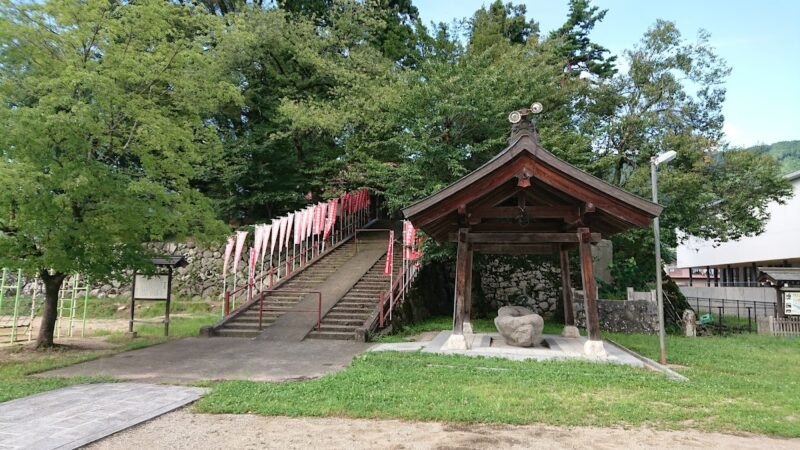
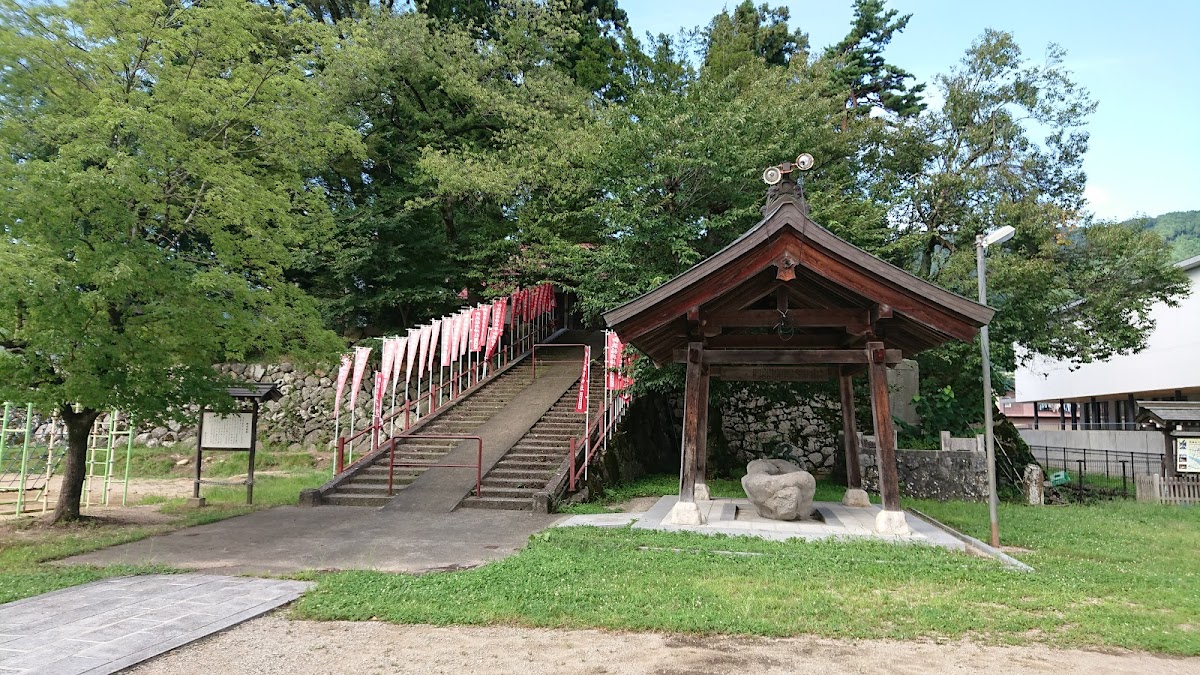
Masujima Castle had a keep base. Currently, the shrine of Masujima Tenman Shrine (now enshrined together with Ketawakamiya Shrine) and the Mikura Inari Shrine are located on this base. It is a common sight at Japanese castle ruins to see shrines built on the sites where keeps and turrets once stood.
From the keep base, one can see a panoramic view of the Furukawa Basin, and the former lords of the castle likely surveyed their territories from this spot. The stone walls of the turret base remain in excellent condition, making it a particularly impressive part of the Masujima Castle ruins.
Remains of Masujima Castle Site Today
Remaining Stone Walls and Moat
At the current Masujima Castle site, the stone walls of the turret base and a portion of the moat remain in good condition. The stone walls of the turret base, in particular, are a valuable relic that allows us to directly observe the castle construction techniques of the time. From the way the stones are stacked and the types of stones used, we can discern the characteristics of stonework techniques from the late Sengoku period to the early Edo period.
Part of the moat also remains, conveying a part of the defensive system that once surrounded the castle. The reflection of the stone walls in the moat creates a beautiful landscape, especially during cherry blossom season, captivating many visitors.
Current State of the Castle Tower Base and Shrine
The castle tower base is currently located between Furukawa Elementary School and Hida City Special Needs School. Masujima Tenman Shrine and Mikura Inari Shrine are enshrined on the base, making it a place of worship for the local community.
Walking around the castle tower base, you can observe the stone walls from different angles in each of the four cardinal directions. The views from the west, north, east, and southeast sides of the castle keep are particularly varied and popular as photography spots.
Existing Relocated Castle Gates
A notable feature of the remains of Masujima Castle is the continued existence of several relocated castle gates. These gates were moved to nearby temples after the castle was abandoned and have been carefully preserved.
Rinsho-ji Temple’s Back Gate: Located east along the JR Takayama Main Line, Rinsho-ji Temple houses the relocated back gate of Masujima Castle.
Enko-ji Temple’s Front Gate: Enko-ji Temple, located in the center of Furukawa, houses the relocated and preserved front gate of Masujima Castle.
Jotoku-ji Temple’s Gate: Located approximately 2-3 km northwest, Jotoku-ji Temple also houses a relocated and well-preserved gate from Masujima Castle.
Visiting these relocated gates allows for a more three-dimensional image of Masujima Castle in its heyday.
Highlights and Tourist Information of Masujima Castle
Photo Spots
Masujima Castle ruins are not only historically significant but also an attractive location for photography. The following points are particularly recommended:
Moat and Stone Walls in Cherry Blossom Season: In spring, cherry blossoms bloom, creating a beautiful contrast between the cherry blossoms reflected in the moat and the stone walls.
View from the Castle Tower Platform: From the castle tower platform, you can overlook the Furukawa Basin and take landscape photos with the Hida Mountains in the background.
Texture of the Stone Walls: When photographed up close, the construction of the stone walls and the texture of the stones stand out, allowing you to take photos that convey a sense of history.
Castle Tower Platform from Different Directions: Photographing the castle tower platform from each of the four cardinal directions allows you to capture different perspectives.
Nearby Tourist Attractions
When visiting Masujima Castle ruins, we recommend also visiting nearby tourist attractions.
Hida Furukawa Townscape: The beautiful townscape lined with white-walled storehouses is a symbol of Hida Furukawa. The scenery along the Setogawa River is particularly famous and has been used as a setting for movies and anime.
Hida Furukawa Festival Hall: The castle stamp for Masujima Castle is sold here (300 yen). You can also learn about the history and culture of the Hida Furukawa Festival.
Ketawakamiya Shrine: This shrine, which enshrines Masujima Tenman Shrine, is deeply connected to the history of Hida Furukawa.
Relocated Castle Gate Tour: The castle gate tour visiting the aforementioned Rinsho-ji, Enko-ji, and Jotoku-ji temples is also ideal for gaining a deeper understanding of the history of Masujima Castle.
Castle Stamp Information
The castle stamp for Masujima Castle is a popular souvenir among castle enthusiasts.
Sales Location: Hida Furukawa Festival Hall (14-5 Ichino-machi, Furukawa-cho, Hida City)
Price: 300 yen
Collecting castle stamps while visiting castles in Gifu Prefecture is one way to enjoy historical exploration. Masujima Castle is attracting attention as one of the 27 castles in Gifu Prefecture whose castle stamps can be collected.
Access Information
Basic Information
Location: 8-35 Katahara-machi, Furukawa-cho, Hida City, Gifu Prefecture
Designation: Gifu Prefecture Designated Historic Site
Visiting: Free
Access by Public Transportation
Using JR: Get off at JR Takayama Line “Hida Furukawa Station,” approximately 5 minutes on foot.
Hida Furukawa Station is also a stop for the limited express “Wide View Hida,” making it convenient to access from Nagoya and Toyama. The Masujima Castle Ruins are within walking distance from the station, and you can enjoy the beautiful townscape of Hida Furukawa along the way.
Access by Car
Expressway:
- Approximately 30 minutes from the Hida Kiyomi IC on the Tokai-Hokuriku Expressway via National Routes 158 and 41
- Approximately 20 minutes from the Takayama IC on the Chubu Jukan Expressway via National Route 41
Parking: There is no dedicated parking lot near the Masujima Castle Ruins, but there is a free parking lot behind JR Hida Furukawa Station, from which the castle ruins are a few minutes’ walk away. There are also parking lots around the Hida Furukawa Festival Hall.
Points to Note When Visiting
- Part of the castle ruins are adjacent to school grounds, so please be considerate and avoid disturbing school activities during your visit.
- The stone walls and moats are valuable cultural assets, so please be careful not to climb on them or damage them.
- When visiting the relocated castle gates, please observe the proper etiquette for visiting each temple. – The cherry blossom season (early to mid-April) is particularly beautiful, but it can get crowded.
Historical Significance of Masujima Castle and Hida
The Role of the Kanamori Clan in Hida’s Rule
Masujima Castle played a crucial role in the Kanamori clan’s rule of Hida Province. Within the Kanamori clan’s system of rule, with Takayama Castle as its main base, Masujima Castle was a strategic point controlling the important Furukawa Basin.
The Furukawa Basin was the granary of Hida Province and an economically important region. Securing control of this area was essential for stabilizing the Kanamori clan’s rule over Hida.
Hida and the Masujima Castle Ruins during the Shogunate’s Rule
After the Kanamori clan’s transfer, Hida Province became a shogunate territory under the Edo shogunate. Although Masujima Castle was demolished due to the shogunate’s rule, Hida underwent unique development during this period under direct shogunate rule.
The area of Furukawa, where Masujima Castle once stood, continued to flourish as an important town in Hida even during the period when it was a shogunate territory. Although the castle itself is gone, the townscape that developed as a castle town remains today, attracting many tourists as “Hida’s Little Kyoto.”
Value as a Cultural Property in Modern Times
The Masujima Castle ruins, protected as a Gifu Prefecture designated historical site, are a valuable cultural property that conveys the history of the Hida region. In particular, it possesses multifaceted historical value due to its uniqueness as the only flatland castle in Hida, its intriguing feature of having the same layout as Jurakudai Palace, and the existing stone walls, moats, and relocated castle gates.
Preservation activities by local residents and its utilization as a tourist resource are progressing, playing an important role in historical education and regional development.
Summary
Masujima Castle, built by Kanamori Nagachika, is a castle with unique historical value as the only flatland castle in Hida Province. From its construction in 1586 (Tensho 14) to its demolition in 1695 (Genroku 8), Masujima Castle played a crucial role in Hida’s history for approximately 110 years.
Currently, only the stone walls, a portion of the moat, and a relocated castle gate remain, but these remnants are valuable cultural assets that convey the castle’s appearance at the time. Its beauty, especially during cherry blossom season, is exceptional, attracting not only history enthusiasts but also many tourists.
Its convenient location, within walking distance of JR Hida-Furukawa Station, is another attractive feature, allowing visitors to combine a visit with a stroll through the beautiful townscape of Hida-Furukawa. Collecting castle stamps and touring the relocated castle gate are just some of the various ways to enjoy Masujima Castle.
When visiting Hida, be sure to visit the Masujima Castle ruins and immerse yourself in Hida’s history and culture while reflecting on the era of the Kanamori clan.
References
Information about Masujima Castle can be obtained from the following sources and documents:
- Historical site information board by the Hida City Board of Education
- Research report by the Gifu Prefectural Cultural Properties Protection Center
- Local history research books such as “Hida Castles and Fortifications”
- Castle-related books published by the Japan Castle Association
- Exhibition materials at the Hida Furukawa Festival Hall
For those who wish to learn more about Masujima Castle, we recommend viewing related materials at the Hida Furukawa Festival Hall or the Hida City Library.