Complete Guide to Gongenyama Castle (Mitake-cho, Kani-gun, Gifu Prefecture) | A Thorough Explanation of the History and Highlights of Kirigakure Castle
What is Gongenyama Castle?
Gongenyama Castle is a Sengoku period mountain castle located in Mitake, Mitake-cho, Kani-gun, Gifu Prefecture. Also known as “Mitake Castle,” it was built on the northern edge of a 188-meter-high hill overlooking the Kani River. Currently, the main enclosure is the grounds of Kinpo Shrine, and it is known as a castle ruin with a unique history and legends among the mountain castles of Mino Province.
This castle is nicknamed “The Impregnable Kirigakure Castle,” and a legend remains of it repelling repeated attacks by Mori Nagayoshi, the lord of Kanayama Castle. This legend tells of a large white snake, a messenger of Gongen-sama, generating mist to protect the castle, making it an interesting anecdote linked to local beliefs.
History of Gongenyama Castle
Construction Period and Lord
The exact construction period of Gongenyama Castle is unclear, but it is said that a samurai named Oguri Shinano-no-kami served as its lord during the Sengoku period. The Oguri clan, as local lords of Mino Province, maintained a certain level of power in this region.
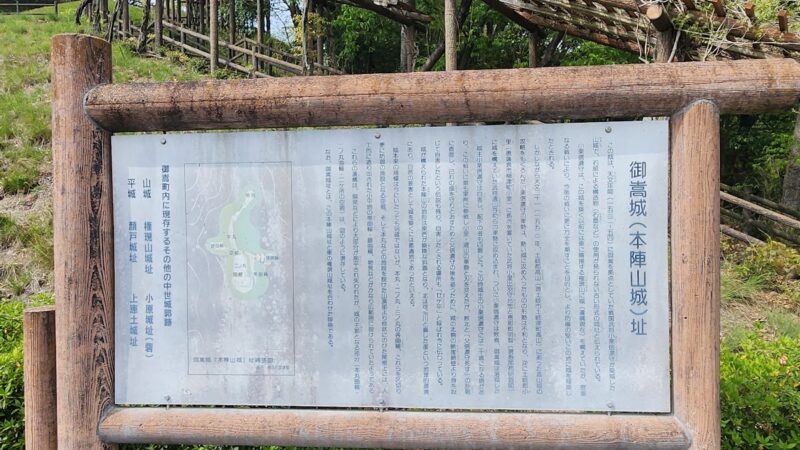
Mitake Castle actually formed a complex defensive system consisting of two fortresses: Gongenyama Castle and Honjinyama Castle. The two castles complemented each other, and it is believed that by coordinating with Honjinyama Castle to the west, a stronger defensive system was established.
Battles with Mori Nagayoshi
The most important event in the history of Gongenyama Castle is the repeated attacks by Mori Nagayoshi, the lord of Kanayama Castle. Mori Nagayoshi, a vassal of Oda Nobunaga, attempted to conquer this region during the process of unifying Mino Province.
Mori Nagayoshi led large armies to attack Gongenyama Castle many times, but it is said that he failed to capture it each time. This inexplicable battle situation gave rise to the legend that “a large white snake, a messenger of Gongen-sama, emitted mist to hinder the enemy forces.” In reality, it is more likely that the mist, generated by the topographical features along the Kani River, worked to the defenders’ advantage.
The Fall and Aftermath
Gongen-yama Castle, known as the “impregnable mist-hidden castle,” ultimately met its fate. While the exact date of its fall is unknown, it is presumed to have been abandoned along with the end of the Sengoku period, like many other mountain castles.
Structure and Layout of Gongen-yama Castle
Characteristics of the Main Enclosure
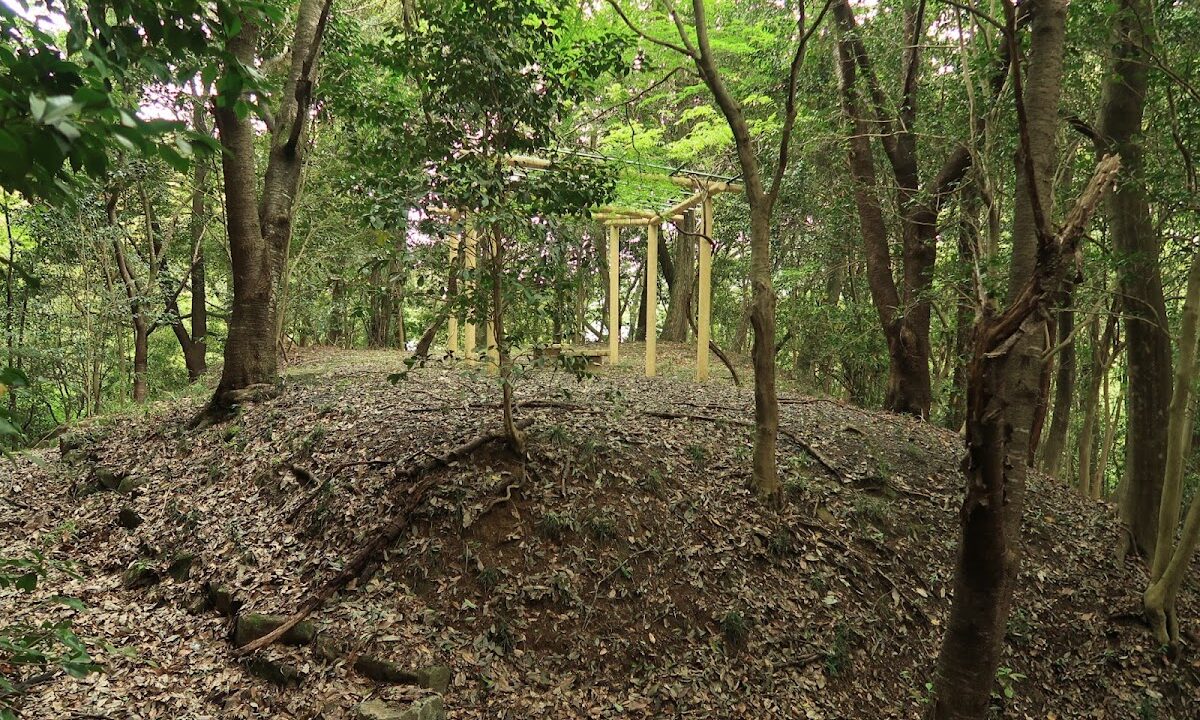
The main enclosure of Gongen-yama Castle has a long, east-west shape and is currently maintained as the grounds of Kinpo Shrine. The main enclosure is relatively large, suggesting that the lord’s residence and important facilities were located there.
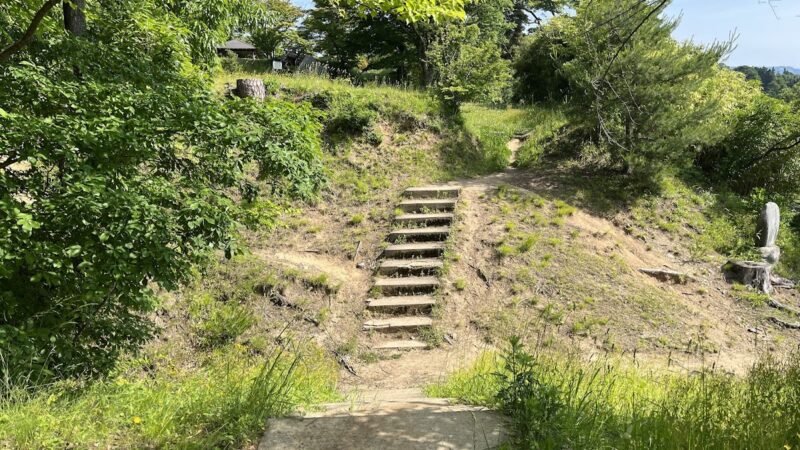
A straight stone staircase leads to the western side; however, this was constructed when the area was developed as a shrine and differs from the original castle structure. The original entrance (koguchi) of the castle is presumed to have been located on the route descending to the saddle on the south side, and the gate shape, accompanied by an earthen embankment, still remains on that slope.
Arrangement of Enclosures
Gongen-yama Castle has multiple enclosures, forming a tiered defensive line centered around the main enclosure. The castle cleverly utilizes the topography of a hill facing the Kani River, demonstrating ingenuity in making enemy intrusion difficult.
Each enclosure is positioned using the difference in elevation, allowing for firing from higher enclosures to lower ones. This is a typical layout technique for mountain castles of the Sengoku period, reflecting wisdom for efficient defense with limited forces.
Earthen Embankments and Moats
Earthen embankments and moats have been identified as defensive structures at Gongen-yama Castle. The earthen embankments around the entrance, in particular, functioned as an important defensive line to prevent enemy intrusion.
The earthen embankments are arranged to surround the main enclosure and important enclosures, and some parts remain clearly visible today. Furthermore, trenches were constructed to divide the ridge, serving to hinder enemy advances.
Ridge-shaped Vertical Ditches
Among the remains of Gongen-yama Castle, the presence of ridge-shaped vertical ditches is particularly noteworthy. These consist of multiple vertical ditches excavated continuously parallel to the slope, a sophisticated defensive technique that made lateral movement difficult for enemy soldiers and prevented attacks from the slope.
The ridge-shaped vertical ditches are an important remains demonstrating the castle-building techniques of the late Sengoku period, indicating that Gongen-yama Castle was not merely a local lord’s fort, but a full-fledged mountain castle built with considerable skill and effort.
Highlights of Gongen-yama Castle
Remains within the Grounds of Kinpo Shrine
Currently, the main enclosure of Gongen-yama Castle is located within the grounds of Kinpo Shrine, allowing visitors to enjoy both worship and castle ruins simultaneously. The flat areas of the enclosures around the shrine buildings are well-preserved, allowing visitors to appreciate the scale of the castle at the time.
Kinpo Shrine has been carefully preserved for many years as the center of local faith. The legend of “the white serpent, messenger of Gongen-sama,” is deeply intertwined with the faith of this shrine.
Remains of the Fortified Enclosure and Earthworks
The remains of the fortified entrance on the southern saddle are a must-see point when visiting Gongen-yama Castle. The earthworks, positioned along the sloping terrain, clearly demonstrate the defensive structure of the time, making it a fascinating relic for castle enthusiasts.
The fortified entrance was the most important defensive point of a castle, and battles fought here often determined the fate of the castle. The fortified entrance of Gongen-yama Castle is cleverly designed to utilize the terrain, showcasing the high level of castle-building technology of the Sengoku period.
Views and Topography
The views from Gongen-yama Castle are magnificent, offering a panoramic view of the Kani River basin and the surrounding plains. This excellent view also held significant military importance. It allowed for early detection of enemy movements and the establishment of appropriate defensive positions.
The location on a hill overlooking the Kani River was advantageous for monitoring water transport and controlling transportation routes, which explains why the Oguri clan chose this area as their base.
Relationship with Honjin-yama Castle
Honjin-yama Castle is located to the west of Gongen-yama Castle, and the two castles formed an integrated defensive system. When visiting Gongen-yama Castle, visiting Honjin-yama Castle as well will give you a deeper understanding of the overall structure of Mitake Castle.
Honjin-yama Castle is thought to have functioned as an outpost or subsidiary castle of Gongen-yama Castle, and the cooperation between the two castles allowed for a wider area of defense.
The Truth Behind the Legend of “The Impregnable Castle of Mist”
The Content of the Legend
The legend that gave rise to Gongen-yama Castle being called “The Impregnable Castle of Mist” is as follows:
When Mori Nagayoshi, the lord of Kanayama Castle, led a large army to attack Gongen-yama Castle, a thick fog suddenly appeared, obscuring the attacking army’s visibility. This fog is said to have been caused by a large white snake, a messenger of the Gongen deity, forcing the Mori army to abandon their attack.
This legend was passed down among the local people and deepened their faith in Gongenyama Castle and Kinpu Shrine.
Topographical Factors
In reality, the topographical characteristics along the Kani River likely created conditions conducive to fog formation in this area. The combination of temperature differences and humidity conditions between the lowlands and hills along the river can lead to dense fog, especially in the early morning and evening.
The defenders were likely well aware of these topographical characteristics and may have timed their defensive tactics to coincide with the fog’s occurrence. On the other hand, the attacking Mori army was unfamiliar with the geography, so poor visibility due to the fog likely posed a significant obstacle.
Tactical Interpretation
The legend of the “impregnable Misty Castle” is thought to be rooted in the excellent defensive tactics of the Oguri clan. The combination of factors likely made it difficult for the Mori army to conquer the castle, including the construction of defensive positions utilizing the terrain, surprise attack tactics using fog, and coordination with the main camp at Yamashiro.
It is also thought that the legend, passed down through generations, enhanced the authority of the castle and shrine and strengthened local ties.
Access Information
Access by Public Transportation
The nearest station to Gongen-yama Castle is Mitake Station on the Meitetsu Hiromi Line. It’s about a 15-20 minute walk from Mitake Station to Kinpo Shrine. Head northwest from the station, passing through a residential area, and you’ll reach the shrine’s approach.
From Nagoya, a convenient route is to take the Meitetsu Inuyama Line to Inuyama Station, then transfer to the Meitetsu Hiromi Line to Mitake Station.
Access by Car
If traveling by car, the nearest interchange is the Kani-Mitake Interchange on the Tokai-Kanjo Expressway. It takes about 10 minutes from the interchange to reach the area around Kinpo Shrine.
There is some parking space near the shrine, but it can get crowded during peak seasons, so we recommend considering using public transportation.
Ascent Route
The main ascent route is the approach to Kinpo Shrine. The stone steps are well-maintained, making it relatively easy to reach the main enclosure. However, if you plan to carefully observe the remains, we recommend wearing comfortable shoes and clothing.
To see the southern gate remains, you will need to descend a somewhat steep slope, so please watch your step.
Nearby Attractions
Honjin-yama Castle
As mentioned above, Honjin-yama Castle, located west of Gongen-yama Castle, is another castle that makes up Mitake Castle. Visiting both castles will give you a deeper understanding of the defensive system of medieval mountain castles.
Mountain Castles of Kani City
The area around Kani City is known as a “city of mountain castles,” and many mountain castles remain, including Kanayama Castle. When visiting Gongen-yama Castle, exploring the surrounding mountain castles will allow you to learn about the Sengoku period history of Mino Province in a more comprehensive way.
Historical Spots in Mitake Town
Besides Gongen-yama Castle, Mitake Town has historical sites that tell the story of its history as a post town on the Nakasendo road, as well as old townscapes. You can enjoy a historical stroll through the town in conjunction with visiting the castle ruins.
Preservation and Utilization of Gongen-yama Castle
Current Situation and Challenges
The main enclosure of Gongen-yama Castle is maintained as Kinpo Shrine, so its basic state of preservation is good. However, some remains outside the shrine grounds are gradually becoming unclear due to overgrown trees and natural erosion.
Preserving mountain castle remains requires regular mowing, surveying, and the installation of explanatory signs, but due to budget and personnel constraints, it cannot be said that sufficient preservation activities are being carried out.
Connection with the Community
Gongen-yama Castle is cherished by residents as part of the region’s historical identity. The fact that interest in the castle ruins is maintained through events such as the Kinpo Shrine festival is commendable.
In recent years, with the boom in mountain castles and the growing interest in historical tourism, there are also movements to utilize Gongen-yama Castle as a regional resource.
Future Prospects
To make the value of Gongen-yama Castle known to more people, it is important to strengthen information dissemination in parallel with the preservation of the remains. This requires improving explanatory signs, creating brochures, and providing information on websites.
Furthermore, developing a wide-area tourist route in conjunction with surrounding mountain castles and conducting guided tours would also be effective strategies for utilizing the castle ruins.
Points to Note When Visiting Gongen-yama Castle
Clothing and Equipment
Since Gongen-yama Castle is a mountain castle, it is recommended to prepare the following equipment when visiting.
- Comfortable walking shoes (trekking shoes or sneakers)
- Long-sleeved shirt and long pants (to prevent insect bites and injuries from vegetation)
- Hat (for protection from the sun and branches)
- Drinking water
- Insect repellent spray (in summer)
- Rain gear (in case of unpredictable weather)
Visiting Period
Gongen-yama Castle is open to visitors year-round, but please note the following:
- From spring to autumn, vegetation grows thickly, making it difficult to see the remains.
- In summer, there are many insects and the heat is intense, so visiting in the early morning or evening is recommended.
- In winter, the leaves of the trees fall, making the remains easier to observe, but be careful as the ground can be slippery.
- It is best to avoid visiting during or after rain, as the ground becomes muddy.
Manners and Safety
- Kinpo Shrine is also a place of worship, so please be considerate of other visitors.
- Be careful not to damage the remains or collapse the earthworks.
- Always take your trash with you.
- Avoid visiting alone; if possible, go in a group.
- Do not approach steep slopes or areas at risk of collapse.
- Check your cell phone signal strength beforehand.
Research and Materials on Gongen-yama Castle
Historical Materials
Primary sources regarding Gongen-yama Castle are limited, but fragmentary information can be obtained from local history and temple/shrine records. Regarding the battles with Mori Nagayoshi in particular, historical materials related to the Mori clan and local traditions are important sources of information.
Archaeological Investigation
While no full-scale excavation has been conducted at Gongenyama Castle, the castle’s structure is gradually becoming clear through observation of remains on the ground surface and surveying. Further academic research may yield new insights into the construction period and renovation process.
Castle Layout Map
Castle layout maps have been created by castle researchers, which are useful for understanding the arrangement of baileys, earthworks, and moats. Some of these maps are available in castle-related books and websites.
The Position of Gongenyama Castle in Mino’s Mountain Castle Culture
Characteristics of Mino’s Mountain Castles
Mino Province (present-day southern Gifu Prefecture) was a region where powerful daimyo such as the Saito and Oda clans held sway during the Sengoku period, and numerous mountain castles were built there. Mino’s mountain castles are characterized by robust defensive structures that utilize the steep terrain and advanced construction techniques such as ridged trenches.
Characteristics of Gongen-yama Castle
Gongen-yama Castle is classified as a medium-sized castle among Mino’s mountain castles, but it is unique in that it has the legend of being the “impregnable castle of the mist.” Its defensive tactics, which made maximum use of the topographical characteristics, can be said to be a typical example of Mino’s mountain castle culture.
Furthermore, the fact that it remains a local object of worship as Kinpu Shrine is of great importance from the perspective of preserving the castle ruins.
Relationship with the Mori Clan
Mori Nagayoshi, as a senior retainer of Oda Nobunaga, played an important role in the pacification of the Mino and Tono regions. The attack on Gongen-yama Castle was part of the Mori clan’s process of establishing regional control, and this battle is one of the important episodes in Mino’s Sengoku period history.
Summary
Gongen-yama Castle (Mitake Castle) is a Sengoku period mountain castle located in Mitake-cho, Kani-gun, Gifu Prefecture, and is known for the legend of the “impregnable castle of the mist.” It served as the residence of Oguri Shinano-no-kami and has a history of repelling attacks by Mori Nagayoshi. Currently, it is protected by the local community as part of the grounds of Kinpo Shrine.
Remains such as the main enclosure, baileys, earthworks, gate, and rows of vertical moats remain, making it a valuable historical site for learning about the structure of Sengoku period mountain castles. The layout, which skillfully utilizes the topography of the hills facing the Kani River, demonstrates the high level of castle-building technology of the time.
It is accessible on foot from Mitake Station on the Meitetsu Hiromi Line, and related historical sites, including Honjin-yama Castle, are scattered throughout the surrounding area. For those interested in the mountain castle culture of Mino Province and the history of the Sengoku period, Gongen-yama Castle is a castle site well worth visiting.
Gongenyama Castle, where local legends and history intertwine, is a historical site with cultural value far exceeding that of a mere castle ruin, and its preservation and utilization are expected to continue in the future.